Tegan Hanlon, Alaska Public Media

As Alaska hair salons prepare to reopen, some owners wish they had more notice

Jen Bersch, the owner of Salon DaVinci in Anchorage on April 23. (Photo by Hannah Lies/Alaska Public Media)

At Salon DaVinci in Midtown Anchorage this week, owner Jen Bersch was busy making changes to prepare to welcome back customers.

She took down a sign encouraging walk-in clients. She removed the chairs from the waiting area. She bought hand sanitizer in bulk.

“I want to make sure that I do this right,” she said. “You don’t get to go back and change once you’ve done something wrong and you’ve infected yourself or someone else.”

Across the city, and the state, salon owners like Bersch are figuring out when and how to safely reopen during the coronavirus pandemic. They’re part of the first wave of Alaska businesses given the go-ahead to restart — with limitations — since the virus-related closures were put into place about a month ago.

Gov. Mike Dunleavy announced Tuesday that the salons could open as soon as Friday, while Anchorage Mayor Ethan Berkowitz has pushed the earliest start date to Monday for the state’s largest city.

In some ways, Bersch said, it’s exciting and she looks forward to seeing her clients again. But it’s also stressful and a little bit scary. There are a lot of unknowns. Bersch said she plans to take it slow. The risks are high. While cutting or dying hair, it’s impossible for the stylist and client to stay at least 6 feet apart.

“To be honest, personally, I don’t really want to be the guinea pig of the first phase,” Bersch said. “I don’t want to rush. I want to make sure that we take all the steps.”

Brian Ivy, owner of Salon Ivy, talks about keeping distance between clients and hairstylists at his Midtown Anchorage business on April 23. (Photo by Hannah Lies/Alaska Public Media)

It’s a complicated calculus as salon owners weigh demand, finances, health risks, rent and the availability of supplies when deciding what business looks like in the time of the coronavirus. There’s also the competition to consider, said Brian Ivy, the owner of Salon Ivy in Anchorage.

“If we’re not open for our clients, there will be someone that is and the client may go there,” he said. “At this point, you know, that’s money that we need. So we’ve been kind of involuntarily forced into a position where we have to open if we want to stay open.”

Ivy said he plans to partially reopen his salon as soon as he can. It’s not something he expected to do this early. Ivy, Bersch and other salon owners interviewed this week said Dunleavy’s announcement caught them off guard.

“It was pretty abrupt,” Ivy said. “And it was a bit of a surprise to a lot of us.”

Lorna Cochran, the owner of Fringe Hair Design in downtown Anchorage, said she worries the timeline to reopen is too short. She thought the governor and mayor would have given businesses more notice to rev up and prepare to operate during the pandemic.

“It just happened really quickly and it felt like a pie in the face,” she said. “And then it’s sort of a mad scramble to get all of us coordinated and our ducks in a row.”

The absence of immediate guidelines tangled planning even more, and led to confusion, she said.

A sign that says "Love is in the air, and so are germs, so please wash your hands!"
Salon DaVinci in Midtown Anchorage, April 23, 2020. (Photo by Hannah Lies/Alaska Public Media)

The state didn’t release its new requirements for hair salons and other personal care businesses until Wednesday. Even then, it said the businesses needed surgical masks to reopen, sending some salon owners rushing to the internet to search for the hard-to-find supplies. Then, on Thursday, the state said it was an error and should have read “fabric-face coverings.”

Berkowitz was expected to release his requirements for the municipality on Friday, and the state Board of Barbers and Hairdressers is also meeting to discuss its guidance.

“Sending out different mandates has been entirely confusing for everybody,” said Kari Mystrom, owner of Salon Poppy in Anchorage.

As she waits for more guidance, Mystrom is formulating plans to put new measures in place to keep workers and clients safe. So are Bersch, Cochran and Ivy.

That includes having clients wait in their cars, instead of inside, and allowing just a few people in the salon at a time.

“It’s just this sort of jigsaw puzzle of scheduling people and keeping that 6 feet,” Bersch said. She said the salon has at least 200 people on a waiting list to get an appointment.

Salon owners also said they’ll increase cleanings even more, adding that they’re already trained to follow a high-degree of sanitation. The state says there must be at least 6 feet between “customer-employee pairs,” and limits the maximum number of people in a shop to 10.

“I have no fear for any of the clients or for any of my staff, otherwise I wouldn’t open,” Ivy said.

Hairstylists will change their aprons between each client and everyone will wear masks.

“I feel like when people walk into our salon we are going to look like we are doctors and nurses,” Mystrom said, “but really we are psychologists and hairdressers.”

Over the past few weeks, Cochran has spent time sewing cloth masks for hairstylists and clients, preparing to run her business in a new way.

“It’s definitely a mix of emotions,” she said.


Oil prices fell to a historic low Monday. Here’s what that means for Alaska.

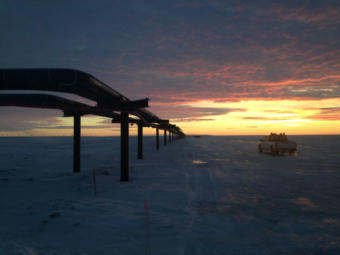
Pipelines stretch toward the horizon in the National Petroleum Reserve-Alaska. (Photo by Elizabeth Harball/Alaska’s Energy Desk)

For the first time ever, prices for a key U.S. oil benchmark went into the negatives on Monday.

The rapid crash of West Texas Intermediate crude is linked to the intricacies of the futures market, and underscores the volatility in prices as the coronavirus pandemic crushes demand and storage capacity dwindles.

“This is an unprecedented event in the oil market,” said Dan Stickel, chief economist for the Alaska Department of Revenue. “There’s an extreme oversupply and an extreme curtailment of demand and it’s led to significant volatility in pricing.”

While crude prices have continued to plummet in recent weeks, and oil companies have announced spending cuts, Monday’s price meltdown for the Lower 48 benchmark was particularly staggering.
“I almost didn’t believe the headline. Like, ‘What? How is that possible,’” said Kara Moriarty, chief executive of the Alaska Oil and Gas Association. “It’s this massive convergence of some crazy world dynamics that no one anticipated.”

The price of a barrel of West Texas Intermediate for May delivery sunk far below $0 on Monday, collapsing to almost negative $40. That effectively means sellers must pay that much to have someone take the crude off their hands.

It was unclear late Monday what price Alaska North Slope crude would close at. The Department of Revenue typically posts the price a day later.

Stickel, however, cautioned that Monday’s negative prices may not heavily impact Alaska oil producers, who sell most — if not all — of their crude farther in advance because of their distance from the market, and are already focused on June deliveries.

“They’ve already firmed up their May plans and they’re saying, ‘Okay, where are we going to sell our oil production in June?’” Stickel said.

BP and Exxon also have their own refineries, said Larry Persily, a long-time observer of the oil and gas industry.

“Today’s panic prices are not reflective of what Alaska North Slope producers are going to get for what they’re delivering to their West Coast refineries this month,” Persily said. “But it’s still a kick in the head for the entire industry.”

Alaska North Slope crude prices have also already fallen from about $70 at the start of the year to $15.42 on Friday, nearly $3 under West Texas Intermediate on that day and the lowest price in more than 18 years.

“At current prices, the producers in Alaska are not covering their costs of operations,” Stickel said.

Production taxes and royalty payments in Alaska are based on the monthly average of the prices, he said.

At a Monday evening news conference, Gov. Mike Dunleavy described the plunging oil prices as stunning and another challenge for Alaska. Oil is the backbone of Alaska’s economy and fuels the state budget, he said.

“We expect oil prices to rebound, but we don’t expect necessarily to see them at the price that Alaska needs to balance its budget,” he said.

Monday’s oil free fall is nuanced, and has to do with a specific contract for a specific supply of oil.

The contracts for the May delivery of West Texas Intermediate crude expire Tuesday. Traders who have waited until the last minute to unload the contracts are desperate to find buyers.

And supply is far outpacing demand as the coronavirus pandemic keeps people at home. They’re driving cars less often. They’re not taking flights. Concerns continue to mount about the shrinking storage capacity for the oil that’s being produced and not used — a glut that the oil price war also helped create.

“If you’ve got a contract… you’re just going to get out and take your losses because you sure as hell really don’t want physical delivery of that oil,” Persily said.

Persily said he doesn’t expect the negative prices for West Texas Intermediate crude to last long. The June delivery price was just over $20 a barrel on Monday, still low but not below zero.

Stickel said he expected the June delivery prices to better reflect the price of a barrel of oil.

“As far as the true value of Alaska oil, I think the June deliveries are what actually matter for the revenue that we’re going to get and the money that flows back to the producers,” he said.

Still, Persily said, Monday’s drop highlights the uncertainty in the industry, and the underlying problem remains: “There are millions and millions of barrels a day of production around the world that don’t have a buyer.”

Earlier this month, several nations ended the oil price war with an agreement to cut output, but the supply reductions haven’t hit the market yet, Persily said.

Moriarty said she also has concerns about the impact the below-zero prices may have on financing.

“Even a futures price kind of chills the hearts of investors,” she said.

Questions also surround what low prices will mean for oil production in Alaska. Persily said he expected Alaska to see long-term impacts as companies cut costs by spending less on exploration and developing new oil fields.

“So we’re going to see a delay in that new production that we hoped would maintain the flow out of the North Slope,” Persily said.

This pandemic couldn’t have come at a worse time for Alaska’s tourism businesses

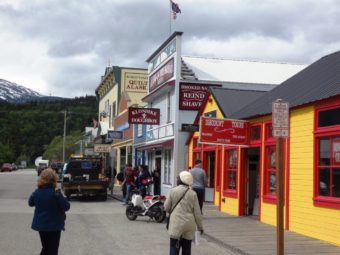
Cruise ship visitors browse Skagway shops on a May afternoon. (Photo by Emily Files/KHNS)

Alaska had planned for a record-number of cruise ship passengers this year. But then came the coronavirus pandemic. Travel halted. Ports closed. And now, more than half of the scheduled sailings to Alaska have been called off.

The impacts are widespread. And painful.
Taylor Vidic thought she’d be in Skagway by now, preparing for the cruise ship passengers to arrive.

“I was planning on taking a ferry there to get ready for my first day of work tomorrow at the Red Onion Saloon and Brothel Museum,” she said.

But instead, the 26-year-old is at home in Juneau, out of work and reading announcement after announcement about the coronavirus pandemic canceling cruises, closing ports and shutting down businesses.

“There’s kind of a cloud hanging above you,” Vidic said. “You are waiting for these announcements to come out and then when they finally do it’s, it’s kind of like you feel the wave hit.”

Vidic says the recent cancellations from the Holland America Line and Princess Cruises feel like just another painful wave. The major cruise lines have called off most of their sailings to Alaska, and won’t run lodges or sightseeings buses this summer.

At this point, Vidic says she has no idea when she’ll return to work in Skagway. She applied for unemployment. Like many of her co-workers, she earns the bulk of her income during the tourist season.

“I think we’re all kind of you know, hoping for the best but expecting the worst,” she said. “There might be ships come like July, but I’m not holding my breath on that with how the world has been looking as of late.”

So far, at least 360 sailings to Alaska — about 60% — have been canceled. And it means about 700,000 fewer visitors will come to the state this summer. It’s a loss of thousands of seasonal jobs, and hundreds of millions of dollars in passenger spending, plus money coming from taxes and the cruise line itself.

And those dollars are spread wide — they flow to hotels, museums, coffee shops, restaurants, flightseeing, sled dog kennels, gas stations, souvenir shops and so much more.

In interviews, Alaskans who work in or with the tourism industry reached for words to describe the impact of the cruise cancellations so far this year:

“Devastating,” some said.

“Unprecedented.”

“Scary.”

“A blow that’s bringing a pillar of the state’s economy to its knees.”

“I believe it’s over half of the tourists that come to the state every year come on cruise ships. And so, yeah, just that the loss of that is heavy,” said Jason Bickling, the executive director of the Chamber of Commerce in Seward, which normally welcomes its first cruise ship in early May and its last one at the end of September.

Now, it’s erasing May and June sailings from its calendar, and waiting to learn more. Bickling says it’s hard to remain hopeful that many cruise ships will come in late summer. And, even if they do, who will be onboard?

“It’ll just be kind of a wait and see game to see if some of those other cruise ship companies decide they’re able to operate this summer,” he said.

Joshua Howes, the president of Premier Alaska Tours, is also wrestling with the sudden impacts of the coronavirus. His Anchorage-based company provides transportation services to tour operators and cruise lines, moving passengers by bus and train around the state.

Early this year, he says, the company was preparing for a busy summer. They were finalizing menus for the train and orders for luggage tags. They planned to hire back hundreds of employees for the summer. Then, everything changed.

“We’re now kind of at a point where we’re putting the company almost on life support at this point,” Howes said.

Now, the company is down to about 15 workers, furloughing some year-round employees and not hiring more than 500 seasonal staff.

In Howes 20 years at the company, he says he’s never experienced a blow to business like this. He’s concerned about other companies too, and whether they’ll survive it.

“There are so many many small companies out there that I just worry about whether or not they’ll be able to go from September of 2019 to potentially May of 2021 with zero revenue,” he said.

State economists say the timing of the coronavirus in the United States is an extra punch for Alaska, hitting the state as it prepares for the summer, when its biggest chunk of economic activity usually takes place.

Valdez challenges RCA’s decision to keep Hilcorp finances confidential

valdeztanker_harball
An oil tanker docked at the Valdez Marine Terminal in April 2018. (Photo by Elizabeth Harball/Alaska’s Energy Desk)

The City of Valdez is taking a fight to have Hilcorp reveal its finances to state Superior Court in Anchorage.

The city is appealing a decision from the Regulatory Commission of Alaska, the state agency tasked with reviewing a critical piece of BP’s proposed $5.6 billion sale to Hilcorp.

Valdez filed a notice of appeal in court on Monday, first reported by The Anchorage Daily News. It presents another wrinkle in one of the state’s largest oil industry deals. The sale has yet to close.

Valdez’s appeal stems from an order by the RCA last month. The agency approved requests from BP and Hilcorp to keep their financial statements confidential during the agency’s review process.

The oil and gas companies argued the public release of the finances would damage their businesses and give their competitors an unfair advantage.

In public comments, however, some Alaskans demanded financial transparency from privately-owned Hilcorp, saying they wanted assurance that the company has the resources to operate the assets it wants to buy, and to respond to any costly oil spills.

The RCA ultimately decided that the companies’ and their affiliates’ financial statements submitted to the agency were “confidential as a matter of law.”

In its appeal, Valdez is arguing that the RCA’s interpretation of the state’s public records law is wrong. It says the agency’s decision violates fundamental rights under the state and U.S. constitutions, “thereby impeding transparency and the right to question, investigate and monitor the discharge of RCA’s duties,” according to the court documents filed by the Anchorage firm Brena, Bell & Walker, attorneys for the City of Valdez.

The RCA declined to comment on the appeal. It said it doesn’t comment on pending litigation.

The five-member RCA is charged with approving the portion of the BP-Hilcorp deal involving the Milne Point and Point Thompson pipelines, and the trans-Alaska pipeline, which ends in Valdez.

Earlier this month, the RCA asked Hilcorp to disclose whether and how the historic drop in oil prices will affect its ability to finance the deal. The company must respond by May 4.

The Wall Street Journal reported last week that banks had become uncomfortable providing a loan to Hilcorp as oil prices collapse. Alaska Natural Resources Commissioner Corri Feige recently told S&P Global Platts that the BP-Hilcorp deal is still on, but she expected it to close later than the companies wanted.


ConocoPhillips cuts spending in Alaska by another $200M as oil prices sink

The ConocoPhillips building in downtown Anchorage, December 2019. (Photo by Joey Mendolia / Alaska Public Media)

ConocoPhillips said Thursday that it will cut capital spending in Alaska by another $200 million as demand plummets and oil prices tumble to an 18-year low. That’s on top of a $200 million reduction the oil giant announced last month.

“The combination of COVID-19 and the oil market downturn has been difficult on industry and on stakeholders everywhere,” Ryan Lance, Conoco’s chief executive, said in a statement on Thursday that detailed the company’s massive cuts to oil production and its budget.

While Conoco is slashing oil production in the Lower 48 and Canada, it did not announce any cuts to production in Alaska or any layoffs on Thursday, said company spokesman John Roper.

“We continue to monitor the market situation,” he said in an emailed statement. “But at this time, based on our current outlook, we chose to maintain organization capacity so we can resume programs in the future.”

In total, the $400 million cut to capital spending in Alaska represents about a 25% reduction from what the company had expected to spend on capital in the state this year, Roper said, citing budget plans from February.

In a conference call on Thursday, Matt Fox, Conoco’s chief operating officer, said the company is cutting costs in Alaska, at least in part, by reducing drilling, including shutting down traditional and coiled tubing drilling activity.

“And we’ve elected not to start up the extended-reach drilling rig we mobilized to the North Slope last year,” Fox said. Also, he added, the company has ended its winter exploration program early to minimize the risk of COVID-19.

He didn’t provide additional details about the Alaska cuts in the call, and Roper said the company wasn’t providing more specifics.

Conoco had expected this winter to be its largest exploration and construction season ever in Alaska. Citing concerns about the coronavirus, the company announced last week that it planned to shut down development drilling, and reduce its workforce at the remote North Slope oil fields. It said wells in production would continue to produce oil.

Across its operations in the Lower 48 and Canada, Conoco said Thursday, it will slash oil production by 225,000 barrels a day, nearly a fifth of its global production. The Financial Times described it as the biggest coronavirus-related production cut of any U.S. energy producer. Across the company, Conoco is cutting more than $5 billion in spending.

On the conference call, Lance said the company expected oil prices to remain “weak and quite volatile” over the next several months.

“We’re just not going to sell our crude for these kinds of prices,” he said.

Alaska North Slope Crude sunk to $16.65 a barrel on Wednesday, the lowest price since early 2002, as the coronavirus pandemic crushes demand and an oil-price war ravaged the industry.

Related: Why does a barrel of Alaska oil cost less than a pizza?

Don Wallette, Conoco’s chief financial officer, said on Thursday’s call that Alaska is “in the mix” as a place Conoco would consider curtailing production, “at least the portion we operate on the western North Slope.” But, for now, he said: “Alaska is sold a little bit further forward than Lower 48 is and so the pricing is still acceptable to us.”

“So we don’t plan to curtail Alaska in May,” he said. “And as far as future production projections, we’re not going to be in a position to provide that with all the uncertainty that we’re under.”

Other oil companies have also announced reductions in Alaska: BP said last month it was ending its two-rig drilling program on the North Slope, and OilSearch has said it’s cutting about $70 million in spending in the state.

Despite the cuts, the amount of oil flowing down the trans-Alaska pipeline so far this month has remained similar to last year’s average production.

Updated: Princess and Holland America cancel most of their Alaska cruises, won’t open lodges this summer

The Royal Princess is designed to carry about 4,900 passengers and crews making it one of the largest in the company’s fleet. It will begin calling into Alaska ports in May 2019. (Photo courtesy of Princes Cruises)

Two cruise lines announced Tuesday that they’re canceling most of their Alaska sailings this summer and won’t operate their lodges and sightseeing buses in the state, as they continue to respond to the coronavirus pandemic and its impacts.

The announcements serve another blow to Alaska’s economy and mean the loss of thousands of seasonal jobs.

“This global outbreak continues to challenge our world in unimaginable ways,” said a statement from Jan Swartz, president of Princess Cruises, a global cruise and tour company.

Princess Cruises said it’s canceling its 2020 Princess Alaska Gulf cruises and cruisetours, and it’s more widely canceling all of its voyages worldwide through at least the end of June.

Swartz said the company remains optimistic that its Emerald Princess and Ruby Princess will continue to offer round-trip cruises from Seattle to Alaska in the late summer. It will reevaluate those plans in the weeks ahead.

But the shortened season has made it not viable to operate the company’s five Alaska lodges, trains and buses, Swartz said.

“We deeply regret that we won’t be able to employ the approximately 3,500 teammates who help show our guests the great land each summer,” she said. “Our thoughts are also with all of our small business partners throughout Alaska, who we’ve supported every summer for decades.”

Princess Cruises operates lodges in Fairbanks, Cooper Landing, Copper Center and the Denali area.

“We know these decisions will have a large adverse economic impact on the state of Alaska which relies on tourism,” Swartz said.

The cruise line had previously announced on March 12 that it was pausing all of its operations for two months. It says it’s offering guests credit or refunds.

Holland America Line also announced Tuesday that it’s canceling all of its sailings across the globe through at least the end of June, citing continued port closures and travel restrictions stemming from the pandemic.

It’s canceling its Alaska cruises on five ships for the entire season: the Maasdam, the Noordam, the Oosterdam, the Volendam and the Westerdam.

The company says it’s also canceling all land excursions in the state. It says it will not operate the McKinley Chalet Resort, McKinley Explorer rail cars and tour buses this summer.

“These are unprecedented times. Having to delay summer cruising and cancel our land tours for the entire season is the responsible thing to do, yet also very disappointing and a first in our more than 70 years of taking guests to Alaska,” said Orlando Ashford, president of Holland America Line, in a statement.

The Centers for Disease Control and Prevention is recommending Americans avoid cruise ship travel because passengers are at an increased risk of person-to-person spread of diseases, including COVID-19.

This story has been updated to include Holland America Line’s announcement.


Site notifications
Update notification options
Subscribe to notifications