This transmission electron microscope image shows particles of SARS-CoV-2, the coronavirus that causes the disease known as COVID-19. (Image courtesy of National Institute of Allergy and Infectious Diseases Integrated Research Facility)
A woman in her 30s from the Matanuska-Susitna Borough has died from COVID-19, according to data from the state Department of Health And Social Services.
She is the ninth Alaskan whose death is linked to the disease, and the first from Mat-Su. Two of the Alaskans died out of state.
The state health department also reported that another eight Alaskans were diagnosed with COVID-19 on Monday, bringing the total to 285. The number who have recovered from the disease rose by 13, to 98. The total number of hospitalizations remained unchanged, at 32.
The department reported that the woman who died acquired COVID-19 locally. A health department spokesman said he did not immediately have more information.
Of the new cases, five of the Alaskans are from the Municipality of Anchorage, one is from the Prince of Wales-Hyder area, one is from the Mat-Su Borough and one is an employee at the Lemon Creek Correctional Center in Juneau. It’s the fourth correctional officer at the prison who has tested positive for the disease.
More than 8,300 tests have been administered in Alaska.
Across the United States, the Centers for Disease Control and Prevention reported more than 575,000 COVID-19 cases and 22,252 deaths.
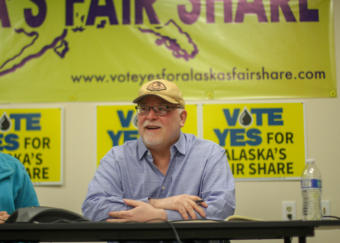
Anchorage attorney Robin Brena sits at a meeting of the citizens initiative campaign to raise taxes on Alaska’s largest oil producers on Thursday, January 16, 2020. (Photo by Nat Herz / Alaska’s Energy Desk)
The Alaska Chamber and five other industry trade groups are suing the backers of a ballot initiative that would raise taxes on the state’s largest oil fields.
The groups claim that many of the signatures gathered to get the initiative on a statewide ballot are invalid. An attorney for the groups, Matt Singer, is arguing that some signature gatherers were paid more than one dollar per signature collected — a violation of state law.
“It looks like these ballot sponsors cut corners to try to gather sufficient signatures,” said Singer. “And, specifically, they hired this Las Vegas outfit that offered to pay signature gatherers well in advance of the legal limit of one dollar per signature.”
The complaint was filed in Superior Court in Anchorage on Friday, April 10.
The group backing the oil tax initiative is called Vote Yes for Alaska’s Fair Share. And its chair, Robin Brena, is an oil and gas attorney. Brena describes the lawsuit as baseless, ridiculous and a “sign of desperation by companies that don’t want Alaskans to have a voice” on oil taxes.
“There’s no violation of the law,” Brena said. “They don’t understand the law. They’re misquoting it. They don’t understand the scope of it. They have their facts wrong.”
He says the consultant hired by his group did not pay any signature gatherers on a per-name basis.
The oil tax initiative would raise the minimum tax and eliminate oil tax credits for Alaska’s largest legacy fields: Prudhoe Bay, Kuparuk and Alpine. It would also require oil companies to publicly report their revenues and costs from those fields.

The other defendants named in the suit are Lieutenant Governor Kevin Meyer, the state division of elections and its director.
Last month, Meyer notified the backers of the oil tax initiative that their petition was properly filed and they had gathered enough signatures to get on a statewide ballot. They collected nearly 40,000 qualifying signatures from across Alaska.
Singer, the attorney for the trade groups, is arguing to have many of those signatures thrown out.
Alaska Gov. Mike Dunleavy speaks at a news conference in Anchorage about COVID-19, Thursday, April 9, 2020. (Creative Commons photo by Alaska Governor’s Office)
Updated story — Tegan Hanlon, Alaska Public Media
State officials on Monday announced a plan to use university dorms, hotel rooms and other buildings to temporarily quarantine and isolate health care workers and some homeless families if needed.
Alaska Department of Health and Social Services Commissioner Adam Crum said the new mandate gives the state access to federal funding to help pay for the temporary housing for specific groups.
“First responders and health care workers who need to quarantine safely without exposing their families,” he said. “Homeless families with at least one member who tested positive for COVID-19 and homeless individuals who require quarantine or isolation.”
Crum outlined the latest mandate at a news conference Monday evening.
Gov. Mike Dunleavy also announced that five more Alaskans tested positive for COVID-19 on Sunday, bringing the total number of cases to 277. The state reported one more hospitalization and no new deaths. At least 85 Alaskans have recovered from the disease.
“Alaska is doing pretty good dealing with this virus compared to other locales,” Dunleavy said.
Four of the newly-diagnosed Alaskans are from the Anchorage area and one is an employee at the Lemon Creek Correctional Center in Juneau. A total of four of the workers at the prison have been diagnosed with the disease so far.
At the news conference, Dunleavy said he’s monitoring the state’s COVID-19 cases to determine when to restart sectors of Alaska’s economy. He said he plans to work with local governments and industry leaders to determine when to reopen businesses and communities.
“This is going to be the week that we’re going to start talking about the economy,” Dunleavy said. “And how we are going to be able to re-enter an era of normalcy, or at least as close to it as possible. We may not get back totally to where we were before this virus, but it’s our goal to get our life back, our economy back, to as close as possible.”
Dunleavy said he’s going to put Alaskans’ health first. He said the state could open a few sectors at a time and then monitor how that impacts the number of COVID-19 cases in Alaska. Depending on the results, it could relax additional restrictions or not.
“We’re not going to do anything unilaterally,” Dunleavy said.
Dr. Anne Zink, Alaska’s chief medical officer, said one of her focuses is testing. About a month ago, the state estimated it needed somewhere between 2.5 million and 3 million tests, Zink said, and “we are a long way from that right now.”
“I think we’re going to need enough tests to be able to test all Alaskans multiple times for numerous reasons, and so that’s what we’re shooting for,” Zink said.
She said one of the biggest obstacles is the availability of the chemicals needed for the testing, known as reagents. The availability of swabs and vials that the swabs go into are also limitations.
“We are literally looking at how to manufacture every part ourselves,” she said.
She underscored that the global pandemic will not be over soon, and thanked Alaskans for the work they’ve done so far to help slow the spread of the virus in the state.
“This disease doesn’t go away tomorrow,” she said. “This disease doesn’t go away if we start to open things up. This is going to be a long haul.”
Original post — Jeremy Hsieh, KTOO
Gov. Mike Dunleavy’s latest COVID-19 press conference is scheduled for 5 p.m.
Health and Social Services Commissioner Adam Crum and Chief Medical Officer Dr. Anne Zink will also participate by videoconference. Dunleavy has been holding these briefings almost daily since March 10.
Press briefings notwithstanding, the state has been sharing COVID-19 data on testing, confirmed cases, local counts and recoveries on this interactive online data hub. Additional public health information about COVID-19 in Alaska — including the 14 public health mandates in effect — are available at coronavirus.alaska.gov.
Correction: An earlier version of this story understated the number of public health mandates that had been issued as of Monday afternoon. There were 13, not 12. Later, a 14th mandate was issued.
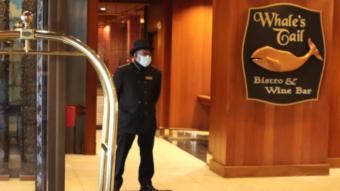
Mike Davis, a doorman, works in an empty lobby at the Hotel Captain Cook on Friday. (Tegan Hanlon/Alaska Public Media)
At the Hotel Captain Cook in Anchorage, demand collapsed quickly over the past month.
“One minute we have a hotel that has a lot of staff in it and restaurants that are open and the feel-good buzzing noise going on,” said Raquel Edelen, vice president of operations at the Captain Cook. “And now we’re a hotel that is quiet.”
As the coronavirus continues its unrelenting spread, halting most travel, hotels across the globe are feeling the strain. In Anchorage, it’s no different. To keep their doors open, some hotels say they’re shifting their business model — transforming from tourist havens to quarantine sites.
“The quarantine business is sustaining us, albeit at much lower rates, but it’s a business that we think is vital to the essential services provided in the state,” said Greg Beltz, general manager at The Lakefront Anchorage hotel near the city’s major airport.
At the Captain Cook, The Lakefront and other hotels, the global pandemic has also meant fewer guests, quiet lobbies and massive layoffs at a time when the businesses would normally be ramping up for a busy summer tourist season.
“We’re working every day trying to figure out how we can keep another housekeeper working or keep a server working,” Edelen said.
The Hotel Captain Cook in downtown Anchorage. (Tegan Hanlon/Alaska Public Media)
The Captain Cook is a 546-room landmark in downtown Anchorage that also has several restaurants, bars and gyms. But those were shut down, or limited to take-out last month as government mandates tumbled out in response to the pandemic.
“It’s a huge impact,” Edelen said.
The hotel laid off roughly two-thirds of its staff, shrinking to under 100 employees. On a recent weekday morning, the hotel’s spacious lobby was nearly empty, the remaining employees wearing face masks.
Ryan Marcey, a front desk clerk, works in a quiet lobby at the Hotel Captain Cook on Friday. (Tegan Hanlon/Alaska Public Media)
Instead of tourists, the hotel is now mostly serving three groups: Airline crews, oil employees and Anchorage workers, including those in health care, who are choosing to distance themselves from family.
“Alaska Airlines, FedEx, ConocoPhillips, we’re grateful for them,” Edelen said.
The hotel is housing the Conoco workers in a separate tower, she said. The governor mandated that people arriving in Alaska quarantine themselves for two weeks, and Conoco is having its out-of-state workers stay at the Captain Cook before flying to the North Slope oil fields.
The hotel has also created a new “sanitation squad” — a team of housekeepers charged with deep cleaning the hotel, from its walls to its elevator buttons to its railings.
“We’re cleaning all of our public bathrooms, I mean, three times an hour to make sure that people know that those things are clean constantly,” Edelen said.
Fletcher’s, one of the restaurants at the Hotel Captain Cook in Anchorage, is closed to dine-in service but continues to offer take-out. (Tegan Hanlon/Alaska Public Media)
Similar practices are going on at hotels across the city, said Alicia Maltby, president and chief executive of the Alaska Hotel and Lodging Association.
Housekeepers are leaving fresh sheets and towels outside of hotel rooms, instead of going inside. They’re wearing face masks and gloves. If they can, they’re waiting at least three days to clean the rooms after guests leave. Some hotels are also locking their lobby doors, so the public can’t just walk in.
“It’s a whole change in the game of how they are servicing rooms and doing checkouts and what the check-in process looks like and the security of the hotel properties,” Maltby said.
Anchorage hotels may be hovering around 30% occupancy on average, Maltby said, though she described that as a generous estimate. Meanwhile, a few hotels have decided to temporarily close, including the Westmark downtown.
“This pandemic is going to affect the industry worse than 9/11 and the 2008-2009 recession combined,” Maltby said.
The Westmark Anchorage has closed temporarily during the coronavirus pandemic. (Tegan Hanlon/Alaska Public Media)
State economists expect the impact to only grow as hotels don’t hire like they normally would for summer tourism.
“There won’t be the job gains that we typically have,” said Neal Fried, an economist with the Alaska Department of Labor and Workforce Development.
Last April, Anchorage hotels employed about 3,400 workers, with that number rising to nearly 4,000 by August, Fried said. The state, as of Thursday, did not yet have data on how many total hotel jobs were eliminated in recent weeks.
Neither did Marvin Jones, the president of UNITE HERE Local 878, a union that represents Alaska hospitality workers. Over the past few weeks, Jones said, he’s received dozens of phone calls from members who were suddenly laid off as the pandemic crushed business.
“I do have a rough time sleeping at night, because I know what I’m dealing with during the day,” he said. “And my phone starts early in the morning and it continues to late at night.”
In his 30 years in the industry, Jones said, “I have not seen anything that even comes close to what we’re dealing with right now.”
A sign at The Lakefront Anchorage alerts the public that only guests and authorized personnel can enter the building. (Tegan Hanlon/Alaska Public Media)
Instead of hiring, The Lakefront Anchorage has laid off about 70% of its staff, and it’s down to around 40 employees, said Beltz, the general manager.
“We’re not seeing any tourism-related travelers, people that are sightseeing, for obvious reasons — everybody’s hunkered down,” he said.
The number of rooms filled at The Lakefront depends on who’s quarantining, he said.
Keith Osowski wasn’t quarantining yet, but he recently stayed at The Lakefront after flying into Anchorage from South Dakota, where he goes to college. His classes were all moved online.
Osowski said he had just one night in the city before going home to Kodiak, and he didn’t want to stay at his brother’s apartment, worried he could be carrying the virus. So he went to The Lakefront, where he hardly saw anyone.
“It was just the person sitting at the counter, and it just seemed kind of dead,” Osowski said.
The Lakefront Anchorage photographed on Wednesday. (Tegan Hanlon/Alaska Public Media)
Beltz said he’s trying to remain positive despite the quiet hotel. But he can’t help thinking about how long it will take for business to rebound.
“The main thing that’s going through my head, you know, is what’s to come?” he said. “When are we going to see tourism have some type of bounce back?”
Reach reporter Tegan Hanlon at thanlon@alaskapublic.org or 907-550-8447.
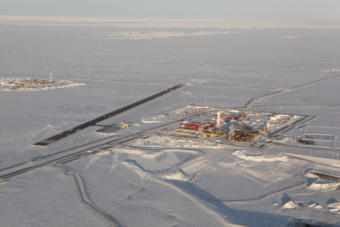
BP’s operations center at Prudhoe Bay. (Elizabeth Harball/Alaska’s Energy Desk)
BP’s sale of its entire Alaska business to Hilcorp is in jeopardy, The Wall Street Journal reported on Thursday. As oil prices crater, banks are hesitant to finance the $5.6 billion deal, the newspaper says.
It’s the largest deal in the world involving oil and gas production assets that has yet to close, the WSJ reports. It includes BP’s stakes in the massive Prudhoe Bay oil field and trans-Alaska pipeline.
BP and Hilcorp have said they expect the deal to close this summer.
However, citing people familiar with the deal, the WSJ reports a group of banks led by JP Morgan Chase & Co. have become uncomfortable providing a loan as oil prices collapse in response to the coronavirus pandemic and declining energy demands.
The WSJ also said it reviewed a recording of a call between Hilcorp management and bond investors. Management said whether the deal moves forward or doesn’t, the goal is to stay amicable with BP, the newspaper reported.
Hilcorp spokesman Luke Miller declined on Friday to comment on the WSJ report, including whether the deal was at risk and how the company plans to finance it.
In response to questions, BP spokeswoman Megan Baldino said the company isn’t commenting outside of its market update from early April. The update says BP expects the sale to Hilcorp to be completed this year, “subject to regulatory approvals.”
Larry Persily, a longtime observer of Alaska’s oil industry, said he’s not surprised to read about banks balking at financing the sale.
“Any banker in the world is going to pick up the phone and say, ‘Hey, Mr. Hilcorp, you got to come in. We got to talk about the terms on this because we’re not feeling as comfortable as we used to feel,’” Persily said.
But, Persily said, BP still wants to exit Alaska, and some of its employees have already left the company. He said he expects BP and Hilcorp to make the deal work — somehow.
“As painful as it may be to change the terms, it would be more painful to unwind the deal and put a for sale sign back up at Prudhoe Bay because there are no other buyers out there,” he said.
The Regulatory Commission of Alaska continues to review a critical piece of the deal, and asked Hilcorp last week to disclose whether and how the historic drop in oil prices will affect its ability to finance the deal. The company must respond by May 4.
The main camp at the Kuparuk field. (Photo courtesy ConocoPhillips)
Oil giant ConocoPhillips announced Wednesday that it’s shutting down its drill rigs on the remote North Slope oil fields, and placing them into long-term storage, to protect its employees and contractors during the coronavirus pandemic.
This winter was supposed to be Conoco’s largest exploration and construction season ever in Alaska. In a statement, Conoco spokesperson Natalie Lowman said the company is significantly reducing its workforce on the Slope because of the heightened risk of COVID-19, the disease caused by the coronavirus.
“The health and wellbeing of our workforce, along with mitigating the spread of COVID-19 is our top priority,” Lowman said. “The preventative actions we’re taking in Alaska are primarily due to the remoteness and complexity of operating on the North Slope during the COVID pandemic.”
Lowman said she didn’t have additional information Wednesday on workforce impacts, including any layoffs and how many fewer employees and contractors will be on the Slope. In a letter, the president of Doyon Drilling, a subcontractor, said the impact of the decision will be “severely felt” by all of its employees and Alaskans, The Anchorage Daily News reported.
Wells in production will continue to produce oil, Lowman said. Development and exploration drill rigs will be demobilized. That includes its massive rig nicknamed “The Beast” that was expected to begin drilling this month.
“Given the high degree of uncertainty on how the situation plays out, we can’t say how long these measures will be in place,” Lowman said.
The oil industry is not only dealing with the coronavirus, but also a historic drop in oil prices. In early March, Alaska North Slope crude sold for roughly $50 a barrel. On Tuesday, the price fell below $20.
So far, there has been one confirmed case of COVID-19 on the Slope oil fields, where employees live and work in close quarters. BP announced last week that a Prudhoe Bay worker had tested positive for the disease.
In response, BP also said it would limit its activity at Prudhoe Bay “to safety critical and regulatory compliant activity.” It ended this year’s development drilling.
Asked if any Conoco workers on the Slope had tested positive, Lowman said in an email, “I can’t share information on workforce health matters.” The state is the primary source of information on COVID-19 cases, she said, and had only confirmed one case.
The number of cases across Alaska continues to grow, reaching 226 by the end of the day Tuesday.
Oil companies, including Conoco, have reported an array of efforts to keep the virus off the Slope including longer shifts, health screenings and increased sanitation.