
The number of known COVID-19 cases in Alaska jumped to 59 on Wednesday, up 17 from the announcement a day earlier, as the outbreak continues.
Two of the people who tested positive for the disease were hospitalized and in critical condition, Alaska Chief Medical Officer Dr. Anne Zink said at a news conference Wednesday evening. She later announced there was also a third person in the hospital in Alaska with COVID-19, the disease caused by the coronavirus.
Of the new cases, 11 are from Anchorage, one is from Fairbanks, three are from Ketchikan and one is from North Pole, Zink said. Another is from Homer — that person became ill after traveling out of state, tested positive in Anchorage and has not left the city, said the Alaska Department of Health and Social Services.
“As we’ve been seeing every day, the cases continue to climb,” Zink said. “Again, we didn’t know this disease existed a few months ago, and what we’re seeing is that it is very contagious.”
She said the virus is in an “acceleration phase,” with a huge increase in cases across the United States. Alaska is a little bit behind the rest of the country, Zink said, “so we’re not quite at that acceleration curve, but I am highly concerned that we’re headed that direction.”
The total count includes 25 confirmed cases in Anchorage, including on Joint Base Elmendorf-Richardson, three in the Chugiak-Eagle River area and two in Palmer. There’s also 11 cases in Ketchikan, eight in Fairbanks and two in Juneau.
Of the 59 cases, 24 are believed to be related to out-of-state travel, six are not related to travel and 16 had been in close contact with someone who also had the disease. The rest remain under investigation, according to the health department.
More than 1,800 COVID-19 tests had been completed for Alaskans by Tuesday.
The number of known COVID-19 cases in Alaska has continued to grow each day since the first case was announced in Anchorage on March 12. Dunleavy also announced Tuesday that a resident of Southeast Alaska had died of COVID-19 in Washington state on March 16. They were the first Alaskan who’s known to have died of the disease.
Laura Norton-Cruz’s home in Anchorage this week as she worked on her fellowship and cooked lunch with her two children home from daycare and kindergarten, 3-year-old Rio and 6-year-old Ida Luna. (Photo courtesy Laura Norton-Cruz)
Thousands of Alaska parents are in a tailspin as they scramble to find care for their kids during the global coronavirus pandemic that has closed public schools across the state.

For some, daycares are still an option. But for parents of school-age children, the choices are slim. And that means staying home with kids while working, considering grandparent care, which can be risky for elders, or leaning on older children to care for the younger ones. Other parents say they still don’t know what they’re going to do. In some homes right now, the days are chaos.
“We’re just trying to find creative ways to keep everybody busy. Or keep the kids busy, we’re plenty busy with work.” said Jen Collins in a phone interview while her two children played outside in the snow.
Gus Collins, 4, and Woodson Collins, 8, play outside in Anchorage on Tuesday. (Photo courtesy Jen Collins)
Collins and her husband, Wade, are both working from home this month. They have jobs in the oil industry in environmental permitting. Collins said they’re balancing meetings and conference calls with taking care of their two children: 4-year-old Gus and 8-year-old Woodson.
“It can be a little tough,” she said. “We work in an industry right now where, you know, things aren’t going very well. So we’re trying to do our best to be as efficient as possible because it’s a little scary with oil at such a low price right now.”
Collins’ oldest son, Woodson, is in second grade at Rogers Park Elementary School. Children across the state didn’t go back to school after spring break this month, and won’t be back in classrooms at least through the end of March in an effort to slow the spread of the coronavirus. There are more than 125,000 children enrolled in Alaska’s public schools.
Collins said she and her husband decided to pull their younger son, Gus, out of daycare, which stayed open.
On Tuesday, Alaska’s state health department recommended child care facilities stay open if they can safely do so. The department said it didn’t want elders to care for children because older people are at an increased risk of severe COVID-19 illness. It recommended child care sites take aggressive measures for screening children for respiratory infections and keep groups small.
Collins said her family decided last week to keep themselves as isolated as they could as the number of known coronavirus cases continues to grow.
“We kind of made a decision as a family on Friday that we were going to practice social distancing, and not really go anywhere,” she said. “So we’ve basically, as of Friday, stayed put in the house, and if one of us had to go run an errand or get something that we needed, we did it solo.”
Collins said they’re focused on keeping some semblance of normalcy at home. That means daily schedules, and waking Woodson and Gus up at 7 a.m., like they would get up for school.
Woodson Collins, 8, sleeps with the day’s schedule next to his bed. It includes making his bed, letting the chickens outside, reading books, doing puzzles and going outside. (Photo courtesy Jen Collins)
“We try to have it so that they have clear expectations of what the day looks like. My older son is very driven by schedules and order and rules,” Collins said. “He asked me to make two copies of the schedule so he could keep one on his nightstand so he could read it first thing in the morning.”
Their schedule includes time for academics and exercise — whether going outside or following karate lessons online. Collins said she’s fielding questions from her kids about the coronavirus too like: “Can our dog Junebug get the virus?”
They’re also using FaceTime to connect Woodson and Gus with their friends for what Collins calls “virtual playdates.”
Woodson Collins, 8, and Gus Collins, 4, video chat with friends in Anchorage with schools closed because of coronavirus. (Photo courtesy Jen Collins)
Some Alaskans can’t work from home, and are facing different challenges.
Ashley Robbins is a single mother in Anchorage who searched online this week for affordable, reliable child care options. She just landed a new job in customer service at a local distribution center. It’s great news, she said. But she needs to find someone to watch her 1-year-old son Carson. And she needs that person right now.
“I did my interview over the phone today and they said, ‘OK, you’ve got X amount of days to find child care or this position will be filled because it needs to be filled soon,’” she said.
Normally, Carson goes to daycare at the Boy’s and Girl’s Club in West Anchorage. But, following the school district’s lead, the agency has shut down its child care centers and clubs for at least the rest of the month. That impacts about 4,000 children in Anchorage and roughly 8,000 statewide between the ages of six weeks old and 18 years old.
With no family close by to ask, Robbins requested help in one of the COVID-19 Facebook groups that are popping up online. Within an hour, she said, she had more than a dozen people offering to help watch Carson. Many of them had recently gotten laid off after the city mayor shut down dine-service at restaurants and bars, and later the governor issued a similar order for all of Alaska.
“My phone’s been going off, even still I’m getting messages,” she said about two hours after posting her request online. “There’s a lot of people that are also out of work because they’re in the food industry. So they’re now looking for something to kind of help with their income.”
Robbins said the response has given her a strong sense of community. She’s now going through background checks and interviews.
Across the city, parents like Robbins are trying to figure out how to balance at least two weeks — and possibly more — with their children out of classrooms. Some, like Collins, say they’re trying to stick to a schedule and homeschool their kids. Some are simply trying to figure out how to keep their children safe and also keep their jobs.
Another Anchorage mom, Laura Norton-Cruz, is still figuring it out. She has a 3-year-old son, Rio, and a 6-year-old daughter, Ida Luna. She’s keeping Rio home from daycare and Ida Luna’s public elementary school is closed.
“I would usually rely on my parents but I don’t want to expose my parents to my kids, because they’re little vectors for viruses,” she said.
Six-year-old Ida Luna Avellaneda-Cruz plays inside of a box at home this week. She goes to kindergarten at Government Hill Elementary School in Anchorage. The school is closed for the rest of the month in an effort to slow the spread of the coronavirus. (Photo courtesy Laura Norton-Cruz)
Norton-Cruz was working on her fellowship on Tuesday and will start a new job at the end of the week with the state health department. She’ll mostly be working on Alaska’s response to coronavirus.
She said she hopes her ex-husband, a freelancer, and his girlfriend — who has a job at a restaurant but is out of work with the closures — will mostly watch Ida Luna and Rio. They’re working on coordinating their schedules.
While she was still home earlier this week, Norton-Cruz said Ida Luna wrote a to-do list for them each day and practiced her Spanish on an online app. She’s enrolled in a dual-language program at the Anchorage School District. Together, they’re also making crafts and taking long morning walks.
Laura Norton-Cruz and her children practice writing their names in the snow this week in Anchorage. (Photo courtesy Laura Norton-Cruz)
Six-year-old Ida Luna Avellaneda-Cruz writes a to-do list each day with schools closed for the rest of the month in an effort to slow the spread of the coronavirus. (Photo courtesy Laura Norton-Cruz)
There’s still a lot of emotions to process, Norton-Cruz said. Her son Rio said he’s sad he’s not with his daycare friends. And Norton-Cruz, like many, is adjusting to the new coronavirus reality.
“It is so strange. I feel sometimes really calm and present and accepting of where we’re at,” she said. “And I also wake up in the middle of the night with a startling realization that everything is going to be different now.”
Are you a parent in Alaska wrestling with child care in the rapidly evolving coronavirus situation? Reporter Tegan Hanlon wants to hear from you. What are you doing that works? What problems are you trying to solve? What are you learning? And what questions do you still have? Reach Tegan at thanlon@alaskapublic.org or 907-550-8447.
University of Alaska Anchorage professor Audrey Taylor teaches conservation biology on March 5. (Photo by Tegan Hanlon/Alaska Public Media)
Along with coronavirus concerns, students and staff at the University of Alaska Anchorage are also facing budget uncertainty.
University leaders are proposing to eliminate degree programs to reduce spending, and they say the process is expected to continue — at least for right now — even with students leaving dorms and classes moving online in an effort to slow the spread of COVID-19.
As university faculty and students in those programs wait to see if the proposals will become reality, they say feel demoralized.
UAA professor Audrey Taylor stood next to a photo of a pair of howler monkeys in early March, as she explained to her class of about 30 college students how to estimate the population of endangered animals.
It was two days before the start of a weeklong spring break, and before the University of Alaska system announced widespread changes, including moving most in-person classes online for the rest of the semester, in an effort to slow the spread of coronavirus.
Already, students in Taylor’s class said they were stress and concerned. That’s because the class, conservation biology, is key for a major that university leaders are proposing to eliminate.
“It’s very demotivating, I guess, because you’re putting all this energy into teaching these students who are potentially going to be finishing a degree program in a department that’s no longer going to exist,” Taylor said.
UAA is in the middle of deciding which degree programs it will recommend cutting. So far, UAA deans have proposed eliminating nine degree and certificate programs. The provost wants to erase more. On both of their lists of cuts is environment and society — the degree program for Taylor’s department.
The university chancellor still needs to make her recommendations, and the university system’s governing board will ultimately decide what stays and what goes.
Taylor said she didn’t expect her program to be proposed for elimination.
“I think we were pretty shocked that the entire program was recommended for deletion,” she said.
UAA deans and the provost say there isn’t enough demand for the program, and the university can’t sustain it. They say students can learn environmental sciences as part of another bachelor’s degree program called natural sciences.
Taylor said there are roughly 75 students in her program. One of those students is Grace Wyatt, a junior at UAA.
University of Alaska Anchorage junior Grace Wyatt on March 5. (Photo by Tegan Hanlon/Alaska Public Media)
“I should be really focusing on trying to find summer internships right now, but that’s kind of been pushed off because I’m trying to save my degree program,” Wyatt said.
Wyatt said she cried after she learned her degree program was up for elimination. She said she’s devastated, angry and confused.
“Our professors created this program to prepare students to become scientists in Alaska,” she said. “They went around talking to all of the industries around Alaska, and asked them what they wanted students to be learning, and that’s how they created our curriculum. It’s super-involved with climate change. It’s super involved with the species of Alaska.”
University of Alaska Anchorage senior Nabi Qureshi on Thursday, March 5, 2020. (Photo by Tegan Hanlon/Alaska Public Media)
Another student, senior Nabi Qureshi, said she was spending a significant amount of time trying to figure out next steps and how students can rally to save environmental studies at Alaska’s largest university.
“I feel like I have spent a lot of time doing just research. There’s 15 tabs open on my laptop right now, just because, like I said, there’s so many different directions where this could go. There’s so many different steps,” she said. “So it’s taken up a lot of my time.”
Once final decisions are made, UAA programs won’t disappear immediately. The university needs to give faculty notice of job cuts, and it needs to provide students already enrolled in programs with a path to a degree.
UAA junior Grayson Bacon said he’s waiting to hear what that path might look like. A graduate of Palmer High School, he wants to become a wilderness ranger.
He said it’s not really financially feasible to transfer to another university at this point.
“I’m hoping to ride it out because I only have a year left, but I’m not really sure how it’s all going to go. There’s not a lot of communication as to what is going to happen,” he said.
University of Alaska Anchorage junior Grayson Bacon on March 5. (Photo by Tegan Hanlon/Alaska Public Media)
Taylor said she’s telling students to talk to their advisers and sign up for classes early to make sure they can finish the major.
Aside from giving lectures and grading papers, she said she also feels like she’s now entrenched in a fight to save her program and possibly her job.
“It feels like some kind of guerrilla warfare here, where we’re going all guns blazing to try to figure out what the best angle to save environmental studies is,” she said.
Now Taylor is also in the midst of figuring out how to continue to teach her classes, and move them online. She said she worries that the program reviews — and the long-term process to reshape UAA — are going to get lost in the shuffle as the university responds to coronavirus.
“It just feels chaotic,” she said.
UAA is currentlytaking community input on the proposed program cuts. The UA Board of Regents is expected to make final decisions in June. The next fiscal year starts July 1.
A UA spokesperson said to expect in-person meetings to be moved to virtual meetings.
Other programs up for elimination include the master’s in anthropology and bachelor’s in theater.
Defending Iditarod champion Pete Kaiser mushing into Nikolai on Tuesday, March 10, 2020. (Photo by Zachariah Hughes/Alaska Public Media)
Hundreds of sled dogs are running across Alaska this week as the Iditarod Trail Sled Dog Race plays out over 1,000 miles from Willow to Nome.
While the teams race to the finish line, we’re featuring a sled dog a day on our “Iditapod” podcast.
Meet Forrest, Sarah Jane, Sparky, Jeep and Juke — five exceptional sled dogs with a lot of personality.
Forrest: A very hard worker
Forrest is a 5-year-old team dog on Monica Zappa’s team. (Photo by Casey Grove/Alaska Public Media)
Forrest is a 5-year-old team dog with Monica Zappa. A team dog basically means Forrest doesn’t run in the front or in the back. He’s in the middle. Zappa, of Kasilof, said Forrest always wants to run — it doesn’t matter the place or the time.
“He’s a solid, hard-pulling dog. His first year was the year I had to scratch, and he was the only one, when we were sitting out on the ice outside of Shaktoolik, that just would not lay down for like five hours,” Zappa said about the 2017 Iditarod. “He always wants to go.”
Sarah Jane is a 5-year-old dog on Iditarod musher Meredith Mape’s team. (Photo by Joey Mendolia/Alaska Public Media)
Sarah Jane is a 5-year-old lead dog on Meredith Mapes’ team, and she’s the queen. Mapes, of Palmer, said Sarah Jane always rides in the cab of her pickup truck and sleeps in her bed. In the morning, she runs out to the dog yard to check on her teammates. She can be a bit bossy.
“She’s very commanding,” Mapes said. “She knows that she’s the queen of the dog yard. So if somebody is doing something that she doesn’t like, she yells at them for stepping out of line and things like that.”
Sparky is a 6-year-old lead dog on Aliy Zirkle’s team. (Photo by Casey Grove/Alaska Public Media)
His real name is Sparky, but he actually goes by Sparky Dooh Dah, and he’s a 6-year-old lead dog on Aliy Zirkle’s team. His parents are Nacho and Olivia. Zirkle, of Two Rivers, said Sparky Dooh Dah needs a lot of attention.
“He definitely needs TLC,” Zirkle said. “Just like people, there’s the hardcore kind of guy football player who’s just like, ‘Ugh. Just leave me alone, I’ll do it.’ And we’ve got a couple of them. But I would have to say Sparky is not that. Sparky needs like, ‘Hey, Sparky. How are you doing? Good boy. Do you need a little massage? Is it OK?’ And then he works perfectly.”
Jeep is a 6-year-old lead dog on Brent Sass’ team. (Photo by Casey Grove/Alaska Public Media)
Jeep is a 6-year-old sled dog. At exactly 59 pounds, he’s the heaviest dog on Brent Sass’ team. Sass said he has a special connection to Jeep. Jeep belonged to Joee Redington Jr., a sprint musher and a mentor who died in 2017.
“He loved this dog Jeep. And he always told me that, ‘This dog can run a distance race. I’m confident that he has the head to do it,’” said Sass, of Eureka. “But, he’s like, ‘Oh, you’re never going to get the chance because he’s my favorite dog.’ But after Joee passed away, I had the opportunity to buy Jeep.”
Jeep has been a staple in Sass’ team ever since. He led the team to victory in the 2019 Yukon Quest. Sass said it’s a testament to Redington and the sense he had about dogs. He described Jeep as a high-energy, fun-loving and positive sled dog.
Juke is a 2-year-old dog on Iditarod musher Karin Hendrickson’s team. (Photo by Tegan Hanlon/Alaska Public Media)
Juke is Karin Hendrickson’s loudest, biggest and most excitable dog. He’s the life of the party and he never seems to get tired, Hendrickson said, as Juke jumped on her truck at the Iditarod ceremonial start.
Hendrickson, of Wasilla, would like Juke to step up and lead the team more. But, she said, she also has to keep telling him who’s boss.
“He’s a two-year-old male so he thinks he’s the toughest dog around, and I have to keep reminding him that I’m the toughest dog around,” she said.
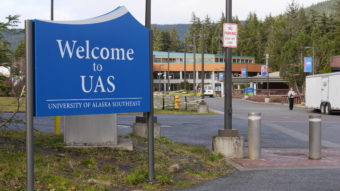
University of Alaska Southeast’s Juneau campus on Tuesday, Nov. 15, 2016. On Mar. 12, 2020, the University of Alaska system extended spring break, moving classes online in response to the spread of coronavirus. (Photo by Quinton Chandler/KTOO)

The University of Alaska (UA) system is extending spring break, moving classes online and canceling gatherings in response to the spread of coronavirus, President Jim Johnsen announced Thursday, Mar. 12. It’s also asking students to leave on-campus dorms for the rest of the semester.
“While, as we know, there are no confirmed cases of COVID-19 yet in Alaska, we think prevention is absolutely critical,” Johnsen said during a phone call with reporters. “We want to make sure that our university communities across the state, from Ketchikan all the way up to Kotzebue and many places in between, are safe and that we do our piece to slow the spread of the disease as it may take place here in the state.”
Across Alaska, the coronavirus threat is canceling events, suspending travel and disrupting the economy. Gov. Mike Dunleavy has signed an emergency declaration. All Anchorage public schools will remain closed for one week after spring break, and the school district is preparing for possibly a longer closure. Alaska Public University is also moving its classes online.
UA will suspend most in-person classes for the rest of the spring semester, Johnsen said. Faculty will instead deliver lessons by other methods such as email, video or over the phone.
Johnsen said he extended spring break an extra week to give faculty time to prepare.
“Classes will restart via distance delivery on March 23,” said a statement from UA. “University offices will remain open throughout the rest of the semester, unless the situation warrants changing that.”
Alaska’s public university system has more than 6,500 employees and 21,000 students across three main universities and about a dozen community campuses. Students have been on their week-long spring break since Monday and were supposed to return next week.
Johnsen said university chancellors may make some exceptions and allow some classes to be held in person, such as lessons that require lab work.
“But again, personal safety measures are paramount whenever these few exceptions will be made,” he said.
He acknowledged that not all students have computer access, and said UA is working to provide ways for students to get online, through computer labs, libraries or other facilities “again ensuring social distancing.”
UA is also asking students to leave on-campus dorms for the rest of the semester as a preventative measure. There are about 1,600 students who live in the dorms.
“Students can either move completely out of the residence halls now, or gather anything they need for the rest of the semester and return later to move out of their rooms,” said UA’s statement. “There will be a mechanism for students to request exceptions if they are unable to leave the residence halls until later in the spring.”
UA is canceling or postponing all events and gatherings of 25 people or more through the end of March.
“University leaders will revisit events guidance later this month and make a determination regarding whether to cancel events for the rest of the semester,” the statement said. “That discussion will include a decision on commencement ceremonies.”
The university joins a host of other academic institutions that have cancelled or postponed in-person classes. That includes the University of Washington, Seattle University, University of California, Berkeley and UCLA, as well as many Ivy League and East Coast schools.
University of Alaska Anchorage’s BP Asset Integrity and Corrosion Laboratory in the Engineering and Industry Building. BP donated $1 million to create the lab. (Photo courtesy of James Evans/UAA)
The head of the College of Engineering at the University of Alaska Anchorage said he found out about BP’s proposal to sell its entire Alaska business to Hilcorp the same way a lot of people did.
“We just heard it from the news like everybody else,” said Kenrick Mock, the interim dean. “And then it was, ‘Oh no. What’s next?’”
BP has long supported the university’s engineering programs, Mock said. It funds youth summer camps and university clubs. Its employees sit on the college’s advisory board.
The company’s departure from the state, Mock said, will leave “a huge hole” at the already cash-strapped university.
“There’s so many things that BP has helped fund,” he said.
UAA is among the nonprofits and programs in Alaska that have long benefited from BP’s donations and employee volunteers — and among those now adapting to a changing philanthropic scene.
Hilcorp’s giving strategy is more about individual employee donations than corporate sponsorship. And, a national expert says, that’ll diffuse donations and make them harder to predict — at least at first. Alaska nonprofit executives say it will require some of the state’s philanthropic organizations to rethink their strategies and diversify their donors.
A different way of giving
Over its 60 years in the state, BP has grown into a major philanthropic force, said Laurie Wolf, president and chief executive of The Foraker Group, an Anchorage-based organization that works with and advises nonprofits.
“And it’s not just in terms of their philanthropic financial investment, but also just in the way that they have encouraged their employees to get involved and engaged in the nonprofit sector,” she said.
BP Alaska President Janet Weiss in her Midtown Anchorage office. (Photo by Tegan Hanlon/Alaska’s Energy Desk)
BP reports donating $4 million to Alaska organizations in 2018. It hosts teacher awards, funds scholarships and pays for the bright-colored bags for a statewide trash cleanup program.
“We came in and we’ve gotten involved as a big, international oil company with a local energy company touch and feel,” Janet Weiss, president of BP Alaska, said in an interview last month.
“I think that Hilcorp comes in and evolves that model even further,” she said. “The way that Hilcorp operates is, they really unleash their employees.”
Hilcorp, a private company, is poised to buy BP’s entire Alaska business in a $5.6 billion deal. It estimates its Alaska employees will donate $5 million to charities over the next 12 months.
At an event in Anchorage in January, Hilcorp Alaska Senior Vice President David Wilkins said the company’s giving program centers on employee choice.
“We give away a lot of money through our employees, and that will remain to be the cornerstone of our program,” Wilkins told the crowd.
Under Hilcorp’s philanthropy program, the company gives each of its new employees $2,500 to donate to qualified charities of their choice. It also matches employees’ donations up to $2,000 each year.
“In extraordinary cases, corporate sponsorships are considered,” the company’s website says.
Hilcorp says it expects to triple its Alaska workforce as a result of the BP sale, growing from about 500 employees to about 1,500. That includes about 750 BP employees that will move to Hilcorp.
“That means we’re going to be giving a lot of money in the community,” Wilkins said.
But where exactly that money will go is anyone’s guess. As is how much of it will stay in the state.
“Chances are, many Alaskan charities will benefit. However, the distribution of the money is in the hands of Hilcorp employees,” said Elizabeth Miller, vice president of communications and development at The Alaska Community Foundation, which recently announced that it will manage Hilcorp’s giving program for the company’s Alaska workers.
Hilcorp declined an interview request for this story. In a statement, the company said it aims to build a greater community of giving by empowering its employees.
Since 2012, Hilcorp said, its employees have donated more than $2.8 million to almost 400 Alaska-based organizations, including food banks, youth shelters, athletic groups and churches. Nationally, Hilcorp reports the largest chunk of its employees’ donations — some 42%, or about $6.3 million — has gone to religious causes.
That’s not surprising, Wolf said. While most corporations don’t donate to religious institutions, individuals do, she said.
“Giving starts at home, and for many people home starts with their religious congregation, whatever that might be for them,” she said.
‘A bucket of cold water’
Eileen Heisman, president and CEO of the National Philanthropic Trust, a Pennsylvania-based nonprofit that advises donors, said the transition from corporate giving to a more individualized approach could be a “bucket of cold water” for some of the nonprofits that have leaned on BP.
“You’re going to go from a bird’s-eye view, very organized, corporate look at everything in the community and where the most important needs are, to many individuals deciding what they’re personally interested in,” she said.
“And I think it’s going to diffuse the giving in a way that’s going to be really hard to predict at this point, but after a year or two the charities that have been depending on BP are probably not going to be able to depend on the individual donors.”
Heisman said one big question is how many dollars will stay in Alaska, since the money can go to any qualifying nonprofit in the country.
“Some of them might want to be giving money back to the communities they lived before, or where they grew up or some other place that’s important to them or where their kids might be living,” she said.
Hilcorp says it will encourage employees to donate to charities in Alaska.
Wolf, with The Foraker Group, said Hilcorp’s giving program isn’t better or worse than BP’s. It’s just different. (The Foraker Group has received just under $1 million from BP, she said.)
“The real impact is that you don’t just write a proposal to a ConocoPhillips and a BP and an Exxon and go, ‘OK, I’m good, I’ve done my corporate grant-making process, right?’ Now you go like, ‘The landscape is way bigger, and I have to really be thinking about being in a relationship with a whole myriad of groups now,’” she said.
And that, Wolf said, will take more time and more strategy. It’s writing 20 proposals instead of three.
As for UAA and its engineering college, Mock said they are already making changes. That includes searching for new sponsors and raising summer camp fees.
“With this new landscape, we actually do foresee having a lot of companies pitching in smaller amounts,” he said.
The entire University of Alaska is also pivoting in that direction. BP has donated about $36 million to the public university system, according to Megan Olson, UAA vice chancellor for university advancement.
In a statement, Olson said universities across the country typically receive the majority of donations from individuals and just a small portion from corporations and foundations.
“It has been just the opposite at the University of Alaska historically, and we have recognized for a while the need to reduce our reliance on corporate philanthropy,” she said.
As for the bright-colored bags used to pick up litter, BP will still partially sponsor them this year, and the Alaska Oil and Gas Association is stepping in to fund the other half, said Anita Nelson, executive director of Alaskans for Litter Prevention and Recycling.
“But we’re not sure what 2021 will look like,” she said.
The future of BP’s teacher awards is still uncertain.