Tegan Hanlon, Alaska Public Media

Alaska sees its largest 1-day spike in confirmed COVID-19 cases; total grows to 213

This scanning electron microscope image shows, in yellow, SARS-CoV-2 — the coronavirus that causes COVID-19 — isolated from a patient in the U.S., emerging from the surface of cells, in blue and pink, cultured in a lab. (Image courtesy of National Institute of Allergy and Infectious Diseases – Rocky Mountain Laboratories)

The number of Alaskans diagnosed with COVID-19 rose by 22 on Monday — the largest one-day increase in reported cases in the state.

The Yukon-Kuskokwim Delta region also recorded its first case of the disease, according to the state Department of Health and Social Services.

In total, 213 Alaskans have been diagnosed with COVID-19, the disease caused by the coronavirus.

Of the 22 newly-diagnosed Alaskans, 11 are from the Fairbanks North Star Borough, 10 are from the Municipality of Anchorage and one is from Bethel, according to the health department.

The new cases stem from midnight to 11:59 p.m. on Monday. The state health department is reporting the new COVID-19 cases in Alaska from the prior 24-hour cycle by noon each day.

Nearly 7,000 people had been tested for COVID-19 in Alaska by the end of the day Monday.

The state health department reported no new deaths or hospitalizations. Six Alaskans have died after they were diagnosed with COVID-19 and 23 have been hospitalized. At least 29 Alaskans have recovered from the disease, according to the department.

Of the total number of confirmed COVID-19 cases in Alaska, the largest percentage — 20.19% — are in Alaskans ages 30 to 39, followed by 19.72% in Alaskans ages 50 to 59.

Most of the Alaskans diagnosed with the disease are from the Municipality Anchorage, with 98 cases. The Fairbanks area has 65 cases, and state officials have described the Interior Alaska community as a coronavirus “hot spot.”

Across the United States by Tuesday, the Centers for Disease Control and Prevention reported more than 374,000 cases of COVID-19 and 12,064 deaths.


Alaska’s new, Florida-based virtual school is not sitting well with some educators

Alaska Education Commissioner Michael Johnson discusses the new statewide virtual school on Wednesday at a news conference with Gov. Mike Dunleavy. (Creative Commons photo by Office of Gov. Mike Dunleavy)

As Alaska educators scramble to adjust lessons to the new reality of online teaching, some are blasting a decision by Gov. Mike Dunleavy’s administration to launch a new virtual school in partnership with a Florida program that was recently rocked by scandal.

The Florida Virtual School, which was recommended to Dunleavy’s education commissioner by former Florida Gov. Jeb Bush, had enrolled about 80 Alaska students by Friday. But some educators say they were offended and shocked to get the news of the state’s $525,000 contract with the school without advance notice.

“The ‘4th quarter solution’ that is suggested through the purchase of this Florida version of distance delivery is seen as an insult to most, if not all, teachers in the state who have been supporting their students,” Juneau School District Superintendent Bridget Weiss wrote in an email.

Alaska Education Commissioner Michael Johnson is defending his department’s one-year contract with the Florida Virtual School, saying the state-run school has a long track record and has worked with Alaska schools. The new partnership will expand options for students stuck at home right now, especially those enrolled in small schools, he said.

“We’re in the middle of a pandemic that we’ve never been in before,” Johnson said. “It’s a well-respected public school, and we are trying to find as many options as we can.”

Alaska’s school buildings are closed to students until at least May 1, and teachers are delivering lessons remotely.

The state’s contract with the online Florida school includes three parts:

  • Alaska students in kindergarten through 12th grade can register now to take online classes through the Florida Virtual School for the final part of the school year. The classes are free to students, and taught by Florida-based teachers certified in that state.
  • Staff from the Florida Virtual School will train up to 50 Alaska teachers to move their own classes online.
  • The Florida staff will also help the state transition to Alaska-based educators teaching the classes.

Johnson said Alaska students can use the classes as supplements during the rest of the school year, or as graded courses. No one is forced to use them, he said.

The coronavirus response is unfolding differently in every community, he said, including those wrestling with virus-related travel issues.

“It’s really been inspiring to see how teachers have responded and are filling in these gaps,” he said. “And so it’s not intended to say that somebody’s not doing what they should. It’s just trying to put as many options for students on the table as possible and, where it works and where it’s helpful, then it’s there.”

But the head of Alaska’s statewide teachers union is objecting. Tim Parker, the president of NEA-Alaska, said he’s fielding many questions and concerns from educators across the state.

“People did not see this coming,” said Parker, whose union represents more than 12,000 Alaska public school teachers and support staff. “There’s a lot of questions lingering out there.”

Parker said he heard about the new Alaska Statewide Virtual School on Tuesday — the same day the state’s education department sent a press release about it, and the first day students could register for the Florida classes.

Bridget Weiss smiles as she's congratulated on her appointment to interim superintendent of the Juneau School District at a meeting of the Juneau School Board on Aug. 6, 2018. (Photo by Jeremy Hsieh/KTOO)
Bridget Weiss, the superintendent for the Juneau School District, at a meeting of the Juneau School Board on Aug. 6, 2018. (Photo by Jeremy Hsieh/KTOO)

Weiss, superintendent of Juneau schools, said she’s disappointed by the lack of transparency and communication from the state. Teachers are working harder than ever for their students, while school districts continue to struggle with thin budgets, she said in her email.

Also, she said, the state and school districts have put a lot of effort into developing Alaska-specific cultural standards, and having teachers trained on them.

“This seems to be in direct conflict with hiring a Florida virtual school to teach our students,” she said.

Parker said he didn’t see a specific need for the new program right now.

“We’re in a crisis, and teachers and educators are meeting the needs of the students that they have,” he said. “I’m not sure having a teacher in Florida is going to improve the situation at this point in time.”

Parker said he also has concerns about the cost of the program and the state sending money out of Alaska, along with the Florida Virtual School’s recent management scandal. Florida’s education department released a report last year that said the school was plagued by “recurring leadership crises,” and needed a new board and new ethics standards.

Anchorage School District spokesperson Alan Brown said Thursday it was too soon to say how the new online classes would tie into the state’s largest school district, and its students’ work in the final weeks of the school year, which is scheduled to end in late May.

He said the school district already has robust online offerings, including its own iSchool, which was built years ago using the Florida Virtual School platform. The Florida classes have since been mostly replaced with Anchorage school content, Brown said. But he added that the district realizes the new school is “a tremendous resource for the state.”

The Florida Virtual School was created in 1997 as Florida’s first internet-based public high school and has grown into a statewide public school district, offering more than 190 online courses. It enrolls more than 200,000 students. Most of them are from Florida, but there are others from across all 50 states. The school told NPR in late March it was looking at doubling its enrollment by the end of April.

Johnson said that Bush, the former governor, first connected him with the online school.

“I was having a conversation with him last fall, and just talking about the unique aspects of Alaska and he said, ‘You know what? You ought to talk to Florida Virtual School and find out more about them,’” Johnson said.

Johnson said he spoke with the school then, and the education department contacted the school again recently. He said virtual schools aren’t a new concept for Alaska.

Mike Hanley, former Alaska education commissioner, fields questions from members of the House Finance Committee, March 17, 2014. (Photo by Skip Gray/KTOO)

Another superintendent, Mike Hanley, said he’s grateful for Johnson’s work and the new resource.

Hanley is a former Alaska education commissioner, and he’s currently the superintendent of two school districts that serve small communities — the Chugach School District and the Aleutian Region School District. The districts’ largest school has just 60 students, he said.

“It doesn’t surprise me, having sat in that seat, that a lot of people — for whatever reason — have found concerns with it,” he said about the virtual school. “I don’t have concerns with it.”

Already, he said, a teacher in the tiny Aleutian Islands village of Atka is having her 10 students sign up for the new online classes. In small schools, he said, teachers are often instructing students in multiple grades, and it takes a lot of time to repackage all of those classes in a new way with school buildings closed.

“The materials that teachers may have been using are not necessarily easily transferred to an online model. If you were using a textbook, if you were using hands-on materials, if you were using worksheets for some areas of math or whatever it might be, you can make copies all day long and send over a PDF. But those are not necessarily interactive,” Hanley said.

“The idea that you’ve got something that is addressing the same standards that you were addressing, but it’s already online — that in and of itself has value,” he added

Hanley said teachers using the online classes will have direct contact with students, using the online curriculum, and will determine whether students have done the work to earn credit.

Alaska’s contract with Florida Virtual School runs through February 2021, with the state agreeing to pay the Florida school up to $525,000.


Prudhoe Bay worker tests positive for COVID-19, BP says

BP’s operations center at Prudhoe Bay. (Photo by Elizabeth Harball/Alaska’s Energy Desk)

Oil and gas company BP confirmed Tuesday that a worker at Prudhoe Bay has tested positive for COVID-19, the disease caused by the coronavirus. It’s the first confirmed case of the illness at the massive oil field in northern Alaska, where many workers live in close quarters.

BP is the operator of the field.

“BP is following procedures and protocols to minimize the risk of COVID19 and ensure the safety of our people. We are eliminating all non-essential activity on the slope,” said a statement from the company. “The safety and wellbeing of staff and contractors and respect for the communities in which we operate is our highest priority.”

A BP spokesperson did not immediately respond to additional questions. It’s unclear where the employee is from, what condition the employee is in and whether they have exposed others.

The company also did not provide specifics about which work activities qualify as essential.

BP previously said it has deployed new measures to prevent the spread of the coronavirus on the Slope. Those include checking employees for fevers, extending many workers’ shifts to at least three weeks and increasing cleaning. It also said its out-of-state workers will self-quarantine for two weeks in Alaska before flying to the Slope.

This story has been updated.


Wristbands, longer shifts, fever checks: How Alaska oil companies are responding to the global pandemic

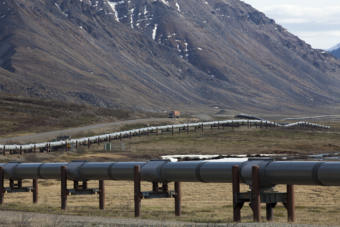
The Trans-Alaska Pipeline runs alongside the Dalton Highway near the Toolik Field Station on June 9, 2017, in the North Slope Borough. (Photo by Rashah McChesney/Alaska's Energy Desk)
The Trans-Alaska Pipeline runs alongside the Dalton Highway near the Toolik Field Station on June 9, 2017, in the North Slope Borough. (Photo by Rashah McChesney/Alaska’s Energy Desk)

About 500,000 barrels of oil continued to flow daily down the trans-Alaska pipeline this month as the coronavirus pandemic grew at dizzying speeds.

But, while work is continuing on Alaska’s remote North Slope, oil and gas companies say it’s not business as usual. They’re taking new precautions to keep the virus away.

And that includes health checks.

Workers driving the Dalton Highway to the North Slope oil fields must now have a colored wristband or a wallet-sized health card before they can travel to the oil sites beyond Deadhorse — the hub at the end of the haul road at the top of Alaska.

To get a wristband or a card, they first need a check-up, said ConocoPhillips spokesperson Natalie Lowman.

“Our medical screening process is a no-touch thermometer, so one temperature is collected per passenger,” she said. “The worker must pass all medical questions and temperature readings and those who are cleared will be given a wristband, and those are good for one day.”

https://www.flickr.com/photos/specialk80731/8229830783/in/pool-northslope
The sun rises on the North Slope behind the two Parker drilling rigs. (Creative Commons photo by Kevan Dee)

As the number of coronavirus cases in Alaska continues to increase, the checks are among several measures Conoco says it’s taking to protect its workers who temporarily live on the Slope. Other oil and gas companies in Alaska say they’re also boosting sanitation, keeping workers farther apart and reducing flights.

“We’ve got three very important priorities: protecting the health and well-being of our workforce and their families. We want to mitigate the spread of the virus, and we want to safely run our business,” Lowman said.

Lowman listed the company’s other new measures.

“We’ve limited travel to the North Slope, and we’re deferring some non-critical work to reduce the number of personnel we have on site,” she said.

Out-of-state workers must quarantine for two weeks in Alaska before traveling to the oil fields, Lowman said. To accommodate the change, Conoco recently asked its employees already on the Slope to extend their shifts by another two weeks.

Many Slope employees work two weeks straight, then go home for two weeks before flying back north again.

Lowman said Conoco has about 2,800 employees and contractors working on the Slope. This winter was supposed to be the company’s largest exploration and construction season ever.

Lowman said Conoco’s policies comply with the state’s new two-week quarantine requirement.

Alaska Gov. Mike Dunleavy speaks about the state's COVID-19 response from the Atwood Building in Anchorage on March 23, 2020.
Alaska Gov. Mike Dunleavy speaks about the state’s COVID-19 response from the Atwood Building on March 23, 2020, in Anchorage. (Creative Commons photo courtesy Alaska Governor’s Office)

Starting Wednesday, Gov. Mike Dunleavy began requiring people traveling into Alaska to self-quarantine for two weeks, unless they support “critical infrastructure,” including oil production. Hundreds of businesses have filed plans with the state outlining how they’ll bring out-of-state workers safely into Alaska. That includes Conoco and BP.
Oil company BP is also asking its workers to quarantine themselves for two weeks before returning to the Slope, but had planned to allow those living Outside to quarantine at their homes there. The company was also looking at flying employees directly from the Lower 48 to Deadhorse, instead of stopping in Anchorage, said company spokeswoman Megan Baldino.

However, the State of Alaska didn’t approve of that plan. Baldino confirmed on Saturday that BP will now have all of its workers self-quarantine in Alaska for two weeks before flying them to the North Slope, including its out-of-state workforce.

BP’s Prudhoe Bay workforce totals about 1,000 employees, and 39% live out of state.

“We continue to review the latest information in this dynamic situation and when necessary are updating our guidance to BP employees and contractors,” Baldino said on Saturday.

Similar to Conoco, BP has also slimmed down its on-site workforce on the Slope to essential personnel, Baldino said. BP has extended many workers’ shifts to at least three weeks. No visitors are allowed at the facilities.

Both BP and Conoco are also screening employees before they board their flights. Their temperatures are taken, and they’re asked about recent travel. Disinfection of buildings and planes has increased. BP is also currently in the process of selling its entire Alaska business to Hilcorp, which declined to comment for this story.

There are also all of the service companies operating on the North Slope, including Cruz Construction.

Cruz Construction’s work includes building ice roads and gravel pads. It also supports drilling crews, said Jeff Miller, the company’s vice president and one of its owners. He said the company has asked its Slope workers to stay weeks beyond their usual shifts, potentially until the middle of April.

“That helped mitigate the risk of bringing or introducing somebody that could have been infected from down here in the Anchorage area or the [Mat-Su] Valley area or Fairbanks, and it kept those camps safe,” Miller said.

Despite the leaner workforce on the Slope, the amount of oil flowing down the trans-Alaska pipeline each day this month has remained similar to last year’s average production.

Kara Moriarty, president and CEO of the Alaska Oil and Gas Association, testifies in the House Finance Committee in the Alaska Capitol on April 11, 2018.
Kara Moriarty, president and CEO of the Alaska Oil and Gas Association, testifies in the House Finance Committee on April 11, 2018, in Juneau. (Photo by Skip Gray/360 North)

But while the coronavirus might not be having a huge impact on oil production in Alaska — at least not yet — Kara Moriarty, head of the Alaska Oil and Gas Association, said cratering oil prices likely will.

“I think a lot of people, and rightly so, are focused on the pandemic, but our industry is being hit by two different factors,” she said. “We have the coronavirus, which of course is changing people’s travel with Alaska Airlines cutting back 70% of their flights. Obviously, they’re not going to need as much jet fuel.”

There’s also the oil price war. In early March, Alaska North Slope crude sold for roughly $50 a barrel. By Friday, it was about $26.

“So it’s sort of a double hit for us as the industry adjusts,” Moriarty said.

As a result, Conoco announced it was cutting its capital spending in Alaska by roughly $200 million. That means reducing drilling and demobilizing some drill rigs, Lowman said.

“It’s safe to say that the drop in oil prices isn’t helping any of the situations that we have going on right now,” she said.

Meanwhile, Lowman said, Conoco continues to closely monitor the coronavirus pandemic and will adapt its strategy as necessary. She said the company also has a detailed plan in case an oil field worker gets sick with the virus. It includes identifying who that person had come in contact with, quarantines, medical monitoring and a possible emergency flight off the Slope.

UA chancellors unveil proposals for cutting degree programs

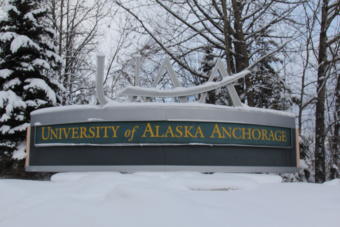
A sign on the campus of the University of Alaska Anchorage. (Photo by Tegan Hanlon/Alaska Public Media)

At the University of Alaska Anchorage, Chancellor Cathy Sandeen is recommending the university end 17 degree and certificate programs to cut spending, including a bachelor’s in theater and master’s in early childhood special education.

Sandeen released her proposal on Monday, March 23, as did the chancellors at the University of Alaska Fairbanks and University of Alaska Southeast.

It’s the latest step in a monthslong process across the University of Alaska system to close a budget gap driven by years of cuts to state funding and declining enrollment. UA’s governing board will ultimately decide in June what stays and what goes.
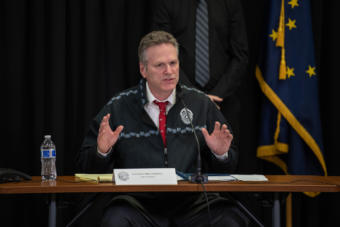
UA President Jim Johnsen said he knows it’s a painful process, made even more difficult by the coronavirus and its wide-spread impacts. But, he said, it’s necessary. The funding cuts aren’t going away. In fact, the university system’s budget situation may only get worse, he said.

“So lots of stress, lots of uncertainty. But what is certain is our state funding is going down,” Johnsen said. “And the COVID impact on us is serious. It is impacting us in terms of additional costs, which have to be borne in some way.”

Sandeen’s recommendations largely align with the prior proposals from Anchorage university leaders. At the University of Alaska Fairbanks, chemistry and sociology programs are on the chopping block, among others. And, in Southeast, the chancellor’s recommended cuts include a bachelor’s in geography and environmental resources.

There are other degree programs the chancellors are recommending be reduced, but not cut completely, while others, they say, should be enhanced. The chancellors are also looking for ways to save money within administrative services, and will provide recommendations for cuts to regents.

In the meantime, university leaders are also responding to the rapidly-developing coronavirus situation. They have largely shut down student life on campus. Most classes have been moved online. Most students have left their dorms.

Maria Williams is chair of the UA Faculty Alliance and a professor at UAA. She said it’s challenging to go through the degree program cuts while students and faculty are also adapting to the new coronavirus reality.

“I think clearly our public health crisis is taking all the oxygen out of the room,” she said.

She said faculty have concerns that they haven’t seen a cost-benefit analysis of the proposed degree eliminations.

“The other concern that faculty have is that if we’re really cutting academic programs, we’re cutting students, meaning we’re cutting student tuition dollars,” she said.

Also, Williams said, faculty think more cuts should come from UA statewide administration. But statewide officials counter the administration has already absorbed a large portion of the cuts over the years.

A UA spokeswoman said there wasn’t yet a total of how many jobs would be eliminated if the chancellors’ recommendations are approved.

Also, the coronavirus and its impacts may force the UA system to cut spending even further next year, according to Johnsen.

“We are working very hard to get our hands around what those extra costs are, and what impacts COVID may have on our revenues going forward,” Johnsen said.

Johnsen spoke Monday from his home office in Fairbanks where he is self-quarantining for two weeks after visiting his mother in California over spring break. In mid-March, UA announced that university faculty, staff and students returning from travel outside of Alaska have to stay home and watch for symptoms for 14 days.

Johnsen said UA’s spending has gone up as it responds to the coronavirus. Last week, UAA said it was helping buy students’ plane tickets to go home, if they couldn’t afford them, and refunding a portion of their dining and dorm fees.

The pandemic could also gouge the revenue side of UA’s budget, including reducing money for research, Johnsen said. UA is already bracing for a $25 million cut to state funding for the next fiscal year that begins July 1, and a $20 million cut in the following year.

Regents are taking public testimony in April and May, before making their decisions in June.

Alaska health department confirms 10 new COVID-19 cases

Update (6:16 p.m.) — Tegan Hanlon, Alaska Public Media

Alaska Gov. Mike Dunleavy speaks at a news conference on COVID-19 in Anchorage, March 25, 2020. (Creative Commons photo by Office of Gov. Mike Dunleavy)

The number of known COVID-19 cases in Alaska grew to 69 by Thursday, up from 59 confirmed cases the day before, as the disease continues to spread throughout the state and the country.

The new cases include five newly-diagnosed Alaskans from the Anchorage area and two from Fairbanks. Two are from North Pole and one is from Juneau, according to the latest data from the Alaska Department of Health and Social Services, updated daily.

One person is under the age of 18, two are between the ages of 19 and 29, five are between the ages of 30 and 59 and two are over the age of 60, Alaska Chief Medical Officer Dr. Anne Zink said at a news conference Thursday evening. Four are male and six are female, Zink said.

The number of coronavirus-related hospitalizations remained the same. Three Alaskans have been hospitalized with COVID-19, the disease caused by the coronavirus. The disease has killed one Alaskan.

Of the newly-infected Alaskans, four had been in close contact with someone who also had the disease and six of the cases remain under investigation, Zink said.

More than 2,300 COVID-19 tests had been performed in Alaska by Wednesday, according to the health department.

The Associated Press reported Thursday that the U.S. now leads the world in the number of known COVID-19 cases, with the number of people known to be infected topping 82,000, according to a count by Johns Hopkins University. The Centers for Disease Control and Prevention reported more than 990 deaths.

This story has been updated.

Original story — Rashah McChesney, KTOO

Alaska Gov. Mike Dunleavy speaks about the state's COVID-19 response from the Atwood Building in Anchorage on March 20, 2020.
Alaska Gov. Mike Dunleavy speaks about the state’s COVID-19 response from the Atwood Building in Anchorage on March 20. Also pictured: Department of Health and Social Services Commissioner Adam Crum, Chief Medical Officer Dr. Anne Zink, and an unidentified sign language interpreter. (Creative Commons photo courtesy Alaska Governor’s Office)

Gov. Mike Dunleavy’s latest COVID-19 press conference is scheduled for 6 p.m. today.

The governor, Health and Social Services Commissioner Adam Crum, and Chief Medical Officer Dr. Anne Zink have been holding these briefings almost daily since March 10.

They’ve shared updates on the number of people in the state with confirmed cases, announced public health mandates, and explained the administration’s strategy and rationale.

The number of known COVID-19 cases in Alaska grew to 69 by Thursday, up from 59 confirmed cases the day before.

That’s according to the latest numbers from the Alaska Department of Health and Social Services, updated daily.

The new cases include five newly-diagnosed patients from Anchorage, two from Fairbanks, two from North Pole and one from Juneau, according to the department’s data. COVID-19 is the disease caused by the coronavirus.

To date, Dunleavy’s administration has imposed 10 public health mandates that have reshaped daily life across Alaska to combat the spread of the virus. Those mandates and other Alaska-specific COVID-19 resources and information are available at coronavirus.alaska.gov.

There is no statewide shelter-in-place order, though many Alaskan communities have imposed versions of them.

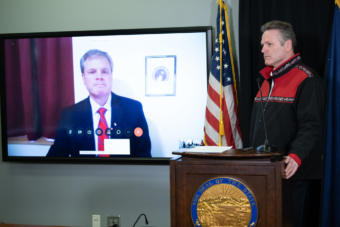
During an extended press conference on COVID-19 on Wednesday night, the state’s former chief medical officer spoke to the effectiveness of those types of orders. Dr. Jay Butler is now the deputy director for infectious diseases at the Centers for Disease Control and Prevention, or CDC.

“In terms of what’s happening in the United States, we’re probably only about a week into — in some parts of the country — doing that kind of hunkering down,” Butler said, calling into the meeting from Atlanta. “The cases that are being diagnosed now were most likely acquired seven to 10 days ago. So we’re only at the point where we might begin to see some impact from the steps that had been taken.”

Across the United States by Thursday, there were more than 68,000 confirmed cases of COVID-19 and 994 deaths, according to the CDC.

You can watch today’s press conference live on this post, the governor’s Facebook or Livestream pages, or on 360 North television.

Site notifications
Update notification options
Subscribe to notifications