Tegan Hanlon, Alaska Public Media

Alaska oil tax initiative has enough valid signatures to appear on ballot, election officials say

Supporters of the initiative to raise oil taxes pose for a photo on Jan. 16, 2020. From left to right: Les Gara,
Jane Angvik, Robin Brena, David Carter and Harry Crawford. (Photo by Nat Herz/Alaska Public Media)

An initiative that would raise taxes on Alaska’s largest oil fields has enough valid signatures to go before voters, election officials say.

The proposed initiative, called the Fair Share Act, needed 28,501 signatures from registered Alaska voters to get on a statewide ballot. It also needed a minimum number of those signatures to be from at least 30 House districts.

It has met both of those requirements, according to Gail Fenumiai, director of the Alaska Division of Elections.

As of Monday, election officials had verified more than 36,000 signatures.

Fenumiai said the division will continue to review the remaining names, and then forward the information to Lt. Gov. Kevin Meyer.

“He certifies the initiative for placement on the ballot,” Fenumiai said.

When the initiative would appear on a ballot depends on when the Alaska Legislature wraps up its work. If the current legislative session ends by April 19, the initiative would go on the August primary ballot. If it ends later, it would appear during the next scheduled election, Fenumiai said.

Also, if the Legislature passes a bill that is “substantially similar” to the proposed initiative, then it would not appear on the ballot, she said.

The proposed ballot initiative would raise the minimum tax and eliminate oil tax credits for Alaska’s largest legacy fields: Prudhoe Bay, Kuparuk and Alpine. It would also require oil companies to publicly report their revenues and costs from those fields.

Supporters of the initiative say oil companies aren’t paying enough in taxes. They say the initiative could bring in another $1 billion in production taxes. But those opposed to the initiative say it would hurt the industry and make investing in the state less attractive.

The group OneAlaska was formed last year to oppose the initiative. It has raised about $2 million, including a pair of nearly $800,000 donations from both Hilcorp and ExxonMobil in mid-February.

The group supporting the initiative, Vote Yes for Alaska’s Fair Share, reports raising about $340,000, much of it from Robin Brena, an Anchorage-based oil and gas lawyer and primary sponsor of the initiative.


‘None of us wants to do this’: UAA leaders recommend eliminating degree programs to shrink budget gap

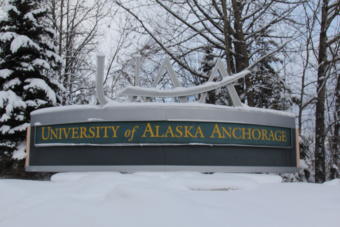
A sign on the campus of the University of Alaska Anchorage. (Photo by Tegan Hanlon/Alaska Public Media)

Leaders at the University of Alaska Anchorage are proposing to delete, suspend or revise more than two dozen programs to reduce spending and shrink budget gaps.

UAA published the proposed program eliminations on its website on Tuesday, Feb. 25. The nine programs recommended for deletion include the university’s bachelor’s degree in theater, master’s degree in anthropology and MFA in creative writing and literary arts.

“None of us wants to do this,” UAA Chancellor Cathy Sandeen said in an interview. “But this is the situation we’re in.”

Faced with three years of budget cuts, the University of Alaska Board of Regents tasked its universities last fall, including UAA, to begin fast-tracked program reviews. The task followed a tense, months-long state budget battle.

Sandeen said it’s still early in the review process: The university will take community feedback on the proposed eliminations, and then Sandeen will send her recommendations to the regents who are expected to make the final decisions in June.

This week, UAA is holding meetings with students and employees about the initial, proposed cuts, Sandeen said.

“It is quite dramatic for a university to cut academic programs at this scale,” she said. “So it really comes as a shock and people react with anxiety and sadness because what they know as UAA is definitely changing.”

When deciding what programs should go, university leaders weighed factors including enrollment and workforce demand, Sandeen said.

“If a program is eliminated, it doesn’t mean that it was a bad program. It’s just the situation we’re in right now. Because of these dramatic, extensive budget cuts, we need to go to this extreme,” she said.

Of the more than 100 degree and certificate programs reviewed, nine were recommended for deletion, 10 for suspension, 11 for revision and about 30 for continued review.

Sandeen said UAA expects to save about $4 million by slashing programs. It’s not an immediate savings. The university needs to give faculty notice of job cuts, and it needs to provide students already enrolled in programs with a path to a degree, she said.

It wasn’t immediately clear Tuesday how many jobs would be eliminated if the proposed cuts go through.

Sandeen said just because a degree program is cut doesn’t mean every related class would also disappear.

The release Tuesday of the proposed degree program cuts follows a turbulent year for the state’s public university system.

After a lengthy budget back-and-forth, the then-chairman of the UA regents and Gov. Mike Dunleavy signed a three-year agreement in August 2019 that included a $25 million budget cut for the university system in the current academic year followed by a $25 million cut next year and a $20 million cut the following year.

UAA also continues to grapple with a significant drop in student enrollment.

Despite the cuts, Sandeen said, the Anchorage university will continue to invest in the programs it keeps.

“Many, many of our programs will be preserved and will continue and will get strong so UAA will still be here,” Sandeen said. “It’s just we will be a different UAA going forward.”

This story has been updated.

What foods do Iditarod mushers pack? Trail mix, chile relleno — and pork for the dogs.

Iditarod volunteers sort mushers’ bags of food and gear at Air Land Transport in Anchorage on Wednesday. The 1,000-mile sled dog race starts in early March. (Photo by Tegan Hanlon/Alaska Public Media)

The Iditarod Trail Sled Dog Race starts next month.

But before mushers and their sled dogs take off on the race to Nome, there’s a lot of preparation to do — and that includes getting teams’ supplies to the remote communities along the trail.

On Wednesday, mushers dropped off their food and gear in Anchorage, so it could be sorted and flown to race checkpoints.

Chugiak musher Jim Lanier brought 64 bags of food and gear to send out to the Iditarod trail. Together, the bags weighed nearly 2,500 pounds.

Packing all of that gear, he said, is a challenge.

“This is the 21st time I’ve done it for Iditarod, and it’s always a huge job,” said 79-year-old Lanier, the oldest musher in this year’s race.

Lanier joined a stream of mushers who hauled truckloads of bags to a cavernous building in South Anchorage. Volunteers then weighed and sorted the bags, readying them for flights to the remote communities and ghost towns that serve as race checkpoints along the trail. It’s part of the massive web of logistics to prepare for the annual 1,000-mile sled dog race.

Iditarod volunteers sort mushers’ bags of food and gear at Air Land Transport in Anchorage on Wednesday. The 1,000-mile sled dog race starts in early March. (Photo by Tegan Hanlon/Alaska Public Media)

Iditarod race marshal Mark Nordman said each team usually sends about 1,500 to 2,700 pounds of supplies to the trail ahead of the race. The bags contain a little bit of everything, he said.

“From personal clothing to extra runner plastic to, of course, the most important thing: the dog food,” he said.

Nordman described getting those bags ready as a “huge chore.”

“So many people say that the hardest part about Iditarod is getting your drop bags together, because everything is portioned out how you want it for your team, and different size booties and plastic — everything else that they need on their trip to Nome,” he said.

To pack, mushers need to map out where they might need more food for longer breaks.

Iditarod musher Linwood Fiedler at Air Land Transport in Anchorage on Wednesday. (Photo by Tegan Hanlon/Alaska Public Media)

Willow musher Linwood Fiedler said he also considers the weather.

“I’ve done this race a bunch, and I’ve gotten stuck at checkpoints where there is no going forward. There is no trail,” he said. “And so being able to calculate, to be able to sit in Unalakleet for a day if there’s a coastal storm, that sort of thing is part of the equation as well.”

Fiedler brought about 1,800 pounds of supplies to Anchorage on Wednesday. He packed a couple thousand dog booties, plus batteries, plastic sled runners and food, he said.

The food for his dogs includes frozen beef and pork. For himself, it’s vacuum-sealed meals made by his wife, Cathy.

“I kind of like spicy things, like chile relleno and some lasagna with a little zip in it, that sort of thing,” he said. “She makes killer chili.”

Iditarod musher Jim Lanier writes a check for $1,394.90 to send his bags of food and gear to communities along the race trail on Wednesday in Anchorage. At 79 years old, Lanier is the oldest musher on the trail year. (Photo by Tegan Hanlon/Alaska Public Media)

For Lanier, it’s all about trail mix.

“I open a little package and pour it into my mitt, and then I can extract one little kernel of trail mix — a nut or an M&M or whatever — at a time and chew on it,” he said. “The process of chewing really helps to stay awake.”

Lanier wrote a check for nearly $1,400 to send his food and gear to the trail. He’ll reunite with the bags next month.

The Iditarod begins with a ceremonial start in Anchorage on March 7, followed by the official race start in Willow the next day.

Lanier and Fiedler are among the 57 mushers signed up to compete.


As it prepares to exit the state, BP donates nonprofit meeting property in Anchorage to community foundation

The BP Energy Center in Midtown Anchorage. (Hannah Lies/Alaska Public Media)

Oil company BP is not only planning to sell its pipelines and oil fields in Alaska as it prepares to exit the state, it also has pieces of its philanthropic efforts to hand off.

That includes the BP Energy Center, a popular building in Anchorage where nonprofits and educational groups can meet for free. It’s BP’s only big asset in Alaska that’s not included in the oil company’s proposed $5.6 billion sale to Hilcorp.

“That one we carved out so we could do something like this,” said BP Alaska President Janet Weiss.

On Tuesday, Feb. 11, BP announced it will donate the BP Energy Center property and building to The Alaska Community Foundation. The foundation has agreed to maintain the center as a free meeting space for at least the next 20 years.
“Legacy is important, and it takes all of us working together,” Weiss said. “So finding a like-minded organization that believes in meeting space, and providing that to nonprofits, that’s cool.”

BP Alaska President Janet Weiss in her Midtown Anchorage office. (Tegan Hanlon/Alaska’s Energy Desk)

Weiss talked about the transfer from her office on the top floor of the BP tower in Midtown Anchorage, just north of the Energy Center.

The donation is the latest announcement related to BP’s proposal to sell its entire Alaska business to Hilcorp in one of the state’s largest oil industry deals. It provides another part of the picture of what Alaska will look like without BP — a large, long-time employer and major player in the state’s philanthropic sector.

BP will continue to operate the center until its pending deal with Hilcorp is approved, according to The Alaska Community Foundation.

Elizabeth Miller, the foundation’s vice president of communications and development, said it’s an honor to carry on BP’s legacy “by continuing to operate the BP Energy Center as a community meeting center for nonprofits and education organizations.”

Miller said the BP Energy Center’s name won’t change.

There also won’t be any cancellations or disruptions of scheduled events at the center, the foundation says.

The Energy Center opened in 2002, and BP says hundreds of organizations use it each year. Its upcoming events range from a breastfeeding conference to community council meetings to a sustainable agriculture conference.

The schedule also includes “Wildlife Wednesdays” hosted monthly by the Alaska Wildlife Alliance. The free talks about bears, king crabs and seabirds wouldn’t be possible without the center, said Mandy Migura, the nonprofit’s deputy director.

“We don’t have a budget to pay room fees,” she said. “So it has been a really great experience, centrally located in Anchorage with free parking, so a lot of folks like that. And it has enabled us to offer this as a part of our education outreach program.”

A fund set aside by BP at The Alaska Community Foundation will be used to pay for the Energy Center’s future operational costs, Miller said. The foundation is also managing Hilcorp’s employee giving program.

Alaska regulators say they need more time to weigh Hilcorp’s request to keep its finances confidential

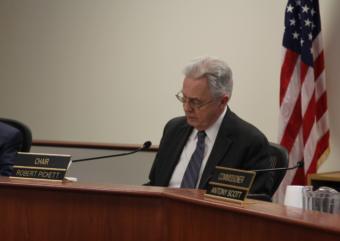
Regulatory Commission of Alaska Chair Robert Pickett at a February meeting in downtown Anchorage about the proposed BP-Hilcorp deal. (Photo by Tegan Hanlon/Alaska Public Media)

The state regulatory commission overseeing a major part of Hilcorp’s proposal to purchase BP’s entire Alaska business says it needs more time to weigh Hilcorp’s request to keep its finances confidential. It’s the second delay this year.

In the order issued Tuesday, the Regulatory Commission of Alaska said it will extend its deadline to March 12 to decide on Hilcorp’s request to shield its financial statements from public view. It’s asking the private oil company for more information.

Meanwhile, the RCA also granted a less-controversial request from Hilcorp and BP: The companies’ purchase and sale agreement for BP’s pipeline assets will remain confidential during the commission’s review process.

The RCA is charged with overseeing the portion of the pending $5.6 billion deal that includes BP’s stakes in the trans-Alaska pipeline. The oil companies announced the sale in August. It’s one of the state’s largest oil industry deals, and needs to clear several regulatory hurdles.

In RCA filings, BP and Hilcorp are arguing that the public release of their financial information during the commission’s review process would damage their businesses and give their competitors an unfair advantage.

In public comments, however, some Alaskans have demanded financial transparency from Hilcorp. They say they want assurance that the company has the resources to operate the assets it wants to buy, and also that it has the money to respond to any costly oil spills.

The RCA, in its order Tuesday, said that the argument made by Hilcorp and BP in support of their requests for confidentiality of their financial information isn’t as strong as their argument about the purchase and sale agreement.

The commission is asking Hilcorp and BP to file an explanation of the specific harm that would result from the disclosure of the financial statements they’ve already submitted to the commission. It also wants to know whether any of the financial records must be filed with a federal agency.


Conoco shelves proposal to build a temporary island after criticisms from North Slope

An aerial view of one of the exploration pads and wells that ConocoPhillips drilled during the 2018 exploration season at its Willow prospect. (Photo courtesy of Judy Patrick Photography/ConocoPhillips Alaska)

ConocoPhillips has made a big change to its development plans for its massive oil discovery on Alaska’s western North Slope.

Instead of building an entire, temporary island as a staging area to move its infrastructure to the remote Willow site, the oil company has abandoned that plan and now proposes to rely more heavily on ice roads.

The change is in response to criticism from North Slope residents and groups, including those in the small, Arctic village of Nuiqsut, who opposed construction of the island, according to Connor Dunn, Conoco’s development manager for the Willow project. They were worried about pollution and impacts to subsistence activities and wildlife.

“We wanted to take those concerns seriously and took the opportunity to try and find a way to get the support of the community for a different option to bring these modules to the North Slope,” Dunn said.

The pivot demonstrates the influence that the North Slope’s indigenous people and groups can exercise over multi-billion-dollar oil companies like Conoco. In the past 15 years, the company has also changed its plans for bridge construction and power generation in response to local feedback.

The decision on Willow comes in the middle of the U.S. Bureau of Land Management’s environmental analysis of the proposed project. It’s significant enough to prompt BLM to push back its final decision on the project, the agency announced last month.

“This is very indicative of how public comments can help shape best decisions,” said Lesli Ellis-Wouters, a spokesperson with BLM in Alaska.

The Willow prospect is located in the National Petroleum Reserve in Alaska and, if built, would be the North Slope’s westernmost oil field. And that lends itself to unique logistical challenges. At the center: How to transport the giant pieces of the facility needed to process the oil that will come from the new field.

Conoco’s original island pitch

For the first time in about two decades, Conoco wants to send an oil processing facility to the North Slope, Dunn said.

Dunn is leading the effort to move the Willow project from an oil find to an oil producing field.

A processing facility filters out sand and other unwanted materials from crude oil before it’s sent down the trans-Alaska pipeline. It also handles water and natural gas.

Dunn said Willow wouldn’t be able to use an already-existing processing facility because of its size and location

“We haven’t had anything as big as this really in about 20 years,” Dunn said.

At its peak, Conoco says, Willow could produce more than 100,000 barrels of oil a day. That’s compared to the roughly 500,000 barrels a day that currently flow down the whole trans-Alaska pipeline.

Dunn said the prefabricated pieces of a processing facility can weigh more than 3,000 tons. That’s like hauling more than two dozen large bulldozers.

The pieces are too heavy to drive them up the Dalton Highway to the North Slope, Dunn said. So Conoco needs to send the pieces by sea.

“The plan is that we’ll barge those up to the North Slope and offload them,” Dunn said. “And then the complex aspect is: How do we get them to this relatively remote location of Willow?”

At first, Conoco proposed building the temporary island out of gravel in the shallow waters of Harrison Bay, off the coast of the petroleum reserve. It would have measured about 13 acres — or roughly ten football fields.

The company said in the summer, when sea ice receded from shore, barges would carry the pieces of the processing facility to the island. And in the winter, the company would move the pieces to Willow by ice road.

Conoco said once it was done with the island, it would slowly wash away.

A pivot to roads

But, not everyone liked that plan.

Gordon Brower, a top land management official with the North Slope Borough, said the borough had concerns about the island’s impact on subsistence activities, including fishing.

He also said he didn’t think it made sense to use so much gravel for a temporary island. North Slope communities need gravel for roads and other projects, and it’s not an abundant resource in the region, he said.

“You really don’t want to waste any of it and allow nature to reclaim it,” he said. “You want to use it in a way that’s beneficial and I think that’s our approach.”

The tribal and city governments of the nearby village of Nuiqsut also raised concerns about the island, as did the usually pro-development Arctic Slope Regional Corporation (ASRC).

In a letter, ASRC told the federal government there was firm local opposition to the proposed island. It said community members had raised “valid concerns the gravel island would cause sedimentation of subsistence use areas and pollution from the sandbags used to secure the island in place.”

Environmental groups criticized the proposal too.

Andrew Hartsig, the Ocean Conservancy’s Arctic program director, said the proposed island would have had substantial impacts. The area is “a hotspot for marine birds,” he said. “And it’s also important feeding and denning habitat for polar bears.”

After a series of meetings with North Slope residents and other public comments, Conoco decided to shift directions, Dunn said.

That’s where more ice roads come in.

Conoco is now proposing to barge the pieces of the oil processing plant to an existing dock farther east on the North Slope. It would then move them along about 90 miles of gravel and ice roads to Willow.

Dunn said the drive would take weeks, but he doesn’t expect it to impact the project’s overall timeline.

So far, Dunn said, Conoco is hearing positive responses to the change.

“I think it’s a good call in, maybe, just responsible planning,” Brower said.

The revised proposal would use less gravel and reduce the amount of mining activity, according to Conoco.

North Slope residents and environmental groups, however, have also raised other concerns with Willow, apart from the island. Those include the project’s potential impacts to air quality, caribou and hunting.

BLM expects to release the supplement to its draft environmental analysis on the proposed Willow project this spring. It will also open a new public comment period.

Conoco estimates first oil production from Willow by late 2025 or early 2026.


Site notifications
Update notification options
Subscribe to notifications