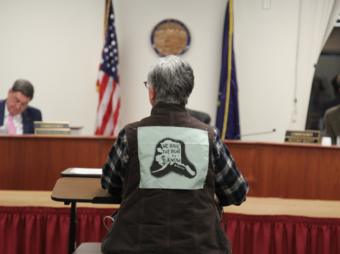
Dana Dardis raised concerns about Hilcorp’s environmental record at Tuesday’s Regulatory Commission of Alaska meeting, and demanded financial transparency. Her vest read: “We have the right to know.” (Photo by Tegan Hanlon/Alaska’s Energy Desk)
A state regulatory commission heard from dozens of people Tuesday, Feb. 4, about oil company BP’s proposed sale of its entire Alaska business to Hilcorp.
It was the first time Alaskans could provide in-person comments to the Regulatory Commission of Alaska about one of the state’s biggest oil industry deals.
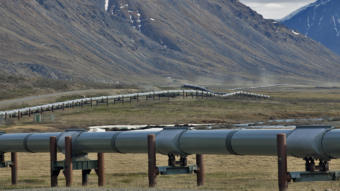
The five-member RCA will ultimately decide whether to approve the portion of the pending $5.6 billion sale that includes BP’s stake in the 800-mile trans-Alaska pipeline.
Over the course of six hours on Tuesday, about 100 people weighed in. They each had up to three minutes to comment, and they were split over what the commissioners should do and how they should do it.
Some pushed for the RCA to sign off on the deal. They told the commissioners it was in the best interest of the state’s economy, and would lead to more jobs for Alaskans. They called attention to Hilcorp’s experience in Cook Inlet and on the North Slope, and highlighted the company’s work in older oil fields.
“Hilcorp has already demonstrated to Alaska that it can increase oil production in aging fields,” said Alaska Chamber’s Allen Hippler. “It goes without saying that during this challenging fiscal time Alaska needs more production to help fund vital public services.”
But others said they had too many concerns about Hilcorp, including the company’s environmental and safety records. They called for more vetting, more time and a public hearing. They demanded Hilcorp publicly disclose audited financial statements.
People waited their turn in downtown Anchorage Tuesday to speak in front of the Regulatory Commission of Alaska. (Photo by Tegan Hanlon/Alaska’s Energy Desk)
“Alaskans deserve to be informed on this decision as decision makers in this process and as owners of our resources,” said Anchorage resident Jenny-Marie Stryker. “And we should know whether Hilcorp will be able to handle a potential tens-of-billions-of-dollars cleanup.”
Hilcorp is asking that its finances be kept confidential during the commission’s review process. The commission has given itself until Feb. 11 to decide on that request.
On Tuesday, the commissioners didn’t respond to any of those providing comment. In a statement, the RCA said it will consider what was said at the meeting in its dockets on the pending transaction.
Before Tuesday, it had also received more than 200 written comments.
The commission has not yet provided a timeline for a final decision on the proposed deal.
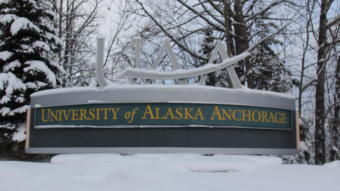
A sign on the campus of the University of Alaska Anchorage. (Photo by Tegan Hanlon/Alaska Public Media)
Leaders at the University of Alaska Anchorage are grappling with their largest drop in enrollment in years.
The number of students who signed up for UAA classes this past fall compared to the year before fell by about 1,500 students, or nearly 10%, according to preliminary data from the University of Alaska system.
The enrollment drop follows a tense state budget battle and accreditation issues for the Anchorage university, and it adds additional financial loss to a system that’s already cash-strapped and stressed.
“It’s significant for us,” said Bruce Schultz, UAA’s vice chancellor for student affairs. “It’s one of the largest declines we’ve seen in the last 10 years.”
While UAA, the University of Alaska Fairbanks and the University of Alaska Southeast have struggled for almost a decade with shrinking enrollments, along with colleges across the country, a one-year, 10% decline is “not typical by any means,” according to Robert Anderson, president of the State Higher Education Executive Officers Association.
He described it as “seismic.”
“I think it represents an uncertainty that students and their families feel regarding at what level Alaska will support higher education,” Anderson wrote in an email.
(Graphic by Hannah Lies/Alaska Public Media)
UAA Chancellor Cathy Sandeen said it became apparent this summer that fewer students would show up in the fall — defying projections.
“We keep a dashboard of our admission and enrollment data, and everything was green,” she said. “We were expecting a banner year for fall of 2019. And then in July, all those indicators turned red as fewer and fewer students were enrolling.”
She attributed the decline to a number of factors.
Then came the summer’s state funding battle sparked by the governor cutting an unprecedented 41% of state funding for the UA system.
In response, university leaders warned they’d have to erase degree programs and shut down whole campuses.
In the middle of all of that, thousands of Alaska students also learned there was no money to pay for their college scholarships.
Talk about consolidating the UA system also gained new momentum.
It was a chaotic pileup of issues during a key time for UAA enrollment, Sandeen said.
“We had many, many questions from students,” she said. “And during portions of the summer, we didn’t have a lot of good answers for them. We tried to assure them that, ‘There still would be substantial programs offered in Anchorage. Hang in there with us.’ But, you know, some of them chose a wait-and-see approach.”
It’s also important to remember that many UAA students are older than the traditional college student, Sandeen said. They’re often working while they’re earning their degrees, and many are the first in their family to go to college.
A lot of them also wait until shortly before the semester starts to enroll in classes, Schultz said.
“It’s just the pattern,” he said. “Because they’re so dependent on financing and wanting to know how much time off they get from work and family obligations, they register in August. And because of the conversations and the negativity that was going through the community about the future of UAA and the statewide budget, our students didn’t register.”
Keon O’Brien is one of the university students who nervously watched the budget back-and-forth play out in the news this summer. He had just finished his freshman year at UAA, studying music.
“I honestly had no clue what I was going to do. I was working three jobs over the summer trying to save up for school,” he said. “I had plans for the fall. And that was sort of all turned on its head. I started looking at transfer options in June, July-ish.”
But, O’Brien said, he didn’t have enough time to transfer out of state.
So he’s still at UAA this year, and he said he notices fewer people on campus, whether in the dorms or in the student union.
O’Brien said he’s still weighing whether to stay at UAA another year, but he’s leaning toward leaving.
Even with the smaller state budget cut agreed to and scholarships going out, O’Brien said staying at UAA feels too risky. He worries about continued funding cuts decimating his program. Some of his friends are already gone.
“Which is really unfortunate because I love UAA. I love all the opportunities I’ve had here. I love the people here,” he said. “And so it’s sort of like, I don’t want to leave, but I sort of have to.”
According to a survey of UAA students who didn’t return this fall, the largest chunk who responded — about 38% — said they were taking a break from college.
“The biggest barrier we have is students deciding not to go to school at all,” Schultz said. “We don’t have students just flowing across state boundaries and among institutions.”
Nearly a quarter cited concerns about costs and financial aid, and 18% said they had transferred to another university.
To adjust to a smaller student body, UAA is offering fewer classes.
This fall, the university had 412 fewer course sections, about a 15% cut, Schultz said.
UAA also expects to be down at least $5.5 million in tuition and fees this year. That’s on top of its slice of the state funding cut: nearly $12.5 million.
Sandeen said UAA is currently reviewing its programs to inform where to cut spending. So are the other universities.
“Right now we’re still in somewhat of a period of uncertainty,” she said. “And I understand where people are coming from, but we’re working as hard as we can to turn this around so that we continue to help people fulfill their dreams.”
Sandeen said UAA also continues to “invest heavily” in recruiting new students and retaining those already enrolled.
Watch the latest legislative coverage from Gavel Alaska.
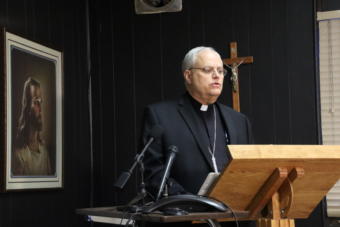
Bishop Andrew Bellisario, the apostolic administrator in Anchorage, holds a press conference on January 16, 2020 at the Archdiocese of Anchorage building. (Photo by Valerie Kern/Alaska Public Media)
An Alaska bishop offered a series of apologies on Thursday, Jan. 16, in the wake of a review that disclosed reports of sexual misconduct by 14 men who worked for the Archdiocese of Anchorage — some stretching back more than 50 years.
All but one of the accused were priests. The abuse involved children and vulnerable adults.
At a press conference at the archdiocese in downtown Anchorage, Bishop Andrew Bellisario said he wanted those abused by clergy members to know: “It’s not your fault. It’s never, ever been your fault.”
“The pain that you suffer is the fault of others and representatives, most specifically, of the church who have perpetrated crimes upon you,” he said. “It’s with great shame that I stand here today, as a representative of the church, to offer this apology to you.”
The report released by the archdiocese detailed the findings from a review of church documents by an independent, three-person commission.
The review found “credible evidence” that 13 priests and one other church employee who served under the Anchorage Archdiocese engaged in sexual misconduct involving minors or vulnerable adults.
The men served across Southcentral Alaska from Valdez to Talkeetna to the Kenai Peninsula to the Matanuska-Susitna Valley.
Allegations against 10 of the men came while they served in the Anchorage Archdiocese. The other four served in the archdiocese but faced allegations elsewhere, the report said.
The allegations are as recent as 2015, and date back to 1956.
A search of state records appears to show no criminal charges filed in Alaska against the men, though some were named in various civil lawsuits and a bankruptcy case involving the Fairbanks diocese.
Bellisario said the church shared the report with the attorney general’s office before posting it online.
It wasn’t clear how many of the allegations were reported to authorities by the church at the time they were recorded.
“All of these cases that needed to be reported have been reported either at the time, later or in some cases, much later,” Bellisario said.
Bellisario said he didn’t have information on how many victims were found during the commission’s investigation. He said the commission reviewed the personnel files to create the report, and he had not.
The Anchorage Archdiocese covers 138,985 square miles — larger than the size of New Mexico. It stretches from Glennallen to Unalaska, an area with an estimated Catholic population of 32,170, according to its website.
Bellisario, the bishop of the Diocese of Juneau, is also serving as the apostolic administrator in Anchorage until a new archbishop is appointed.
Asked if the commission found that church leaders had tried to cover up the abuse, Bellisario said it didn’t “identify anybody of gross negligence.”
“However, I think we all know — throughout the United States in particular and here, too — that if things would have been done the way we do them today, as opposed to the way they did them in the ‘70s, the ‘80s and the ‘90s, I think this list would be very, very small, possibly, maybe, even nobody on that list, which would be our goal,” he said.
He said the church now has trainings, certifications, background checks, ongoing education and additional programs.
Thursday’s report is the first time the Anchorage Archdiocese has named its clergy members who have been accused of sexual misconduct. It follows a cascade of reviews and disclosures from other dioceses across the country, including in Juneau, Fairbanks and across rural Alaska, as the Catholic Church wrestles nationally and internationally with abuse allegations and their fallout.
“The purpose of putting the names out, as many dioceses throughout the United States are doing, is to have an opportunity for people to come forward for healing,” Bellisario said. “We’re doing this for people who have been harmed. People who have been victimized.”
Bellisario encouraged people who had been victimized to consider reporting to law enforcement. He said people could also contact the archdiocese’s victim assistance coordinator.
An above-ground section of the Trans-Alaska Pipeline System near the Toolik Field Station in the North Slope Borough. (Photo by Rashah McChesney/Alaska’s Energy Desk)
An initiative that would raise taxes on Alaska’s largest oil fields has enough signatures to go before voters this year, its supporters say.
In a statement Tuesday, the group supporting the initiative announced it had collected more than 43,000 signatures from across the state. That pushes it beyond the requirement to get on a statewide ballot: 28,501 signatures.
The group, called “Vote Yes for Alaska’s Fair Share,” says it plans to turn the signatures over to election officials on Friday for certification.
The ballot initiative would raise the minimum tax and eliminate oil tax credits for Alaska’s largest legacy fields: Prudhoe Bay, Kuparuk and Alpine. It would also require oil companies to publicly report their revenues and costs from those fields.
Anchorage-based oil and gas lawyer Robin Brena, a primary sponsor of the initiative, has said the state is receiving a smaller share of gross oil sales than it has historically.
“Right now we are not getting our fair share,” said Jane Angvik, a former Anchorage Assembly chairwoman who’s also a sponsor of the initiative.
Angvik said the initiative could bring in another $1 billion in production taxes.
But Kara Moriarty, president of the Alaska Oil and Gas Association, has said the initiative would hurt the industry and make investing in the state less attractive.
BP Alaska has said the initiative could cost companies up to an additional $2 billion, and those costs would stunt investment.
The group OneAlaska was formed last year to oppose the initiative. By early January, it had raised about $254,000 from the Alaska Oil and Gas Association, the Resource Development Council and oil companies, according to its quarterly report.
Vote Yes for Alaska’s Fair Share filed its last quarterly report in October and had raised about $45,000, mostly from Brena himself.
Earlier this month, supporters of an initiative that would overhaul Alaska’s election laws also announced they had gathered enough signatures for the ballot.
Bret Moffet installs a frost plug heater at L and M Motors in Anchorage on Wednesday, Jan. 8. The shop had an increase in calls for block heaters during the cold snap. (Photo by Tegan Hanlon/Alaska Public Media)
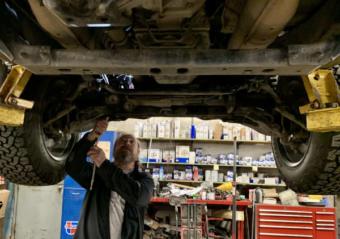
Anchorage auto mechanic Bret Moffet stood underneath a forest green pickup truck last week that was hoisted about seven feet in the air. He used a long wrench to unscrew a bolt hidden deep in a maze of parts.
“This requires quite a bit of patience,” he said, the bolt tight and difficult to remove.
Moffet was in the middle of installing yet another engine block heater at L and M Motors. The process had become almost routine: It was his third one in three days.
With temperatures sinking below zero degrees last week, demand for engine block heaters skyrocketed, said Moffet’s boss, Michael Feeney, who stood nearby in the busy garage.
“We average probably 30 or 40 a winter, but when it gets cold like this we might have 30 or 40 in a week,” he said.
Auto and environmental experts say that’s a good thing. More people plugging in their cars on cold days makes a difference for both the vehicles and for air quality, they said.
“It will extend the life of your car,” said Timothy Mason, owner of Sand Lake Automotive.
There are different kinds of block heaters. Last week, Moffet installed a frost plug heater. The metal piece that went under the truck’s hood was small. It fit in the palm of his hand.
A frost plug heater and L and Motors on Wednesday, Jan. 8. (Photo by Tegan Hanlon/Alaska Public Media)
One mechanic likened it to an electric mattress pad. Randal Smith, an automotive instructor at the University of Alaska Anchorage, said it’s kind of like a hair straightener.
“You plug it into the wall and it starts getting hot,” he said. “All it is is a heating element, and that’s essentially it.”
When plugged in, engine block heaters keep the engine block, coolant and oil warm.
That’s critical, Smith said. When oil gets cold it becomes thick and gooey, like corn syrup, and it doesn’t move like it should to lubricate the engine.
“You ultimately end up with a metal on metal which is not good,” Smith said. “That’s incredibly accelerated wear and potentially catastrophic damage if it continues for too long.”
Smith said an engine block heater not only eases wear and tear on the engine, it also helps the inside of cars warm up quicker.
Plus engine block heaters are good for air quality, said Andria Cross, environmental health educator at the Anchorage Health Department. Cars that start cold belch out more pollutants including carbon monoxide and particulate matter.
“When plugging in your vehicle for two hours into your block heater it actually can reduce emissions up to 60% and that’s specifically the carbon monoxide that’s emitted during the first 10 minutes of engine operation,” Cross said.
For years, the city health department has encouraged Anchorage drivers to plug in their cars at 20 degrees and colder.
Cross said that’s based on an analysis of the times the city exceeded federal recommendations for carbon monoxide emissions. Most often, it happened when temperatures hit 20 degrees or below.
On those cold days, Cross said, cars don’t have to be plugged in for too long. She recommends people use a timer so their heaters turn on two hours before they’re ready to leave in the morning.
Smith said he could think of just one potential con of an engine block heater: The costs.
Jerry Guest, service advisor at Specialized Import Auto Service, said the costs for the parts and installation can vary widely depending on the type of car and heater.
“I put it between $400 and $500, generally speaking,” he said.
There’s also the electric bill. Cross estimates it costs Anchorage residents about 20 cents to plug in small or medium-sized cars for two hours a day, and 50 to 60 cents for larger vehicles.
“The cost is really offset when you look at the fuel efficiency and all those other factors when plugging in your vehicle,” she said.
Cross said the city gives out free timers, and there’s a text messaging service that sends alerts when temperatures dip to at least 20 degrees.
In Anchorage in 2019, that happened during 62 days, said Brian Brettschneider, a climatologist with the University of Alaska at Fairbanks’ International Arctic Research Center.
That number has continued to shrink over the decades.
From the 1950s to mid-1970s, Anchorage had a low temperature of 20 degrees or colder an average of 125 days a year, Brettschneider said. That decreased to about 110 days a year from the 1980s through 2010. In the last decade, it’s averaged 90 days, he said.
Brettschneider said he expected the trend to continue, making the season for engine block heaters shorter and shorter, comparing it to how the Anchorage Assembly recently cut the city’s studded tire season by two weeks.
In future years, he said, an engine block heater “would certainly be less necessary, but that’s not to say it would be unnecessary.”
An above-ground section of the Trans-Alaska Pipeline System near the Toolik Field Station in the North Slope Borough. (Photo by Rashah McChesney/Alaska’s Energy Desk)
The state commission overseeing BP’s proposed sale of its Alaska oil assets to Hilcorp said it needs another month to weigh confidentiality requests after receiving dozens of public comments and new documents from the two companies.
According to an order filed this week, the Regulatory Commission of Alaska will extend its deadline to Feb. 11 to decide on Hilcorp’s request to keep its financial statements private.
It’s the next step in the RCA’s review process of a portion of the $5.6 billion deal between the two oil companies.
The deal includes BP’s stakes in Alaska oil fields, pipelines and other assets. The five-member RCA is charged with approving the transfer of BP’s interest in the trans-Alaska pipeline, and the Milne Point and Point Thomson pipelines.
Hilcorp, a private company, has argued that making its finances public during the process would damage its business and give its competitors an unfair advantage. The company argued that it already routinely discloses financial information to various agencies, according to an RCA filing.
In public comments, however, some Alaskans demanded financial transparency from Hilcorp to ensure the company has the resources to operate the assets it wants to buy and to respond to any oil spills or other incidents. Some also raised concerns about Hilcorp’s safety and environmental record.
The RCA has received more than 200 public comments on the proposed sale.
On Dec. 20, Hilcorp and BP filed a 37-page joint response to some of those comments, saying they wanted to correct “certain misconceptions and misinformation.” They also said the RCA should move forward with the part of the deal involving BP’s 48% interest in the trans-Alaska pipeline without a public hearing.
Close
Update notification options
Subscribe to notifications
Subscribe
Get notifications about news related to the topics you care about. You can unsubscribe anytime.