Zoe Grueskin, KTOO

‘These people we’re afraid of are our neighbors.’ Downtown walking tours discuss housing, public safety and Juneau’s future.

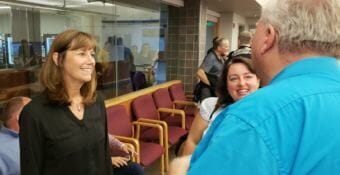
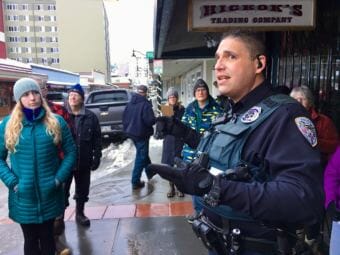
JPD officer Ken Colón shares his perspective on public safety in Juneau's tourist district on a Blueprint Downtown walking tour on Jan. 12, 2019. (Photo by Zoe Grueskin/KTOO)
Juneau Police Department officer Ken Colón shares his perspective on public safety in Juneau’s tourist district on a Blueprint Downtown walking tour on Jan. 12, 2019. (Photo by Zoe Grueskin/KTOO)

Around two dozen Juneau residents, many in rubber boots and ice cleats, turned out last weekend for Blueprint Downtown’s second public walking tour. A collaboration between the City and Borough of Juneau’s Community Development Department, MRV Architects, Lucid Reverie, and Sheinberg Associates, Blueprint’s goal is to create a “community vision” for downtown Juneau.

The walking tours build off a public survey and community meetings last fall to gauge what’s working well downtown, and what could be improved.

Leading the way was Paul Voelckers, president of MRV Architects and vice chairman of the Juneau Planning Commission. This tour was meant to focus on vehicles, parking and pedestrians. But along with some talk of confusing crosswalks, Voelckers let the conversation return to a touchier subject broached the week before: what he called “the reality and the perception of vagrancy and risk.”

The group stopped at the intersection of South Franklin Street and Admiral Way, an unofficial border between year-round businesses and shops that cater to tourists in the warmer months and stay shuttered through the winter.

Juneau police officer Ken Colón was along for the tour. He said that part of town is considered unsafe by some, in part due to the homeless population that tends to gather there.

Colón said many downtown shop owners do their part to be good neighbors — when they’re around. The problem, as he sees it, is the lack of business outside tourist season.

“We do have owners who will sometimes go out of their way and work with those individuals, knowing they’re down on their luck. So if that existed, that 12-month period existed where you had every establishment functioning as it ought to be, we wouldn’t have that problem or eyesore that I hear (about) on a habitual basis,” said Colón.

M.J. Grande has lived in Juneau since 1983 and works downtown, along the route of the walking tour. She called for compassion.

“These people that we’re afraid of are our neighbors,” Grande said. “They are deserving of respect, of recognition, of interaction. Hiding away or spreading the little, ‘Ooh it’s scary, it’s scary,’ serves no benefit to our community in any aspect.”

The group continued on its way, and so will the conversation.

Blueprint Downtown will hold one more walking tour on Saturday, Jan. 19, meeting at the Juneau Arts & Culture Center at 1 p.m. The theme is cultural identity, sustainability and the environment.

M.J. Grande shared her thoughts at the Blueprint Downtown walking tour on Jan. 12, 2019. (Photo by Zoe Grueskin/KTOO)

Newscast – Monday, Jan. 14, 2019

  • Tuesday is the first day of the 2019 Alaska legislative session, and the House of Representatives still doesn’t have a majority.
  • All three of Juneau’s state lawmakers are new to the job and say they’re ready to get to work.
  • A two-year audit of the state’s gasline corporation found the corporation’s spending has generally followed the law, but there are a few issues.
  • Nicolas Petit defended his title in the Copper Basin 300 Sled Dog Race.
  • A 5.0 magnitude earthquake rattled residents in the Anchorage area, another aftershock of Nov. 30’s 7.0 magnitude quake.

What’s in a name? After student push, Juneau-Douglas High School adds Tlingit name: Yadaa.at Kalé.

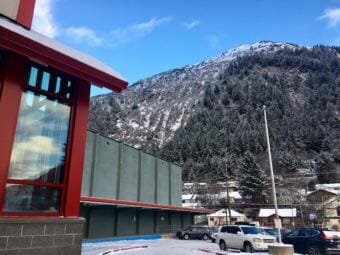
Juneau-Douglas High School: Yadaa.at Kalé sits at the base of the mountain from which it takes its Tlingit name, Jan. 8, 2019. (Photo by Zoe Grueskin/KTOO)

On Tuesday night the Juneau School District Board of Education voted unanimously to accept the gift of a Tlingit name for Juneau-Douglas High School. As with other schools in the district, the Tlingit name of Yadaa.at Kalé will be an addition, not a replacement.

The oldest high school in Alaska’s capital sits at the base of a mountain. That mountain shares its name with the city, and with the school: Juneau.

But it has other names.

“Yadaa.at Kalé is an ancient name. So it’s not as if Mt. Juneau was always called Mt. Juneau,” said Barbara Cadiente-Nelson, Indian Studies Program director for the Juneau School District. She believes names have power. They connect people and places.

For more than a year, a group of people has worked to connect Yadaa.at Kalé to another place: Juneau-Douglas High School.

The push was led by students, including senior Arias Hoyle.

“Even though it’s the name of Mt. Juneau, it does not mean Mt. Juneau. It means ‘beautifully adorned face,’” said Hoyle.

Hoyle said student support for the Tlingit name was widespread at his school. To prove it, he collected signatures from around 70 students of diverse backgrounds.

Arias Hoyle shows the Juneau School District Board of Education the signatures he collected from students at Juneau-Douglas High School in support of adding a Tlingit name to the school, on Jan. 8, 2019. (Photo by Zoe Grueskin/KTOO)

Elders and leaders representing the Áak’w Ḵwaan and T’aaḵu Ḵwáan approved the choice of Yadaa.at Kalé. They offered the name as a gift to the high school, after meeting with students and district staff last April.

Tlingit elder David Katzeek was one of the leaders at that meeting. He graduated from Juneau-Douglas High School in 1962.

Katzeek said Yadaa.at Kalé is open to interpretation. One of the things it means is “coming home.”

He explained it like this: Imagine you’re on your way back from a long trip hunting or fishing. Stormy waters. You’re in a small canoe. Waves are crashing.

“Sometimes the people in the boat would feel like maybe we’re not going to make it,” Katzeek said. “And they’d be working together, wooch.een.”

Katzeek then demonstrated how the boat’s passengers would express themselves in Tlingit when the mountain comes into view.

“We see that beautiful face of the mountain … That mountain is just getting more beautiful all the time,” he said.

Juneau-Douglas principal Paula Casperson welcomes the name.

“It’s hard for me to see a downside. I think that this just adds on to what I view as a strength of the Juneau School District, which is incorporating where we live and the people and the place that we are,” she said.

Cadiente-Nelson said using Tlingit names can be a step toward healing from a painful history. One that has been marked by violent suppression of the Native community.

The name, though, is for everyone.

“The restoration and bringing it back to life, though it’s always been there. It’s meaningful to not just the Native people of this region, but I believe to the majority of this community,” she said.

At their January meeting, the Juneau School Board voted to make Yadaa.at Kalé an official part of Juneau-Douglas High School’s name. It will be written as Juneau-Douglas High School: Yadaa.at Kalé.

It won’t happen overnight. Some things, like a new sign out front, will take time and, more importantly, money.

But Casperson said the school’s website will be updated quickly. She hopes it will include a pronunciation guide, with audio. Getting the new name on anything printed, like student IDs, will be as simple as changing the template.

Hoyle was at the school board meeting when the name was accepted. The vote was unanimous and earned a standing ovation from an unusually large audience. The board members joined in.

After the vote, Hoyle said he felt confident. The change, he said, would be empowering.

Hoyle plans to graduate in May. When he does, he hopes his diploma will name him a graduate of Juneau-Douglas High School: Yadaa.at Kalé.

Juneau school board votes to keep Bridget Weiss as district superintendent

Juneau School Board member Emil Mackey congratulates Bridget Weiss for being selected interim superintendent of the Juneau School District on Monday, Aug. 6, 2018.
Juneau School District Board of Education member Emil Mackey congratulates Bridget Weiss for being selected interim superintendent of the Juneau School District on Monday, Aug. 6, 2018. The school board voted to make her appointment permanent at a Tuesday board meeting. (Photo by Jeremy Hsieh/KTOO)

At its first meeting of the new year, the Juneau School District Board of Education voted unanimously to appoint Bridget Weiss as permanent superintendent of the Juneau School District.

Before the vote, members of the board and the public voiced their support of Weiss.

“It’s clear this is more than just a job for you,” said board member Steve Whitney.

Whitney described the school board’s choice to appoint Weiss as the will of the people: “We got so many letters, and they all said the same thing from so many different sources. It just kind of drives it home in a big way.”

He says he’s hopeful about the direction the district is headed in, although challenges will remain.

“It’s gonna be hard just because money is so short. So many things are just barely being held together by shoestrings,” Whitney said. “Given that, I’m thankful that she’s here right now at this point in time.”

Laura Mulgrew is president of the Juneau Education Association, the teachers’ union. She spoke in support of Weiss before the vote and was happy with how it turned out.

“As a union, we’ve had a very positive working relationship [with Weiss],” she said. “Even through difficult times and conversations, we still manage to end on such a positive note on a regular basis. And we are achieving that needed to get done that have not been addressed.”

Mulgrew also noted Weiss’ commitment, noting she’s frequently seen in the schools and at events, even serving as a substitute teacher when needed.

Weiss called the support “overwhelming.” She has served as interim superintendent since August, when her predecessor left to take a job in California after four years in the position. Much of the feedback the school board received throughout the selection process called for a local leader.

Weiss is a graduate of Juneau-Douglas High School.

“I feel so grateful to be in a position where I can serve this place, my home of homes,” she said.

Becoming superintendent of Juneau School District “was not on my original chart,” said Weiss. “I would not have even known to hope for this.”

The appointment of Weiss earned the night’s second standing ovation. The first, minutes earlier, was in response to the school board’s acceptance of the gift of a Tlingit name, Yadaa.at Kalé, for Juneau-Douglas High School.


Note: This story was expanded to include more information on Jan. 9, 2019.

Juneau-Douglas student arrested after bringing BB gun to school, posting on social media

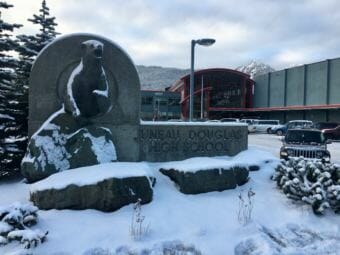
Juneau-Douglas High School on Jan. 8, 2019. (Photo by Zoe Grueskin/KTOO)

Police arrested a student at Juneau-Douglas High School who brought a BB gun with her to school Tuesday. The school went into “stay put” mode while officers investigated.

JPD received a report Tuesday afternoon after the 16-year-old student posted a photo on social media of what appeared to be a handgun. Officers contacted the student at school and confirmed she was in possession of a BB gun, which appeared to be the weapon in the photo.

The student was arrested “for terroristic threatening in the 2nd degree, a class C felony, and taken to the Johnson Youth Center,” according to a JPD press release. No one was injured.

JPD stated in its release there does not appear to be any continuing danger to the community.

The chief of staff for the Juneau School District reported that the “stay put” was lifted at the high school, with normal operations resuming about an hour before the end of the school day.

How Juneau grocers are helping families during winter break

In the back of Super Bear, there’s a stockroom nearly as big as the supermarket itself. Heavy shelves of nonperishables line the walls. Produce sits in cardboard by the doors, ready to be brought out to brightly-lit aisles bustling with holiday shoppers.

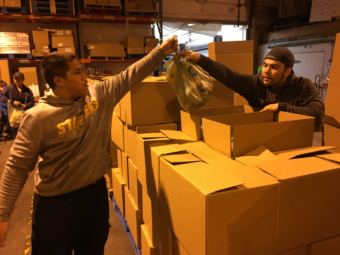
In the back, it’s just as busy. Or at least it was on the Wednesday before Juneau schools let out for winter break. That afternoon, the backroom became headquarters for Project Three Squares, a program to make sure kids get enough to eat during school breaks.

IGA, which owns both Super Bear and Foodland, has run the program in Juneau since 2016. This year, employees from both stores packed up 478 bags of food.

On Thursday those bags were delivered to each of Juneau’s schools, where staff distributed them to students who might need a little extra help over the holidays.

One of the people overseeing the operation was Super Bear store director Tony deMelo. He said the bags were filled with breakfast and lunch in mind. Each bag contained hot cocoa, a can of fruit, a box of cereal, a few packets of ramen noodles, canned tuna and granola bars.

John Ouderkerk, better known as JP, is the assistant store director at Super Bear. He did the ordering for Project Three Squares, most of which happened back in July. He was especially pleased to include the cocoa in this winter’s bags. That’s a first, he said.

“I figured since it’s such a cold, chilly winter, we put some of that in there this time so they have a nice treat on their break,” Ouderkerk said.

Project Three Squares takes place twice a year, before winter and spring breaks. This time around, about 30 employees of both Super Bear and Foodland volunteered to pack bags and deliver them to the schools. Ouderkerk’s own kids also pitched in.

The program is partially funded by the sale of reusable tote bags, designed by local artist MK MacNaughton and sold at both stores. All together, Foodland store director Rick Wilson estimated that IGA spends about $20,000 on the project in Juneau each year.

Site notifications
Update notification options
Subscribe to notifications