Zoe Grueskin, KTOO

Southeast students explore careers to meet Alaska’s behavioral health needs

Holli Davis came to a behavioral health camp in Juneau the week of of Jan. 28, 2019 hoping to get "more of a clear vision" of a career in social work. (Photo by Zoe Grueskin/KTOO)
Holli Davis came to a behavioral health camp in Juneau the week of of Jan. 28, 2019, hoping to get “more of a clear vision” of a career in social work. (Photo by Zoe Grueskin/KTOO)

High school students from around Southeast Alaska met in Juneau last week to explore careers in behavioral health. The state has a shortage of workers in these fields, and there’s a push to recruit Alaskans to come back after college and do those jobs in their home communities.

Holli Davis is a senior at Petersburg High School. She’s been thinking a lot about what she’d like to do in the future, and right now she’s considering social work. She wants to work with kids.

“Being in Petersburg, you know a lot about kids and their upbringing in life,” she said. “And sometimes you know know they didn’t have a good upbringing, and I kind of just want to help them out.”

Along with 18 other teens from the region, Davis spent a week in Juneau for Behavioral Health Career Connections, a program for students to learn more about careers in behavioral health. The field includes jobs like counselors, psychiatrists, social workers — anyone who works with mental health or addiction.

The students took field trips and got to talk with professionals during their time in the state capital. They also did an eight-hour, hands-on training to get certified in mental health first aid, so they’re now better-equipped to help someone struggling with anything from a panic attack or suicidal thoughts to substance withdrawal. Thanks to a federal grant through the Carl D. Perkins Act, the whole program was free.

Sahara Kilic hoped the behavioral health camp that began Jan. 28, 2019 in Juneau would help her turn her interest in post traumatic stress disorder into a career plan. (Photo by Zoe Grueskin/KTOO)
Sahara Kilic hoped the behavioral health camp that began Jan. 28, 2019 in Juneau would help her turn her interest in post-traumatic stress disorder into a career plan. (Photo by Zoe Grueskin/KTOO)

Joan Pardes is the director of the Southeast Alaska Area Health Education Center, which organized the week-long event.

“The goal of this program is to really pull back the curtain of behavioral health careers,” said Pardes, adding she hoped it would show students that these are achievable — and often well-paid — career options.

It’s part of a larger mission to support more health care workers in Alaska — especially in rural and underserved areas, where there aren’t enough providers to meet communities’ needs. According to the Alaska Division of Public Health, that’s true in most of the state.

Sahara Kilic has seen it firsthand in Skagway. She plans to attend college out-of-state in the fall, but she said she can see herself coming home.

“You can definitely see the deficit that we have. We barely have any health care workers here in the state,” Kilic said, “and I feel like helping my community is a good thing, so I’d wanna come back and help them.”

Andy Jones, director of the state’s Office of Substance Misuse and Addiction Prevention, said it’s encouraging to see the students so engaged. He talked to the group about the opioid epidemic.

Jones said he loves working with students because they’re not afraid to ask tough questions, like how does someone getting out of prison find a place in a small community? And how should the community respond?

“These are big questions that professionals are asking,” Jones said. “So by them asking that at such a young age, I have a lot of hope for the future.”

The students have a lot of hope, too. But right now, first thing’s first: figuring out college. Both Davis and Kilic came to the program in Juneau with questions about scholarships and what to study.

Davis is also planning to leave Alaska for school. But she said she loves Petersburg, and she has a feeling she’ll be back.

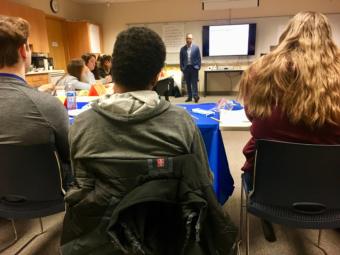
Andy Jones, director of the state of Alaska's office of substance misuse and addiction prevention, talked about the opioid epidemic with teens at a behavioral health camp in Juneau on Jan. 29, 2019. (Photo by Zoe Grueskin/KTOO)
Andy Jones, director of the state of Alaska’s Office of Substance Misuse and Addiction Prevention, talked about the opioid epidemic with teens at a behavioral health camp in Juneau on Jan. 29, 2019. (Photo by Zoe Grueskin/KTOO)

Murkowski reintroduces bill to prevent violence against Indigenous women and girls

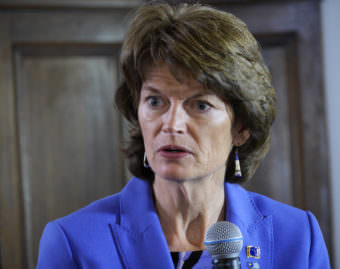
Sen. Lisa Murkowski speaks with reporters at a press availability following her annual address to the Alaska Legislature on Feb. 22, 2017. (Photo by Skip Gray/360 North)
U.S. Sen. Lisa Murkowski speaks with reporters at a press availability following her annual address to the Alaska Legislature on Feb. 22, 2017. (Photo by Skip Gray/360 North)

On Monday, Sen. Lisa Murkowski and a Democratic colleague, Catherine Cortez Masto of Nevada, reintroduced a bill aimed at preventing violence against Indigenous women and girls.

Named for a North Dakota woman killed in 2017, Savanna’s Act would improve data collection on missing and murdered Native women.

Murkowski said records are so limited, authorities don’t even understand the scope of the problem.

“And this is where it gets so frustrating,” she said. “We don’t even know what we don’t know with this. We don’t know if our statistics are right. We know that they’re bad, but we don’t know how bad.”

The bill would also increase tribal access to federal crime databases and require federal agencies to consult with tribes on reporting guidelines and other measures to protect Indigenous women and girls.

This is the second go-around for Savanna’s Act, originally introduced in October 2017 by former Sen. Heidi Heitkamp of North Dakota and co-sponsored by Murkowski.

In December 2018, the bill passed the Senate unanimously. But it was blocked in the House by a single lawmaker: Republican Rep. Bob Goodlatte of Virginia. As a result, the bill expired at the end of the year.

This time around, Murkowski is expecting a smoother road:

“To my knowledge, there is nobody that has a dug-in opposition. But you never can tell. You don’t want to assume anything,” she said.

Murkowski said she’s prepared to do the work to see the bill become law.

Alaska Public Media’s Liz Ruskin contributed to this report.

Juneau schools help food bank stay stocked after government shutdown

During the five-week partial government shutdown, Juneau food pantries served more people than usual and distributed thousands of pounds of food. At least two schools in Juneau are holding drives to replenish the stocks.

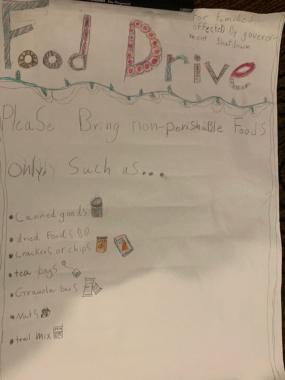
Students at Montessori Borealis made posters to advertise their food drive in Jan. 2019 to replenish the Southeast Alaska Food Bank, which saw increased demand during the partial government shutdown. (Photo courtesy of Callie Conerton)
Students at Montessori Borealis made posters to advertise their food drive in Jan. 2019 to replenish the Southeast Alaska Food Bank, which saw increased demand during the partial federal government shutdown. (Photo courtesy of Callie Conerton)

Maraiya Savland, office assistant at Mendenhall River Community School, said at first they focused on ways to directly support students at the elementary school whose parents work for the federal government.

“But then we also knew that the food bank was opening up to help those families as well,” she said. And they recognized that people in Juneau still need help, even with a short-term funding deal in place through Feb. 15.

So on Monday — the first day many furloughed employees went back to work — they started a food drive, with collection boxes in front of every classroom and one in the front office. At the end of the week, everything will be donated to the Southeast Alaska Food Bank at the end of the week.

Savland said anyone from the community is welcome to stop by the school’s front office with food donations. A similar drive is also taking place at Montessori Borealis.

Darren Adams is the manager of the food bank. He saw a greater demand for the food bank’s services throughout the shutdown — but also for more help from the community.

“People have been coming out of the woodwork, whether it’s donating a couple cans of soup or a whole shopping cart full of food,” he said. “I’m constantly amazed by the generosity of people.”

Adams has opened the food bank specifically to federal workers during special hours the last two weeks. He said about 100 people visited on the first afternoon, taking home around 2,800 pounds of food. Only about a dozen federal workers stopped by during special hours this week, but Adams said the need is still there.

The food bank will continue opening to federal workers each Monday afternoon until a long-term funding deal is reached. The hours will be shared on the food bank’s Facebook page.

Amid uncertainty, Juneau schools still supporting families hurt by shutdown

Juneau School Board member Emil Mackey congratulates Bridget Weiss for being selected interim superintendent of the Juneau School District on Monday, Aug. 6, 2018.
Juneau School District Superintendent Bridget Weiss on Monday, Aug. 6, 2018, when she was named interim superintendent. (Photo by Jeremy Hsieh/KTOO)

During the five-week government shutdown, the Juneau School District saw an increase in families applying for free or reduced-price school meals.
According to the district’s food services program, 17 families affected by the shutdown are now receiving meal benefits.

Superintendent Bridget Weiss said last week’s deal to reopen government does not mean those benefits will disappear immediately.

“It sounds like there may be at least a short-term solution for federal employees, but we also recognize that it may take time for those families to readjust financially,” said Weiss.

Congressional leaders and President Donald Trump agreed to reopen the government on Friday with a three-week funding measure, as negotiations over border wall funding continued. If no subsequent agreement is reached, another shutdown would begin after Feb. 15.

Weiss said the district recognizes there’s still uncertainty for federal workers about when they’ll be paid, and they could be back in the same position next month.

“We are looking at this a little longer-term and are open to supporting families as we move through the next few months,” she said.

Support goes beyond school meals, she said. Families can also get help with things like activity fees and school supplies.

She encourages families having a hard time for any reason, at any time in the school year, to talk to their children’s teachers, principals or district staff about available resources.

‘All hands on deck’ to help Coast Guard members during shutdown

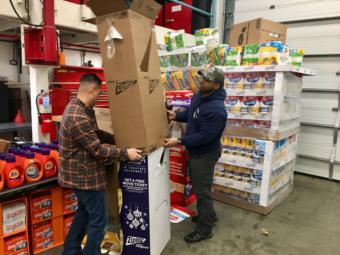
Quy Nguyen (left) and Mahire A'Giza unpack donations at the consumables pantry on Jan. 22, 2019. (Photo by Zoe Grueskin/KTOO)
Quy Nguyen (left) and Mahire A’Giza unpack donations at the consumables pantry on Jan. 22, 2019. (Photo by Zoe Grueskin/KTOO)

Update (Jan. 30, 4:40 p.m.)

Wednesday, Jan. 30, is the final day the Coast Guard’s consumables pantry in Juneau will be open. It will likely re-open in the event of another shutdown after Feb. 15.

Original story

The Coast Guard is the only branch of the U.S. military not receiving pay during the partial government shutdown. A new pantry for household supplies has popped up in Juneau to help service members make ends meet until their next paycheck.

The boat bay at U.S. Coast Guard Station Juneau looks like a small auto shop. Same high ceilings, same polished concrete floor. But there are no cars inside — or boats.

Instead, there’s a towering pile of paper towels, tables loaded with diapers and dog food, and about a dozen men and women in dark blue uniforms or Coast Guard hoodies, hauling boxes and arranging goods.

“It’s kind of all hands on deck here,” said Quy Nguyen.

Nguyen is the Coast Guard’s property officer for all of Alaska, Coast Guard District 17. He’s also the president of the Juneau chapter of the U.S. Coast Guard Chief Petty Officers Association, a nonprofit that supports Coast Guard families.

Right now, Nguyen said, a lot of Coast Guard families are hurting because of the shutdown. The Department of Defense is fully funded through this September, but the Coast Guard falls under a different department: Homeland Security. Most Coast Guard civilian employees are on furlough, and active duty members are working without pay. They received their last paychecks on Dec. 31.

Nguyen’s organization recognized that Juneau already has plenty of food pantries.

“And we thought, ‘What else could we help members with?’ And we came up with consumable items,” said Nguyen, which he explained means “day-to-day use items” like laundry detergent, Ziploc bags and toiletries.

Coast Guard members unpack donations to the consumables pantry on Jan. 22, 2019. (Photo by Zoe Grueskin/KTOO)

So the boat bay became a pop-up consumables pantry. Donations have come from Fred Meyers and Rainbow Foods, and Nguyen is hoping for more. In addition, financial donations will help them buy specific items requested by service members.

Earlier this week, the Coast Guard’s top official, Adm. Karl Schultz, released a video on Facebook. In it, he thanks his “shipmates” for their continued service. But, he said, members of the armed forces “should not be expected to shoulder this burden.”

“I remain heartened by assistance available to you within the lifelines and by the outpouring of support from local communities across the nation. But ultimately, I find it unacceptable that Coast Guard men and women have to rely on food pantries and donations to get through day-to-day life as service members,” he said in the video.

Nguyen’s organization shared the video on their Facebook page. They may agree it’s unacceptable, but still they see the need in Juneau. So for as long as they have anything to give, and as long as the government stays closed, the pantry will be open.

The consumables pantry will be open at Coast Guard Station Juneau on Mondays, Wednesdays and Fridays from 3-5 p.m. for all active duty military and their dependents, Coast Guard civilian employees, and Coast Guard retirees.

The pantry is focusing on household supplies, but food has also been donated, including leftover Christmas candy from Fred Meyers on Jan. 22, 2019. (Photo by Zoe Grueskin/KTOO)
The pantry is focusing on household supplies, but food has also been donated, including leftover Christmas candy from Fred Meyers. Jan. 22, 2019. (Photo by Zoe Grueskin/KTOO)

Online ‘trolls’ spark support for Juneau’s furloughed federal workers

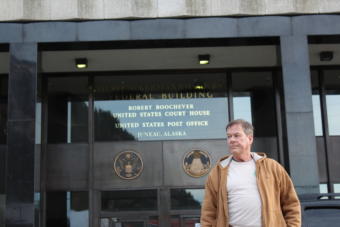
Eric Adam, a U.S. Forest Service employee, stands outside the federal building in Juneau where he works, on Jan. 19, 2019. He has been on furlough since the partial federal government shutdown began on Dec. 22, 2018. (Photo by Zoe Grueskin/KTOO)

From the outside it might look nice to be a furloughed federal employee, but the longest government shutdown in U.S. history isn’t a vacation. Many federal workers are having a hard time paying bills. In addition, they’ve been taking heat online from people who don’t understand.

“Well at first I was just hoping it would be over soon, so I was just cleaning house and visiting friends. But then money started getting a little short,” said U.S. Forest Service employee Eric Adam.

Adam is an Air Force veteran and has worked for the federal government for over 20 years. For the last three years, he’s been with the Forest Service in Juneau.

He’s an administrator, supporting the agency’s work in many ways.

“You do all kinds of things. Could be anything from changing a cartridge in the copy machine or, I know it just sounds mundane, but there’s really a lot of work that needs to be done to make sure things go on schedule. Because if they don’t it costs money.”

Except now, everything’s off schedule. Adam works in the federal building with about 90 other Forest Service employees — and nearly all of them have had to stay home since the shutdown began.

Adam said the shutdown is already hurting federal workers. He’s had to make partial payments on his rent and electric bill, and the worst part for him: He wasn’t able to make his child support payment this month. That comes out of his paycheck automatically, but his last paycheck didn’t come at all.

He said his situation is not unique.

“Everyone is going through the same thing, only their own situations aren’t being taken care of,” Adam said. “You know, it could be their pets, it could be whatever. Their children, their grandchildren, a sick parent.”

Adam said he’s received some support from friends and others in Juneau, but he’s also heard a lot of criticism directed toward federal workers who’ve spoken out about what they’re dealing with.

“You know, ‘They’re whiners and they’re all on paid vacation,'” Adam said, naming an example of what he’s heard. “And that just irked me so much. We’re real people, and we’re not just a bunch of whiners, either. We’re here to serve them, you know, the folks who have the wrong impression of us. We’re here to serve them as well.”

Adam isn’t the only one who’s been bothered by the negativity. Bunti Reed was at a church potluck when friends told her about a Facebook post they’d seen, written by a federal worker.

“Somebody had posted a thank you to somebody that had bought them a cup of coffee, and they just were being appreciative of it. And instead of that standing, it sort of went, ‘You should have saved money, blah blah blah.’ Just this awful, judgmental group of trolls that started coming in and saying terrible things,” said Reed.

With her family the next morning, an idea was born over eggs and ham for a fundraiser breakfast.

Reed called her pastor at Aldersgate United Methodist Church about using the space, and the rest fell into place. All the food and supplies were donated.

Reed estimates about 40 people showed up last Saturday to volunteer at the fundraiser, and almost 100 came to eat. They raised over $2,500. Reed wants to distribute that money to as many federal workers as possible, although she said they’re still sorting out the logistics.

Adam, who volunteered at the event, said he appreciates the support.

“I tell you what, we federal employees are so grateful for the community’s help to us right now,” he said, “and I guarantee they’ll get it a hundredfold back.”

The way they’ll give back, Adam said, is by doing their jobs.

“We want to start up again, man, we’re just wanting to go. You know? I’m tired of this. I want to go to work,” he said.

Juneau Economic Development Council estimates there are around 670 federal workers in Juneau, not counting the Coast Guard. Altogether, the wages they missed out on last payday total about $2.3 million. If the shutdown continues through this Friday, they’ll miss that much again.

A community event to share resources available to furloughed federal workers is planned for Friday, Jan. 25, from 4-6 p.m. at the Juneau Arts & Culture Center.

Site notifications
Update notification options
Subscribe to notifications