Zoe Grueskin, KTOO

Newscast – Monday, Feb. 25, 2019

In this newscast:

  • State senators are pushing back against Gov. Dunleavy’s plan to eliminate a fund that’s intended to equalize the cost of supplying power to rural Alaska.
  • A legislative attorney says language in Gov. Dunleavy’s budget proposal giving his budget office discretion to transfer money within departments raises legal and constitutional questions.
  • Gov. Dunleavy rescinded seven administrative orders last week enacted by his predecessor, Bill Walker. They include an order that halted state spending on six infrastructure projects.
  • Clean up work is underway this week, nearly two months after a landslide closed a road near Thorne Bay on Prince of Wales Island.
  • High school students from around Alaska came to Juneau this month to see for themselves how state government works.
  • A bill pending before the Alaska Legislature would allow the state’s ski areas to serve alcohol.

High school students get a close look at state government during a busy week

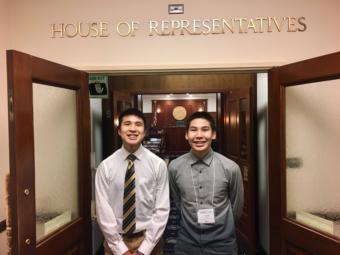
Cameron Mickia Kendrick Andrew (left) and Jacob Michael Andrew in front of House chambers on Feb. 13, 2019. (Photo by Zoe Grueskin/KTOO)
Cameron Mickia Kendrick Andrew (left) and Jacob Michael Andrew in front of the Alaska House of Representatives chambers on Feb. 13, 2019. (Photo by Zoe Grueskin/KTOO)

High school students from across Alaska were at the Capitol this month to see for themselves how state government works. As it turned out, they were there at an especially busy time.
Cameron Mickia Kendrick Andrew said from what he’s seen, it’s usually pretty quiet up at the Capitol.

“We, like, barely see anybody walking around. They’re probably in, like, rooms or something,” he said.

But this day was different. Cameron said the halls of the state Capitol building were uncommonly busy. And outside was another unusual sight.

“There was people outside the Capitol, like, holding up signs. Like, whoa, that’s different,” Cameron said. He read the signs and knew it had something to do with education.

That busy day was Feb. 13 — the day Gov. Michael Dunleavy released his plan for the next state budget. Among its proposals was a more than 40 percent cut to the University of Alaska system — the reason for the rally on the Capitol steps.

But mostly, Cameron was focused on other things that week. The 18-year-old high school senior from New Stuyahok was part of a program called Alaska Close Up that brings students from around the state to the capital city to learn about state government. The group toured state buildings, met lawmakers and studied real bills.

A few students, including Cameron, got an even closer look at the legislative process, spending the week as interns for state senators or representatives.

They were assigned typical intern stuff: make copies, send emails…

“Write down the schedule and go to different meetings that I can attend to, like, take notes,” said Cameron.

Cameron was placed with his district’s representative, House Speaker Bryce Edgmon. Cameron said he mostly worked with staffers, but he and another intern did get to meet the representative. Cameron said they bonded over a shared interest in basketball.

That other intern was Cameron’s cousin, Jacob Michael Andrew, a 16-year-old also from New Stuyahok. He interned with Rep. Tiffany Zulkosky, who represents the Bethel area.

Jacob said he thought being an intern would be hard, but it’s actually pretty fun. He especially liked working with his short-term colleagues in the representative’s office.

“They’re always having fun,” Jacob said. “Won’t be bored with them.”

And those staffers soon had plenty to save them from potential boredom: After 31 days of deadlock, the House elected a speaker the very next day. Rep. Zulkosky is serving in the House majority, and Cameron’s host, Rep. Edgmon, was voted speaker of the House.

‘The community spirit keeps us warm’: Exchange students from Muslim countries feel welcome in Juneau, Sitka

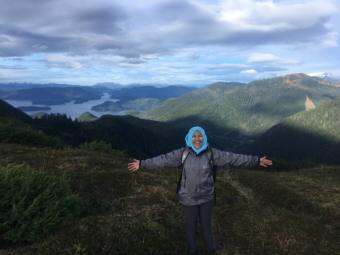
Nisreen Jehka on a hike in Sitka. She says she doesn't hike at home in Thailand, because of snakes, but she loves hiking in Alaska. (Photo used with permission)
Nisreen Jehka on a hike in Sitka. She says she doesn’t hike at home in Thailand because of snakes, but she loves hiking in Alaska. (Photo used with permission)

For the past eight years, families in Juneau and Sitka have opened their homes to high school students on exchange from countries with a significant Muslim population. Volunteers with the program say it’s more relevant than ever.
Zain Mufti was half-asleep, at home in Pakistan, when he looked at his phone. What he saw was an email telling him he would spend the next school year abroad — in Alaska.

“I thought it was a dream,” he said. “And the next morning I wake up, I look at my phone like, oh my god, I am going to Alaska. It was a very big shock.”

Mufti had been accepted to the Kennedy-Lugar Youth Exchange and Study (YES) Program, which brings students to the U.S. from countries with a large Muslim population. The students are matched with a host family and attend local schools for one year. Funded by the State Department, it works the other way too, sending American students abroad to dozens of countries in the Middle East, Africa, Asia and Eastern Europe.

This year, the program brought two students to Juneau and four more to Sitka, coordinated by AFS, a nonprofit that connects students to study abroad opportunities.

Krisanne Rice is a volunteer in Sitka with AFS. She said it was started in the wake of 9/11 as a way to build relationships on a personal level between the U.S. and Muslim countries.

“We have an opportunity to, through this exchange program, meet young people and learn directly firsthand from them what their faith is about, and what their lives and culture are about,” she said.

And the students get to learn firsthand what life is like here in Alaska.

Mohan Raj Arul is from Chennai, a city of 9 million on India’s eastern coast. Back home, temperatures dip into the 70s only in the coldest months. When interviewers asked Arul where he’d like to be placed, he suggested Florida.

But after a few weeks of wearing his coat at all times, indoors and out, Arul said he quickly took a liking to life in Sitka. He got used to everyone in town knowing his name, and he’s had plenty of firsts: first time seeing snow, first time skiing and camping.

He’s especially enjoyed going fishing with his host family. In India, he said, that’s a luxury for the rich.

On the boat, his host dad gave him a quick lesson.

“He taught me like twice, thrice I guess, and then after that I started, like, picking up fishes, and he was kind of jealous for the first time because I got the biggest size of the halibut, like, none of the family members got,” Arul said.

Mohan Raj Arul shows off the halibut he caught while fishing with his host family. (Photo used with permission)

Rice said students in the program haven’t always had an easy time. She knows that over the years some have faced anti-Muslim insults. But she thinks the program is accomplishing its goal of building goodwill and understanding, even with a shifting political climate:

“In 2019 it’s more important than ever, based on our own political realities in our country and what we hear from our friends, neighbors and leaders,” Rice said.

This year’s students say they’ve been embraced by the communities. That’s not to say it hasn’t been challenging: They’re far from home, speaking a second language and pushing themselves out of their comfort zone everyday. And, of course, there’s the cold.

But Yulvie Nuri from Bulgaria said, “It’s the community spirit that keeps us warm.”

Her classmate at Sitka High School, Amra Kojic from Bosnia-Herzegovina, said she’s happy to be here.

“I think for me it’s the best decision that I’ve ever made in my life, because you meet so many people, you see so many things. You become more independent,” she said.

Kojic and the other students said they’ve learned a lot about themselves this year. Some have even discovered new interests.

Nisreen Jehka said back home in Thailand, art class meant learning from a book. That didn’t appeal much to her, but at Sitka High School she’s learned she loves to draw and paint.

Mufti already knew he liked theater when he arrived in Juneau, but he said he never thought he could sing.

“It turns out I can, and I’m in a play, so boom, I’m one of the leads,” he said, referring to his role in Juneau-Douglas High School: Yadaa.at Kalé’s recent production of “Bye Bye Birdie.”

More than halfway through the school year, Mufti said he’s trying to make the most of every moment.

“It’s only 10 months, and it goes like a snap like a finger,” he said.

Rice said right now the program is looking for families in Juneau and Sitka to host next year’s exchange students.

For more information, interested families in Juneau should contact Amelia Jenkins at 907-321-2694 or afsjuneau@outlook.com. In Sitka, call Julia Smith at 907-747-6333.

How Alaska school districts planned to spend that $20 million


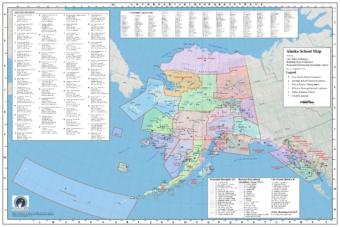
Explore the table below or the map above to see the amount of one-time funding each school district expected to receive and how some planned to use the $20 million that could be cut from a supplemental budget.
[toggles style=”default”][toggle color=”Default” title=”Click to expand — Table: How Alaska school districts planned to spend $20 million”]
School District Amount* Plans
Anchorage School District $5,772,609
Matanuska-Susitna Borough School District $2,619,784
Fairbanks North Star Borough School District $2,016,261
Equivalent to 18 teachers’ salaries. The district will honor those contracts and pull from reserves if necessary.
Kenai Peninsula Borough School District $1,405,152
Lower Kuskokwim School District $1,056,175
Equivalent to 10 certified teaching positions, with benefits.
Juneau Borough School District $671,008
Designated for deferred maintenance and infrastructure projects. Local funding is tied to state funding; a reduction in state funding would result in reduced local funding.
Lower Yukon School District $563,553
Bering Strait School District $557,468
Northwest Arctic Borough School District $547,548
Designated for deferred maintenance and infrastructure projects. Local funding is tied to state funding; a reduction in state funding would result in reduced local funding.
North Slope Borough School District $456,526
Reserved for unexpected, one-time expenditures, such as losing a boiler in teacher housing.
Kodiak Island Borough School District $399,023
Reserved for unexpected, one-time expenditures, such as losing a boiler in teacher housing.
Ketchikan Gateway Borough School District $387,274
Galena City School District $322,539
Yukon-Koyukuk School District $215,425
Funds would help offset increased health care costs.
Sitka School District $212,318
District expected to receive $187,000 based on lower than expected actual enrollment. Funds were to be used for two teaching positions. District does not have sufficient funds in the general fund balance to cover the proposed loss. If cut approved, district will make significant cuts to programming, likely impose a spending freeze at all schools.
Southwest Region School District $178,283
Delta/Greely School District $133,595
Yupiit School District $128,114
Lake & Peninsula Borough School District $127,035
Funds planned for construction fund, which has a negative balance. Superintendent Ty Mase: “We have carpets peeling up, roofs leaking and doors that are rusted through” in need of repair.
Nome Public Schools $122,937
Alaska Gateway School District $117,311
Part was designated for an elementary school reading teacher’s salary, part to transition a principal/teacher to a full-time principal. If cut approved, district would cut majority of summer maintenance like heating system upkeep, painting, deep cleaning.
Valdez City School District $116,492
Planned to fund a teaching position.
Nenana City School District $115,245
Kuspuk School District $113,797
Denali Borough School District $108,388
Yukon Flats School District $101,865
Dillingham City School District $95,372
Funds planned for professional development and student support through trauma-informed practice and counseling services.
Petersburg Borough School District $95,225
Iditarod Area School District $88,989
Copper River School District $88,430
Unalaska City School District $80,644
Funds factored into district’s decision to hire two additional teachers for the 2018-2019 school year.
Kashunamiut School District $79,650
Southeast Island School District $77,127
Aleutians East Borough School District $74,796
Annette Island School District $68,611
Cordova City School District $66,742
Craig City School District $65,632
Funds would support increased costs of staff, insurance, heat and supplies.
Wrangell Public School District $58,143
Mount Edgecumbe $56,252
Chatham School District $50,688
Saint Mary’s School District $46,261
Chugach School District $45,747
Funds would go toward increased teacher salaries and increased costs of health insurance, fuel and energy.
Haines Borough School District $44,272 Would have gone to personnel.
Klawock City School District $36,177
Hoonah City School District $33,898
Kake City School District $32,047
Bristol Bay Borough School District $26,860
Hydaburg City School District $25,326
Skagway School District $21,627
Pribilof School District $21,571
Aleutian Region School District $16,946
Yakutat School District $15,333
Funds would go to a STEM summer camp. If cut approved, camp may be canceled.
Tanana City School District $14,303
Planned to pay a part-time tutor’s wages.
Pelican City School District $7,606
Funds would support salaries and facility operation.

* May 2018 estimates by the Department of Education & Early Development[/toggle][/toggles]In May 2018 the Alaska Legislature approved a one-time grant of $20 million for Alaska’s public schools. The state divvied the money up between each of the 53 school districts, plus Mt. Edgecumbe High School. Districts expected to receive their share this spring, after student enrollment counts were finalized.

That money would have come on top of the regular funding formula that provides school districts with state funding. That formula, the Base Student Allocation, has seen modest increases over the last decade but has not been raised at all for the past three years.

But, when you account for inflation, flat-funding education “ultimately is a reduction in funding” — a budget cut — to schools. That’s according to Chris Reitan, superintendent of the Craig City School District. And there are lot of other superintendents in the state who agree with him.

Reitan’s district is among the smallest in the state, with three schools and a correspondence school on Prince of Wales Island. He said his district’s  share of the $20 million would have gone toward covering rising costs of supplies, heat and utilities, as well as increased staff costs.

“Would have gone” because on Jan. 28, Gov. Dunleavy’s administration proposed eliminating that $20 million as part of his supplemental budget requests.

The proposal came as a surprise to Sen. Gary Stevens, chair of the Senate Education Committee, who noted the one-time funding was “hard fought” last year, and making the cut now, halfway through the school year, would create a hardship for many school districts. He said wants to look forward, not back.

“We’ve got to face an issue of less funding than we need in the future,” Stevens said. “But let’s the look at the future, not the past budgets.”KTOO’s Zoe Grueskin spoke with Alaska Public Media’s Abbey Collins about this story:

It also surprised superintendents across the state, who were not consulted about the proposal. Superintendents like Scott MacManus of Alaska Gateway School District were already planning for the money. His district, which is based in Tok and covers 28,000 square miles from the Alaska Range to the Yukon River and Canadian border, was estimated to receive $117,311. With that expectation, the district hired an elementary school reading teacher and transitioned a staff member who did double duty as teacher and principal to a full-time principal.

MacManus, like many other superintendents, felt assured by the Legislature that the funding would arrive. “We were told what we could count on,” he said.

Alaska’s 53 school districts planned to use the one-time funds in a variety of ways. Some districts, like the Juneau School District and the Lake & Peninsula Borough School District, intended to use the money for maintenance and construction. Lake & Peninsula superintendent Ty Mase said, “We have carpets peeling up, roofs leaking and doors that are rusted through that are all in need of repair.”

A map showing the boundaries between every school district in Alaska.
A map showing the boundaries between every school district in Alaska. (Map courtesy Alaska Department of Education and Early Development)

Other districts planned to fund special programs. The Dillingham School District planned to support trauma-informed counseling and training for staff. And plans are already way for a summer STEM camp at the Yakutat School District, where superintendent Patrick Mayer says “additional opportunities are scant” for hands-on science learning.

Some districts, like Unalaska, Sitka, and Delta/Greely, used the assurance of funding to raise teachers’ salaries or hire new staff. School districts are bound by law to fulfill their contracts with staff for the remainder of the school year, so if the cut is approved, they will need to find other ways to make up the loss this year.

Most school districts have enough money in their general fund balance to cover the loss, although they are limited in how much they can reserve for unexpected costs. Many superintendents are more concerned about what this proposal heralds for the future.

“We can sustain that for the coming year, but remember, we have nowhere else to turn,” said Delta/Greely superintendent Laural Jackson.

The Sitka School District does not have sufficient savings to cover the amount it would lose if the proposal is approved. Superintendent Mary Wegner said instead the school district would have to make “significant adjustments” for the rest of the school year. That might include freezing all funding to schools and departments, meaning “no field trips, no paper,” she said.

She also said sometimes the district can save as much as $20,000 on heating costs if it’s a warm winter, “but we are not going to save enough to cover a $187,000 deficit.”

Many superintendents said it will be easier for large school districts to weather the cut, if approved, because they tend to have more funds reserved.

Pelican School District, which operates a single school in Southeast Alaska, expected to receive $7,606 from the one-time funding, the smallest amount to any district.

“Because we are so small, every penny is vital to our continued operation,” said superintendent Norma Holmgaard.

KNOM’s Katie Kazmierski, KTOO and Alaska Public Media’s Andrew Kitchenman, KUCB’s Laura Kraegel and KHNS’s Claire Stremple contributed reporting to this story.

Falcon or Crimson Bear? Despite shrinking enrollment, Juneau students can pick between two high schools.

Thunder Mountain High School (left) and Juneau-Douglas High School: Yadaa.at Kalé. (KTOO file photos)

In most cities big enough to have two or more high schools, you go to the one that’s closest — and you don’t get a say in it. But in Juneau, incoming freshmen get to choose between the town’s two main high schools: Juneau-Douglas High School: Yadaa.at Kalé and Thunder Mountain High School. But with a shrinking population, some people question whether there should be two high schools at all.

JDHS has an auto shop and the only high school hockey team in town.

Russian is only offered at Thunder Mountain. And it has a rifle team.

These are all reasons a student might pick one school over the other, said JDHS Principal Paula Casperson. It’s a big choice, and she thinks students take that seriously.

“Students are rising to some of the challenge of really taking some ownership of their academic paths, of their areas of interest, of the high school student they want to be,” said Casperson.

Casperson has worked at the high school for 22 years — since well before the newer school, Thunder Mountain, opened in 2008. Today, JDHS is a modest-sized high school with just under 600 students, but Casperson remembers the days when they had almost three times that many. Some classes were held in a neighboring building, but even so, hallways were crowded, and there were concerns about students falling through the cracks.

Casperson said being a smaller school has allowed JDHS to be more personal.

“I think there is a real emphasis on relationship and connectedness,” she said. “And when you’re one student of 600, it’s far harder to be lost in the school day.”

But a high school of 600 is never what the Juneau School District had in mind.

Mary Becker was president of the Juneau School Board in the early 2000s, when plans got underway for a second comprehensive high school. She says back in the early 2000s, when plans got underway for a second high school, the district believed Juneau’s population was growing. They’d hired a consultant who predicted that by 2005, Juneau would be home to 2,127 high school students — far more than could fit in the existing school.

With that expectation, the city voted to build a second high school in the Mendenhall Valley. That’s Thunder Mountain. That happened. But the population growth never did.

Kurt Dzinich Jr. in his classroom at Juneau-Douglas High School: Yadaa.at Kalé on Jan. 31, 2019. (Photo by Zoe Grueskin/KTOO)

“We were peaked out, and then ever since, the numbers have gone down. Every single year,” said Kurt Dzinich Jr.

Dzinich has taught history at JDHS since before the second high school was built. He’s been a vocal critic of the split and hopes to see the district re-merge JDHS and Thunder Mountain into a single high school.

Mostly, he’s concerned that dividing the schools’ resources has limited opportunities for students. He said the small staffs at each school have to focus on teaching courses that are required for graduation. Electives have disappeared.

“We have a huge offering in our course catalog. The course catalog looks quite impressive on paper, but that’s not something that we can offer up on a consistent basis,” he said.

So in a given school year, a lot of those courses aren’t taught, said Dzinich. Or they’re offered so infrequently that students can’t fit them into their schedules.

But not everyone agrees that splitting the high schools is to blame for lost classes. Or at least, some say it’s not the main culprit.

Rylee Rosson (right) and her parents at the Thunder Mountain High School information night on Jan. 23, 2019. Rosson said she's an arts and music person and might choose her high school for its theater program. (Photo by Zoe Grueskin/KTOO)
Rylee Rosson (right) and her parents at the Thunder Mountain High School information night on Jan. 23, 2019. Rosson said she’s an arts and music person and might choose her high school for its theater program. (Photo by Zoe Grueskin/KTOO)

Carol May teaches math. She was one of the original teachers to move from JDHS to Thunder Mountain back in 2008. She said if the schools were to re-combine, they could probably offer a few more things.

But, she said, “The main reason that we have lost electives is because of the state budget cuts. We have been cutting and cutting and cutting, and there’s really nothing left to cut, except for electives.”

May has been pretty happy having two smaller high schools. She knows more of the students in the hallways, and she said she sees more of them getting involved in activities.

Currently, the school district counts 702 students at Thunder Mountain and 590 at JDHS. District Chief of Staff Kristin Bartlett said together that’s more than could fit into either high school. In addition, 95 students are enrolled at Yaakoosge Daakahidi, the alternative high school. Right now, the district is committed to the system in place of two comprehensive high schools and a smaller alternative high school.

There is no magic number, no enrollment threshold, that would trigger immediate changes.

So for now, it’s still up to Juneau’s eighth-graders to decide: Am I a Falcon, or a Crimson Bear?

Eighth-graders in Juneau who submitted their high school choice to the district by Feb. 8 are guaranteed their chosen school — between JDHS and Thunder Mountain. Students interested in attending the alternative high school must apply directly.

How Alaska schools can help students dealing with trauma

Alaska artist Kristin Link illustrated the Alaska Dept. of Education & Early Development's framework for helping students deal with trauma, released Jan. 28, 2019. (Illustration by Kristin Link, used with permission)
One recommendation from the Alaska Dept. of Education & Early Development’s framework for helping students deal with trauma, released in Jan. 2019, suggests transforming the physical space of a classroom to “promote a sense of emotional and physical safety.” (Illustration by Kristin Link, used with permission)

In January, the state put out a new resource designed to help schools support students who have experienced trauma. “Transforming Schools” recommends practices such as embracing culture in the classroom and teaching students how to calm themselves down when they get upset.

Educators are hoping the resource can help schools can do a better job meeting the needs of Alaskan students.

Two out of three Alaskan adults have experienced childhood trauma. That’s according to the Alaska Division of Public Health. And trauma can get in the way of learning.

“A student can’t walk through the door and forget everything that happened to him before he walked through that door, whether he didn’t have breakfast, mom and dad were fighting, different things like that,” said Sharon Fishel, education specialist at the Alaska Department of Education & Early Development.

Fishel said thinking about trauma in schools is not new in Alaska: “Everybody wanted to do trauma-informed, trauma-sensitive, trauma-engaged schools, but they were all recreating the wheel.”

So, with the Association of Alaska School Boards and half a dozen other partners, Fishel’s department set out to create the wheel: a way that schools can help children who have experienced major life stressors or traumatic events. That includes what students experience firsthand, as well as the ongoing impacts of historic events, like the way colonialism worked through the educational system in Alaska. Damage is still unfolding from practices that include the forced removal of Alaska Native children from their homes, the boarding school system and oppression of Alaska Native languages and culture.

Today, Fishel said engaging with trauma in schools is about shifting the mindset from “what’s wrong with you?” to “what’s happened to you?”

Alaska artist Kristin Link illustrated the Alaska Dept. of Education & Early Development's framework for helping students deal with trauma, released Jan. 28, 2019. (Illustration by Kristin Link, used with permission)
Teaching students respect for the land as a cultural value is one suggestion in the Alaska Dept. of Education & Early Development’s framework for addressing trauma in schools, released in Jan. 2019. (Illustration by Kristin Link, used with permission)

The new resource contains eleven chapters full of stories and best practices, created with input from over 200 teachers, counselors, and community members across the state. Fishel said schools can pick and choose and use them in any order — but there is a logic to starting at the beginning: The first chapter explores the brain science of trauma, drawing on research that shows extreme stress can actually disrupt healthy brain development.

Catherine Mendenhall said she can see that in her classroom. She’s been a teacher in Alaska for 18 years, both on and off the road system.

Mendenhall said schools set lofty goals for their students — and face pressure to meet them — but emotional needs have to come first.

“If we’re wanting students to learn math and science and how to read, and they are stuck in fight-or-flight mode, they’re not going to be able to use all of their mind to learn, because so much of it is tied up in wondering whether they’re safe,” Mendenhall said.

The new state resource emphasizes a team approach to helping students deal with trauma.

Mendenhall said this is already working at her school. Parents, teachers, specialists — even the school principal is involved.

But for a lot of schools, building teams to address students’ emotional needs will mean hiring more people or asking staff to do more with less. And without a major priority shift, Mendenhall is not optimistic about the future of school funding in Alaska. She said we’ll get what we pay for.

“Unless we have more mental health help, more counselors, more people who are  experienced in helping these students through their trauma, schools are not going to succeed, because the students aren’t gonna be able to do the tasks we expect them to do,” Mendenhall said.

Last week, Gov. Michael Dunleavy’s administration proposed doing away with $20 million of public school funding that the Alaska Legislature had agreed to in the last budget. His plan for the state’s next budget — and any future changes to education spending — will be released Feb. 13.

The framework for addressing trauma in schools released by the Alaska Dept. of Education & Early Development in Jan. 2019 emphasizes positive relationship-building as a way to counter the negative impacts of childhood trauma. (Illustration by Kristin Link, used with permission)
Site notifications
Update notification options
Subscribe to notifications