Zoe Grueskin, KTOO

Facing declining enrollment, Harborview could lose a teacher next school year

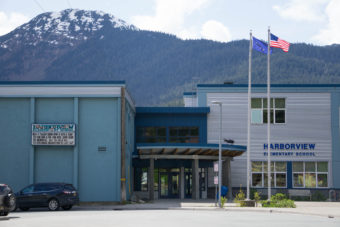
Harborview Elementary School
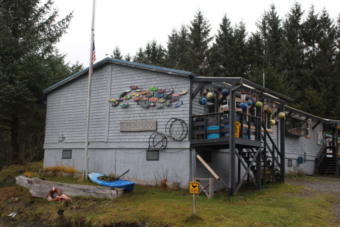
Harborview Elementary School in Juneau. (Photo by Jeremy Hsieh/KTOO)

Harborview Elementary School will lose one teacher position next school year. That’s because the Juneau School District is predicting a small drop in enrollment.

Principal Tom McKenna said this is continuation of a trend. Last year, with fewer students to serve, the school reduced its teaching staff from 12 to 10, not counting teachers in the Tlingit Culture, Language, and Literacy Program.

McKenna said the school will make things work next school year with nine teachers.

“But the impact is, I think, more intense as we get smaller,” he said. “So a shift in staffing, if you’re a large school, you can absorb that shift in more ways than you can if you’re a small school.”

For Harborview, that shift will likely mean more combined-grade classrooms and class sizes of up to 30 students — or even more for some grades.

The district allocates teachers to each school based on an ideal student-to-teacher ratio. McKenna said the city has worked hard to keep that ratio low, but it has crept up under budget pressure.

Harborview Elementary School principal Tom McKenna in his office on April 18, 2019. (Photo by Zoe Grueskin/KTOO)

“If you look over 10 years, we’ve been put under strain by even those small increases. So we’re small enough now that we’re really vulnerable because of the cumulative budget picture,” he said.

If more students than expected show up at Harborview in August, there is a chance the district would then add another teacher. That’s what happened this school year, and McKenna said it was a scramble: The Friday before school started, they still weren’t sure how many teachers they would have.

For now, McKenna said the school is preparing for both scenarios, drawing up multiple schedules and class configurations.

“Teachers would ideally love to spend the summer prepping, knowing what they’re teaching, but we have to do everything with the contingency that we might get that better allocation,” McKenna said.

McKenna said it is a huge help when families register their kids well in advance of the next school year. He especially encourages parents of incoming Kindergartners to contact their elementary school and enroll now for the fall.

Juneau high schoolers headed to world robotics championship

A high school robotics team from Juneau is competing in the world championship this month. It’s the first time a team from Southeast Alaska has made it so far in this event.

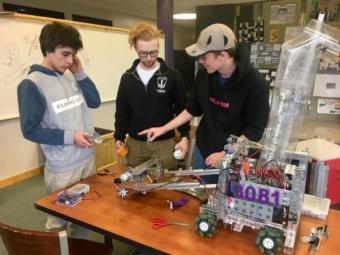
Thunder Mountain High School’s state champion robotics team lives up to its name: Trial and Error. At an after-school practice just a week out from the FIRST championship, they’re still tinkering.

Noatak Post is one of eight members of the team. He’s been doing robotics for over 10 years.

“We use a lot of duct tape to kind of try things out, and if that works, then maybe we’ll screw it down,” Post said. “Sometimes we don’t, but usually we try to screw it down.”

Noatak Post (left) and Teilhard Buzzell work on their robot at Thunder Mountain High School on April 9, 2019. (Photo by Zoe Grueskin/KTOO)

Robotics is a team sport. Together, students build the robots and write computer code to control their movements. They’re designed to accomplish specific mechanical tasks like climbing a ladder or, in this case, gathering up blocks and balls.

“Every year there’s a theme, and this year it’s kind of space travel,” explained Post. “(The blocks and balls) are supposed to be minerals that we’ve mined or something like that.”

The team has faced this challenge before, but since then they’ve completely changed the design of their robot. It now features a device they call “the popper” that scoops up blocks and balls and shoots them out a curved plastic tube into the point-scoring area.

Or, anyway, it’s supposed to. It’s not quite working at the moment.

In less than a week, the team heads to their robotics league’s world championship in Houston, where they’ll face off against teams from around the U.S. and dozens of other countries.

The fact that their robot isn’t exactly functional right now doesn’t worry Eli Douglas. He said they’ll probably be making changes right up until the event.

“We’ve done it just about every time we go to a competition,” he said. “So we’re somewhat confident it will work out.”

Douglas said his favorite part of doing robotics is having a shared project to work on with his friends.

“You know we’ll see each other in hall and talk about the robot. Like, oh, I was thinking about the robot. We should try this later. It’s definitely kept me up at night before, and I’m sure I could say the same for everyone else. Just thinking about different mechanisms that could work for different problems,” said Douglas.

Douglas and his teammates Noatak Post and Riley Sikes have been building robots together since they were all second graders at Auke Bay Elementary School. They estimate they’ve each spent around 300 hours building robots just this season.

(From left) Eli Douglas, Noatak Post and Riley Sikes at a Thunder Mountain High School robotics practice on April 9, 2019. The trio has been building robots together since second grade. (Photo by Zoe Grueskin/KTOO)

Now that they’re seniors, Post said they’re building better robots than ever. He credits that to a major shift in strategy. In the past, he said, they’ve often gotten hung up on one idea, not realizing it won’t work until it’s too late.

“And so, with that in mind, we kind of as a team agreed that if we were ever getting really kind of stuck with an idea, and it just didn’t seem to be working, we would scrap the whole thing, take apart the whole robot, spend a Saturday night taking it all apart and start from scratch. Just really emphasizing an engineering process and trying new things as often as we could,” said Post.

Amber Cunningham is an assistant coach for Thunder Mountain’s robotics teams. She said Trial and Error’s approach can be stressful for the coaches, but she admires it.

“It’s so hard to let go of something you’ve been working on, and their ability to do that and not let them stress out and just go, ‘Hey, you know what? This isn’t working, we’re going to start all over, let’s do something different,’ is just pretty amazing,” Cunningham said.

Post said robotics gives him a new perspective. And he loves the community.

“You come to these competitions where it’s, like, teams from either all over the region, the state, and now all over the world, and you’re gonna be able to see how they have approached the same challenge as you, probably in completely different ways, and it’s just really cool to see all the different ideas people come up with, and the camaraderie that comes from it and working on the robot together,” Post said.

By the end of practice, “the popper” still isn’t working right. But the team still has a whole week before the world championship. Plenty of time for Trial and Error.

Editor’s note: Trial and Error, from Juneau’s Thunder Mountain High School, is the first team from Southeast Alaska to compete in the world championship for FIRST Tech Challenge, a league for students in grades 7-12. Teams from Skagway have competed in previous world championships in the FIRST LEGO League, for students in grades 4-8.

Alaska’s rural schools could get a boost in internet speed

POW Hollis School is part of Southeast Island School District (Photo by Elizabeth Jenkins/Alaska's Energy Desk) 12/20/17
Hollis School is part of Southeast Island School District. (Photo by Elizabeth Jenkins/Alaska’s Energy Desk)

For the last five years, the state has helped Alaska schools pay for faster internet — up to a point. As technology has advanced, some say it’s time to raise the bar. A pair of bills before the Legislature would do just that.
Alaska faces a digital divide. Within the state, rural areas lag behind the larger cities when it comes to internet access.

That lag has a big impact on students. That’s according to Patience Frederiksen, director of the Alaska Division of Libraries, Archives and Museums, who oversees a program that helps school districts across the state pay for faster internet.

“It really enhances education for students, to have so much more stuff that they can offer through the internet that they can’t have locally, because their towns are so small,” said Frederiksen.

Faster internet means more opportunities for distance learning, online testing, and just surfing the web. In many parts of the state, smoothly-streaming audio and video is a luxury.

Since 2015, the state has made funding available to schools to get their internet up to a baseline speed, or bandwidth, of 10 megabits per second (mbps).

But Frederiksen said as technology has advanced, that baseline increasingly isn’t enough.

“What we see again and again is you put a certain amount of internet into a school or into a library, and they say, ‘Thank you very much.’ And within a few months or a year, they’re saying, ‘But we need more.’ And so it’s a moving target, and it’s a target that just keeps getting bigger and bigger for all of us,” she said.

As internet has expanded across the state, fewer and fewer schools have needed state assistance through the program.

But Frederiksen said it’s still a big help for remote, rural schools.

Lauren Burch sees that first hand. He’s the superintendent of the Southeast Island School District, which has fewer than 200 students across nine schools in Southeast Alaska.

“I have a bunch of schools that are roughly 10, 12, 15 students, and with one teacher or maybe two. But you know, one teacher doesn’t know everything,” he said.

At those schools, Burch said, students take many upper-level classes online, through video conference.

Burch is concerned about the future of state support for internet in schools. Several sites in his district are hovering around 10 students. That’s the cutoff point for much of the state funding schools receive.

He said anything that makes it harder to serve students frustrates parents. On the edge like that, he worries about all of it — including falling behind in technology. He’s seen families leave the school district to seek better educational opportunities for their kids. And that, he said, can set off a devastating cascade.

“If the school closes, you know you can have a community of two or three hundred, and within a few years it’s down to 30, 40 people. I’ve closed two schools, Edna Bay and Port Protection, and they’ve dwindled down to, you know, to not much,” Burch said.

Gov. Mike Dunleavy’s proposed 2020 budget would reduce funding for the program to $1,487,500.

That’s actually enough to support all the mostly remote, rural schools that still need help meeting the 10-mbps baseline.

But there is a bill with versions in both the House and Senate that would raise the baseline and help school districts pay for more than twice as much bandwidth, up to 25 mbps. That would make the program useful to more schools.

But it would also put the state on the line for much higher costs. The Senate’s version of the bill would increase funding to $10,163,825.

Frederiksen is watching closely. She would be happy to see the baseline increased.

“I think it would help rural students get a much better education,” she said. “It’s just whether we have the will and the funding to make it happen.”

The House’s version of the bill, HB 75, is in the House Education Committee. The Senate Education Committee referred its version of the bill, SB 74, to the Senate Finance Committee on April 1.

Juneau schools reopen after flooding

The Marie Drake building was built in 1965. (Photo by Lisa Phu/KTOO)

All Juneau schools and after-school programs are up and running today, after a water pipe break on Friday caused early releases.

Flooding was discovered in the boiler room of the Marie Drake building around 1:30 p.m. on Friday. That building houses two schools: Yaaḵoosgé Daakahídi Alternative High School and Montessori Borealis Public School. The Montessori students were picked up from Juneau-Douglas High School next door.

Schools across the district felt an indirect impact when power to the Marie Drake building was shut off: The information technology server room for the entire district is located in the basement.

Juneau School District chief of staff Kristin Bartlett explained, “That room has servers for district phones, network and internet access. So that impacted communication services at other schools in the district.”

As a result, phones and internet were out at most schools for the afternoon. Bartlett said district staff were able to communicate with cell phones. The district’s mass notification system remained fully operational and was used to contact families.

Bartlett said maintenance, custodial and IT crews were able to make necessary repairs to reopen all schools today, but ongoing work will be needed. Costs for permanent repairs are still being assessed.

Juneau elementary students to release album of original songs

Riverbend Elementary School 3rd grader Riley Severance on March 26, 2019. She sang on JAMM: The Album but wasn't completely satisfied with her performance. "I sound like a baby!" she said. (Photo by Zoe Grueskin/KTOO)
Riverbend Elementary School third grader Riley Severance on March 26, 2019. She sang on “JAMM: The Album” but wasn’t completely satisfied with her performance. “I sound like a baby!” she said. (Photo by Zoe Grueskin/KTOO)

Some of Juneau’s youngest musicians are elementary school students. With the help of their teacher-and-sometimes-hip-hop-artist, those students are now releasing an album of original songs.

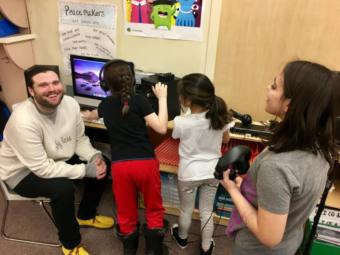
It’s not as hard as you might think to turn an elementary school classroom into a recording studio. At least according to T.J. Cramer, stage name Manner. When he’s not writing and recording his own raps, he’s a second grade teacher at Riverbend Elementary School.

For the past two years, he’s been sharing his love of songwriting with students at Riverbend and Glacier Valley Elementary School through a free extracurricular program called JAMM, or Juneau Alaska Music Matters.

The students are all between second and fifth grade. Songwriting might seem too complicated for students that young. But Cramer said he starts with games.

“For a beginner, I just want them to be able to count the number of beats or bars for one verse, and then we fill it in later,” he explained. “I’ll say, ‘Can we write any line about fish with seven syllables?’”

Pretty quickly, Cramer said, the students are writing their own songs.

“The stuff they come up with is just amazing and so adult-like sometimes. It’s like, how is your brain working like this at this age?” said Cramer.

Altogether, the students have written over a dozen songs. Now Cramer is helping them record those songs and put them together on an album.

T.J. Cramer (left), stage name Manner, on March 26, 2019 with three of the Riverbend Elementary School students he's working with to produce a student-created album. (Photo by Zoe Grueskin/KTOO)
T.J. Cramer (left), stage name Manner, on March 26, 2019, with three of the Riverbend Elementary School students he’s working with to produce a student-created album. (Photo by Zoe Grueskin/KTOO)

One song already recorded is called “Lost In The Woods.” It was written by a group of five girls about moving from elementary school to middle school.

But as is often the case with art, Cramer said, the young musicians didn’t necessarily start out with a clear picture of what they were writing about.

“The original one who wrote that, that wasn’t her intention. But it ended up going there,” said Cramer. “So one person wrote this, and then it sparked an interest in the other one. I was like, that’s what we can write about, the transition. And so it got pretty good after that.”

Over 20 students have contributed to the project. Some students and a few of Cramer’s musician friends played instruments or created the beats behind most of the songs.

Riverbend fourth grader Reace Rosson even helped produce the music, learning how to record and piece together different parts of a song.

“Sitting there, I like pushing buttons, and it’s just, like, really fun wearing the headphones and listening to my friends sing,” she said.

And after recording a few tracks, Rosson wanted to try singing herself. The songs she worked on will be included on the album.

Cramer is currently mixing that album, which features nine original tunes and a few bonus tracks.

“JAMM: The Album” will be available on iTunes and at Riverbend Elementary School starting May 3. A release party will be held at Riverbend on May 3 at 6 p.m.

Despite state funding uncertainty, Juneau School Board passes budget

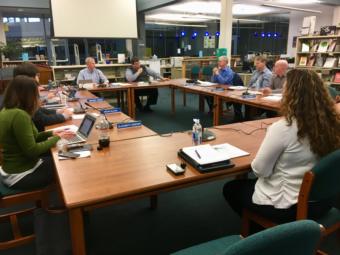
The Juneau School Board approved an operating budget for fiscal year 2020 at a special meeting on March 26, 2019. (Photo by Zoe Grueskin/KTOO)

The Juneau School District Board of Education approved a budget for fiscal year 2020 at a special meeting Tuesday night.

The spending plan now goes to the Juneau Assembly for review. It could pass without changes, but as Juneau School Board Vice President Dan DeBartolo explained, one big question looms over the process: What is the Legislature going to do?

The Juneau School District built the budget with a big assumption in mind: The Legislature will not lower the base funding to public schools or remove the one-time $30 million grant it approved last spring. Gov. Mike Dunleavy’s state budget proposals would do both.

DeBartolo said he is not confident the board’s work is over.

“If the Legislature cuts even 1 percent of public school funding,” he said, “We will be back at the table immediately, because it forces us to move that line up, and something is gonna have to drop off.”

Still, as currently written, next year’s budget largely maintains the status quo for Juneau schools.

“The big surprise this year is that we didn’t have to change very much,” said Sarah Jahn, the director of administrative services for the school district.

The total approved budget accounts for about $71 million.

Site notifications
Update notification options
Subscribe to notifications