Zoe Grueskin, KTOO

Can trauma be passed down through DNA? Researchers and Hoonah residents search for answers.

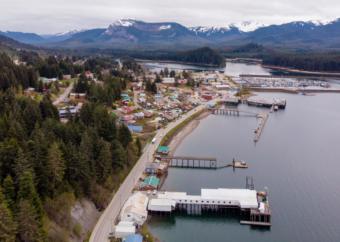
The city of Hoonah on May 2, 2019 (Photo by David Purdy/KTOO)

It’s well known that traumatic experiences can have lifelong impacts on health and well-being. But it’s possible that those effects can last longer than a single lifetime. A new study asks whether the effects of trauma have been passed down genetically in Tlingit families in Hoonah.

Much of the history is familiar to rural Alaska Native communities anywhere in the state: children taken from their families and sent to boarding schools, language suppressed. But the Tlingit community of Hoonah has also experienced unique traumas, such as a fire that destroyed much of the town in 1944.

“This major fire that occurred there in the in the ’40s. And Bureau of Indian Affairs was very much involved in our lives, and at the time, they wouldn’t allow them to rebuild clan houses,” Worl said.

Rosita Worl is the president of the Juneau-based Sealaska Heritage Institute (SHI). She’s also an anthropologist. Some of her first work looked at the social and cultural impacts of historical trauma in Alaska Native communities.

“And then now, how many years later, to find out that these changes, these impacts, could change our very physiological being,” said Worl.

Trauma might even affect our DNA, our most basic stuff. And, if that’s the case, those changes could be passed down through families, impacting people generations removed from traumatic events. 

It’s a young field of research, and SHI is part of it. The non-profit just launched a study to see if residents and descendants of Hoonah have experienced any genetic changes because of that trauma.

Principal investigator Ripan Malhi is a molecular anthropologist at the University of Illinois Urbana-Champaign. Malhi and his team explain it like this: Your DNA is fixed. It’s like a sheet of music; all the notes are already printed on the page. Those are your genes. But as in music, it’s all about expression.

“It’s the musician that can change how the music is played, or you can stress some notes really loudly or play other notes really softly,” Malhi said. “And so that’s kind of like gene expression that changes the level of how the genes are expressed, even though the notes are the same.”

Trauma, so the thinking goes, can change someone’s gene expression. And that could impact their health — maybe make them more likely to develop certain diseases — or it could affect the health of their children, even grandchildren.

Working with the Hoonah Indian Association, SHI is inviting Tlingit residents and descendants of Hoonah to take part in the study, called Epigenomic Effects of European Colonization on Alaska Native Peoples. Participants have their blood drawn, for the DNA sample, and they complete a survey. It asks about both historic and more recent traumatic events, as well as how participants feel about that trauma, how much they think about it. It also asks about participation in cultural traditions, which could act as a buffer. Malhi and his team will then analyze the DNA samples to see if they can find any evidence of genetic change that tracks with the trauma recorded in the survey. Malhi says they’ll compare what they find to the results of similar studies done with survivors of the Holocaust and the Rwanda genocide.

This kind of research is still pretty new, and Malhi says so is the approach. Rather than dropping in on a community, collecting data and leaving, Malhi’s team of scientists is working with Hoonah residents as partners who will give feedback and help direct the research at every step. Starting with what questions to ask and how to ask them.

“And when we get results, we’ll come back and provide an update and get some feedback on what the patterns may mean,” Malhi said. “And things that we can’t explain, maybe community members have a good explanation for it.”

No samples will be shared with other labs, and SHI and Hoonah representatives will review and edit any papers before they’re published.

Malhi says Indigenous communities around the world already have a deep understanding of their own trauma. But genetic evidence of trauma’s impact could be more compelling to Western institutions like state governments or health insurers.

“They may not take traditional knowledge as being real, but when scientific knowledge says the same thing, then all of a sudden it becomes real,” Malhi said.

Building that scientific knowledge is a long and complicated process, and this is just the beginning. The researchers expect the whole study and analysis to take about eight years, although Worl hopes to share initial findings as soon as next year. 

“And why do I want to do it? It’s because I think we need to be aware of these kinds of impacts, when we make policy decisions,” said Worl.

Worl can see the research informing, for example, the management of subsistence resources. A collapse due to overfishing can be a cultural loss, too.

Taking part in a study about your own trauma is heavy work, Worl says, “But yet our people knew that it could be a potential benefit for us. And, you know, I always attribute that to our value system, that we learn from our past to protect our future.”

It’s not just history, Worl says. It’s still happening.

Hoonah descendants now living in Juneau had the opportunity to participate in the study earlier this month. The researchers are planning a trip to Hoonah in September — aiming for a narrow window between ceremonies and subsistence activities.

Tie-dye, rainbows and love songs: Juneau’s first youth LGBTQ Pride party

Juneau drag queen Gigi Monroe performs at the youth Pride party on June 20, 2019. (Photo by Zoe Grueskin/KTOO)

Pride week in Juneau included a pub crawl, Pride prom and queer trivia. But it also featured something new this year: a party just for teens.

On the morning of the youth Pride party, Callum Marks didn’t know what to expect.

“I’m hoping that people show up. I think people will,” he said.

Besides just showing up at the Zach Gordon Youth Center, Marks hoped the middle and high school students at the party would find a safe space “to talk about the stuff that they don’t get to talk about in everyday life,” he said. “Because, you know, queer youth really are going through a time. High school is hard.”

Marks would know — the 18-year-old just graduated from Thunder Mountain High School last month.

As far as he and the other organizers can tell, the party was the first of its kind in Juneau.

Callum Marks displays his tie-dye-stained hands at Juneau’s first youth Pride party on June 20, 2019. “Tie-dying is super fun, and also rainbow,” he said. (Photo by Zoe Grueskin/KTOO)

Stephanie Luther is an education specialist at AWARE, a domestic violence shelter in Juneau. She got involved in the planning after asking friends and folks in the nonprofit world what programs were available for queer teens in Juneau.

“And the answer I got from everybody was, ‘There aren’t any, but there should be,'” she said. “And so I was like, ‘OK, well then let’s try.’”

Soon, Luther hopes to see more programming for queer youth, maybe even a club. But first: a party. Luther said it fills a gap for teens during Pride. Many of the big events take place at bars or have age restrictions. And while family-friendly events like kickball and picnics are great, teens might not necessarily want to hang out with little kids.

“And some teenagers don’t necessarily have families that they want to bring to those events or who would want to go to those events,” Luther said.

Organizer Tayler Shae said the party was planned in the spirit — and history — of Pride, which began as a protest against discrimination and has since evolved into something more like a festival.

“We want to encourage connection, raise awareness in the community that, like, this is a need, that there’s kids out there that need this connection, and then using it as a time to just, like, celebrate and be with each other and have a ton of fun,” Shae said.

That meant tie-dye, plenty of food and a drag performance were all in order. Even some live music, courtesy of 19-year-old Theo “FySH” Houck.

“As a queer person, as a trans non-binary person, I kind of like to imagine that anytime I like anyone, it’s queer. And that means that every time I write a love song, it’s a queer love song. And I write a lot of those. So I guess I’m a bit of a hopeless romantic,” Houck said.

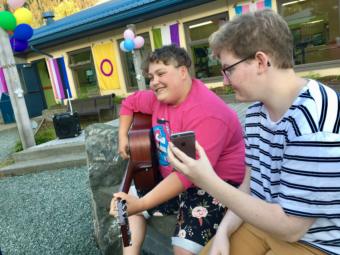
Theo "FySH" Houck outside the Zach Gordon Youth Center, which held Juneau's first youth Pride party on June 20, 2019. (Photo by Zoe Grueskin/KTOO)
Theo “FySH” Houck outside the Zach Gordon Youth Center, which held Juneau’s first youth Pride party on June 20, 2019. (Photo by Zoe Grueskin/KTOO)

Houck graduated last year from Juneau-Douglas High School: Yadaa.at Kalé and now attends college out of state. He was excited when he heard about the youth Pride event in his hometown.

But beyond Pride week or Pride month, Houck said adults can support the youth in their lives year-round by just being there for them.

“Be open and compassionate. Listen to what they have to say,” he said. “I think that one of the best things adults ever did for me was just allow me to figure things out. And really, like, believe me when I said I felt a certain way.”

About 50 teens turned up for the party. They had cake and entered a raffle for various, mostly-rainbow-colored prizes by filling out a survey about the kinds of services and activities they’d like to see for queer youth in Juneau.

Callum Marks (right) serves as a "modern day page turner" for Theo Houck, who played a set of queer love songs at Juneau's first youth Pride party on June 20, 2019. (Photo by Zoe Grueskin/KTOO)
Callum Marks (right) serves as a “modern-day page-turner” for Theo Houck, who played a set of queer love songs at Juneau’s first youth Pride party on June 20, 2019. (Photo by Zoe Grueskin/KTOO)

As the party wound down, a handful of remaining teens and a few adults gathered around the fire pit out back. There’d been talk of starting a fire, but it was a warm night, and, with the summer solstice the next day, still plenty sunny around 8:30 p.m. All eyes were on Houck and his guitar as he played a few queer love songs — plus one breakup song, because, as Houck said: “Love isn’t always happy endings.”

The party, however, ended happily. Houck finished his set, and it was time for the Zach to close. Youth center manager Jorden Nigro apologized for wrapping things up and thanked everyone for being there. The remaining door prizes were handed out. Someone asked if they could take home an extra piece of rainbow cake.

Nigro said many people and organizations came together to make the party happen, because young people saw something missing.

“This gets at the core of the importance of listening to our kids,” she said, “and at working together to create a healthy and equitable community for all our kids.”

Nigro hopes the Zach Gordon Youth Center and community partners will soon offer more programming specifically for queer youth in Juneau.

A table at the youth Pride party on June 20, 2019 held both door prizes and free goodies. (Photo by Zoe Grueskin/KTOO)

$20M state grant released to Alaska schools, but future funding remains unclear

The Juneau school board meets on June 11, 2019. (Photo by Zoe Grueskin/KTOO)

School districts across Alaska are looking forward to a bump in their bank accounts. The Department of Education and Early Development has released funds — $20 million altogether — ending a months-long waiting game for Alaska schools. But the outlook for state education spending is far from clear.
At Tuesday’s school board meeting, Juneau superintendent Bridget Weiss was happy to have good news to share.

“This is again money that we have planned on, so we’re thrilled that it is scheduled to be dispersed,” Weiss said.

Like Juneau, school districts around the state have been planning on that money for over a year — and spending with that in mind. Last May, the Alaska Legislature approved a one-time grant of $20 million for public schools, to be delivered this fiscal year. After years of flat funding public education, lawmakers hoped the money would help school districts meet rising costs — and ease some of the uncertainty they face each year as they wait for a new state budget.

But it didn’t work out that way. In January, Governor Mike Dunleavy proposed cutting that $20 million in school funding as part of his amended supplemental budget. School districts had expected to see the money arrive early this year, but the administration waited to see if the Legislature would approve the cut.

It didn’t. Heidi Teshner, director of administrative services for the state education department, confirmed the funds were processed on Monday and were expected to appear in school district bank accounts Wednesday — just over two weeks before the close of this fiscal year.

FY20 begins July 1, and school funding remains an open — and contested — question.

That’s because back in May 2018, when lawmakers approved education spending for the current year (FY19), they also agreed to forward fund public schools for the upcoming year (FY20). That includes the normal per-student funding districts receive from the state and another, even larger one-time grant of $30 million.

Superintendents like Lauren Burch of Southeast Island Schools celebrated the move. But it hasn’t turned out as he hoped.

“The forward-funding idea was brilliant, but the governor’s been tangling that up, and it’s pretty hard to predict. So that leaves everything pretty unsettled,” Burch said.

That tangle could turn into a lawsuit. The Dunleavy administration says forward funding schools was unconstitutional and told lawmakers if they want school districts to receive funds come July, they must write it into the new budget. But the Legislature disagrees, and didn’t. It says the governor is bound by last year’s law, and it’s preparing to sue the administration to pay school districts.

As July 1 approaches, school districts across the state are watching and waiting. Juneau superintendent Bridget Weiss hopes it won’t be long.

Lawmakers say they hope to avoid the lawsuit. School districts typically receive their first payments of the new fiscal year in mid-July.

Using local foods, a Juneau middle school teacher demystifies cooking for kids

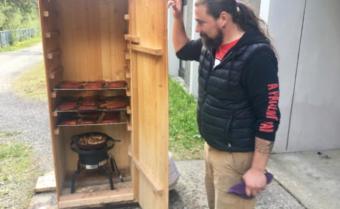
Students in Chris Heidemann's outdoor life skills class on May 20, 2019, enjoying the salmon they smoked the week before. (Photo by Zoe Grueskin/KTOO)
Students in Chris Heidemann’s outdoor life skills class enjoys smoked salmon on May 20, 2019. The class smoked the salmon the week before. (Photo by Zoe Grueskin/KTOO)

For kids who’ve never cooked, smoking their own salmon might seem out of reach. But a teacher at Juneau’s Floyd Dryden Middle School wants his students to know it’s just another life skill they can master — and shows them how to do it.

It’s the last week of school before summer break, and things are pretty laid back at FDMS — at least in room 204, where the students are enjoying snacks and a nature documentary. It’s pretty standard end-of-year stuff, but that smoked salmon wasn’t bought at the store. The students smoked it themselves right outside their classroom just a few days before, with the help of their teacher, Chris Heidemann.

Heidemann teaches hunter education and outdoor life skills classes, which he says mostly focus on preparing food. The smokehouse they use is easily built. Often he’ll have the students construct it, using plans he found online. He says the whole thing comes together in about three hours with $200 worth of materials.

Inside, his classroom is full of more gadgets.

“I have six functioning kitchens, set up with stoves, KitchenAids, microwaves, food processors, everything you’d need. Sinks for doing dishes,” says Heidemann.

Heidemann’s goal is to demystify cooking for his students. Over the years he’s taught the class, he says, he’s learned to start with the basics. Even boiling water on the stove can be intimidating for a first-time cook. So Heidemann says that’s where they start.

His class cooks pretty much every week. Over the course of the semester, they work up to more complicated recipes and projects, like the fish smoking.

Most families contribute a $25 class fee, but Heidemann says that’s just a request, and no one is turned away if they can’t pay. Some projects are funded by specific grants that the Juneau School District helps him find.

Fish smoking is one of them. That project’s been supported by a state program called Nutritional Alaskan Foods in Schools, which aims to bring more local foods to students.

Heidemann has plenty of dreams for the class. He’d love to do more foraging and work with local game meat, like deer.

“Just being able to be even more local with the foods that we use,” he said. “Maybe even growing something, but that could be years in the future with how things are developing right now.”

The state grant that supports Heidemann’s fish smoking was last funded in 2015. That’s been enough to keep his classes smoking salmon since then. The district estimates that money will run out after next school year.

Meet the first girls of Juneau Cub Scouts

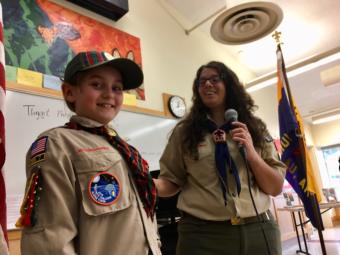
Kelsie Powers (left) receives her Arrow of Light, the highest award a Cub Scout can earn, at a pack meeting on April 20, 2019. Her den leader, Emily Lockie (right) presented the award. Of Kelsie, she said, "She’s a great leader, she’s empathetic, and she’s so good at standing up for what is right." (Photo by Zoe Grueskin/KTOO)
Kelsie Powers (left) receives her Arrow of Light, the highest award a Cub Scout can earn, at a pack meeting on April 20, 2019. Her den leader, Emily Lockie (right) presented the award. Of Kelsie, she said, “She’s a great leader, she’s empathetic, and she’s so good at standing up for what is right.” (Photo by Zoe Grueskin/KTOO)

Last fall, a handful of girls in Juneau became brand new scouts — not Girl Scouts. They are the first girls in town to be officially welcomed into Cub Scouts,  thanks to a decision the national organization made last year. Since then, they’ve met both support and confrontation in the community.
It’s a Wednesday night, and a group, or den, of Cub Scouts is making bird feeders. Families are packed into a heated garage, hammering boards, drilling things together and talking about the birds they might see.

Nights like this are exactly why Kelsie Powers, about to turn 11, wanted to join Cub Scouts.

“I want to be more of an outdoorsy girl, and then I also like it because you can build things, you can go camping. You practically can do anything,” said Powers.

Powers is one of the first girls in Juneau to be an official Cub Scout: the organization just started letting in girls in 2018. Cub Scouts’ parent organization, Scouts BSA (formerly Boy Scouts of America) began accepting girls into the organization this year.

Her den leader, Emily Lockie, says girls have been a part of Scouts for years, they just weren’t recognized. She knows, because that was her story:

“I grew up with three brothers and no sisters, and I got to watch from the sidelines as my brothers participated in this incredible organization,” said Lockie. “And as a teenager, I worked side by side with all my friends. I worked at scout camp with them because they allowed females to work out there. I just couldn’t be a part of the program.”

And as a parent, Lockie was watching that story repeat itself, with her own daughters. So when she got the chance to start a girls’ den in Juneau, she jumped.

Emily Lockie at a meeting of the girls' den she leads on April 17, 2019. (Photo by Zoe Grueskin/KTOO)
Emily Lockie at a meeting of the girls’ den she leads on April 17, 2019. (Photo by Zoe Grueskin/KTOO)

For the most part, she says, it’s been going really well. Their den is small, just four Scouts between 2nd and 5th grade. They get together every week, just girls, to work on projects, and they join the larger, co-ed pack once a month.

Lockie says she loves Scouts because it’s well-rounded. Boys — and now girls — can earn awards for exploring everything from outdoors skills to robotics to spirituality.

But it’s been a challenge to recruit girls to the program, and Lockie says they’ve received some pushback.

“There was definitely controversy in the beginning. We’ve done service in the community and attended events, and for the most part we’ve received incredible amounts of support,” she said. “But there definitely have been some comments from adults to the girls about how there shouldn’t be girls in scouts.”

Powers has heard it from peers, too.

“So at my school, like, I’ll be talking to my friends about what I did at Scouts the night before, and then all the boys will be eavesdropping. And then all of a sudden, they’ll be like, it’s called Boy Scouts for a reason. Or then they’re like, I think it’s really stupid how girls are joining. Girls are overtaking Boy Scouts,” said Powers.

She says she ignores them. Or responds simply, just telling them what she likes about being a Scout.

Kelsie Powers (left) and her family at a Cub Scouts den meeting on April 17, 2019. Her brother, Trey Powers, is also a Cub Scout. (Photo by Zoe Grueskin/KTOO)

Den leader Lockie says the resistance has actually been a learning opportunity. She and her Scouts have spent a lot of time talking about how men and women are treated differently and why that might be, looking at it big picture. Last fall, when they got to meet with Juneau mayor Beth Weldon and a couple legislators, they even drew a connection to the fight for women’s right to vote a hundred years ago.

“And we were able to tie that conversation into how they were making history and how there are laws that aren’t always the right thing,” Lockie said. “And part of being a good citizen is to recognize laws that aren’t the best for our country and our community and do what we can do to change those laws.”

In her way, Kelsie Powers is making history too. This month, she became the first girl in Juneau to earn the Cub Scouts’ highest award, and she’s old enough now to join Scouts BSA, formerly called Boy Scouts of America.

But so far, she’s the only one. She needs at least four other girls to join, so they can form a troop. Until then, she’ll be a lone scout.

Powers says she’d like to tell other girls considering Scouts that it’s a lot of fun.

“And even if the boys don’t want you to do it, you shouldn’t listen to them,” she said.

Powers is hoping in a few years she’ll be the first girl in Juneau to reach the highest rank of Scouts BSA and become an Eagle Scout.

Families in Juneau with girls interested in joining Cub Scouts (Kindergarten-5th grade) can contact Emily Lockie at inspiringscoutsforlife@gmail.com or 907-500-3020. Families interested in Scouts BSA (ages 11-17) can contact Chris Gianotti at cgianotti@pndengineers.com or 907-790-2557.

Kelsie Powers' father -- and assistant den leader -- attaches the new badges she earned to her Scout uniform at a pack meeting on April 20, 2019. (Photo by Zoe Grueskin/KTOO)
Kelsie Powers’ father — and assistant den leader — attaches the new badges she earned to her Scout uniform at a pack meeting on April 20, 2019. (Photo by Zoe Grueskin/KTOO)


Juneau students on exchange get a taste of life in Western Alaska

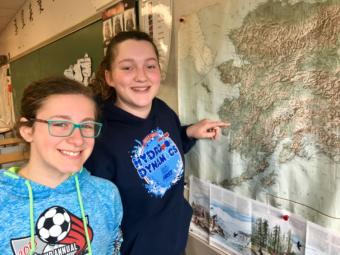
Mackenzie Olver (left) and Sandra Bouvier point out Akiuk on a map of Alaska at Dzantik'i Heeni Middle School on April 17, 2019. (Photo by Zoe Grueskin/KTOO)
Mackenzie Olver (left) and Sandra Bouvier point out Akiuk on a map of Alaska at Dzantik’i Heeni Middle School on April 17, 2019. (Photo by Zoe Grueskin/KTOO)

Juneau middle schoolers traveled to Western Alaska last month as part of a sister school exchange. The program aims to bridge the gap between urban and rural Alaska, showing students how different life can be around the state, but also how much they have in common.

Their visit also happened to coincide with the earliest spring breakup the region has ever seen — a bonus lesson for the students that made a big impression.

Before last month, Mackenzie Olver had never set foot in Western Alaska, let alone in a village of a couple hundred people in the Yukon-Kuskokwim Delta.

That’s exactly why she went: Olver took part in a program funded by the Alaska Humanities Forum that sends Alaska students across the state on short-term exchanges to places very different from their hometowns.

Juneau’s Dzantik’i Heeni Middle School was matched with the school in Akiuk, part of the village of Kasigluk. It’s an all-in-one school, preschool to 12th grade — about a hundred students altogether.

Olver said her first impression of Akiuk was about what she expected.

“Very small, not many people, very flat. The geography did not include, like, any mountains or trees,” she said.

But she was quickly surprised by the warm welcome she and her classmates received. Especially from some of the village’s youngest residents.

“They like, came right up and were ready for piggyback rides,” Olver said.

Sandra Bouvier agrees. Like Olver, she’s in eighth grade at Dzantik’i Heeni. She said that even in their short time in the village, they got to feel like a part of things — at a community dance, or at someone’s sweet sixteen birthday party where it felt like everyone was there, eating beaver stew and celebrating together.

“You had to like, kind of shimmy through. It was crazy,” Bouvier said. “It’s all just connected. Like everybody knows everyone, and it’s not just asking your neighbor for like flour or something. You could go to anyone, pretty much.”

And the students got to see firsthand that community is not just about celebration — it’s also about survival. Like many rural Alaskans, most of Akiuk’s residents rely on subsistence activities like hunting and fishing to feed their families. That requires a lot of cooperation and sharing of skills and knowledge.

As it turns out, the Juneau students were in town for a momentous occasion: spring breakup, when the river ice cracks and melts away. The students watched as what had been a frozen solid highway for snowmachines and even cars quickly became open water.

The significance wasn’t lost on Olver.

“Many people in the village described it as the earliest breakup in 95 to 100 years,” she said. “So it’s really scary to see how climate change has really changed life.”

Breakup dashed some of the Juneau students’ plans. Crossing the river was suddenly a lot more difficult and dangerous, and the students said no one in the village was willing to take that risk with other people’s children.

Jay Lloyd in his classroom at Dzantik'i Heeni Middle School on April 17, 2019. (Photo by Zoe Grueskin/KTOO)
Jay Lloyd in his classroom at Dzantik’i Heeni Middle School on April 17, 2019. (Photo by Zoe Grueskin/KTOO)

Jay Lloyd led the trip to Akiuk. He’s a language arts and history teacher at Dzantik’i Heeni.

“And you know, we ask people about, you know, is it easier when the river’s open or when it’s frozen? And they’re like, ‘Frozen, because we can take our snowmachines anywhere then.’ You can just shoot across everything. They’re like, ‘Winter’s better,'” Lloyd said.

Instead of snowmachining down the river to Bethel for the Cama-i Dance Festival, Lloyd and the students got to see the start of spring fishing and birding — much earlier than normal.

It’s a perspective Lloyd appreciates.

“I look at, you know, the changes that are going on all over the place, and it’s, you know, ‘Hey, everybody has to adapt to them, and we’ll adapt,’ but it doesn’t necessarily mean it’s for the better,” he said.

Lloyd said the value of the program is more than showing students how different life can be in other parts of the state. Actually, he said, it teaches them how much they have in common.

“They dress the same, they look the same, they listen to the same stuff. They like to play basketball, they like to play volleyball. They’re all on their phones, they’re all Snapchatting and whatever else. So a 14-year-old’s a 14-year-old, no matter where you are,” said Lloyd.

A week after the Juneau students returned home, a few students from Akiuk traveled to the capital city, completing the exchange.

Site notifications
Update notification options
Subscribe to notifications