Zoe Grueskin, KTOO

Southeast teachers learn to weave Northwest Coast arts into math lessons

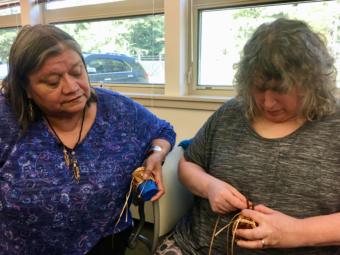
Holly Churchill (left) looks on as Brita Steinberger works on a basket during a Sealaska Heritage Institute seminar for teachers on Northwest Coast arts and math on Aug. 8, 2019. (Photo by Zoe Grueskin/KTOO)

Middle school and high school teachers in Juneau last week learned how to weave — literally weave — Northwest Coast art into math lessons.

Brita Steinberger had her hands full, weaving a small basket using a mix of traditional — and less traditional — materials:

“This is spruce root here, and this is cedar bark right there,” she explained. “This is a tomato paste can with tape around it.”

Steinberger is a special education teacher in Juneau. But last week she was the student, in a weeklong seminar for teachers put on by Sealaska Heritage Institute. 

Delores Churchill, master Haida weaver, on Aug. 8, 2019. (Photo by Zoe Grueskin/KTOO)

Leading the basketry lesson was Ilskyaalas Delores Churchill of Ketchikan. She’s been teaching weaving since the 1970s.

“Actually I was my mother’s assistant at the beginning and didn’t teach until after she died. Even though I taught evening classes she still sat in the classroom to make sure I was teaching correctly,” Churchill said.

Her mother was Haida weaver Selina Peratrovich. Churchill also studied with Tlingit and Tsimshian weavers, learning how to make baskets, hats and regalia.

She said there’s a lot more to it than just mastering skills.

“Basketry is not just basketry. You’re out harvesting in the forest, and you learn to respect the animals that are there, because you know that when you’re in the forest, this isn’t where you belong,” Churchill said.

Churchill said it’s not hard to get kids excited about weaving, because it’s so much fun. And that’s good news for teachers of a subject that could use some livening up: math.

“All basketry is math right from the beginning,” Churchill said.

Ethnomathematician Swapna Mukhopadhyay on Aug. 8, 2019. (Photo by Zoe Grueskin/KTOO)

To back her up on that, with her at the workshop was mathematician Swapna Mukhopadhyay.

“Everybody’s life has mathematics, plays a role in it, sometimes overtly, sometimes covertly,” said Mukhopadhyay. “And how do you unearth that and bring it to [the] foreground and make people realize that they have this fantastic tool, and they don’t need to be afraid of that?”

Mukhopadhyay is a special kind of mathematician: an ethnomathematician. She studies the culture of math and math-learning. She thinks a lot of people’s dislike of math comes from how it gets taught — just numbers and equations that have nothing to do with real life.

“When the cultural artifacts and cultural knowledge system is integrated together, that’s when a lot of the fear could be erased, more or less right away,” she said. “And they get curious about the mathematics and they learn it better, differently.”

Take, for example, basketry. Mukhopadhyay said weaving a basket can help students grasp concepts like measurements, proportions and geometry — and see the links between them.

“It’s a nice flow from one to the other, instead of being so, you know, disconnected, like in a textbook,” she said.

Weaver Debbie Head with class materials for a Sealaska Heritage Institute seminar for teachers on Northwest Coast arts and math on Aug. 8, 2019. (Photo by Zoe Grueskin/KTOO)
Weaver Debbie Head with class materials for a Sealaska Heritage Institute seminar for teachers on Northwest Coast arts and math. (Photo by Zoe Grueskin/KTOO)

There were fifteen teachers at the workshop. They came from local schools in Juneau, but also Klukwon and Kake. 

For Naomi Love, a teacher at Juneau’s Yaakoosge Daakahidi alternative high school, just as important as the math lessons is the opportunity to disrupt typical classroom power dynamics. Many of her students are Alaska Native, and she says she wants to be culturally responsive.

“And also if I’m doing something like basket weaving that I’m a novice at, and they have watched their auntie or maybe done it themselves, and they can come and show me, that’s so empowering for them,” Love said. “So being able to know enough to take it into the classroom, but then struggle kind of with the kids through it, it’s great.”

Love said she’s especially grateful for the seminar after years of budget cuts at the school district.

Honored nationally, a Juneau scientist helps Alaska fisheries managers see the bigger picture

Elizabeth Siddon in her office on Aug. 1, 2019, displays her Presidential Early Career Award for Scientists and Engineers (Photo by Zoe Grueskin/KTOO)
Elizabeth Siddon in her office on Aug. 1, 2019, displays her Presidential Early Career Award for Scientists and Engineers. (Photo by Zoe Grueskin/KTOO)

This summer, a Juneau-based fisheries scientist received the highest honor given to early-career scientists and engineers by the U.S. government.

Of the more than 300 scientists to receive the award, Elizabeth Siddon was the only Alaskan.

Siddon, who goes by “Ebett,” used to spend a lot of her time in the biology lab at the National Oceanic and Atmospheric Administration research facility in Auke Bay. As a PhD student, Siddon wanted to understand what happens to fish like pollock when the cold, cold Bering Sea gets a little warmer.

A whole corner of the lab is taken up with equipment for the impressively-named “bomb calorimeter.” Siddon would work for hours, exploding fish.

Equipment for the bomb calorimeter at NOAA's Ted Stevens Marine Research Institute, photographed on Aug. 1, 2019. (Photo by Zoe Grueskin/KTOO)
Equipment for the bomb calorimeter at NOAA’s Ted Stevens Marine Research Institute, photographed on Aug. 1, 2019. (Photo by Zoe Grueskin/KTOO)

“You dry the fish, grind it into a pellet, put it into this and essentially blow it up, blow up the fish pellet,” she explained. “And you look at the change in the temperature of the water bath surrounding it. And that converts to calories. It’s the same process they use to figure out the calories in your food.”

Siddon still gets to do some research, but these days she spends most of her time talking to other scientists. She puts together something called the “Ecosystem Status Report” for the Bering Sea. The couple-hundred-page document is designed to give the managers of Alaska’s fisheries a well-rounded look at what’s happening in that part of the ocean.

The report is about fish, but it looks much further.

“We also want to think about what their food source is doing, and what their predator populations are doing, and what the temperature is doing,” Siddon said.

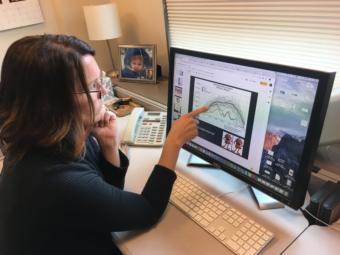
Elizabeth Siddon, photographed in her office on Aug. 1, 2019, points to a figure charting sea ice extent in the Bering Sea, which shows a "double whammy" of back-to-back low sea ice winters in 2017-18 and 2018-19. (Photo by Zoe Grueskin/KTOO)
Elizabeth Siddon, photographed in her office on Aug. 1, 2019, points to a figure charting sea ice extent in the Bering Sea, which shows a “double whammy” of back-to-back low sea ice winters in 2017-2018 and 2018-2019. (Photo by Zoe Grueskin/KTOO)

Siddon talks to climatologists, oceanographers and biologists who study everything from zooplankton to marine mammals. But she also talks to fishers and anyone else who has noticed something unusual, like seabirds washing up dead, or fish swimming belly-up but still alive.

Siddon asks what they’re seeing out there right now, and then she tries to put together all the pieces.

“And that’s the fun part, I think, of my job, is to say, ‘Well, maybe it’s not a one-off observation,'” Siddon said. “Maybe it actually is really linked to all of this other stuff we’re seeing, and we just haven’t — you know, we just need to make that connection.”

Elizabeth Siddon received the Presidential Early Career Award for Scientists and Engineers in Washington, D.C., on July 25, 2019. (Photo courtesy of Elizabeth Siddon)

The report doesn’t make specific recommendations on how to manage fish stocks, but it does try to tell a story. And for the last couple years, Siddon said, the story has been pretty dramatic. In the winter of 2017-2018, a combination of warmer water and unusual pressure zones and wind patterns meant there was almost no sea ice in the northern Bering Sea. It was, Siddon said, unprecedented.

But then the next year — this past winter — it all happened again.

“I said, ‘We can’t be saying “unprecedented” again. We need a new terminology,'” she said. “And so, you know, we have been calling it this ‘double whammy’ of two pretty harsh conditions for the system to respond to.”

In July, Siddon received the Presidential Early Career Award for Scientists and Engineers. The honor recognizes her scientific achievements as well as her leadership and community outreach.

Siddon made a quick trip to Washington, D.C., to accept the award, but now she’s back in Juneau and looking ahead. Alaska’s fishery management council meets a few times throughout the year, but the final quotas for 2020 will be set in December. With most scientists wrapping up their summer research, Siddon said it will be a mad dash from now until the council meeting to pull together the report — to find the story in a sea of data.

But, she said, that’s the fun part.

Newscast – Monday, Aug. 5, 2019

In this newscast:

  • State ferries resumed sailing following the ratification of a contract by striking members of the Alaska Marine Highway System’s largest union.
  • Gov. Mike Dunleavy’s administration extended a no-bid contract awarded to a relative of a major financial supporter of the governor.
  • A lawsuit brought by a former police detective against the City of Sitka is going before a mediator and could be settled out of court.
  • A related case concerning a former Sitka police detective who filed a sexual harassment suit against the city remains on track for trial next spring.
  • A new species of deer are moving into parts of Alaska, including the Upper Lynn Canal.
  • The federally chartered Denali Commission is awaiting results of an investigation into the conduct of one of its staff members.
  • A light earthquake was felt in the greater Anchorage area, and officials say it was an aftershock from the Nov. 30 magnitude 7.1 quake that rocked the city.

Newscast – Friday, Aug. 2, 2019

In this newscast:

  • A tentative deal between the state and a striking ferry union could get the Alaska Marine Highway System back up and running as early as this weekend.
  • Voters in more than a dozen Alaska towns can now sign the petition to recall Gov. Mike Dunleavy, but there are plenty of communities across the state where voters do not have that option right now.
  • Pacific walruses have been spotted on shore in northwest Alaska. It’s their earliest appearance to date, and it’s tied to receding sea ice.
  • A profile on Tom Ainsworth, the National Weather Service’s chief weather forecaster for Southeast Alaska. Ainsworth retired today.
  • Juneau’s Perseverance Theatre removed “One Flew Over the Cuckoo’s Nest” from its schedule after concerns were raised about its content and cost.
Amid UA budget woes, some students are noticing increased military recruitment

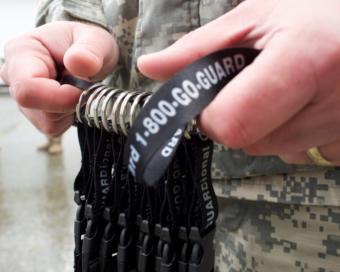
An Alaska Army National Guard recruiting and retention section chief stands ready to greet students Oct. 17, 2017, at Mt. Edgecumbe High School, Sitka, Alaska.
An Alaska Army National Guard recruiting and retention section chief stands ready to greet students Oct. 17, 2017, at Mt. Edgecumbe High School, Sitka, Alaska. (Public domain photo by Sgt. David Bedard/U.S. Army National Guard)

Amid the University of Alaska’s budget woes, targeted ads from out-of-state universities have appeared on social media, encouraging Alaska students to enroll.

Some UA students say they’re hearing more from military recruiters as well.

Leilani Oathout is about to begin her senior year at the University of Alaska Anchorage. She receives both the Alaska Performance Scholarship and an Alaska Education Grant, about $4,500 altogether each school year.

In early July, she and 12,000 other Alaska students were told the state didn’t have funds available to pay those scholarships. Oathout said in the days after she was notified, she started seeing ads on Facebook from other colleges.

“And then I randomly got an email in my inbox for recruiting for the Army,” she said. “And I didn’t think (anything) of it until I got a second email in my spam folder.”

The emails — one from the Army, another from the National Guard — touted benefits like tuition assistance and cash bonuses.

The Alaska Legislature passed a bill on Monday that would restore scholarship funding. It moves now to Gov. Mike Dunleavy’s desk. But with all the university budget uncertainty, Oathout said she understands the attention from recruiters.

“That’s pretty smart that they’re targeting students. But I also feel super bad. Like, I don’t think this is a good route the state is going down,” Oathout said.

Joey Sweet, 26, is pursuing a master’s degree in public administration at UAA. He said he’s received military recruitment emails in the past, but typically about one a year. He said he received three of them within eight days in July. He doesn’t think it’s a coincidence.

“I mean, I think the emails really speak for themselves,” Sweet said. “The one Army email straight up said in the subject line something like, ‘Hey, do you need a backup plan?'”

The subject line read: “A Back up Plan? Secondary Income? Benefits?”

Sweet said he has a lot of respect for the military and that it’s a good option for many students, but he thinks using UA’s budget crisis as a recruiting tactic is inappropriate.

The Army has seen an increase in interest in the last few weeks from Alaska high school graduates, including UA students, but James Puckett, station commander at the recruiting office in Anchorage, said the Army hasn’t changed its outreach.

“My team is not messaging any differently than it has been before,” Puckett said. “We’ve had email campaigns in the past, and we’ve targeted the same market. There’s not been an increase in our marketing or our specific targeting to these areas.”

Puckett said Army recruiters, as always, are letting students know they have options.

“Our message is pretty clear, you know. Check the Army out, and our incentives and educational opportunities,” he said.

This week, the Legislature passed a bill that would undo many of the governor’s line-item vetoes to the operating budget, returning most of what he cut from the UA system. But Dunleavy has indicated more vetoes are likely.

The UA Board of Regents met Tuesday to discuss the budget and options for restructuring.

Online education ad targeting University of Alaska students draws criticism

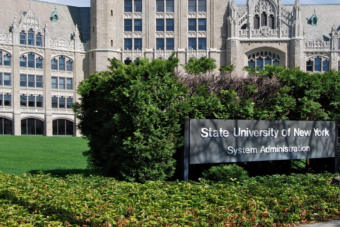
SUNY System Administration Building
SUNY System Administration Building, the administrative headquarters of the State University of New York, located in Albany, New York. (Creative Commons photo by UpstateNYer)

University of Alaska students have plenty to worry about. Gov. Mike Dunleavy’s line-item vetoes made deep cuts to the system’s budget. And separately this month, some 12,000 UA students were told there’s no money for their state scholarships, unless the Alaska Legislature votes to restore funding.

With so much uncertainty, many UA students are considering their options. That’s opened the door to controversial recruiting practices from at least one other university.

Sine Anahita is a professor of sociology at the University of Alaska Fairbanks and the president of the UAF faculty senate. She also created and moderates a Facebook page for the University of Alaska community. She said with the current budget crisis, she’s been spending much of her time there, sharing information and trying to dispel rumors.

That’s how she saw the ad.

“I am just constantly on Facebook,” Anahita said. “So it just came across my newsfeed.”

It was a sponsored post by the State University of New York, or SUNY. A black-and-white photo shows a young woman smiling down at a laptop. The post says this:

“Worried about the future of Alaska’s universities? SUNY is accepting students now. You can bring The State University of New York home with you and complete your degree from a name you can trust, 100% online!”

Anahita said her first reaction was indignation.

This sponsored post from the State University of New York, which appears to target University of Alaska students, appeared on Facebook in July 2019. After receiving complaints from UA officials, SUNY removed the ad. (Screenshot from Facebook, July 2019)

“Our students are feeling very stressed right now. Students don’t know whether they can continue at the University of Alaska,” Anahita said. “There’s just lots of anxiety and fear. And it sounded to me like the SUNY people were taking advantage of our students’ fear.”

Anahita took a screenshot of the ad and shared it with UAF administration. It quickly made its way to the office of the university president.

Robbie Graham, UA’s associate vice president of public affairs, was not pleased.

“This is a very difficult time for the university, as you can appreciate,” Graham said. “And it’s really hard to see those kinds of comments and those kinds of solicitations from a fellow university during a really difficult time like this.”

Graham confirmed UA President Jim Johnsen called SUNY to express his concern. On July 19, state senator Fairbanks Democratic Sen. Scott Kawasaki shared his own screenshot of the ad, along with a short note calling it “sad” that the governor’s vetoes “have caused outside institutions to target Alaskan students.”

The original post has since been removed.

In a written statement, SUNY press secretary Holly Liapis said SUNY contacted the University of Alaska to “extend our regrets regarding the Facebook advertisement.”

Site notifications
Update notification options
Subscribe to notifications