Zoe Grueskin, KTOO

As the Juneau School District responds to online monitoring concerns, student questions remain

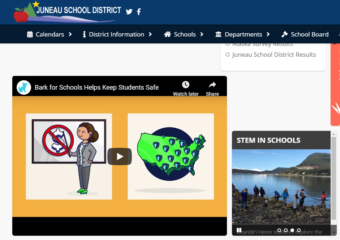
The Juneau School District posted information about Bark for Schools on its homepage, as it appears here on Oct. 31, 2019, including FAQs and an informational video produced by Bark.
The Juneau School District posted information about Bark for Schools on its homepage, as it appears here on Oct. 31, 2019, including FAQs and an informational video produced by Bark. (KTOO screenshot)

This fall, the Juneau School District began using a third-party service to monitor emails and messages sent on school accounts, hoping to increase student safety.

Students and parents have raised concerns about privacy and data control. The district has made adjustments, but there’s still plenty of confusion.

The first time Toby Minick heard about it, he was at school. He’s a senior at Juneau-Douglas High School: Yadaa.at Kalé.

“I think it was probably in calculus class, which is my first class of the day. And a lot of people were kind of, like, murmuring and talking about it.”

Minick’s classmates were talking about Bark for Schools. Provided by a tech monitoring company called Bark, it’s a service the Juneau School District started using this fall to monitor what passes through student accounts. It screens for mentions of violence, self-harm, drug use, sexual content and cyberbullying — flagging messages for school administrators to review.

Parents can sign up to receive those alerts, but they’ll only get them right away if a message is flagged outside of school hours. Otherwise, they’ll receive them in weekly updates on their students’ accounts.

The district’s goal in using Bark for Schools is student safety, but many were unhappy to learn about the service. A handful of students, parents and teachers — and one outgoing member of the Juneau School District Board of Education, Steve Whitney — shared their concerns at the Oct. 8 school board meeting. Most pointed to a lack of communication about exactly what Bark for Schools is and what it does.

Since then, the district has shared more information on its website and directly with families. But weeks later, students like Minick still have questions.

“Until we get answers, I’m super against it. And probably when we get answers, I’ll still be super against it. It just seems like an invasion of privacy,” said Minick.

The school district sees things a little differently.

Bridget Weiss smiles as she's congratulated on her appointment to interim superintendent of the Juneau School District at a meeting of the Juneau School Board on Aug. 6, 2018. (Photo by Jeremy Hsieh/KTOO)
Juneau School District Superintendent Bridget Weiss on Aug. 6, 2018. (Photo by Jeremy Hsieh/KTOO)

“We have no desire to monitor anything private. We are monitoring an academic environment that we are providing,” said Juneau schools Superintendent Bridget Weiss.

Many students and parents still aren’t sure about Bark’s reach.

According to the company and the Juneau School District, Bark only monitors messages sent from — or to — school-issued email addresses and Gmail chat, as well as anything stored in student Google Drive folders or posted in Google Classroom.

Bark does monitor those accounts when a student uses them on a personal phone or computer, but it does not monitor anything else on the device. It doesn’t track internet searches, and it has nothing to do with school Wi-Fi networks.

Weiss said if a student talks about an unsafe situation on a school platform, administrators should be able to respond. She said they treat the alerts just as they would if a teacher or parent overheard something concerning and reported it.

The district has always had the ability — and a legal responsibility under the Children’s Internet Protection Act — to monitor school platforms. But with 2,500 students, Weiss said the district didn’t have an effective way to do it.

“What this is allowing us to do is to have a shield of protection for students that we didn’t have the manpower — would never have. It would be impossible to do a literal monitoring by a human being in the same way,” said Weiss.

For some parents and students, that is their biggest concern: that the monitoring is being done by a third-party company.

Minick shares that reservation.

“It is weird that our schools are monitoring us, but I feel like that’s more acceptable to me than if a company is taking our data or scanning our data and that kind of stuff,” Minick said. “I trust my school more than I trust this ethereal other company, Bark, that I don’t know anything about.”

Bark doesn’t make any money off Bark for Schools, at least not directly. It provides the free service to over 1,500 school districts in the country. According to the company’s website, its motivation was the Parkland school shooting. Through that partnership, Bark hopes to build trust and interest in its main product: a service that parents — not schools — can buy to monitor their kids’ personal messages and social media accounts.

Another complaint raised by parents at the October school board meeting was the influx of advertising for Bark’s parent product sent to parent email addresses since the service’s implementation. In response, the school district has requested Bark to stop sending solicitations, unless a parent has signed up to receive Bark notifications.

Students at the school board meeting also questioned how Bark might use the data it collects. In a phone interview with KTOO, Bark’s Chief Parent Officer Titania Jordan said data is never shared with other companies.

“We are not looking to monetize or sell your children’s personal data,” Jordan said. “Our goal as a company is to protect your family and empower you with the knowledge to protect your family.”

Jordan encouraged anyone with questions or concerns about Bark to contact the company directly at help@bark.us.

Normally, Bark deletes all data 30 days after it’s collected. The Juneau School District requested that period be reduced to 15 days.

Jordan said Bark tries to provide tools to keep kids safe at a time when technology is changing rapidly

“This is a whole new landscape, right? Kids have never had this sort of access before in human history. And schools and parents have never had to school or parent kids in this sort of environment ever,” said Jordan.

Minick, 17, said growing up in that environment doesn’t mean his peers take any of it for granted.

“I don’t think a lot of people have that opinion that, like, our privacy in a new, digitalized age is something that we should assume is already, you know, forfeit or whatever,” Minick said. “We should know where our information is going, who has it, what they’re doing with it.”

In response to concerns from students and parents, Weiss said the district is providing options.

Families have three choices. One is to stick with the status quo and use all school-provided platforms, monitored by Bark. Another is to completely opt out of school platforms — but a lot of classes rely on online tools, and it’s not clear how students and teachers will have to adjust. The third option is restricted access: Students will be able to use Google Classroom and Google Docs, but they won’t have a school-issued email address or Gmail chat. However, any messages sent to school accounts will still be monitored by Bark.

Families interested in restricted access or opting out should contact their principal.

District administrators hope they can answer remaining questions about Bark and move forward with the school year. But district chief of staff Kristin Bartlett said she’s pleased to see students engaged and thinking critically.

“All of the questions that the students have been asking are the questions that we have taught them to ask — about their privacy, and their footprint and how their information is being used. So the fact that they’re asking these questions is exactly what we would want them to do,” said Bartlett.

Bark won’t officially be on the agenda of the next school board meeting — it’s not an action item the board can vote on — but Weiss will give an update.

Members of the public can speak about Bark or any other topic during the public comment period. The board meets on Tuesday, Nov. 12, at 6 p.m. in the library of Juneau-Douglas High School: Yadaa.at Kalé.

Juneau immersion classroom aims to teach new generation of Lingít speakers

Most fluent speakers of the Lingít language are elders. But the instructors of an immersion classroom in Juneau have high hopes: to raise a new generation of Lingít speakers.
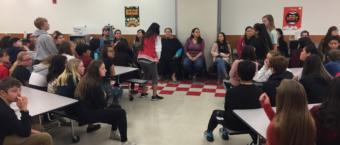
When you step inside the Haa Yóo X̱ʼatángi Kúdi classroom, two rules are immediately clear: shoes off, and Lingít only. At least for the adults.

Haa Yóo X̱ʼatángi Kúdi means “our language’s nest,” or “our language nest.”

Daaljíni Mary Cruise is the lead instructor and administrator of the program. She didn’t grow up speaking Lingít — the language stopped in her family when her great-grandmother was sent to boarding school in Oregon — but when she started college at the University of Alaska Southeast, Cruise signed up for a class. Then another. And another. 

“And my adviser was telling me, ‘Well, you’re probably not going to get a teaching degree anytime soon. Because you keep taking all these language classes,’” Cruise said.

Cruise did eventually earn a master’s in education and took all the Lingít classes she could. But she said she still wouldn’t claim to be fully fluent.

“No matter how much I learn, I’m still just a child in the language,” she said.

The fact is, she said, it’s easier to learn a language when you’re young. Ideally, very young. Most of the students in her immersion classroom are 3- to 5-years-old. Cruise hopes by starting early, they can master Lingít.

The program is still getting off the ground. The money fell into place last summer, when the Central Council of Tlingit and Haida Indian Tribes of Alaska received a $1 million federal grant from the Administration for Native Americans, under the U.S. Department of Health and Human Services, to start a language nest. 

Haa Yóo X̱ʼatángi Kúdi opened briefly this spring and again this September, now located inside Tlingit and Haida’s vocational training & resource center. Currently, 14 students are enrolled in the program, and there’s a waitlist. Class is Tuesday through Friday from 1 to 5 p.m., and the program will roughly follow the school year, with summers off.

Along with Cruise there are two more instructors and a birth speaker language adviser, Kaakal.aat Florence Marks Sheakley.

“At home we hardly ever spoke any English,” Sheakley said. “One of the things that grandma told us was if you stop speaking your language, that means you’re ashamed of who you are.”

Sheakley helps the other instructors with pronunciation and word choice. She also translates a lot of the teaching materials, like children’s books and songs, a skill she first honed translating letters for her aunties.

Daaljíni Mary Cruise (left) works on a lesson plan with Kaakal.aat Florence Marks Sheakley in the Haa Yóo X̱ʼatángi Kúdi Lingít immersion classroom in Juneau on Oct. 9, 2019. (Photo by Zoe Grueskin/KTOO)
Daaljíni Mary Cruise, left, works on a lesson plan with Kaakal.aat Florence Marks Sheakley in the Haa Yóo X̱ʼatángi Kúdi Lingít immersion classroom in Juneau on Oct. 9, 2019. (Photo by Zoe Grueskin/KTOO)

Sheakley has taught Lingít for years, often to adults including Cruise, at UAS. She said it’s heartwarming to work with the youngest students.

“Oh, gosh, they’re just like little sponges,” Sheakley said. “They don’t have a hard time saying difficult sounds that maybe the adults have a hard time saying. The children, they just spit it right out.”

A major goal of the immersion classroom is to involve families. Parents and friends are invited to twice monthly family nights, so they can get to know each other and learn a little of what their kids are learning. The instructors hope the families will keep practicing Lingít at home.

That commitment is something that initially worried Madeline Soboleff Levy. She grew up in Juneau but lived away for many years before moving back with her family. When Haa Yóo X̱ʼatángi Kúdi started accepting applications, she and her husband discussed whether to enroll their 3-year-old in the language nest.

Madeline Soboleff Levy with her son Memo, a student in the Haa Yóo X̱ʼatángi Kúdi Lingít language nest, pictured in the classroom in Juneau on Oct. 9, 2019. (Photo by Zoe Grueskin/KTOO)

“I kind of walked through all kinds of pros and cons with him, and he looked at me, and my husband said, ‘Why are we living here if we’re not going to put him in this program?’ And I thought, well, I think you’re right. Why did we move home? If not to do this?” said Soboleff Levy.

Her son has only been at the Lingít immersion classroom for a few weeks, but she said he’s already picking it up.

“If I talk to him about the day, he doesn’t always have a lot of Lingít to speak to me, but then we’ll be walking around the house and he’ll start singing ‘Twinkle, Twinkle Little Star’ in Lingít, or he’ll start counting things 1-2-3, or telling people he’s nás’k, he’s 3 years old,” she said.

Another parent, Joy Demmert, hopes the language nest is just the beginning of her son’s Lingít education.

“I’m looking forward to it progressing and blossoming and just being a footstep for him to be able to take classes all through high school and being able to graduate and become a fluent speaker,” Demmert said.

At this point, many of those next steps don’t exist. The future of the Lingít language is far from secure. X’unei Lance Twitchell is an associate professor of Alaska Native Languages at UAS and a part-time instructor in the immersion classroom. He estimates the number of Lingít speakers anywhere with a high level mastery of the language is only about 10.

Twitchell sees revitalizing Lingít as a long road. But Haa Yóo X̱ʼatángi Kúdi, the language nest, gives him hope.

“When you try to build these language nests, you feel like you’re doing the wrong thing, because you’re not ready, you’re not prepared, you need more teachers, you need more materials,” Twitchell said. “But when people see those babies start talking, it starts to shift things in ways that other things might not.”

‘Devilfish’ playwright’s favorite audience? Eighth graders.

Eighth graders in Juneau had a day at the theater this month to watch “Devilfish,” a play that tells the story of a young Tlingit girl struggling with grief and new responsibility. After the performances, cast and crew visited middle schools to answer questions and share a few tricks of the trade.

The cast and crew of "Devilfish" visit Floyd Dryden Middle School on Oct. 10, 2019.
The cast and crew of “Devilfish” visit Floyd Dryden Middle School on Oct. 10, 2019. (Photo by Zoe Grueskin/KTOO)

Erin Tripp, star of Devilfish, stood in the cafeteria of Juneau’s Floyd Dryden Middle School. In front of her, eighth graders sat squeezed together at lunch tables, watching Tripp cradle an invisible basket.

“OK, so your berry basket’s in your left hand. Pick a berry on your left,” said Tripp, reaching out as if to pluck a blueberry. “Put it in your basket.”

Tripp was teaching the students a berry picking dance from the play, which they had all watched a couple days before.

At the start of the show, Tripp’s character, Aanteinatu, is about their age.

Playwright Vera Starbard didn’t write Devilfish with middle schoolers in mind, but she told the students that they were the cast and crew’s favorite crowd by far.

“Thank you guys so much not only for coming but for being an awesome audience. When you react to things, and your energy, really affects how the actors are in the play,” Starbard said.

And Starbard realized it makes sense. The play is about a young woman coming of age. She fights with her mother. She has a decidedly complicated love life, which came up a lot during the question-and-answer session in the Floyd Dryden cafeteria.

“Does she like him or him?” asked one student, pointing from Tripp to two of her co-stars.

“I love both of them, OK? That’s what it is, it’s a love triangle!” Tripp replied, drawing a large “ooh” from the students.

But Aanteinatu is also dealing with immense grief. As the play opens, she has just lost her entire village to the mysterious and possibly monstrous devilfish.

Starbard, who is Tlingit and Dena’ina, drew inspiration from stories she heard growing up from her parents and elders. Starbard’s story, of Aanteinatu, first took form as a book she wrote more than 10 years ago. Later, she adapted it into the play, which had its world premiere this fall at Juneau’s Perseverance Theatre.

Juneau eighth graders got to see the show and meet some of its stars and creators through a program called Ensuring the Arts for Any Given Child that connects students to artists in the community. 

Stephen Blanchett, art education director at the Juneau Arts & Humanities Council, helps coordinate the program.

“I have seen firsthand the impact that it makes in the community,” Blanchett said. “Creating new dancers, creating new singers, creating mask makers, creating drummers, I mean, those type of things, when you when you see that happen in a place, it’s huge.”

The hope is that students will be inspired by the art they see and maybe create some themselves. But Starbard said the inspiration goes both ways.

“The way they reacted just made me so excited,” she said. “This has me really thinking I need to do a show just for kids.”

Starbard will write three more plays for Perseverance Theatre over the next three years. One of them, she said, just might be a children’s play.

(From left) Stephen Blanchett, Vera Starbard and Mandy Mallott visited Floyd Dryden Middle School with the cast and crew of Devilfish on Oct. 10, 2019. Mallott, who helped organize the visit, says "It shouldn't matter what school a child goes to, they should all have access to the arts." (Photo by Zoe Grueskin/KTOO)
From left: Stephen Blanchett, Vera Starbard and Mandy Mallott visited Floyd Dryden Middle School with the cast and crew of Devilfish on Oct. 10, 2019. “It shouldn’t matter what school a child goes to, they should all have access to the arts,” said Mallott, who helped organize the visit. (Photo by Zoe Grueskin/KTOO)

Updated: Juneau school board approves elementary school boundary change

Update (Wednesday, 12:09 p.m.)

Families who live in Juneau’s future Pederson Hill subdivision will send their kids to Riverbend Elementary School, following a unanimous vote at Tuesday’s school board meeting to adjust elementary school attendance area boundaries.

Also at the meeting, the school board said goodbye to two outgoing members, Dan DeBartolo and Steve Whitney, and swore in newly-elected Deedie Sorensen and Emil Mackey. Sorensen and Mackey will each serve 3-year terms.

Brian Holst was reelected school board president. Elizabeth “Ebett” Siddon was elected vice president, and Paul Kelly was elected board clerk.

Original story

The Juneau School Board will vote Tuesday on whether to make a small change to elementary school attendance area boundaries.

The area in question is almost entirely covered by what will be the new Pederson Hill Subdivision. With the current boundaries, families who will one day live in the subdivision would have to drive or bus their kids to Auke Bay Elementary School.

But there’s another elementary school within walking distance. Trails have already been built that connect the new subdivision to Riverbend Elementary School.

“So students who live in the Pederson Hill subdivision would be able to walk to school on a trail system without having to go near a road,” Juneau School District Chief of Staff Kristin Bartlett said.

Bartlett also said Riverbend Elementary School has more room available for new students than Auke Bay. 

The change would move the boundary line between Auke Bay and Riverbend elementary schools on the north side of Glacier Highway from the Mendenhall River to Karl Reishus Boulevard.

Although the boundary change would primarily affect the future residents of the Pederson Hill subdivision, a few existing houses would also be included in the change. Bartlett says those families will have the option to continue sending their kids to Auke Bay elementary school.

The Juneau school board will vote on the boundary change at its regular meeting on Tuesday, Oct. 8 at 6 p.m. in the library of Juneau-Douglas High School: Yadaa.at Kalé.

Cemetery caretaker calls on community to clean, protect Alaska Native graves

Bob Sam pictured in Juneau's Evergreen Cemetery on Sep. 28, 2019. (Photo by Zoe Grueskin/KTOO)
Bob Sam pictured in Juneau’s Evergreen Cemetery on Sep. 28, 2019. (Photo by Zoe Grueskin/KTOO)

Many Alaska Native gravesites in Juneau are overgrown and all but forgotten. Tlingit storyteller and cemetery caretaker Bob Sam hopes to change that. He led a tour through Juneau’s cemeteries during the Sharing Our Knowledge conference in September to raise awareness and respect for the graves and the ancestors buried in them.
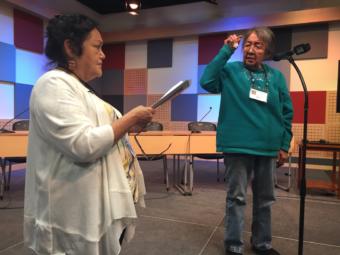
A couple dozen people fill the seats of a small tour bus. It’s standing room only and at the front is Bob Sam. He introduces himself as “just a simple caretaker.”

Sam lives in Sitka. He’s been cleaning and protecting gravesites there for over 30 years, and he picks up the work in Juneau when he’s in town. 

In particular, he’s been visiting Evergreen Cemetery for years, across the street from Harborview Elementary School. His grandfather is buried there, as well as founders of the Alaska Native Brotherhood and Tlingit civil rights advocate, Elizabeth Peratrovich.

But many headstones lay toppled over. Some are overgrown. For years, Sam says, the cemetery was a popular place for high school students to hang out and party. He’d find trash and empty bottles strewn about.

“I found needles here. It was very sad,” he said. “So I cleared all the brush. And I opened up the whole place. And something beautiful happened.”

Sam says when people noticed the cemetery was being cared for, they stopped leaving garbage around the graves. He says he even saw high school students picking up trash.

Toppled and overgrown headstones in Juneau's Evergreen Cemetery, pictured on Sep. 28, 2019. (Photo by Zoe Grueskin/KTOO)
Toppled and overgrown headstones in Juneau’s Evergreen Cemetery, pictured on Sep. 28, 2019. (Photo by Zoe Grueskin/KTOO)

Sam is hoping a good clean-up can transform another cemetery in Juneau. It’s on Douglas Island, hidden in plain sight right off the Douglas Highway and Lawson Creek Road. There’s an area with Alaska Native graves, another with Masons, a Russian Orthodox section and an area known as the Asian cemetery.

Cleaning it up will be a big undertaking. Apart from a neatly mowed section maintained by a Catholic church, most of the cemetery doesn’t look like a cemetery at all. It’s a steep hillside, covered in brush on one side, trees on another. 

Kahdushan Michael Dunlap stands in front of his great-grandfather's grave in a cemetery on Douglas on Sep. 28, 2019. (Photo by Zoe Grueskin/KTOO)
Kahdushan Michael Dunlap stands in front of his great-grandfather’s grave in a cemetery on Douglas Island on Sep. 28, 2019. (Photo by Zoe Grueskin/KTOO)

When the tour group arrives, one man walks off on his own, stepping high through the tall plants to a spot he seems to know well.

His name is Kahdushan Michael Dunlap, and he stands by the grave that belongs to his great-grandfather, Jack Marshal.

Dunlap pulls out brush by the fistful until the headstone is clear.

“This is sacred ground for me,” he said.

Dunlap is good friends with Sam. He helped him clean up the cemetery years ago, although much of the brush has grown back since then.

For Sam, that’s a call to action.

“Maybe it’s our responsibility. Maybe we’re the ones that should take care of this place,” said Sam.

Sam is hoping to begin the work again — soon.

Graves are barely visible in an overgrown cemetery on Douglas island, pictured on Sep. 28, 2019. (Photo by Zoe Grueskin/KTOO)
Graves are barely visible in an overgrown cemetery on Douglas Island, pictured on Sep. 28, 2019. (Photo by Zoe Grueskin/KTOO)

International Lingít Spelling Bee brings together Alaska Native language learners in Juneau

Members of Tlingit, Haida and Tsimshian tribes and clans came together for the Sharing Our Knowledge Conference, held in Juneau Sept. 26-29. The jam-packed schedule included ceremonies, dozens of presentations — and the Fourth International Lingít Spelling Bee.

There is no ready-made Lingít word for “spelling bee.” But Will Geiger was curious.

So not long before he stepped onstage to compete, Geiger consulted Tlingit elder and educator Kingeisti David Katzeek.

Katzeek offered a phrase that, Geiger explained, means something like, “People coming together to — almost, like, against one another, with the written names. Something like that.”

Geiger is not Tlingit, but he has been studying the Lingít language for about eight years. He works on language projects at the Sealaska Heritage Institute in Juneau — and he’s a past champion of the spelling bee, which has happened a few times over the years at clan conferences. It’s meant to be a lighthearted event, not too serious. Geiger showed up at this one not necessarily intending to participate, but he was persuaded.

Organizer Kashgé Daphne Wright was a little worried about having enough competitors.

“We just hope that people will come and participate, because it’s harder than it looks,” Wright said.

Eventually, nine spellers were assembled. A few had grown up speaking Lingít with their families. Others were white Juneauites who’d begun studying the language only recently. And making the competition truly international, one contestant had traveled to the conference from her home in the Yukon.

Wright, a Lingít teacher in Hoonah, discussed what assistance would be available to spellers with Virginia Oliver, who would be pronouncing the words. They agreed Oliver could define a word in English, use it in a sentence and act it out with hand gestures.

Other than that, it was pretty standard spelling bee rules.

“The speller may start over on spelling a word but may not correct an error once it has been uttered. The pronouncer will be the judge,” said Oliver.

Oliver turned to be a pretty forgiving judge — a fact appreciated by contestant Skíl Jáadei Linda Schrack from Ketchikan.

She was given the word “héen,” the Lingít word for “water.”

“X, high tone E, E,” Schrack began. “Oh wait, no. X underline? Oh, H! Third time’s the charm.”

Contestants in the 4th International Lingít Spelling Bee held in Juneau on Sep. 27, 2019. (Photo by Zoe Grueskin/KTOO)
Contestants in the Fourth International Lingít Spelling Bee held in Juneau on Sept. 27, 2019. (Photo by Zoe Grueskin/KTOO)

Wright, who has organized previous Lingít spelling bees with her sister, Linda Belarde, said they usually go fast. Spellers miss words and get eliminated quickly, because when you’re spelling words in Lingít, Wright said, it’s not just letters you have to remember.

“Tone marks, pinches, underlines. It’s all vital, it’s part of the spelling, so if they miss even one of those things (then it’s misspelled),” said Wright.

When Schrack eventually missed a word and was out of the competition, she wasn’t too upset. She’s Haida, not Tlingit. She took part in the spelling bee alongside a couple friends from work at Ketchikan Indian Community. Schrack said they often teach each other words in their languages — Lingít or the Haida language, Xaad Kíl — and they thought it would be fun to do together.

“It was a little nerve racking, because I’m not sure the exact sounds of the Lingít alphabet as compared to the Xaad Kíl, so I was just taking a guess,” Wright said.

Schrack said she’d like to hold a Xaad Kíl spelling bee with her students in Ketchikan.

In the end, Geiger was again named top speller. The winning word: “t’ooch’,” meaning “charcoal.”

His prize: a certificate and a book about Alaska Native languages.

After the bee, several of the contestants wanted to stay and play Lingít language learning games, but another event was scheduled to start in the same room: a panel on learning ancestral languages. A few of the contestants were even speaking on the panel. So there was just time to rearrange some furniture, say congratulations and thank you — Gunalchéesh.

Editor’s note: KTOO Public Media was under contract to produce video coverage of the 2019 Sharing Our Knowledge Conference.

Site notifications
Update notification options
Subscribe to notifications