Alaska Department of Education and Early Development Commissioner Michael Johnson gives an overview about education in Alaska to the Senate Education Committee, Jan. 24, 2019. (Photo by Skip Gray/360 North)
The Alaska Department of Education and Early Development, or DEED, announced Tuesday it will receive $20.7 million from the federal government to support reading skills across the state.
The U.S. Department of Education will distribute the grant over five years, starting with about $4.9 million in the current school year. DEED will then receive about $3.9 million each of the next four years.
According to the state’s education Commissioner Michael Johnson, DEED applied for the grant to support one of the goals in its strategic plan to have all students reading at grade level by the third grade.
The state plans to use the funds to create and implement a literacy program that will include reading coaches for students and specialized training for teachers.
School districts will be able to apply for sub-grants to support reading skills. The state says details on the application process for those sub-grants will be shared in the near future.
Deedie Sorensen laughs with friends at Juneau City Hall as results of the municipal election roll in on Tuesday, Oct. 1, 2019, in Juneau. (Photo by Rashah McChesney/KTOO)
Unofficial results show a clear front-runner in the election for Juneau School District Board of Education.
Retired elementary school teacher Deedie Sorensen earned not only the most votes overall on election night, but the most votes in each precinct.
Sorensen was at Juneau City Hall as the final precincts were reported. She said the results left her surprised, excited, humbled “and pleased that, you know, people think that my experience will be valuable on the school board.”
Juneau School Board candidate Emil Robert Mackey III watches municipal election results come in on election night, Oct. 1, 2019, in Juneau. (Photo by Rashah McChesney/KTOO)
Sorensen taught in Juneau elementary schools for 35 years before retiring. She has a master’s degree in education from Eastern Montana College, now called Montana State University Billings. She currently works part-time in medical reception and billing.
The top two finishers will each earn three-year terms on the school board. Behind Sorensen, it was a close race between Emil Robert Mackey III and Martin Stepetin Sr.
Tuesday’s results showed Mackey with a 187-vote lead. But with more than 2,000 absentee and questioned ballots still to be counted, Mackey’s not celebrating yet.
“I’m happy, but it’s not over yet,” Mackey said.
Stepetin, who came to City Hall after wrapping up his watch party, said he was happy with the numbers on election night.
Martin Stepetin Sr. watches results roll in for a school board seat he has been running to fill, Oct. 1, 2019, in Juneau. (Photo by Rashah McChesney/KTOO)
“For a first-time campaign, I would like to think I did OK here, you know? I’m really happy with the amount of votes I pulled off today,” Stepetin said.
The city hopes to certify the results by next Tuesday, Oct. 8. Stepetin and Mackey both said if the other is elected, he’d make a great school board member.
Mackey previously served on the Juneau School Board from 2015-2018. He has a Ph.D. in public policy with a concentration in higher education policy from the University of Arkansas and a master’s degree in education from the University of Alaska Fairbanks.
Stepetin works for the Central Council of Tlingit and Haida Indian Tribes of Alaska as a caterer and courier driver. He has four children in the Juneau School District.
Unofficial results showed Bonnie Jensen in fourth place. Jensen, who grew up in Juneau, is an accountant at the Alaska Department of Fish and Game.
The two newly elected members will be sworn in at the next school board meeting on Oct. 8. They’ll replace outgoing board members Dan DeBartolo and Steve Whitney.
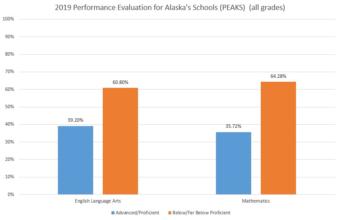
Results of the Performance Evaluation for Alaska’s Schools (PEAKS) assessment, administered in spring 2019, were released Sep. 5, 2019. (Data from the Alaska Department of Education and Early Development; Graphic by Zoe Grueskin/KTOO)
Over 76,000 Alaska students took statewide math and English tests this spring.
The state Department of Education and Early Development shared the results last week. There’s plenty of room for improvement.

Alaska students in grades three through nine took the tests this spring. Just 39.2% — fewer than 2 in 5 — earned at least a proficient score in English Language Arts. That number is even lower for math, at 35.72%.
What proficient means varies by grade level. To earn that score on the math test, a student in fifth grade must multiply and divide multi-digit numbers, among other things. For the English test, a fifth-grader needs a solid grasp on figurative language.
This is the third year the state has used this test, called the Performance Evaluation for Alaska’s Schools, or PEAKS.
Assessments Administrator Isaac Paulson said the scores aren’t much of a change from previous years. They’re down slightly from last year, but up slightly from the year before that.
“About the same over all,” Paulson said, adding that there’s not enough data yet to talk about long-term trends.
The state also shared the results of the Alaska Science Assessments, which tests students in grades four, eight and 10. Statewide, 44.65% of tested students scored at least proficient.
The state has already published every school district’s scores online. School districts can use the results to evaluate programs and inform funding decisions.
Students will receive their individual scores no later than Sept. 25, but the state is looking at the big picture. The scores help the state determine which schools need the most support, in compliance with the federal Every Student Succeeds Act.
Erin Hardin, special assistant to the education commissioner, said a major goal for the state is closing achievement gaps between different groups of students.
“When you look at, say, our economically disadvantaged students, our English learners, our students with disabilities — their results compared to all students — there are large gaps in achievement,” said Hardin.
The state is in the process of determining which Alaska schools need the most support.
In addition to assessment results, the state considers other factors including graduation rate and English language proficiency.
School districts will learn next week how the state has designated each school and make it public at the end of the month.
Bridget Weiss smiles as she’s congratulated on her appointment to interim superintendent of the Juneau School District at a meeting of the Juneau School Board on Aug. 6, 2018. (Photo by Jeremy Hsieh/KTOO)
The Juneau school board approved a new three-year contract for superintendent Bridget Weiss on Tuesday.
“I am very much looking forward to the next three years and looking forward to serving Juneau families, and teachers, and staff and students, and really working toward some of our common goals,” Weiss said.
Those goals include increasing the number of students reading at grade level by third grade and strengthening Tlingit language and culture programs.
Weiss is a graduate of Juneau-Douglas High School, now Juneau-Douglas High School: Yadaa.at Kalé.
She has worked for the Juneau school district since 2014.
A desirable piece of waterfront property in downtown Juneau may have a new private owner — Norwegian Cruise Lines — despite the City and Borough of Juneau’s efforts.
Holland America Line will pay the state a $17,000 fine a year after one of its cruise ship’s holding tanks leaked greywater into Glacier Bay National Park.
A public comment period is ending soon on proposed logging, recreation and stream work in the Tongass National Forest near Petersburg, Wrangell and Kake, but the U.S. Forest Service continues to face questions about a lack of specifics.
It could end up being the best commercial Dungeness crab season for a decade in Southeast Alaska.
Despite a large transfer to the state treasury, the Alaska Permanent Fund has grown by $1.4 billion.
The federal Bureau of Land Management is holding public meetings around the state to allow public input on two projects: a proposal to develop a section of the National Petroleum Reserve-Alaska and the Ambler Road mining project.
Moose season begins this month in Southeast Alaska. In Wrangell, sportsmen and charities are teaming up to improve the process of distributing illegally obtained moose to people in need.
The newly-opened Cannery Park in Petersburg is a place for visitors to learn about the town’s history of seafood production.
The Alaska Department of Commerce has said it does not support a regulation draft that would prohibit alcohol manufacturing businesses from hosting onsite activities including festivals, classes and performances.
Close
Update notification options
Subscribe to notifications
Subscribe
Get notifications about news related to the topics you care about. You can unsubscribe anytime.