Zoe Grueskin, KTOO

Newscast – Friday, Sept. 6, 2019

In this newscast:

  • The state announced it’s shutting down ferry service to Prince Rupert, British Columbia; the news has been met with shock and disappointment in Ketchikan.
  • NOAA scientists are tracking marine heatwave across millions of square miles of water in the Pacific Ocean.
  • Southeast’s landless tribal communities want to form five new village corporations out of 115,000 acres of Tongass national Forest.
  • A national Muslim civil liberties group has resolved its federal lawsuit against the State of Alaska for providing what it says were insufficient meals to Muslim inmates fasting as part of their faith.
  • The Alaska Supreme Court has ordered the state to pay about $100,000 in attorneys’ fees and other costs after losing a legal fight earlier this year over abortion.
  • A Southwest Alaska museum has received dozens of ancestral remains to hold until they can be returned to the Alutiiq Tribe of Old Harbor.

Newscast – Thursday, Sept. 5, 2019

In this newscast:

  • The group pursuing a recall of Gov. Mike Dunleavy has submitted signatures to state elections officials as part of an initial phase of its push.
  • The Alaska Marine Highway System opened booking for its winter schedule with fewer sailings and a new pricing system that could take travelers by surprise.
  • The cruise industry’s public face in Alaska is stepping out of the limelight.
  • The Alaska Board of Fisheries violated the state’s open meetings law, according to Alaska’s ombudsman.
  • Last month, Alaska’s US Senators accompanied Education Secretary Betsy DeVos on a trip to communities around the state.


Newscast – Wednesday, Sept. 4, 2019

In this newscast:

  • Trial has begun in Juneau Superior Court for a man accused of killing two people in Juneau over three years ago.
  • The Alaska Marine Highway System is ending service to Prince Rupert, British Columbia, at the end of the month over an impasse with U.S. customs agents demanding armed protection in Canada.
  • A high-level Alaskan appointee in the Trump administration who pushed to open the Arctic National Wildlife Refuge to oil leasing is taking a job with an oil company seeking to develop a major project in Alaska.
  • Negotiations between the University of Alaska land office and a potential buyer ground to a halt as the result of an escalating trade war between the US and China.
  • Another stock in the Bering Sea blue king crab fisheries was just added to the nation’s overfished list.
Savoonga artists bring blanket toss to Juneau

John Waghiyi, Jr. finishes work on a walrus-hide blanket in Juneau on Aug. 29, 2019. Waghiyi and his wife, Arlene (right), were artists-in-residence at the Sealaska Heritage Institute. (Photo by Zoe Grueskin/KTOO)
John Waghiyi, Jr. finishes work on a walrus-hide blanket on Aug. 29, 2019, in Juneau. Waghiyi and his wife, Arlene (right), were artists-in-residence at the Sealaska Heritage Institute. (Photo by Zoe Grueskin/KTOO)

Two Alaska Native artists from St. Lawrence Island spent a week in Juneau sharing their work. The couple’s residency culminated with a blanket toss, with a walrus-hide blanket finished only minutes before.

Around 70 people gathered outside the Sealaska building in downtown Juneau on a sunny afternoon. John Waghiyi, Jr. told them to grunt — and they did.

“I feel like I’m on the ice pack!” he said. “(It sounds like) there’s a whole herd of walrus.”

 As he spoke, young helpers hurriedly threaded a thick rope through the holes around the edge of the walrus-hide blanket, finishing the handles.

Waghiyi and his wife, Arlene, used the time to teach the crowd a walrus dance from their hometown, Savoonga, on St. Lawrence Island in the Bering Sea.

Waghiyi explained how the blanket will be used, likening it to a 14-foot trampoline, “But in this case people grab onto the rope around the edges, and a toss leader will direct everybody to pull in unison and propel a person up. Based on experience they can go higher and higher.”

When the handles are done, one crucial thing is still missing: People, lots of them, to grab hold of the handles and pull.

Sealaska Heritage Institute president Rosita Worl called out to passersby on the street: “We need pullers! Come and help! Come and help!”

Worl asked Waghiyi to create the blanket during his week-long artist residency at the institute. He had the hide already, from a walrus he harvested years ago to feed his family.

The home of the blanket toss, like walrus, is far from Southeast Alaska.

“It’s Inuit, Inupiat, Siberian Yupik — it’s predominantly an up north event. Nalukataq is what they call it. It’s a celebration of the harvest of the bowhead whale,” said Waghiyi.

But in more recent years, the blanket toss has become a feature across Alaska in competitive events like the World Eskimo-Indian Olympics and Native Youth Olympics.

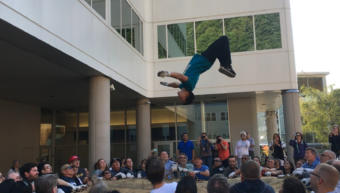
When enough pullers have grabbed hold of the blanket, Juneau Native Youth Olympics coach Kyle Worl climbed onto the blanket. He steadied himself as he was lifted a few feet above the ground. He double-checked that everyone understood the process: a few gentle pulls as he counted down, and then the big one. He landed a tidy backflip.

Kyle Worl does a back flip during a blanket toss in Juneau on Aug. 29, 2019. (Photo by Zoe Grueskin/KTOO)

The second, and final, jumper of the day was 9-year-old Race Katchatag, a young relative of the Waghiyis who lives in Juneau. It was his first time jumping, and he did it cross-legged. He left the blanket grinning.

“I thought I was gonna fall, like hit the ground, but I didn’t,” he said.

Katchatag offered this advice to first-time blanket toss jumpers: “Just like, believe in yourself.”

The blanket Waghiyi created will be used for blanket toss competitions in Juneau for years to come.

‘Molly of Denali’ creators help Juneau kids find their own voices

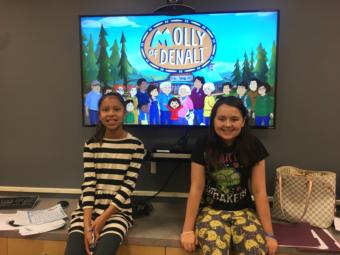
Nanibaa' Frommherz (left) and Isadora Kizer participated in a voice acting workshop led by creators of Molly of Denali, organized by the Central Council of the Tlingit and Haida Indian Tribes of Alaska, on Aug. 9, 2019. (Photo by Zoe Grueskin/KTOO)
Nanibaa’ Frommherz (left) and Izzy Kizer participated in a voice acting workshop led by creators of “Molly of Denali,” organized by the Central Council of the Tlingit and Haida Indian Tribes of Alaska, on Aug. 9, 2019. (Photo by Zoe Grueskin/KTOO)

The new animated children’s TV show, “Molly of Denali,” is the first national children’s show to feature an Alaska Native lead.

Some of the show’s creators came to Juneau this month. As part of their visit, they put on a vocal acting workshop to help local kids find their own voices.
Joel Price said he didn’t really know what his father had signed him up for.

“Um, just meeting some fancy people,” Price said.

Those fancy people included the creative producer of “Molly of Denali,” Princess Daazhraii Johnson, and the voice of Molly herself: Sovereign Bill.

A girl in a black vest stands in front of a tv screen. Tlingit and Muckleshoot actress Sovereign Bill poses at a voice-over workshop at KTOO Public Media before the Juneau premiere of the PBS KIDS show "Molly of Denali" Saturday, August 10 at 9:30 a.m. at Elizabeth Peratrovich Hall.
Tlingit and Muckleshoot actress Sovereign Bill poses at a voice-over workshop at KTOO Public Media before the Juneau premiere of the PBS KIDS show “Molly of Denali” Saturday, August 10 at 9:30 a.m. at Elizabeth Peratrovich Hall. (Photo by Sheli DeLaney/KTOO)

For the record, Price said they weren’t actually very fancy at all, just really nice.

Price was one of 13 kids in the workshop on self-expression and voice acting. It was held the day before a community screening of the show in Juneau. Both events were organized by the Central Council of the Tlingit and Haida Indian Tribes of Alaska. KTOO provided the space for the workshop.

Johnson kicked things off with some energizing warm-ups, reaching for the stars on tippy toes, shaking everything out.

When everyone was good and stretched, Johnson and Bill talked about their work and then walked through the basics of vocal acting. The kids got to put it into practice right away, recording some public service announcements, which will air on KTOO.

That was Izzy Kizer’s favorite part of the afternoon.

“I thought I would stutter, or lisp, or mumble or something like that,” Kiser said. “And I actually surprised myself that I didn’t do any of that in the entire recording. I thought I did kind of good.”

Twelve-year-old Kizer is happy to see “Molly of Denali” on the air. The show takes place in a fictional village in Interior Alaska. Molly and many of the characters are Athabaskan. Kizer hopes the show will broaden perspectives.

“Not many people really acknowledge our culture,” she said. “They think we live in, like, igloos with polar bears and penguins, but really we don’t.”

Kizer, who is Tlingit, has some ideas of her own for a kids show set in Southeast Alaska. The main character would be a grizzly bear, Kizer’s favorite, and it would feature other regional animals, like seals and wolves.

“They would solve problems, like, act like people in real life,” she explained, “and they would talk and stuff, and it would be cool.”

Ideas like that are exactly what the workshop’s organizers hoped to hear. Emily Edenshaw is director of business and economic development at Tlingit & Haida, and she helped put together the event.

“There were 13 youth today. If one of them gets the tiniest bit of hope that, ‘Maybe I can do this,’ or, ‘I want to do this’ — this is why I do the work that I do,” Edenshaw said.

Edenshaw, who is Yup’ik and Iñupiaq, said she’s been watching “Molly of Denali” at home with her kids. It’s a powerful experience, she said, watching as a family.

“Being a 35-year-old woman, and I’m having the same experience as my 9-month-old daughter and my 13-year-old,” she said. “My kids are never going to grow up in a world where they’re not going to be able to see themselves represented.”

After the workshop, Johnson offered some short and sweet advice for any kids who want to get involved in the arts: Explore, have fun and be curious.

It’s the kind of thing “Molly of Denali” might say.

State funding for early education restored, but services this year could still be affected

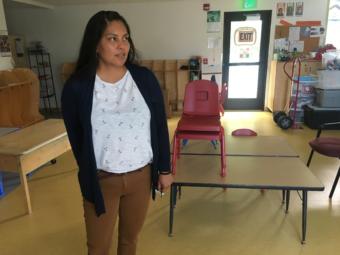
Amber Frommherz, director of Tlingit & Haida’s Head Start program, pictured in one of five Juneau Head Start classrooms on July 24, 2019. (Photo by Zoe Grueskin/KTOO)

Gov. Mike Dunleavy agreed Tuesday to restore funding for early education in Alaska. But educators in Juneau say that even with funding back in place, services this year could be affected.

In June, the governor vetoed nearly $9 million for Head Start and early learning programs from the state operating budget.

The Central Council of the Tlingit and Haida Indian Tribes of Alaska, which operates 15 Head Start classrooms around Southeast, planned to respond to those cuts by closing three classrooms and discontinuing bus services.

Tlingit and Haida Head Start director Amber Frommherz said the funding reversal is good news — but it’s not yet certain if all services will be restored.

“Plans have been put in place that it’s hard to walk back from, because this was such a disruption,” she said.

Frommherz said she and her staff are working to open all classrooms in September, but it will be a scramble. Reinstating bus services will be a particular challenge, she said, because they’ve already gotten out of their contracts.

Juneau School District had hoped to add preschool classrooms this year. But with the start of the school year just around the corner, superintendent Bridget Weiss said that’s off the table for now.

“It’s very disruptive to the system to try to do that and find a teacher and move forward right now with expanding a classroom,” Weiss said.

But if it’s too late to add an entire preschool classroom, Weiss said the restored state funding gives the district more room to expand services in other ways. That could include more full-day and after-school preschool programs. Weiss said those changes could happen this school year.

The first day of preschool at Juneau schools is Aug. 27. Tlingit and Haida Head Start classrooms will open in early September.

Site notifications
Update notification options
Subscribe to notifications