Zoe Grueskin, KTOO

Governor’s veto could close Head Start classrooms in Southeast Alaska

Amber Frommherz, director of Tlingit & Haida's Head Start program, pictured in one of 5 Juneau Head Start classrooms on July 24, 2019. (Photo by Zoe Grueskin/KTOO)
Amber Frommherz, director of Tlingit & Haida’s Head Start program, pictured in one of five Juneau Head Start classrooms on July 24, 2019. (Photo by Zoe Grueskin/KTOO)

Head Start pre-K classes in Southeast Alaska usually start in late August. But Gov. Mike Dunleavy vetoed state funding for the program, and now some Head Start classrooms might not open at all.

The Central Council of the Tlingit and Haida Indian Tribes of Alaska operates 15 Head Start classrooms around Southeast, from Yakutat to Saxman, including five in Juneau.

They say the veto cost them $441,171 in state funding.

“Without those funds, we’re not going to close all of our doors, but we certainly have to make up the same amount through saving costs,” said Amber Frommherz, Tlingit & Haida’s Head Start director. “And unfortunately, it might just have to come to closing slots and closing programs.”

Head Start is a national program aimed at providing low-income 3- and 4-year-olds with early education, as well as meals and other services — all for free.

Frommherz said if the state does not restore funding, Tlingit & Haida will start by cutting back on non-mandatory services like busing. But she said their biggest expense by far is staffing, and cutting positions will require cutting spots in classrooms or shutting them down altogether.

Tlingit & Haida hasn’t determined yet where those cuts would be made. Frommherz said it’s a complicated choice.

“You know, we have to look at different variables of: Are there other pre-K programs there? Are we serving our target audience? You know, lower income, families experiencing homelessness, disabilities, or engaged with the foster care system,” said Frommherz.

Losing state funding also puts Tlingit & Haida at risk of losing federal dollars for Head Start. They need 20% of their funding to come from non-federal sources in order to qualify, and the state funds they were counting on would have been almost all of that. According to Frommherz, Tlingit & Haida’s state Head Start grant accounts for 14% of their total funding. She said they can apply for a waiver from the national office of Head Start, which would release them from the match requirement this year, but it won’t keep doors from closing.

She’s still hoping the Alaska Legislature will restore Head Start’s funding — and Dunleavy will let it stand. But if that doesn’t happen, she said, Tlingit & Haida will most likely make a decision next week about which positions to cut.

“I wish I could have an answer,” she said. “Even if it was bad news, I wish I knew today. I have people’s lives in limbo. I have their livelihood in limbo.”

Families are in limbo too. Frommherz said it makes sense for the state to support Head Start in rural Alaska, and that pre-K shouldn’t just be available to city dwellers and the wealthy.

“You know, fishermen, and all of our caretakers of our beautiful state in these tourist-heavy, visited areas. Those folks, their children also deserve an early education,” said Frommherz.

Tlingit & Haida’s Head Start program currently serves 262 children throughout Southeast Alaska.

Financial exigency likely means UAS layoffs and program reductions — but not before fall classes begin

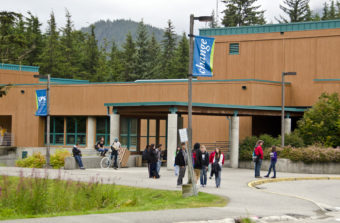
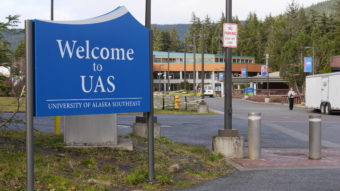
University of Alaska Southeast (Photo by Heather Bryant/KTOO
University of Alaska Southeast’s Juneau campus on August 19, 2013. (Photo by Heather Bryant/KTOO)

The University of Alaska Board of Regents voted yesterday to declare financial exigency. That clears the way for rapid downsizing, including significant layoffs.

Kevin Maier teaches English and humanities and serves as chair of the Humanities Department at the University of Alaska Southeast. But right now, he’s on vacation. On Monday, while his family went to the pool, he stayed in. On one screen he watched the Alaska House of Representatives debate a capital budget bill, and on another he tuned into the UA Board of Regents meeting.

The House failed to pass the bill. But the regents took action: They declared financial exigency for the University of Alaska. Maier said it wasn’t a surprise.

“We’ve known that something like this was coming,” he said. “It’s still shocking when it actually happens.”

The board of regents will spend the next couple months considering paths forward. They won’t decide to cut or cut back any programs until at least September. But Maier said students are right to worry about reduced class offerings and flexibility. And while faculty layoffs are likely, he expects many of his colleagues to leave on their own, taking jobs out of state with more stability.

Maier said that’s something his family is thinking about too.

“We’re definitely having conversations about whether we stay and push back, and I think staying, unfortunately, might mean that I give up an academic career that I just spent, you know, really the last 25 years of my life both preparing for and doing,” said Maier.

While final decisions are still months away, UAS leaders have some idea already of what to keep and what to cut.

Speaking before Monday’s decision, UAS Chancellor Rick Caulfield said programs with larger enrollments are more likely to be retained. But he added that some smaller programs are valuable for other reasons.

UAS Chancellor Rick Caulfield in his office on July 10, 2019. (Photo by Zoe Grueskin/KTOO)

“Alaska Native languages, the languages of the Indigenous peoples of Southeast Alaska, typically don’t have very large enrollments. And yet I see that is a very important part of our mission at UAS,” Caulfield said. “So that’s an example of an array of programs that I would not envision going away, even though the numbers are relatively small.”

Even if the Alaska Legislature restores some funding to the UA budget, big changes are likely across the system.

In a month, UAS students will move into campus housing and start heading to class. The semester must go on.

Maier said he’s not quite sure what to expect.

“I think it’ll be very strange, right? Well, on the one hand, it’ll just be business as usual. We’ll be teaching classes, students will be engaged and we’ll do those parts of our jobs that we love. But on the other hand, we’ll know that these potential cuts are looming and are there,” said Maier.

Fall classes at UAS begin Aug. 26.

UAS accreditation renewed despite budget concerns

University of Alaska Southeast's Juneau campus on Tuesday, Nov. 15, 2016. (Photo by Quinton Chandler/KTOO)
University of Alaska Southeast’s Juneau campus on Tuesday, Nov. 15, 2016. (Photo by Quinton Chandler/KTOO)

The University of Alaska Southeast announced on Thursday its accreditation has been renewed by the Northwest Commission on Colleges and Universities.

The announcement comes despite a letter earlier this month to the Alaska Legislature from commission president Sonny Ramaswamy. In it, he expressed concern that cuts to the University of Alaska’s budget could jeopardize the institutions’ accreditation in the future.

The commission visited UAS in April to complete its evaluation process, which typically happens every seven years.

In the renewal letter, Ramaswamy commended UAS for its distance learning opportunities, the integration of its three distinct campuses and its inclusion of Alaska Native language and culture into curriculum and administration.

In a shorter list of recommendations for improvement, the commission expressed a need for greater stability in the UAS administrative team.

The University of Alaska Anchorage’s accreditation was renewed last year. And the University of Alaska Fairbanks recently began its reaccreditation process.

Despite governor’s legal challenge, Juneau School District expects to receive full funding

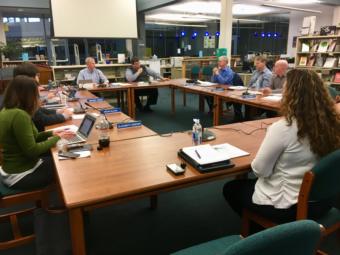
The Juneau School Board approved an operating budget for fiscal year 2020 at a special meeting on March 26, 2019. (Photo by Zoe Grueskin/KTOO)

The Juneau School District Board of Education approved a budget for the upcoming school year back in March. But it was prepared to revisit the numbers this July in the event of major cuts to state education spending.

It’s now July, but even though Gov. Mike Dunleavy’s administration has challenged the legality of this year’s school funding, school board president Brian Holst said so far the district hasn’t changed its plan to spend those funds.

“If they fail to emerge, we would need to revisit, but at this point we are still counting on those resources to flow to the school district as appropriated by the Legislature,” he said.

Holst said the district still expects to receive its usual per-student state funding, as well as its share of the one-time $30 million education grant forward-funded by the Legislature in 2018.

But the school district will be affected by a few of the governor’s line-item vetoes to the state operating budget. Holst said they’ll lose out on $150,000 in state support for pre-K programs. An increase in city funding will balance that out.

“So the effect is that our programming will continue as the previous year,” he said. “But we are foiled in our attempt to expand the program to include more kids.”

A more substantial cost to the city will come in the form of school bond debt. Dunleavy vetoed half of what school districts expected to receive in state reimbursement for construction costs. That leaves the city of Juneau on the hook for $3.7 million.

With no veto override, UAS chancellor expects layoffs at Southeast campuses

Bronze whale sculpture at UAS
A scale model of the humpback whale sculpture at the University of Alaska Southeast campus, Aug. 14, 2015. (Photo by Jeremy Hsieh/KTOO)

The vote to override Gov. Mike Dunleavy’s line-item vetoes fell short again Thursday in Juneau. With more than a third of legislators absent, there was little suspense, but University of Alaska Southeast student India Busby said that didn’t make the news any easier.

“I mean, I knew that it was going to fail, which I hate. I hate that. I feel in a way that my state is kind of falling apart,” Busby said. “You know, I was born and raised here in Alaska, and just watching everything that’s happening is really hurting me.”

Busby will start her senior year at UAS in Juneau this fall — if she returns at all. The 23-year-old creative writing and sociology student said her school’s uncertain future has her considering finishing college in the Lower 48.

Dunleavy has said the $130 million cut to the UA system would primarily impact the Fairbanks and Anchorage campuses. But UAS Chancellor Rick Caulfield said every campus relies on statewide UA services.

Rick Caulfield in his office on Monday, June 26, 2017.
Rick Caulfield in his office on Monday, June 26, 2017. (Photo by Quinton Chandler/KTOO)

“So it’s not reasonable to assume that UAS and the community campuses would not feel the impact of these reductions,” he said. “I think almost certainly we will.”

If the 41% cut to the overall UA budget stands, the UA Board of Regents will likely declare an official process to rapidly downsize. 

“Whether it’s consolidating programs, eliminating programs, campuses, what have you. So it is an unprecedented action if we go there,” Caulfield said.

Caulfield said that could happen as soon as Monday, July 15.

He said it’s very likely that will include significant layoffs of staff and faculty at the Juneau, Sitka and Ketchikan campuses.

For Busby in Juneau, that’s what worries her most.

“We’re a very small school, and a lot of the students are very close with their faculty and other staff members as well. And so the fact that these budget cuts are going to really affect them and, like, what’s going to happen with their job, it’s really upsetting, because these faculty members mean so much to us. It’s just devastating,” Busby said.

Adding to uncertainty for students, the Alaska Commission on Postsecondary Education notified 12,000 students — including Busby — this week that funds are not currently available for their grants and scholarships. Legislative action is needed to restore funding.

Artists call on Legislature to fund state arts council

People dressed in black hold up paintings, books, drums, and artwork on a street corner in Juneau. Juneau artists hold up their work at a demonstration outside Sealaska Heritage Institute protesting the budget cuts to the Alaska State Council on the Arts on Tuesday, July 9, 2019. (Photo by Annie Bartholomew/KTOO)
Juneau artists hold up their work at a demonstration outside the Walter Soboleff Building protesting the budget cuts to the Alaska State Council on the Arts on Tuesday, July 9, 2019. (Photo by Annie Bartholomew/KTOO)

Unless 45 lawmakers vote to override Governor Dunleavy’s veto by Friday, the Alaska State Council on the Arts will be completely defunded. Artists gathered in Juneau last night to protest the cut.

Around 5 p.m. on Tuesday, amidst cruise ship passengers and Juneauites leaving work, a few dozen people dressed all in black assembled in front of the Walter Soboleff Building. They carried with them tools of their trade and pieces of their work: paintings, weavings, books of poetry.

The gathering was a show of support for the Alaska State Council on the Arts, which provides grants to groups and individuals across the state and supports public arts events. If the veto stands, the council will run out of funds on Monday, July 15th. That would make Alaska the only state in the U.S. without an arts organization.

Lily Hope, who coordinated the event, says she doesn’t like to think about that.

“You know, we’re talking about like, people losing jobs at the university, the arts organizations, the artists themselves,” Hope said. “It’s trickling down into so many things, arts education, I mean, you name it, it’s going to go down bad.”

A woman holds her baby on a street corner in Juneau. Master Chilkat Weaver Lily Hope holds her daughter at the peaceful demonstration opposing the budget cuts to the Alaska State Council on the Arts outside Sealaska Heritage Institute on Tuesday, July 9, 2019. Hope helped organize the event which covered the totems with black fabric to create a public art "black out." Photo by Annie Bartholomew/KTOO.
Master Chilkat Weaver Lily Hope holds her daughter at the peaceful demonstration. Hope helped organize the event, which covered the totems with black fabric to create a public art “black out.” Photo by Annie Bartholomew/KTOO.

As protests go, it was pretty quiet. Hope said that was by design. She wanted to demonstrate what the community would look and sound like without art. With permission from the institute, the three bronze totem poles that stand in front were covered with black cloth. The artists stood silent for a few moments, then turned around completely, their backs to the street and the onlookers who’d gathered on the sidewalk. A few tourists took pictures.

Artists dressed in black turn their back to the street
Juneau artists turn their backs during the demonstration. (Photo by Annie Bartholomew/KTOO)

There was some music, though: a Yup’ik prayer song, sung by Stephen Qacung Blanchett.

Juneau Arts and Humanities Council Education Director Stephen Qacung Blanchett of the band Pamyua shares a prayer song next to Ishmael Hope at the peaceful demonstration protesting budget cuts to the Alaska State Council on the Arts. Photo by Annie Bartholomew)
Juneau Arts and Humanities Council Education Director Stephen Qacung Blanchett of the band Pamyua shares a prayer song next to Ishmael Hope at the demonstration. (Photo by Annie Bartholomew)

Blanchett is an award-winning musician and dancer and the new education director at the Juneau Arts & Humanities Council. He’s also a teaching artist, traveling to schools across Alaska through a state arts council program that would be eliminated by the budget cut.

He says he’s seen first-hand that bringing artists into communities can have long-lasting effects, reviving cultural traditions and empowering young people to make their own art. 

He points to Old Harbor on Kodiak Island, a community he’s been working in for a decade along with other artists, all with the support of the state arts council. When he first visited, he says, the community had no songs or dances.

“Now they have drum makers in their village. They have mast makers, they have song makers, they have tradition bearers, and they have people who create ceremony. That never would have happened without that support,” he said.

The Legislature has until Friday to override the governor’s vetoes, a move that requires three-quarters of both houses. A vote to override all of Dunleavy’s line-item vetoes together failed on Wednesday.

Christianne Carrillo, who showed up to the protest with a self-portrait she recently painted, hopes the state will find a way to fund the council. Without support for the arts, she says, “There’d be no music. There’d be nothing colorful. It’d just be a deadzone, I feel like, it’d just be gray.”

If state arts council closes on Monday, a spokesperson says it will reopen. It’s just a matter of when. Even if the Legislature does not override the veto, they could still fund the council through the capital budget.

Site notifications
Update notification options
Subscribe to notifications