Zoe Grueskin, KTOO

How carving halibut hooks teaches Juneau students both science and tradition

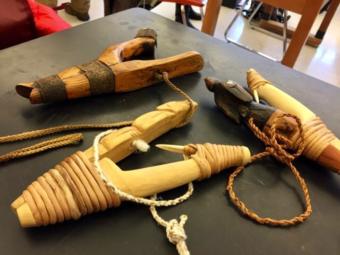
Traditional Tlingit halibut hooks brought as examples to a science class at Juneau-Douglas High School: Yadaa.at Kalé on March 5, 2019. (Photo by Zoe Grueskin/KTOO)

In a science classroom at Juneau-Douglas High School: Yadaa.at Kalé, students are holding carving knives. Teacher Henry Hopkins walks up and down the rows of desks, showing them how to shape the hunks of yellow cedar in their hands.

“The students were working on traditional Tlingit halibut hooks, which sounds like it’s primarily a Tlingit carving project, but it’s actually a science project,” said Hopkins.

Hopkins has taught science at JDHS for nearly 20 years. Before that he taught in rural Alaska, in remote communities with majority Alaska Native populations. He said he quickly realized subsistence activities like hunting and fishing were their own kind of science textbook.

Hopkins started working with Elders and culture-bearers to emphasize that in the classroom.

“It’s important for me that we don’t stop the science to teach Native knowledge,” he said. “I would rather teach the science through Native knowledge.”

Henry Hopkins (left) and Donald Héendei Gregory teach students at Juneau-Douglas High School: Yadaa.at Kalé the science and tradition of Tlingit halibut hooks on March 5, 2019. (Photo by Zoe Grueskin/KTOO)

Take Tlingit halibut hooks: They look almost nothing like the metal circle hooks used by commercial fishermen. They look more like over-sized clothespins. Two pieces of wood are lashed together in a V-shape, with a spike of either metal or bone. Woods of different density are used to achieve the right float, and the hooks are designed to catch only fish of a particular size.

Hopkins said studying — and crafting their own — halibut hooks gives students in his outdoor biology class the opportunity to learn about everything from sustainable fisheries management to changing oceans.

Leading the carving itself is Tlingit carver and teacher Donald Héendei Gregory.

Tlingit carver Donald Héendei Gregory teaches students at Juneau-Douglas High School: Yadaa.at Kalé how to carve Tlingit halibut hooks on March 5, 2019. (Photo by Zoe Grueskin/KTOO)

“My name, Héendei, is translated to ‘in the water’ or ‘into the water area,’” said Gregory, “and we’re Deisheetaan, we’re Raven Beaver, so it’s an appropriate name for a beaver.”

Gregory learned his craft from a long lineage of Tlingit carvers, and he hopes to continue that legacy.

“For me, the most important thing about learning it is to be able to pass it on to the next group of people that want to learn it,” he said. “I don’t want to take anything with me to the grave.”

Gregory has worked with Hopkins for several years, teaching both the science and the tradition of halibut hook carving to students at JDHS. He said the project builds some pretty specific carving skills, but mostly it’s about common sense: paying close attention and working with what you’ve got.

“Oh, I think it’s real important, I mean when you get out of school, if you don’t have common sense, you’re way behind the curve,” Gregory said.

Hopkins said by incorporating Native knowledge and hands-on learning into his science classes, he’s been able to get buy-in from students who’d never engaged much in school.

“Oh yeah, usually I’ll get a number of texts and emails in the summer of kids holding up halibut and these hooks,” said Hopkins.

Once, a student even gave Hopkins a fish. It was a halibut caught on a hook carved in his classroom.

Students at Juneau-Douglas High School: Yadaa.at Kalé begin carving Tlingit halibut hooks on March 5, 2019. (Photo by Zoe Grueskin/KTOO)

How school districts can keep students safe from abuse

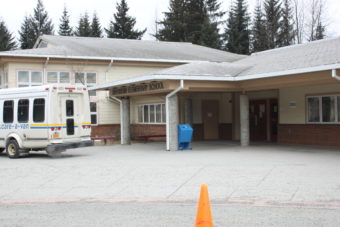
Riverbend Elementary School. (Photo by Lisa Phu/KTOO)

Last month, a Juneau principal was placed on leave when questions were raised about how staff at his former school handled reports of student abuse. A pair of new lawsuits claim that families had brought concerns to the attention of the Wasilla school’s leaders years before action was taken.

Principal Scott Nelson’s name does not appear in the lawsuits filed last month against his former employer, the Matanuska-Susitna Borough School District. Still, Juneau School District Director of Human Resources Darryl Smith said Nelson’s connection to the case was a distraction from student learning at Riverbend Elementary School, where Nelson has worked since the beginning of the school year.

“It kind of hindered the direction the school needs to go for the rest of the year,” said Smith. “So in order just to allow the educational process to keep happening in that school, we thought it was best to take the action that we did.”

Parents were notified of the decision by phone on Feb. 20.

The district hired Nelson last spring. Smith said at no point in the hiring process did the district find anything to raise concerns about Nelson’s commitment to student safety.

Smith described the Juneau School District’s hiring and vetting practices as “extensive.” The steps include a federal background check, rounds of interviews, and making plenty of phone calls — beyond a candidate’s listed references.

“It could be like, in the case of a school administrator, sometimes we’ll call the admin assistant in that building and talk to them a little bit. And then we may ask for names of other people that might be worth talking to,” said Smith.

If records and reference checks don’t turn up any red flags, there isn’t much other information available to school districts.

However, there are other steps districts can take during the hiring process to emphasize that student safety is taken very seriously.

Amy Russell is the executive director of the Children’s Justice Center, a child advocacy center in Clark County, Washington. She trains professionals around the country, including in Alaska, how to recognize and prevent child abuse.

She recommends districts include a pointed hypothetical question in their interview process.

She gave this question as an example: “If you had this situation that you were presented with, a child has alleged that one of your colleagues is offending against a child, what would you do?”

Russell said asking a question like this sends a strong signal to potential abusers: This is not a school where you can fly under the radar. It also encourages all staff to take reports — and their own observations — seriously.

All teachers and administrators in Alaska schools are required by law to report any suspected abuse to the state. But Russell said too often that reporting doesn’t happen. She has heard many stories, like the ones in the lawsuits, of staff dismissing concerns.

“They don’t want to think that they would be socially connected to an individual or an institution that would do that. And so the immediate thought is this disbelief: ‘No, that can’t possibly be what’s going on,'” Russell said.

But Russell is very clear on this: Teachers and staff don’t have to believe a claim in order to report it to authorities.

Smith said that’s exactly what he tells staff of the Juneau School District.

“It’s not your responsibility to decide. It’s your responsibility to report,” he said.

Both staff and students in the district receive training on abuse prevention. Smith said as the district enters hiring season, they’re already thinking about how to better use the interview process to screen out potential abusers and to send a message that Juneau schools are serious about keeping kids safe.

Are more Juneau high school graduates ready for college? It depends.

UAS campus
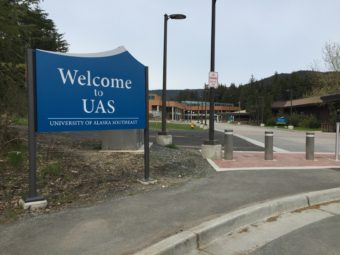
The University of Alaska Southeast’s Juneau campus. (Photo by Lisa Phu/KTOO)

Over the past five years, more students who graduate from Juneau high schools are ready for college. That’s according to the University of Alaska Southeast. But whether you see improvement depends on what you’re looking at.

Each year, a few dozen students graduating from Juneau high schools choose to stay in town for college. They enroll at the University of Alaska Southeast.

UAS Provost Karen Carey said those students haven’t always had an easy time when they get there. But recently, she said, things have been looking up.

“Their students are being much more successful now at the college level,” said Carey, “So we are very pleased about that.”

Carey said more and more Juneau high school graduates are arriving at UAS and across the University of Alaska ready for college. She shared the good news with the Juneau School District Board of Education in February and explained how it’s measured.

At UAS, “college ready” means you don’t have take any remedial courses below college level. Those are typically math and English courses that get students up to speed. Remedial courses don’t earn students any credit toward a degree — but they cost just as much as credit-earning courses.

“And so in some cases in the past we had students taking those courses two, three, four times and were paying for those courses out of pocket but weren’t getting any college credit at all,” said Carey.

In just the past five years, the number of Juneau graduates who had to take at least one course below college level when they reached the UA system has fallen dramatically: from over half to just 1 in 5.

Remedial course enrollment for JSD graduates in the UA system. (Data from UAS Office of Institutional Effectiveness)

UAS and the Juneau School District are calling it a win. But not everyone is convinced.

Herb Schroeder is vice provost for the Alaska Native Science and Engineering Program, or ANSEP, at the University of Alaska Anchorage. A couple years ago, he led a study that looked at college readiness of Alaska high school graduates over a ten-year period between 2006-2015.

The findings were not encouraging, especially for Juneau. Three-quarters of Juneau-Douglas High School graduates enrolled in at least one math or English course below college level during their first year in the UA system.

Schroeder questions the sunnier UAS report. That’s because while his study used national standards to define college-level coursework set by ACT — the education nonprofit best known for its standardized test widely used for college admissions — UAS sets its own bar. And that bar is lower than those national standards.

Schroeder is troubled that high schools and colleges in Alaska are making up their own definitions of college readiness. But Carey sees it differently. She said she won’t agree or disagree with the national standards.

“I think you have to know your individual students and what your population looks like,” she said.

And Carey said for UAS students, their definition of “college ready” makes sense.

It includes two courses that fall short of the national standards: one in math, one in English. Those courses don’t count toward general education requirements at UAS — they’re prerequisites for qualifying courses — but Carey said placing into them doesn’t necessarily mean extra semesters — and extra dollars — for students.

“Those courses can count toward electives or toward other things that the student might need in their program,” said Carey. “They get college-level credit.”

For an explanation of why more Juneau graduates are coming into college well-prepared, Carey points to changes the Juneau School District made five years ago. That’s when the high school graduation requirement was raised to three years of math and four years of English, and the district rolled out a more rigorous curriculum for both math and language arts.

Success in college is ultimately not about how you start, but how — and if — you finish. Juneau students have a higher four-year graduation rate from UA schools than the state average, but it’s still just 1 in 5 on average for all JSD graduates who entered the UA system in the last 10 years.

Four-year graduation rates for JSD graduates in the UA system. (Data from UAS Office of Institutional Effectiveness)

That too could change. The first class of Juneau high school students who had to clear that higher bar started college four years ago last fall. It remains to be seen just how many of them will walk across UA stages this spring, diploma in hand.

Remedial course enrollment vs. four-year graduation rates for JSD graduates in the UA system. (Data from UAS Office of Institutional Effectiveness)

Newscast – Thursday, Feb. 28, 2019

In this newscast:

  • President Trump addressed troops at Alaska’s Joint Base Elmendorf-Richardson on his way back from a summit with Kim Jong Un.
  • Alaska’s oil production could see a bump as new fields come on line on the North Slope.
  • The City and Borough of Juneau wants to explore expanding port infrastructure to allow more cruise ships to connect to the city’s electric grid.
  • Sitka Rep. Jonathan Kreiss-Tomkins says that residents fearful over the governor’s proposed budget should focus their advocacy efforts on Republican senators, who will have the power to override the governor’s vetoes come May.
  • Juneau’s Ernestine Saankalaxt’ Hayes will remain Alaska’s writer laureate a little longer than expected while the State Council on the Arts chooses the next writer to hold the title.

Newscast – Wednesday, Feb. 27, 2019

In this newscast:

  • The Alaska Legislature’s top budget analyst says it’s unrealistic for lawmakers to vet and make decisions on Gov. Dunleavy’s budget proposal during the regular session.
  • How Alaskans feel about the governor’s proposed budget has a lot to do with how they make their living and their views on the size of government.
  • The U.S. House voted to cancel President Trump’s declaration of emergency to fund construction of a wall along the southern border. The Senate still must vote on the issue.
  • There’s still no plan to remove the abandoned tugboat sitting in Juneau’s Gastineau Channel, but the city is sending a crew out this week to remove water from the boat so it stays afloat.

Newscast – Tuesday, Feb. 26, 2019

In this newscast:

  • Congress today passed a massive public lands bill sponsored by Sen. Lisa Murkowski. It includes a provision to help Alaska Native veterans of the Vietnam era by allowing them to select up to 160 acres of land. But critics predict a land grab.
  • Gov. Dunleavy wants to sell the Mt. Edgecumbe High School Aquatics Center — before the brand new $26M facility has even opened to the public.
  • Ketchikan, Petersburg and Wrangell’s sources of hydropower are at extremely low levels. The communities will gradually dip into their lake reserves when needed.
Site notifications
Update notification options
Subscribe to notifications