Archives for:

"Government Shutdown"

U.S. military pay in question, including thousands in Alaska, as government shutdown approaches

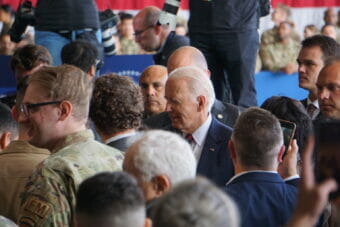
President Joe Biden mingles with service members and others in the audience at Joint Base Elmendorf-Richardson on Sept. 11, 2023, after he delivered a speech commemorating the terror attack that occurred 22 years earlier. (Photo by Yereth Rosen/Alaska Beacon)

The three members of Alaska’s congressional delegation are trying to ensure that members of the U.S. military, civilian Department of Defense workers and military contractors remain paid during a partial federal government shutdown that could begin as soon as Sunday.

In separate statements, Republican Sens. Dan Sullivan and Lisa Murkowski, and Democratic Rep. Mary Peltola said they support stopgap legislation to preserve military pay.

According to figures provided by the White House, Alaska is home to 20,200 active-duty members of the military, plus thousands more civilians who work for the Department of Defense either directly or as contractors.

For context, that’s a bigger economic driver than the state’s construction industry, which employed 19,400 Alaskans in August.

During a government shutdown, civilian Department of Defense workers would be temporarily furloughed, unless they’re associated with particular “excepted activities.”

Military personnel on active duty will continue to work without pay. Base services will be limited: Commissaries within the United States will close, elective medical procedures at military hospitals will be postponed, postal service on base will be disrupted, and changes of station will be paused, the Defense Department said.

Workers will be paid retroactively when the shutdown ends, but a shutdown is expected to affect the spending of thousands of Alaskans and millions of Americans nationwide.

In addition, military contracting — both within the state and outside — is a major industry for Alaska’s Native corporations, and payments could be disrupted by a shutdown.

“Servicemembers, of course, would continue to work to keep our country safe, but they wouldn’t receive their paychecks until funding was available,” said John Kirby, spokesperson for the Biden administration’s National Security Council, in a conference call with reporters on Tuesday.

“Hundreds of thousands of their civilian counterparts will also be furloughed, affecting the ways in which the Department of Defense is able to manage affairs globally. That includes some aspects of contract management, procurement,” Kirby said.

A senior government official on the call said that search and rescue missions by the Coast Guard and other branches of the military will still continue, even in a government shutdown. Veterans Administration facilities are also expected to remain open, the official said.

Sullivan and Murkowski voted on Tuesday to support a bill that would keep the federal government funded through Nov. 17 in order to allow further negotiations on a longer-term funding bill.

The Senate is expected to pass the interim measurel before the end of the week, but its future isn’t certain in the House, where Republicans hold a divided majority and haven’t been able to muster enough votes to pass a budget bill.

With that in mind, various lawmakers are proposing stopgap bills that could keep portions of the government functioning during a shutdown.

Sullivan is the lead sponsor of a Senate bill cosponsored by Murkowski and more than 13 other senators that would fund military paychecks.

“All Americans count on our military members to be ready to respond to threats to the homeland, wherever and whenever they may arise. The last thing our brave men and women in uniform need to be worrying about is whether they will get a paycheck, and whether their families are taken care of back home,” he said in a prepared statement.

In the House, Peltola cosponsored legislation that would ensure pay for members of the Coast Guard, which is part of the Department of Homeland Security rather than the Department of Defense.

Both the Senate legislation and legislation in the House remain pending. Congress is expected to continue meeting throughout the week.

Senators take up a stopgap spending bill, but Murkowski is doubtful it can prevent a shutdown

U.S. Senator Lisa Murkowski, R-Alaska, speaks with reporters at the Juneau International Airport on Wednesday August 16th, 2023 (Mikko Wilson/KTOO)

The U.S. Senate voted Tuesday to begin work on a stopgap bill that would keep the government funded until mid-November.

Sen. Lisa Murkowski said she wishes she could reassure everyone that the bill will pass and prevent a government shutdown.

“But I can’t tell you that because I am worried,” she said. “And I have been worried with each passing day, where it seems that in the House, it has just become not only more complicated, but just nastier. And it’s really hard to get hard work done when people cannot talk to one another. And that’s what we’re seeing in the House.”

Murkowski said a shutdown would hit Alaskans particularly hard because it has a high number of federal workers per capita.

Alaska has about 11,000 civilian federal workers, according to the Congressional Research Service. In a shutdown, some would be furloughed and some would have to work without pay.

The stopgap bill could get through a series of procedural votes and pass the Senate later this week. But in the House, Speaker Kevin McCarthy is hamstrung by the demands of right-wing Republicans, and some of them immediately rejected the Senate bill. They especially don’t like that it includes $6.1 billion in defense aid for Ukraine.

Murkowski, who visited Kiev this spring, said helping Ukraine is an investment in the defense of democracies around the globe, including our own. A shutdown, she said, would lower America’s standing internationally.

“That’s a pretty basic step – keep your government funded,” she said, outside the Senate chamber. “If the message is that we cannot even agree to do that, what kind of a statement does that send to the rest of the world about our reliability as a friend and an ally, as a partner in peace?”

The first procedural vote to take up the stopgap bill passed 77-19. Sen. Dan Sullivan voted yes. He sponsored a bill last week to pay the military, including the Coast Guard, in the event of a shutdown. Sullivan’s office did not respond to an interview request Tuesday.

Alaska’s budget impasse won’t interrupt ferry service, DOT says

The Alaska Marine Highway System ferry Columbia passes through Wrangell Narrows headed south from Petersburg in Southeast Alaska, June 15. 2012. (Photo by Skip Gray/KTOO)
The Alaska Marine Highway System ferry Columbia passes through Wrangell. (Photo by Skip Gray/KTOO)

State officials say ferries would continue to sail even if a political impasse over the budget isn’t resolved by the end of the month.

“Should a government shutdown take place on July 1, 2021, the Alaska Marine Highway System will continue to provide service and remain fully operational,” reads a notice that’s appeared on the state-run ferry system’s website.

The Department of Transportation has referred all questions about a potential shutdown to the governor’s office. But DOT Commissioner John MacKinnon wrote in an email to agency employees that confirmed that sailings would continue regardless of what happens inside the Capitol in Juneau.

All scheduled vessels will provide passenger services without interruption, MacKinnon wrote in an all-staff memo Wednesday evening.

That’s in line with a 10-page document also released late Wednesday by Gov. Mike Dunleavy’s administration outlining which state functions would operate, which would be scaled back and which would grind to a halt.

Lawmakers are in Juneau for a special session to resolve the dispute. But time is running short.

MacKinnon wrote that there’s still time for the political impasse to be resolved but that the agency has to be prepared if it is not and state government functions are largely curtailed.

“Beyond that, only my assurance that every effort will be made to minimize the impact of this partial government shutdown to you, the lifeblood of this department, and the public whom we serve,” he wrote.

The governor’s office said Thursday afternoon ferry crew members would continue to be paid.

“Staffing would remain the same for the vessels in operation and shoreside crew will still be necessary,” Kate Sheehan, division director for the state’s Division of Personnel and Labor Relations, wrote in an email to CoastAlaska. “The money exists — it is only that the authority to spend it does not.”

Summer is the busiest season for the marine highway. In July, there are six vessels scheduled to sail seven days a week across coastal Alaska.

The Inter-Island Ferry Authority which runs vessels between Ketchikan and Prince of Wales Island also won’t be affected, “unless a shutdown is protracted,” Ron Curtis, IFA’s general manager wrote in an email to CoastAlaska.

Editor’s note: This article has been updated with more information about payroll for ferry crew members.

State employees anxious as government shutdown threat looms

Retired Alaska Marine Highway System employee Tony Tengs joins other former and current state employees at a rally outside the Alaska State Capitol on June 12, 2019. (Photo by Adelyn Baxter/KTOO)

Earlier this month, Gov. Mike Dunleavy sent a message to state workers telling them to expect layoff or furlough notices after Friday if the Legislature is unable to finish the budget by the end of the special session.

An operating budget is now on its way to his desk. The question is whether it will be enough to prevent a government shutdown on July 1.
As legislators debated inside, about 20 people stood across from the state Capitol Wednesday afternoon with signs urging lawmakers to fund state services and override any potential vetoes from the governor.

It was a quiet gathering compared with many of the protests during the regular session.

Most of the group consisted of current or former state employees like Tony Tengs, who spent 24 years working for the Alaska Marine Highway System. He’s experienced shutdown threats before.

“It’s not a pleasant feeling knowing things could shut down, and you don’t know how to plan your life,” Tengs said. “Fortunately, we made it through those times.”

Whether or not state workers will make it through this time remains to be seen.

An operating budget passed earlier this week, but it’s still awaiting Dunleavy’s signature.

His administration previously warned that he could choose to veto the entire budget. He has not yet not indicated exactly what he plans to do with the budget before him.

Legislators previously managed to avert looming shutdowns in 2015 and 2017, but Minta Montalbo of Save Our State said even when they don’t happen, they take a toll.

“I can speak from experience that yeah, everyone’s feeling nervous and pretty weary of … this cycle of not having a budget and not knowing.”

It should come as no surprise that state government employment makes up Juneau’s largest employment sector.

But over the past seven years, Juneau has lost 650 state jobs.

That’s according to Meilani Schijvens of Juneau-based research firm Rain Coast Data. She said that accounts for about 15% of the local state workforce.

“We’re losing jobs in Juneau at a rate that’s about twice as fast as the rest of the state,” Schijvens said.

That has impacted Juneau’s overall population, which declined for the third year in a row last year.

State job losses are one of a number of contributing factors, but Schijvens said budget instability also has a direct impact on Juneau’s business community, where confidence declined again this year in a poll of local business owners.

“We see business owners … just trying to batten down the hatches and make sure their businesses are stable rather than being in a business expansion mode,” Schijvens said.

Unions representing state workers are hopeful, but they’re also advising members to be prepared even if a shutdown on July 1 doesn’t necessarily mean layoffs for everyone.

Jeff Kasper was also at the rally. He’s the Southeast manager for the Alaska Public Employees Association, representing nearly a thousand members in the region.

“We’ve got agreements with the administration in case there was a shutdown that employees would be protected and go on furlough instead of being laid off,” Kasper said.

His colleague at APEA, business manager Brian Penner, said even still, the disruptions to state programs would be large.

“We’re getting contacted by employees talking about enormous projects that have gone out where you know an incredible amount of money has already been invested,” Penner said. “It’s money that will never be recouped, and it’s projects that are going to cost that much more money.”

Legislators are hoping to avert a shutdown, but whether they have the votes to override line-item vetoes is unclear.

Juneau Democratic Sen. Jesse Kiehl agrees that shutdown threats have costly impacts at a time when the state is already facing budget cuts.

“It all adds up, and state governments shouldn’t waste money,” Kiehl said. “They also shouldn’t jerk people’s lives around.”

Employee contracts require layoff notices to go out a minimum of 10 working days ahead of time, which is Monday.

Juneau schools help food bank stay stocked after government shutdown

During the five-week partial government shutdown, Juneau food pantries served more people than usual and distributed thousands of pounds of food. At least two schools in Juneau are holding drives to replenish the stocks.

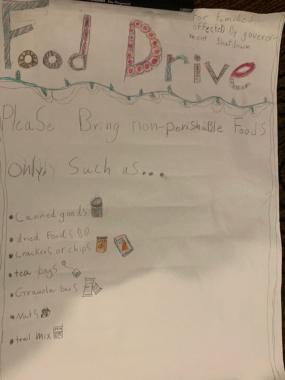
Students at Montessori Borealis made posters to advertise their food drive in Jan. 2019 to replenish the Southeast Alaska Food Bank, which saw increased demand during the partial government shutdown. (Photo courtesy of Callie Conerton)
Students at Montessori Borealis made posters to advertise their food drive in Jan. 2019 to replenish the Southeast Alaska Food Bank, which saw increased demand during the partial federal government shutdown. (Photo courtesy of Callie Conerton)

Maraiya Savland, office assistant at Mendenhall River Community School, said at first they focused on ways to directly support students at the elementary school whose parents work for the federal government.

“But then we also knew that the food bank was opening up to help those families as well,” she said. And they recognized that people in Juneau still need help, even with a short-term funding deal in place through Feb. 15.

So on Monday — the first day many furloughed employees went back to work — they started a food drive, with collection boxes in front of every classroom and one in the front office. At the end of the week, everything will be donated to the Southeast Alaska Food Bank at the end of the week.

Savland said anyone from the community is welcome to stop by the school’s front office with food donations. A similar drive is also taking place at Montessori Borealis.

Darren Adams is the manager of the food bank. He saw a greater demand for the food bank’s services throughout the shutdown — but also for more help from the community.

“People have been coming out of the woodwork, whether it’s donating a couple cans of soup or a whole shopping cart full of food,” he said. “I’m constantly amazed by the generosity of people.”

Adams has opened the food bank specifically to federal workers during special hours the last two weeks. He said about 100 people visited on the first afternoon, taking home around 2,800 pounds of food. Only about a dozen federal workers stopped by during special hours this week, but Adams said the need is still there.

The food bank will continue opening to federal workers each Monday afternoon until a long-term funding deal is reached. The hours will be shared on the food bank’s Facebook page.

Amid uncertainty, Juneau schools still supporting families hurt by shutdown

Juneau School Board member Emil Mackey congratulates Bridget Weiss for being selected interim superintendent of the Juneau School District on Monday, Aug. 6, 2018.
Juneau School District Superintendent Bridget Weiss on Monday, Aug. 6, 2018, when she was named interim superintendent. (Photo by Jeremy Hsieh/KTOO)

During the five-week government shutdown, the Juneau School District saw an increase in families applying for free or reduced-price school meals.

According to the district’s food services program, 17 families affected by the shutdown are now receiving meal benefits.

Superintendent Bridget Weiss said last week’s deal to reopen government does not mean those benefits will disappear immediately.

“It sounds like there may be at least a short-term solution for federal employees, but we also recognize that it may take time for those families to readjust financially,” said Weiss.

Congressional leaders and President Donald Trump agreed to reopen the government on Friday with a three-week funding measure, as negotiations over border wall funding continued. If no subsequent agreement is reached, another shutdown would begin after Feb. 15.

Weiss said the district recognizes there’s still uncertainty for federal workers about when they’ll be paid, and they could be back in the same position next month.

“We are looking at this a little longer-term and are open to supporting families as we move through the next few months,” she said.

Support goes beyond school meals, she said. Families can also get help with things like activity fees and school supplies.

She encourages families having a hard time for any reason, at any time in the school year, to talk to their children’s teachers, principals or district staff about available resources.

Site notifications
Update notification options
Subscribe to notifications