Canned goods on the shelf at the Southeast Alaska Food Bank in March 2015. (Photo by Kevin Reagan/ KTOO)
As the partial government shutdown enters its second month, more people than usual are stopping by the food bank in Juneau.
Darren Adams is the manager of Southeast Alaska Food Bank. He said the shutdown took a lot of people by surprise.
“There have been some individuals who have told me they never thought they’d be in this position,” he said.
On Monday he will open the food bank beyond its regular hours. Between noon and 4 p.m., he’s inviting federal workers to come by and take home up to 50 pounds of food. All they need to show is federal identification.
Adams said the longer the shutdown lasts, the greater the need becomes.
“A lot of people think, okay I can make a week’s worth of groceries stretch for ten days if I need to, but you can’t make a week’s worth of groceries stretch for a month,” he said.
He added that since the shutdown began, he’s heard from more people in Juneau who want to volunteer their time — including federal workers on furlough.
Adams said he will continue to open the food bank to federal workers every Monday until the government is reopened.
The front door of the Southeast Alaska Food Bank in Oct. 2016. (Photo by Quinton Chandler/KTOO)
Note: Several organizations in Juneau provide food and support for those in need. Some of those resources are listed here.
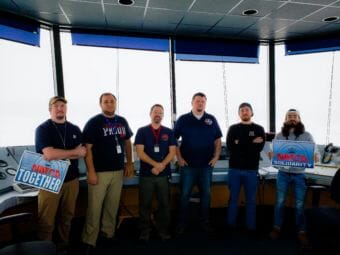
Air traffic controllers who are members of the union National Air Traffic Controllers Association pose for a photo in the tower of Juneau International Airport in this undated photo. From left to right: Devin Styers, Lenny Zeifman, Dan Parks, Rob Swinton, Steve Ott and Bryan Barrett. (Photo courtesy Rob Swinton)
Air traffic controllers from the northern Canadian city bought their counterparts in Juneau some Domino’s last week as the federal employees’ unpaid payday came and went on Wednesday.
Canadian air traffic controller Mark Hilman heard about some of his colleagues in Edmonton sending pizzas to their Anchorage counterparts. He works at the Yellowknife Airport.
“One of the fellas here suggested Juneau to do something just to show solidarity, right? I mean it’s … I can’t imagine having to go to work and not getting paid,” Hilman said. “We kinda just wanted another northern tower that was maybe similar in size to ours. … Yellowknife is the capital of the Northwest Territories and Juneau obviously the capital of Alaska, so we figured we’d sorta fit in there.”
Hilman called up his counterpart in Juneau last week.
“Honestly, it was a little out of the blue,” said Juneau air traffic controller Rob Swinton.
He represents 13 air traffic controllers for his union who work in that tower. He and Hilman were strangers.
“But I’m definitely interested in going to visit now. You know, once this government gets opened back up,” he said.
Swinton said it was good timing. Last Friday was when he and his coworkers could go online to see what their upcoming paychecks would be.
“We were anticipating it, but it makes it a little more real when you log in and you see zero dollars and zero cents, when you know you’ve worked 80 hours or more in the last pay period,” Swinton said. “So morale took a big dive on Friday. And then, yeah, we got that call. … It helped for sure to know there are people out there that are, you know, supporting us.”
They had their pizza lunch, paid for by Hilman’s Canadian air traffic controllers’ union, in the tower. There are no pizza pictures — Swinton said they have to jump through a lot of hoops to get permission to shoot photos up there for security reasons and to minimize distractions. With the shutdown, Swinton said they’ve got other stuff to worry about.
“You got this very real distraction right now of controllers not knowing when they’re gonna get their next paycheck, how their mortgage (is) gonna get paid,” he said. “I mean, you know how cold it’s been. These heating bills are gonna rack up. This is all something that’s on everybody’s mind everyday while they’re up there.”
He’s quick to add they’re still being professional and keeping the airport running safely.
One of his new coworkers was just starting his new job as the shutdown began. Swinton was reluctant to identify him because he doesn’t have union protections yet. He said he ought to be in training, but he can’t because of the shutdown. He just signed a lease and is living off savings.
The Prince of Wales Landscape Level Analysis Project would dwarf the Big Thorne timber sale pictured above. (Photo by Elizabeth Jenkins/Alaska’s Energy Desk)
Despite the partial federal government shutdown, some U.S. Forest Service staffers are still working on a plan for a large timber sale in Southeast Alaska.
Those who oppose the logging are worried their concerns aren’t visible enough during the shutdown. Leaving them to wonder how the agency can keep up with the public record when it’s not fully staffed.
The Southeast Alaska Conservation Council, or SEACC, opposes a federal timber sale that could take place on Prince of Wales Island.
The group wanted to file its objections by the December deadline and managed to submit its complaints the day before the government shutdown.
“We were surprised there was any activity going on with the Forest Service,” he said. “Particularly with this controversial timber sale.”
According to the Forest Service’s website, work that should be prioritized during a government shutdown includes protecting public safety and assets.
For example, there’s avalanche forecasting still happening in the Chugach National Forest. On Prince of Wales, some Forest Service employees are responding to a recent landslide.
On Tuesday, SEACC received an invitation confirming another thing. Forest Service staff are continuing to work on the timber sale SEACC objected, and the project is seemingly on schedule.
The Forest Service planned to hold a public meeting next week in Klawock to address the objections to the plan — basically, another milestone that moves the process along. But there’s no notification of it on the agency’s website.
Lindekugel said there’s also another thing missing.
He tallies up the people who’ve submitted some kind of objection. Their names are visible from the Forest Service’s website, but not the content of their objections.
“The way for the general public to participate in this process is to go onto this page and click on these objections,” Lindekugel said. “And see what the problems people have with this proposal, and they can’t.”
Lindekugel said it makes it difficult for his organization, too. How do you prepare for a meeting that’s a week away when you don’t have all the information?
Owen Graham, the executive director of the Alaska Forest Association, said that’s not an issue for him.
“There’s not an opportunity to sit around and talk with the other objectors and horse trade or bargain,” Graham said.
Graham represents a timber industry group. He has objections to the Forest Service’s plans, too. He doesn’t object to the sale itself, but he wants to see a different version of the sale to go through.
So he’s glad things are moving along, and he wants the meeting in Klawock to happen.
“If they delay these objection meetings, then it will be that much longer until we get a timber sale,” Graham said. “And there will be greater risk that people will be out of work because of it.”
The Forest Service did send Lindekugel the other objections this week after he requested them.
Still, he believes important documents are slipping through the cracks that would inform a public meeting.
“Call a timeout on this damn thing,” Lindekugel said. “Slow down. There’s not need to rush ahead. Push the clock back to where it was before before the shutdown occurred.”
On Thursday, Lindekugel received yet another email from the Forest Service. It said next week’s objection resolution meeting in Klawock is canceled. It didn’t give a reason why or provide another timeline.
A spokesperson for the Forest Service said they’ll update the website about other happenings on Prince of Wales Island soon.
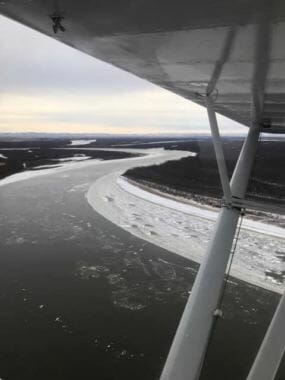
An aerial survey by the U.S. Fish and Wildlife Service shows the open water river conditions on the Kuskokwim River from below Bethel up to the Kuskokwak and Napakiak Sloughs on Nov. 15, 2018. (Photo courtesy U.S. Fish and Wildlife Service)
Safety on the Kuskokwim River has become more expensive during the nation’s longest-running partial federal government shutdown.
For decades, Bethel Search and Rescue has flown with the U.S. Fish and Wildlife Service to monitor winter river conditions. But with that government service closed, the all-volunteer group is having to turn to pricey commercial airlines for help.

When the weather changes, so does the Kuskokwim River. But what doesn’t change is that people still need to travel.
Bethel Search and Rescue lets travelers know which routes on the river are safe.
“A lot of that is preventative,” explained Perry Barr, the organization’s vice president. “We have become more active in trying to prevent tragedies.”
Tragedies like losing people to open holes in the ice — which has not happened this winter, but which has happened too many times in the past.
“So that’s kind of the biggest reason as to why we do a lot of the surveys,” Barr said, referring to Bethel Search and Rescue flying the river, observing and taking note of ice conditions.
“We want to see where the open holes are, where we have areas where the ice maybe hasn’t really formed, or areas where we have thin ice. We can see a lot of that from the air,” Barr explained. “We can see the type of ice that is actually building. Is it clear ice that may indicate a stronger surface, versus dirty ice that may have air pockets in it and not freeze as stiffly? And of course, some debris that may be found on the river that is dangerous to traffic.”
The most important time to check these ice conditions is after a warm-up, and Bethel just experienced a big warm-up. This weekend temperatures plummeted to 25 degrees below zero. Then, in the following days, temperatures shot up to nearly 40 degrees above.
Usually, Bethel Search and Rescue would be calling a pilot at the local U.S. Fish and Wildlife Service office to schedule a survey, but the current government shutdown has shuttered that partnership.
“We’ve always had a relationship with them. I would say it would stretch more than 20 years,” Barr said.
The U. S. Fish and Wildlife Service does not charge Bethel Search and Rescue for these flights. Now the organization is having to turn to commercial airlines to charter a plane; the going rate is about $1,000 per hour. That’s a steep price for a donation-based organization that runs off an annual budget of about $60,000.
Barr believes that there are better ways for the nation’s leaders to work out issues rather than by closing the government.
“I don’t necessarily think that butting heads within government is a great example to the American people,” Barr stated.
Organizations along the Kuskokwim River have another example to offer. Last week two tribes — Bethel’s Orutsararmiut Native Council and the Native Village of Napaimute — helped Bethel Search and Rescue fund a charter flight, making everyone a bit safer.
The mold of a 37-foot catamaran sits in Eric Sloth’s boat shop in Homer. (Photo by Aaron Bolton/KBBI)
The federal government’s partial shutdown shows just how important basic government operations are to Alaska’s coastal communities.
Most U.S. Coast Guard operations are suspended, and that’s holding up commercial boat and permit sales as well as some construction of passenger vessels.
“We’re really just coming into the busy season,” Doug Bowen, a broker for Alaska Boats and Permits in Homer, said. “The next few months will be the busiest time of the year for us.”
Bowen facilitates the sales of all types of boats, but commercial fishing vessels are his bread and butter.
However, fishermen trying to buy or sell those vessels are hitting the same wall.
“The shutdown is affecting us because we work every day with the United States Coast Guard re-documenting vessels,” Bowen explained. “When a title transfers from a seller to a buyer, all of that is recorded with the Coast Guard back in Falling Waters, West Virginia. They’re closed, so none of that recording goes on.”
Coast Guard registration is much like an automobile title. It details not only who owns the boat, but if there are any loans taken out on the vessel. Most commercial fishing vessels are required to be federally registered.
That means the boats Bowen sells can’t officially change hands during the shutdown. Sales that weren’t complete before the shutdown began are on hold as well.
“There’s several deals like that that we’re in the middle of,” Bowen added. “Needless to say, if you’re waiting for a couple or several hundred thousand dollars, you’re not happy about the delay, and there’s really nothing we can do about it.”
Commercial fishing permit sales are also affected. They can cost thousands of dollars, and fishermen commonly put their boats up as collateral on loans to finance them. It’s also common on loans used for major repairs to vessels.
But without a recent copy of a boat’s federal registration, private and state lenders often won’t move forward.
Figuratively speaking, that’s the boat Homer-based fisherman Larry Reutov finds himself in. Reutov hoped to use his vessel to secure a loan for new engines he needs by the March fishing season.
“I’m just waiting probably another week or two, and then if not, I’ll have to come up with something else,” Reutov said, “because the Coast Guard are closed and can’t do nothing with the boat.”
He’s considering putting his house up for collateral, but he’ll need to decide soon — the work will take more than six weeks to complete.
Boat builders are also feeling the pain of the shutdown. Passenger vessels such as large fishing charters and ferries are required to be inspected by the Coast Guard from the planning phase of construction to the day vessel touches the water.
Eric Sloth’s shop in Homer is filled with a mold for a 37-foot power catamaran.
“It will be a work boat that we hope to be certified by the Coast Guard, so probably a passenger vessel,” Sloth said. “We are prepared to submit plans, and we won’t be going any farther until we get approval.”
Sloth said the boat isn’t due to be complete until the spring of 2020, but every week the shutdown lasts is another week he can’t start the long process toward the finish line.
“The way the community works with the Coast Guard is really good, and I think things run pretty smoothly apart from politics,” he said. “I’d like to see it all get going again.”
That may just happen in some respects. Alaska Sen. Dan Sullivan supported a bill Tuesday that would provide pay for active duty Coast Guard members and payments to its retirees.
Correction: A previous version of this story mischaracterized the bill supported by Sen. Dan Sullivan, as well as his role in the bill’s promotion.
The U.S. Capitol in Washington, D.C., on March 28, 2017. (Photo by Jeremy Hsieh/KTOO)
Sen. Lisa Murkowski said it’s slow-going, but she sees progress at the U.S. Capitol among lawmakers working to end the partial government shutdown, now in its fourth week.
Does she see a path to reopening government? The question prompted her to sing a Beatles line: “A long and winding road. Buh-boom.”
Murkowski has been meeting with other senators, Republicans and Democrats, who also want to end the stalemate. She said their numbers are growing, and she’s somewhat hopeful.
“The important thing for folks is to know that we’re not just sitting back here and hoping that one day (House Speaker) Nancy Pelosi or President (Donald) Trump are going to wake up and say, ‘I’ve changed my mind.’ That’s not how we’re going to get out of this,” Murkowski said. “I think it’s going to take a coalition of the willing, and I’m part of that willing.”
Her latest plan may sound familiar: She wants Congress to pass a short-term continuing resolution that would re-open government now, and then consider all the elements in President Trump’s border security package, including the border wall. President Trump just rejected a similar idea.
“Well, it’s been re-floated,” Murkowski said. “And it’s been suggested that, look, if there is a significant group of folks that would get behind this, is this something that we can talk about? And so we’re taking very baby steps here.”
Murkowski said she knows that workers who are no longer getting paid want to see more than baby steps, but she said it takes some work to resolve what’s become a serious impasse.
Sen. Dan Sullivan said on the Senate floor the solution has to include Trump’s border security program.
“Every nation has the right, has the responsibility to protect its citizens, protect its sovereignty, and in my view this is something that should not be controversial,” Sullivan said.
Sullivan sees a different path forward. He says all sides are near an agreement to secure pay for the Coast Guard, and he says that can serve as a template for ending the broader shutdown.
Meanwhile, in an unusual display of impatience, a group of Democrats — all brand-new House members — marched over to Senate Majority Leader Mitch McConnell’s office to urge him to break the impasse. But McConnell wasn’t in.
“We left a note for them to set up a meeting,” Rep. Ilhan Omar, D-Minn., told a throng of reporters following them. “So we’ll be back!”
After a few more statements to the Capitol press corps, they turned to head back to the House.
They went the wrong way.
“Hey, we’re freshmen,” one said.
Close
Update notification options
Subscribe to notifications
Subscribe
Get notifications about news related to the topics you care about. You can unsubscribe anytime.