Archives for:

"Government Shutdown"

Coast Guard personnel to receive Dec. 31 paychecks despite government shutdown

USCGC Maple pulls away from Coast Guard Station Juneau. (Photo by Matt Miller/KTOO)

After some uncertainty, U.S. Coast Guard personnel and retirees should be getting this week’s pay, which is good news.

However, the system put into place that allowed the current checks to go out was a one-time only action, and future paychecks will depend on an act of Congress concerning the federal budget.

That’s according to an update posted on Coast Guard All Hands, the official blog for Coast Guard workers. The post says that meeting payroll in January “will require a fiscal 2019 appropriation, a continuing resolution, or passage of an alternative measure.”

There was some confusion last week as to whether or not Coast Guard members would get paid this week. The All Hands article said that the Coast Guard has no authority to pay its members during a lapse in appropriations.

However, because of the timing of the shutdown and the timing of the pay process, the Department of Homeland Security, which is the Coast Guard’s parent command, was able to determine that it did have the authority to execute the remainder of the December pay and allowances.

Pay or no pay, the Coast Guard will continue to do its job.

“During partial government shutdowns like this one, the Coast Guard continues operations to protect national security, life, property and the environment,” said Coast Guard spokesman Nate Littlejohn.

Littlejohn, who is based in Anchorage, said there will be some changes due to the shutdown.

“Activities like the renewals of merchant documentation and licensing and routine maintenance to aids and to navigation are typically postponed, as are some administrative functions, some training, and some maintenance to our boats, cutters and aircraft,” he said.

As for Coast Guard members, if the shutdown runs long and future paychecks don’t come, Littlejohn said there is support within the Guard.

“In the event that folks will be negatively impacted economically, we do have something called the Coast Guard Mutual Assistance program, which is basically a loan that the Coast Guard can provide to folks who are in a tight spot,” he said. “But we’re all here for each other during this difficult time.”

Federal government shutdown affects 4,000 at JBER

Members of the U.S. Air Force 673rd Security Forces Squadron patrol during the Arctic Thunder Open House at Joint Base Elmendorf-Richardson on July 31, 2016.
Members of the U.S. Air Force 673rd Security Forces Squadron patrol during the Arctic Thunder Open House at Joint Base Elmendorf-Richardson on July 31, 2016. This past weekend, the federal government shutdown disrupted drills planned at JBER. (Public domain photo by Alejandro Pena/U.S. Air Force)

Active duty troops were working without pay over the weekend due to the government shutdown. It was effective at midnight eastern time on Friday and looks likely to be resolved today.

Whether service members ultimately receive back pay, as happened after the 2013 shutdown, is up to Congress. Many civilian employees and Defense Department contractors face unpaid furloughs if the shutdown continues.

Over the weekend, some operations were halted. Members of Alaska’s National Guard were supposed to be at Joint Base Elmendorf-Richardson over the weekend for drills. But most of those exercises were canceled, affecting about 4,000 people.

Trump signs funding bill, bringing shutdown to an end

Updated at 9:05 p.m. ET

President Trump has signed a stopgap spending bill passed by Congress on Monday, ending the partial shutdown of the federal government after three days.

The White House has said normal government operations will resume by Tuesday morning.

The bill passed the Senate on Monday afternoon with a 81-18 vote, but the real hurdle was the procedural vote earlier in the day requiring at least 60 votes. That’s where the measure hit a snafu late Friday night, triggering the stalemate. The House later passed the 17-day extension by a 266-150 vote.

Shortly before the Monday procedural vote was set to begin, Senate Minority Leader Chuck Schumer, D-N.Y., announced that he would vote to reopen the government along with enough Democrats needed to advance the bill. After 24 hours of furious negotiation over plans to consider immigration legislation in the coming weeks, the Senate voted to move forward with the continuing resolution, which would fund the government through Feb. 8.

In exchange for his support, Schumer said, he has received assurances from Senate Majority Leader Mitch McConnell, R-Ky., that if an agreement isn’t reached by then, the GOP leader will bring a vote to the floor on legislation to grant legal status to those protected under the Deferred Action for Childhood Arrivals program, roughly 700,000 immigrants who are in the country illegally after being brought here as children. The bill also extends the expired Children’s Health Insurance Program for six years.

McConnell says Democrats caved because they realized holding out for a DACA deal tied to the funding deal was not wise politically.

“I think if we’ve learned anything during this process it’s that a strategy to shut down the government over the issue of illegal immigration is something that the American people didn’t understand,” McConnell said.

Schumer, however, argued that blame for the weekend-long stalemate lay at the president’s feet.

“The reason the Republican majority had such difficulty finding consensus is they could never get a firm grip on what the president of their party wanted to do. These days, you never know who to deal with when it comes to the Republicans,” Schumer said. “The Republican leaders told me to work out a deal with the White House. The White House said, work it out with Republican leaders on the Hill. Separately, President Trump turned away from not one, but two bipartisan compromises. Each would have avoided this shutdown.”

In statement later Monday, Trump said that with the government on the path to reopening, the administration would work on immigration legislation — but “only if it’s good for our country.”

“I am pleased that Democrats in Congress have come to their senses and are now willing to fund our great military, border patrol, first responders and insurance for vulnerable children,” Trump said. “As I’ve always said, once the government is funded, my administration will work towards solving the problem of very unfair illegal immigration. We will make a long-term deal on immigration if and only if it’s good for our country.”

White House press secretary Sarah Huckabee Sanders dodged questions at the daily briefing as to whether that would include a path to citizenship for DACA recipients, which many hard-line conservatives oppose. And she insisted that the president has been clear about what he wants in an immigration bill, despite shifting positions over the past week that even GOP leaders have complained about.

With the measure moving forward, it will now be hard for Democrats to argue they extracted many concessions from GOP leaders. McConnell’s promise is just that — a promise. “Some of us struggle to trust him,” Sen. Chris Coons, D-Del., told NPR’s Morning Edition“because of the famously vulgar way that President Trump sort of blew up the last time that Sens. [Lindsey] Graham and [Dick] Durbin offered him a bipartisan deal [on immigration].”

Democrats were trying to frame the deal as a temporary victory, though. Senate Minority Whip Durbin took the floor to call the DACA issue the “civil rights issue of our time” and underscore the importance of passing an immigration bill by the new deadline, which he said McConnell had assured them would be on a level playing field.

While many Senate Democrats had remained entrenched in their opposition to any funding deal that didn’t include a DACA fix, a growing number of moderate lawmakers were wary of an extended shutdown fight. Most of the endangered Democrats who are up for re-election in 2018 in states that Trump won all voted to advance the measure, except for Montana Sen. Jon Tester.

Sen. Bill Nelson, D-Fla., who faces a potentially competitive re-election this fall, sounded optimistic about the agreement.

“What you have is pretty much an ironclad commitment that if we don’t resolve this — and that’s what we’re going to try to do with the Graham bill — resolve the DACA issue by Feb. 8, the commitment is you go to the floor with a neutral bill, like a shell, and you let the Senate process work,” Nelson said.

Many Democrats had worried that the Republican talking point that Democrats were siding with “illegal immigrants” over the military and government would resonate with voters as the stalemate extended into the workweek Monday morning.

President Trump tweeted that argument himself.

Sen. Tom Cotton, R-Ark., who has argued for tougher immigration standards, also echoed that sentiment.

“Shutting down the government and depriving American citizens of services because you want amnesty for illegal immigrants is a massive political blunder,” said Cotton.

Trump has generally kept a low profile during the shutdown. He canceled a planned trip to Florida where he hoped to celebrate the first anniversary of his inauguration with a high-dollar fundraising party.

Aides say the president spent the weekend telephoning lawmakers and working with staff to minimize fallout from shuttered government operations.

Sanders pushed back on allegations from Schumer and other Democrats that Trump was absent from negotiations over the weekend and never reached out to their side. “What the president did clearly worked,” Sanders countered. “The vote just came in 81-18.”

A group of about 20 senators met for several hours on Saturday and again on Sunday afternoon to hash out the plan that ultimately allowed both sides to back down from their increasingly entrenched positions and vote to reopen the government.

Representatives from those talks briefed leaders Sunday afternoon, but the suspense dragged out for nearly six hours before McConnell made his announcement.

Several of the senators in the bipartisan group said they worried a prolonged shutdown could become harder to fix and would cause greater damage to the country.

Sen. Heidi Heitkamp, D-N.D., who is one of several Democrats up for re-election in states where Trump won in 2016, joined the talks. “One of the things we learned from the last shutdown was that as time goes on, positions harden,” Heitkamp said. “Resolution gets more difficult the longer we wait.”

However, more liberal senators — including several potential 2020 hopefuls such as Cory Booker of New Jersey, Kirsten Gillibrand of New York, Kamala Harris of California and Bernie Sanders of Vermont — all voted against the measure, standing firm over the DACA issue.

Two conservative GOP senators, Mike Lee of Utah and Rand Paul of Kentucky, also voted no, though they have repeatedly opposed on principle any continuing resolutions as a way to keep the government funded.

The House still has to vote on the new legislation. Speaker Paul Ryan, R-Wis., said Sunday on CBS’s Face the Nation that he would support a spending bill like the one being discussed in the Senate.

“[McConnell] is going to bring up a bill keeping things funded to Feb. 8,” Ryan said. “We have agreed that we would accept that in the House.”

One potential issue is that the deal to vote on immigration proposals applies only to the Senate. The House could choose to ignore whatever the Senate takes up.

NPR White House correspondent Scott Horsley and NPR congressional correspondent Susan Davis contributed to this report.

Copyright 2018 NPR. To see more, visit http://www.npr.org/.

Schumer, White House respond to shutdown by pointing fingers

Updated at 4:26 p.m. ET

The federal government is in the midst of a partial shutdown, and it appears it will be that way for some time.

President Trump and members of Congress publicly say they want to reopen the federal government, but, in the first day of a shutdown, Republicans and Democrats on both sides of Pennsylvania Avenue show no signs of ending their stalemate.

In a midafternoon press conference Saturday, White House Legislative Affairs Director Marc Short reiterated the position of the president and congressional GOP leadership that they will not negotiate on immigration and the Deferred Action for Childhood Arrivals program while the government is shut down. Short also placed blame on Democrats.

“We continue to remain anxious to reach a deal on DACA, and we look forward to resuming those negotiations as soon as the Senate Democrats reopen the government,” Short said.

Members of the House and Senate reconvened at the Capitol on Saturday to try to find a way to resolve the impasse. There was hope that lawmakers would quickly take up a patchwork resolution that is all of one week shorter than the measure that failed late Friday night in the Senate.

As it was in the days leading up to the shutdown, the gears of a political blame game kept rolling Saturday morning. Trump was tweeting at dawn, blaming Democrats for the lapse in government funding as the Senate failed to advance a four-week extension overnight.

Trump accused Democrats of choosing “unchecked illegal immigration” over the military. Democrats say he has not kept his word to find a deal to protect immigrants who came to the country illegally as children and have been shielded from deportation by the DACA program.

Trump has canceled plans to travel to his Mar-a-Lago resort in Florida over the weekend, where he was to attend a gala fundraiser Saturday to commemorate his inauguration one year ago.

Office of Management and Budget Director Mick Mulvaney told reporters Saturday at the White House that the president’s planned trip to the World Economic Forum in Davos, Switzerland, next week may not happen if the shutdown lingers.

“The president will not be going to Florida now, and we’re taking Davos both from the president’s perspective and the Cabinet perspective on a day-by-day basis,” Mulvaney said.

The latest shutdown is an unprecedented situation, given that most usually happen in times of divided government. This is the first time it has happened with the same party controlling both Congress and the White House.

Saturday afternoon, Senate Minority Leader Chuck Schumer, D-N.Y., said it was the president’s “intransigence” that led to the shutdown.

“He’s rejected not one, but two viable bipartisan deals,” said Schumer, who had met with the president Friday in attempt to broker a deal.

“What’s even more frustrating than President Trump’s intransigence is the way he seems amenable to these compromises before completely switching positions and backing off. Negotiating with President Trump is like negotiating with Jell-O,” Schumer said.

The working proposal on the table, as outlined by Senate Majority Leader Mitch McConnell, R-Ky., early Saturday morning, is virtually the same stopgap resolution that the House passed but with a Feb. 8 expiration date instead of the original Feb. 16 date.

In other words, it does not have any substantive changes on immigration or long-term spending, which would be key to a longer resolution.

Senate Republicans would like to hold a procedural vote to move forward on Feb. 8 proposal later Saturday, but Senate Democrats will need to yield back debate time. If Democrats do not, that vote cannot happen before Sunday per Senate rules.

Across the Capitol, House Republicans and Democrats met privately Saturday morning.

The House is planning to vote Saturday afternoon on a “same-day rule” that will give House GOP leaders the flexibility to expedite another stopgap funding bill through Jan. 29, if, or when, a deal is made to reopen the government. The House is essentially in a waiting period to see what the Senate comes up with next.

House Speaker Paul Ryan, R-Wis., speaking from the House floor Saturday sought to cast blame for the shutdown squarely on the shoulders of Democrats in the upper chamber.

“At this hour, the federal government is needlessly shutdown because of Senate Democrats,” Ryan said. “One party, in one house of this Congress, is deliberately holding our government hostage. This did not need to happen.”

But House Minority Leader Nancy Pelosi, D-Calif., said Democrats want to have deals “in principle” outlined on immigration and on other items in order to get a deal to end the shutdown.

She said that Trump needs to engage and that “it’s no use having another CR (continuing resolution or short-term funding package) unless we have the terms of engagement” moving forward.

Pelosi accused Republicans of “using the kids as an excuse” not to pass a domestic agenda.

“That is the heart of the matter,” Pelosi said. “That is the reason they are using DACA as an excuse, they’re using kids as an excuse, they’re using CHIP as an excuse.”

The House bill included an extension of the popular Children’s Health Insurance Program.

Early Saturday morning, Trump accused Democrats of playing “Shutdown politics.”

Sen. Chris Van Hollen, D-Md., who leads the Senate Democrats’ campaign strategy, told NPR’s Weekend Edition that Trump and Schumer had a productive meeting at the White House on Friday. But after that, Van Hollen said, “the naysayers at the White House then got involved, and things went downhill from there,” referring to immigration hard-liners in the administration.

Because most government offices won’t open again until Monday, there is time over the weekend for legislators to reach a compromise.

The three-week proposal before the Senate on Saturday has been championed by Sen. Lindsey Graham, R-S.C., since Friday evening. Graham had opposed the longer measure for four weeks of funding, which passed in the House on Thursday but failed in the Senate early Saturday morning, just after the shutdown took effect. Throughout the evening Friday, Graham’s proposal for a shorter time frame of stopgap funding seemed to be picking up steam with senators as the chamber failed to pass the House measure or to reach any larger deal on a number of issues that have been under consideration relating to spending levels, immigration and border security.

As the shutdown took effect, Senate leaders were still talking on the floor after a procedural vote late Friday lacked the 60 yes votes needed to advance the House’s four-week funding bill.

Around 12:15 a.m. ET, McConnell voted no on the House measure, doing so for procedural reasons that allowed him to preserve the ability to bring up a substitute bill later. The final vote was 50-49, with Sen. John McCain, R-Ariz., absent from the vote.

The apparent congressional paralysis risked overshadowing the first anniversary of Trump’s inauguration and capped off a year defined at times by chaos and frustration from both the White House and congressional Republicans despite their unified control of Washington.

And it comes after days of hurried negotiations to find a compromise failed, leading to finger-pointing from both parties eager to shift the blame.

Republicans and McConnell had been angling for a four-week continuing resolution that included extending CHIP for six years in an effort to entice Democrats to vote for the insurance program they want to fund.

But Democrats, led by Schumer, pushed to include an immigration measure that would include a pathway to citizenship for roughly 700,000 immigrants enrolled in the DACA program the Trump administration rescinded last year.

Republicans blamed Democrats for angling for the DACA legislative fix over keeping the government open, using the hashtag #SchumerShutdown and launching an accompanying website focused on Schumer.

Shortly before midnight, the White House released a statement blasting Democrats as “obstructionist losers.”

“Senate Democrats own the Schumer Shutdown. Tonight, they put politics above our national security, military families, vulnerable children, and our country’s ability to serve all Americans. We will not negotiate the status of unlawful immigrants while Democrats hold our lawful citizens hostage over their reckless demands. This is the behavior of obstructionist losers, not legislators,” White House press secretary Sarah Huckabee Sanders said.

Just after midnight, McConnell took the Senate floor to fault Democrats for not backing the House bill and averting a shutdown.

“What we have just witnessed on the floor was a cynical decision to shove aside millions of Americans for the sake of irresponsible political gains,” the GOP leader said. “A government shutdown was 100 percent avoidable, completely avoidable. Now it is imminent all because Senate Democrats chose to filibuster a noncontroversial funding bill that contains nothing — not a thing — that they do not support.”

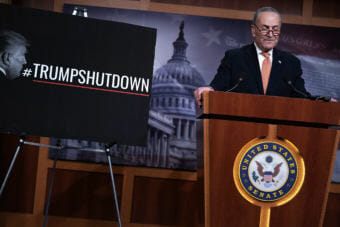
However, the hashtag #TrumpShutdown was also trending on Twitter late Friday night, and Democrats believe that it’s Republicans who will end up shouldering the majority of blame from the public given that the GOP controls both Congress and the White House.

Trump appeared to complicate efforts to reach a compromise over the past weeks, at first signaling he would sign any immigration deal but then rejecting a bipartisan proposal, bending to his conservative, hard-line base and insisting any deal had to have funding for his trademark border wall. Negotiations further stalled after Trump reportedly used a vulgarity in questioning why the U.S. should welcome immigrants from Africa instead of from places like Norway. (Trump has denied that he used that language.)

Schumer took to the Senate floor immediately after McConnell early Saturday and said that when he met with Trump at the White House on Friday, he had put the border wall on the negotiating table in order to reach a compromise on DACA. But “even that was not enough to entice the president to finish the deal,” Schumer said, accusing Trump and Republicans of “rooting for a shutdown,” which he said would “crash entirely” on the president’s shoulders.

“What happened to the president who asked us to come out with a deal and promised he’d take heat for it? What happened to that president? He backed off at the first sign of pressure,” Schumer said.

Polling released Friday from both Washington Post/ABC News and CNN found that most Americans would blame Trump and Republicans over Democrats in the event a shutdown occurred. However, CNN also found a majority said approving a budget deal was more important than finding a way to advance DACA.

As NPR’s Brian Naylor reported, if the shutdown continues, essential services will continue and essential workers would remain on the job, though they would be unpaid. Active-duty military will stay in service, along with post offices. In a change from the last time the government shut down in October 2013, the Interior Department announced it will work to keep national parks open and “as accessible as possible.”

Copyright 2018 NPR. To see more, visit http://www.npr.org/.

If the government shuts down, what’s open? What’s closed?

Mount Rainier's Nisqually Entrance gates are locked during the federal government shutdown in October 2013. This time, the Interior Department says if the government shuts down, most open land will remain accessible.
Mount Rainier’s Nisqually Entrance gates are locked during the federal government shutdown in October 2013. This time, the Interior Department says if the government shuts down, most open land will remain accessible. (Photo by Kevin Bacher/National Park Service)

The government is set to cease operations at 8 p.m. Friday Alaska time if Congress can’t reach an agreement on spending. How will that affect you?

These things continue as usual

  • The U.S. Postal Service will operate normally.
  • Active-duty military go to work as normal.

  • The Veterans Health Administration plans to keep all its appointments. So does the Alaska Native Medical Center.
  • The National Park Service and U.S. Fish and Wildlife Service will not erect special barriers blocking access to open land at parks and wildlife refuges. As a rule of thumb, unless there’s a gate that closes during non-business hours, you should be able to enter.
  • Federal courts have enough money to continue operations for about three weeks.
  • Social Security checks will still go out and applications will be processed, at least at the beginning.
  • Weather forecasting will continue and the Federal Aviation Administration will continue to operate.
  • The National Oceanic and Atmospheric Administration says it plans to carry out fisheries management activities and enforcement.

What will change

  • Many civilian Defense Department employees will be furloughed.
  • National Park visitor centers will close. Parks and refuge personnel won’t be on duty, except for emergency services.
  • Many federal workers will be furloughed.

Will the federal workers and military members who have to work during the shutdown get paid?

  • Yes, most just got their mid-month paychecks. The military will have no gap in pay until Feb. 1. If a shutdown lasts longer, the agencies incur an obligation to pay their employees, and they will be paid once Congress resumes funding the government.
  • In 2013, Congress passed emergency funding during a 16-day shutdown, so the military paychecks arrived on time.

What about the furloughed employees?

That’s up to Congress, but after past shutdowns, federal employees got back pay.

Can federal workers volunteer to work their jobs?

No. By law, the agencies are not allowed to accept voluntary service from their employees.

Anything else?

The Bureau of Ocean Energy Management has a public hearing Tuesday on the Trump administration’s draft plan for offshore drilling. If the government shuts down, that meeting is off.

Reporters Rachel Waldholz, Elizabeth Harball, Zachariah Hughes, Anne Hillman and Elizabeth Jenkins compiled this information.

Senate Democrats to huddle as shutdown vote looms

Updated at 7:19 p.m. ET

A Senate procedural vote on a stopgap spending bill to avoid a partial government shutdown is slated for 10 p.m. ET, but congressional leaders so far appear to lack the 60 votes needed to advance the measure.

Updated at 2:59 p.m. ET

Senate Minority Leader Chuck Schumer, D-N.Y., met with President Donald Trump at the White House Friday to discuss a path forward to avoid a partial government shutdown.

After the meeting, Schumer told reporters negotiations with Republicans would continue. “We had a long and detailed meeting,” Schumer said of his meeting with Trump. “We discussed all of the major outstanding issues. We made some progress, but we still have a good number of disagreements. The discussions will continue.”

The meeting began less than 12 hours before the midnight deadline for Congress to pass a new spending bill. Democrats and Republicans remain deadlocked without a path forward, even as both sides face potentially dramatic political fallout if a shutdown does occur.

Republicans stepped up their attacks on Democrats in the hours leading up to the White House meeting, blaming them for forcing the standoff. Senate Majority Leader Mitch McConnell, R-Ky., accused Democrats of using immigration as a bargaining chip in the fight.

“The Senate is now just hours away from an entirely avoidable government shutdown,” McConnell said Friday morning on the Senate floor. “The craziness of this seems to be dawning on my friend, the Democratic leader.”

Senate Democrats insist they will not vote for a stopgap measure without an agreement for long-term increases in military and domestic spending and a pathway to citizenship for roughly 700,000 immigrants. Those are individuals who are in the country illegally after being brought here as children and are enrolled in the Deferred Action for Childhood Arrivals program established by the Obama administration. Those protections from deportation are set to begin expiring in March after the Trump administration announced it was rescinding DACA last year.

“Government Funding Bill past last night in the House of Representatives. Now Democrats are needed if it is to pass in the Senate – but they want illegal immigration and weak borders. Shutdown coming? We need more Republican victories in 2018!” Trump tweeted at 7:04 a.m. ET.

Democrats launched into a last-minute flurry of talks late Thursday after a House vote to approve a short-term spending bill to keep the government open until Feb. 16 and fund the popular Children’s Health Insurance Program, or CHIP, for six years. Schumer and McConnell say they want to avoid a shutdown, but both leaders have become increasingly insistent that they are unwilling to compromise on their demands.

McConnell and other Republicans say they have more than a month to agree to an immigration package before the Deferred Action for Childhood Arrivals program, or DACA, is set to expire. They are calling on Democrats to back the short-term bill in order to give them more time to negotiate.

Republicans are already dubbing it the “Schumer Shutdown.” The minority leader has warned Republicans that they will not have enough Democratic votes to break the 60-vote filibuster threshold.

It is unlikely that McConnell even has a simple majority of Republicans to support a House-passed stopgap measure to keep the government running until Feb. 16. Republican Sens. Lindsey Graham of South Carolina and Jeff Flake of Arizona have indicated they will oppose it.

“I am not going to support continuing this fiasco for 30 more days by voting for a continuing resolution,” Graham said Thursday. “It’s time Congress stop the cycle of dysfunction, grow up and act consistent with the values of a great nation.”

The Senate convened Friday morning, but lawmakers and aides said there is no consensus on how to head off the impending midnight partial government shutdown.

Sen. Chris Van Hollen, D-Md., who runs Senate Democrats’ 2018 campaign operation, told NPR’s Morning Edition that Democrats would support a stopgap measure for three to four days to keep the government running and give negotiators more time to clinch deals in stalled immigration and budget talks.

“I’m not voting for a government shutdown. I’m voting to get an agreement to move forward,” Van Hollen said. “Let’s stay in. Let’s get it done.” The White House and Senate GOP leaders have not yet indicated whether they would accept that offer.

Van Hollen also said Trump, not the Democrats, will shoulder the blame if a shutdown occurs. “If the president of the United States, whether by design or incompetence is going to shut down the government, that is a big problem,” Van Hollen said. “I hope he will show some leadership; he says he’s the great negotiator.”

New data seems to agree. A Washington Post-ABC News poll out Friday found that 48 percent of Americans would blame Trump and Republicans for a shutdown, compared with 28 percent who would blame Democrats. The rest of the participants either blamed both equally or had no opinion.

Shutdowns are usually the product of divided government. A midnight shutdown would be the first time one occurred when the same party controlled both chambers of Congress and the White House.

Still, the Trump White House is working hard to shift blame back to the Democrats.

“There is no way you could lay this at the feet of the president of the United States,” said Mick Mulvaney, the director of the Office of Management and Budget, in a press conference on Friday.

“The reality is Republicans are united in keeping the government open. Democrats are united in trying to shut it down,” White House Legislative Affairs Director Marc Short told NPR’s Morning Edition.

Short downplayed the merits of an even shorter stopgap, arguing that negotiators need more time to reach an immigration deal to determine the fate of the hundreds of thousands of people in the DACA program.

“I think we’re making progress on DACA, but I think it’s unrealistic to think there’s going to be a solution in the next five days,” Short said.

Republicans have also sought to call attention to what they see as hypocrisy from the Democratic leadership, who loudly criticized Republicans in 2013 when the government last shut down, over Affordable Care Act disagreements.

The House passed the four-week stopgap on Thursday, 230-197, with just six Democrats voting with Republicans. The measure includes a six-year renewal of the popular Children’s Health Insurance Program and further delays of certain taxes under the Affordable Care Act, also known as Obamacare.

There is ostensibly Democratic support for all of those provisions, but the vast majority of Democrats oppose the stopgap because of the ongoing inability to reach a bipartisan immigration deal. Democrats are also withholding support for a longer-term spending deal until an immigration deal is clinched.

“This vote should be a no-brainer,” McConnell said Friday morning on the Senate floor. “And it would be, except the Democratic leader has convinced his members to filibuster any funding bill that doesn’t include legislation they are demanding for people who came into the United States illegally.”

The president has been an erratic negotiator in recent days, throwing already-contentious talks into disarray. After initially suggesting he would support any bipartisan proposal lawmakers could come up with, Trump rejected a proposal authored by Graham, a Republican, and Senate Minority Whip Dick Durbin, D-Ill., at the advice of more conservative lawmakers and his own top White House aides.

Trump was also seemingly at odds with his own chief of staff, John Kelly, over the president’s continued support for building a physical barrier along the U.S.-Mexico border. Kelly told Fox News that Trump was “flexible” on the wall, to which Trump later tweeted: “The Wall is the Wall, it has never changed or evolved from the first day I conceived of it.”

Trump further complicated budget negotiations on Thursday with a series of tweets that suggested he opposed the House stopgap bill. The White House put out a statement later that he did support it, and the president ultimately helped win over reluctant House conservatives to vote for the bill.

Most Americans would not feel the effects of a partial government shutdown. However, hundreds of thousands of federal workers would face furloughs.

“The military would still go to work, they will not get paid. The border will still be patrolled, they will not get paid,” said Mulvaney, the director of the Office of Management and Budget. “Folks will still be fighting the fires out West, they will not get paid. Parks will be open, people won’t get paid.”

All national security and military personnel deemed “essential” would continue to report to work, but they wouldn’t get paid. That includes active-duty U.S. troops, unless Congress passes separate legislation to make sure their paychecks go out. Lawmakers, however, face no such threat. Members of Congress continue to get paid in a government shutdown.

It costs more to shut down the government than to keep it running. Standard & Poor’s estimated that the 2013 government shutdown, lasting 16 days, cost the economy $24 billion and shaved 0.6 percent off the economic growth for the fourth quarter that year.

Copyright 2018 NPR. To see more, visit http://www.npr.org/.
Site notifications
Update notification options
Subscribe to notifications