Archives for:

"Government Shutdown"

U.S. House passes bill to avoid government shutdown, but Senate prospects uncertain

Updated at 8:46 p.m. ET

The House passed a stopgap funding bill Thursday evening, though the measure now faces uncertainty in the Senate as Republican congressional leaders work to avert a government shutdown by late Friday night.

Republicans need 60 votes in the Senate to proceed on the four-week continuing resolution, which would extend funding only until Feb. 16. That is looking more and more difficult after most Democrats and at least three Republican senators have said they won’t vote for the bill.

The measure passed in the House, 230-197, with 11 Republicans voting against the bill and six Democrats voting for it, after House Freedom Caucus members reached a deal to vote for the bill. The group’s chairman, Mark Meadows, R-N.C., had initially said enough of his members would withhold support that the bill would fail with GOP votes only, but about an hour before the vote was expected to begin Meadows told reporters he had received enough concessions from House Speaker Paul Ryan, R-Wis. — including plans for future votes on additional military funding — that he would recommend his caucus vote for the bill. And Thursday evening, the group said on Twitter that a majority of its members had decided to support the stopgap measure.

Democrats, however, wanted to include a fix for the Deferred Action for Childhood Arrivals program, set to expire in March, to protect the roughly 700,000 enrollees in the program who were brought to the U.S. illegally as children. And House Democrats had indicated they wouldn’t encourage their members to vote for the bill to bail out Republicans if the GOP had fallen short of the votes needed.

After the House vote, Ryan and other GOP leaders put the onus on Senate Democrats and their leader Chuck Schumer, D-N.Y., to pass the bill. And the House speaker was already calling any interruption in the operations of the federal government the “Schumer Shutdown,” should the bill fail in the Senate.

“I ask the American people to understand this: The only people standing in the way of keeping the government open are Senate Democrats,” Ryan said Thursday night. “Whether there is a government shutdown or not is now entirely up to them. I also want people to understand that Senate Democrats do not oppose anything that is in this bill. They are just holding this critical funding hostage for a deal on a completely unrelated immigration issue.”

Some Senate Republicans have already said they won’t support the bill. Republicans have only a 51-49 advantage, with Sen. John McCain, R-Ariz., possibly unavailable owing to medical issues.

Sen. Lindsey Graham, R-S.C., who was one of the lawmakers pushing for a bipartisan immigration deal to go along with a funding bill, reiterated Thursday evening he would oppose any short-term measure.

“I am not going to support continuing this fiasco for 30 more days by voting for a continuing resolution,” Graham said. “It’s time Congress stop the cycle of dysfunction, grow up and act consistent with the values of a great nation.”

President Trump had injected fresh confusion into tense negotiations to avert an impending shutdown with a Thursday morning tweet that indicated he opposed the measure the White House had previously signaled support for.

“CHIP should be part of a long term solution, not a 30 Day, or short term, extension!” Trump tweeted Thursday morning. The House funding bill includes a six-year renewal of the popular Children’s Health Insurance Program, which GOP leaders included as a potential sweetener to get the votes they need to pass the stopgap measure and force Democrats to vote against the program they are eager to reauthorize.

Ryan downplayed the tweet to reporters Thursday morning. “I am sure where he stands. He fully supports passing this legislation,” Ryan countered, noting that he spoke to the president after the tweet was posted.

Trump’s tweet also contradicted the White House’s already stated position in favor of the stopgap bill. In a statement Thursday, White House spokesman Raj Shah said the president supports the House bill. “The President supports the continuing resolution introduced in the House. Congress needs to do its job and provide full funding of our troops and military with a two-year budget caps deal,” Shah said. “However, as the deal is negotiated, the President wants to ensure our military and national security are funded. He will not let it be held hostage by Democrats.”

The House bill that passed Thursday evening included funding to extend the CHIP program for six years. After the House passed the bill, Senate Majority Leader Mitch McConnell, R-Ky. posted on Twitter essentially suggesting that Senate Democrats choose between protecting DACA enrollees whose program runs until March and protecting millions of children insured by CHIP who could face funding shortfalls more immediately.

McConnell, R-Ky., had said Thursday morning that he anticipated the House would pass the funding bill, but its fate in the Senate is uncertain. Senate Majority Whip John Cornyn, R-Texas, had said he was “not sure what the president means” when asked on Fox & Friends about the CHIP tweet.

The last-minute confusion over CHIP had further complicated spending negotiations that were stalled when Trump rejected a bipartisan Senate immigration plan intended to pave the way for a long-term-spending agreement.

The president had also jabbed at Democrats in another tweet Thursday morning over the stalled negotiations to reach a deal on spending limits for this fiscal year. “A government shutdown will be devastating to our military…something the Dems care very little about!” he tweeted. Democrats are resisting a spending deal agreement until a bipartisan immigration deal is clinched.

The immigration talks fell apart last week after Trump rejected a plan proposed by Sens. Lindsey Graham, R-S.C., and Dick Durbin, D-Ill., to pair increased border security with new legal protections and a pathway to citizenship for the roughly 700,000 DACA participants who are in the country illegally after being brought here as children.

It was during that meeting that Trump questioned why the U.S. would want more immigrants from “shithole countries” in Africa.

Trump also weighed in Thursday on Twitter on immigration, again demanding money for a wall along the Southern border with Mexico. “We need the Wall for the safety and security of our country. We need the Wall to help stop the massive inflow of drugs from Mexico, now rated the number one most dangerous country in the world. If there is no Wall, there is no Deal!” Trump tweeted.

Democrats say they will not accept any spending bill that funds the construction of a physical border wall, but they have been willing to negotiate over money for increased technology and other forms of border security.

Now, a second group of negotiators, led by the second-ranking Republicans and Democrats in the House and the Senate, has stepped in to attempt to craft a new deal, but the talks have been largely unsuccessful, according to several aides familiar with the talks.

Durbin is one of those negotiators, but he has indicated he will vote against the stopgap funding measure in the Senate. A growing number of Senate Democrats see the vote on the funding bill as a leverage point to try to reach a deal on immigration, even if their opposition threatens a shutdown.

Three centrist Democrats, Sen. Angus King of Maine (he is an independent but caucuses with Democrats) and Virginia Sens. Tim Kaine and Mark Warner, all announced Thursday morning they would oppose the funding measure. All three voted in favor of the previous stopgap measure in late December.

“Congress should remain in session with no recess until we work out a long-term bipartisan budget deal that addresses all issues,” Kaine and Warner said in a joint statement in which they said they would vote for a stopgap measure lasting just a few days to keep the government’s lights on and negotiations continuing. Virginia is home to a large number of government employees who would be directly affected by a shutdown.

“The continuing resolution is just a gimmick,” Kaine said Thursday evening on NPR’s All Things Considered. “It’s a way of saying, ‘Well, we can’t decide so let’s just drive by looking in the rearview mirror and do what we did yesterday.’ ”

The House needed to pass a bill Thursday to give the Senate time to do the same ahead of the midnight Friday deadline.

One key Democratic divide in the Senate: a tactical split between the Democrats running for re-election this year in states that Trump carried and the Democrats being mentioned as possible 2020 contenders.

2020 hopefuls like New Jersey Sen. Cory Booker, California Sen. Kamala Harris and New York Sen. Kirsten Gillibrand all oppose voting for a funding bill, if it doesn’t include permanent protections for DACA recipients. Vermont Sen. Bernie Sanders has advocated for this, too.

In December, seven of the 10 Democrats running in states that Trump won in 2016 voted in favor of the funding bill.

Immigration activists have increased the pressure on Democrats to oppose any spending measure while DACA is still unresolved. United We Dream has labeled Democrats who voted for the last funding bill, in December, as the “Deportation Caucus.”

When asked Thursday morning if he would be responsible if the government shuts down, Trump responded: “Could happen. We’ll see what happens. It’s up to the Democrats.”

Editor’s note: NPR has decided in this case to spell out the vulgar word that the president reportedly used because it meets our standard for use of offensive language: It is “absolutely integral to the meaning and spirit of the story being told.”

Copyright 2018 NPR. To see more, visit http://www.npr.org/.

Budget deal announced to avert Washington state government shutdown, fund schools

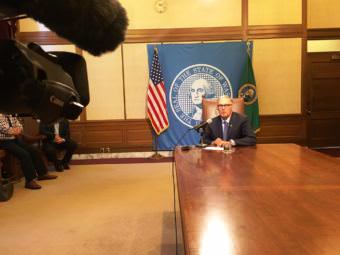
Washington Gov. Jay Inslee speaks with reporters Tuesday after a bill signing. At the time there was no budget agreement and he said that was creating "considerable anxiety" as a government shutdown loomed. (Photo by Austin Jenkins/Northwest News Network)
Washington Gov. Jay Inslee speaks with reporters Tuesday after a bill signing. At the time there was no budget agreement and he said that was creating “considerable anxiety” as a government shutdown loomed. (Photo by Austin Jenkins/Northwest News Network)

After months of partisan deadlock and weeks of brinksmanship as a government shutdown loomed, Washington legislative budget negotiators have reached an “agreement in principle” on a two-year budget designed to fully fund schools, as required by the state Supreme Court.
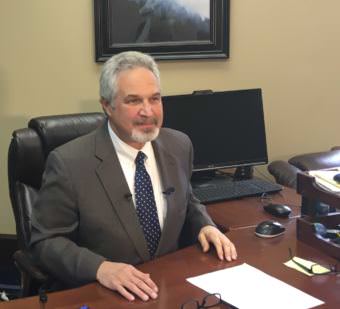
The deal came together early Wednesday morning following an all-night, marathon negotiating session at the Capitol.

No details on the deal were immediately released, but Senate Majority Leader Mark Schoesler, a Republican, said he believes the budget will help equalize school funding statewide.

“No longer will a student in Washington be funded on their zip code,” Schoesler told reporters gathered in the Senate wings.

House Majority Leader Pat Sullivan, a Democrat, also predicted it will pass constitutional muster.

“It will get my vote, I can tell you that,” Sullivan said. “And I wouldn’t be voting for it if I didn’t believe it satisfied the McCleary case.”

McCleary is the name of Washington Supreme Court case that says the state is not amply funding public schools. The 2017-19 operating budget is viewed as the third and final down payment on that 2012 ruling.

Lawmakers left the costliest and most difficult piece for last—shifting the responsibility for funding teacher and staff salaries from local districts back onto the state. The cost to fully fund the McCleary obligation over the next four years has been pegged at more than $7 billion.

Last spring, Senate Republicans proposed to solve McCleary with a new state property tax levy for schools of $1.55 per $1,000 of assessed value, along with the elimination of local maintenance and operation school levies. Republicans pitched the levy swap as a tax break for most Washington property owners.

Democrats panned the idea saying it would harm school districts and unfairly jack up property taxes in central Puget Sound.

By contrast, House Democrats proposed a multi-billion dollar tax package that included a new capital gains tax, changes to the real estate excise tax and a plan to capture sales tax from more online sales. But they never voted on the tax package, leading Senate Republicans to say they wouldn’t negotiate with “ghost dollars.”

Gov. Jay Inslee, a Democrat, later took the capital gains tax off the table, even though he supports the idea as a way to make Washington’s tax system less regressive.

The final budget and tax deal is likely to include elements from both plans.

Lawmakers now have less than 72 hours to pass the budget and send it to Inslee for his signature before midnight on Friday, June 30, the end of the fiscal year. That would avert a partial government shutdown on Saturday, July 1, including the temporary layoff of more than 30,000 state employees and the shuttering of state parks just before the Fourth of July holiday.

“We could have some unforeseen disaster, but we are all committed,” said Senate Majority Leader Mark Schoesler. “I will continue to believe we will not shut government down.”

“Yes, it will avoid a government shutdown,” added House Majority Leader Pat Sullivan, a Democrat.

Despite the clock running out on the session, legislative leaders said they wouldn’t release details of the budget until noon on Thursday, after they brief their respective caucuses. Voting on the budget could happen as early as Thursday afternoon or evening. That would leave very little time for lobbyists or the public to scrutinize the budget.

After the budget is signed into law, lawmakers will have 30 days to report back to the Supreme Court, which has retained jurisdiction in the McCleary case. The state is currently in contempt of court and paying a $100,000-a-day fine for not complying with a previous court order. If the justices aren’t satisfied, they could increase the current fine or impose a more dramatic sanction, like invalidating all tax exemptions.

Besides education funding, the budget is expected to put more money into mental health and into addressing homelessness. The budget may also create a new Department of Children, Youth and Families.

This is the third time since 2013 that Washington lawmakers have taken budget negotiations right up to the end of the fiscal year before forging a bipartisan agreement.

The legislature has been in session continuously since January and is currently meeting in a third, 30-day special session.

With one day left in special session, little public progress on budget

Senate President Pete Kelly gives a statement on the budget on Thursday, June 15. Kelly wants legislative leaders to focus on the budget. (Photo by Andrew Kitchenman/KTOO and Alaska Public Media)
Senate President Pete Kelly gives a statement on the budget on Thursday. Kelly wants legislative leaders to focus on the budget. (Photo by Andrew Kitchenman/KTOO and Alaska Public Media)

Leaders from both chambers of the Legislature met behind closed doors Thursday as they tried to reach a budget agreement.

But there was little public progress.

The 30-day special session will end Friday and the House and Senate majorities remained far apart.

Fairbanks Republican Senate President Pete Kelly said leaders should focus on the budget.
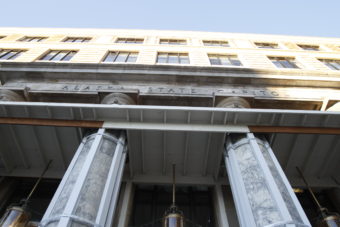
“The highest priority we have in the Senate is to avoid a government shutdown and that means we have to pass an operating budget,” he said. “The consequences of a government shutdown are devastating. A lot of people think it just affects the public sector, but that’s not true. It’s the private sector as well.”

Kelly singled out the state’s fishing industry as an example of an important business sector likely to be damaged by a shutdown.

Dillingham Democratic House Speaker Bryce Edgmon was in a caucus meeting Thursday afternoon.

On Wednesday evening, he said the House majority wanted to reach an agreement on a long-term plan to balance the amount the state government spends with what it receives.

“Our caucus has taken a very difficult, but we think appropriate, position in that we want to get a responsible budget in place this year,” he said. “We do not want a shutdown. But we also do not want to be back in this situation again next year.”

Kelly said it’s still possible to reach an agreement tonight and tomorrow.

If that doesn’t happen, Gov. Bill Walker is likely to call lawmakers into another special session. The Legislature must pass a budget before July 1 to prevent a shutdown.

Tax would require low- to middle-income residents to pay higher share

Rep. Les Gara, D-Anchorage, address the Capitol Press Corps during a House Majority Press Availability on March 28, 2017. (Photo by Skip Gray/360 North)
Rep. Les Gara, D-Anchorage, speaks during a House Majority press availability in March. Gara prefers raising oil and gas taxes to a payroll tax. (Photo by Skip Gray/360 North)

The House Finance Committee turned its attention Monday to a tax that Gov. Bill Walker included in the compromise package he proposed a week ago.

The tax has been called a few different names, including a “head tax” and an “income tax.”

Today, House Finance aides referred to it as a payroll tax. That’s because it would only tax the money people are paid for their employment, either on their employer’s payroll or through self-employment. But other forms of income – like the money people make on investments – wouldn’t be taxed.

Anchorage Democratic Rep. Les Gara said he’d rather have oil and gas companies pay more in taxes.

“The wealthiest pay the lowest percentage of their income under this bill, the way it’s written,” Gara said of Senate Bill 12. “The lowest income pay the highest percentage of their income under the way this bill is written, which seems a little backwards to me – or quite backwards.”

Under the current proposal, workers would pay one of five tax amounts – ranging from $50 for people making less than $20,000 per year to $500 for those paid more than $500,000.

Arnold Liebelt, an aide to Homer Rep. Paul Seaton, said the payroll tax could be changed to increase the number of tax levels, or to make the effect more similar across the income spectrum.

“There’s so many different ways that this can be sliced and diced,” Liebelt said.

North Pole Republican Rep. Tammie Wilson was skeptical of the tax. She noted that under the current proposal, some self-employed people would be able to deduct expenses before paying the tax, while employees wouldn’t.

“It’s another thing, just to bring up – that when we’re trying to be fair, ‘fair’ is something you go to in the summertime,” Wilson said. “You can’t always be fair when it comes to taxes.”

Both the House and Senate have passed bills to close most of the gap between what the state government spends and what it raises. They would draw from Permanent Fund earnings and reduce Permanent Fund dividends. But the House majority wants to set dividends at a higher level than the Senate. And while the House wants to raise taxes on income and on oil and gas companies, the Senate prefers spending cuts.

The special session will end on Friday. The Legislature has until the end of the month to pass a budget to avoid a state government shutdown.

Major progress eludes Alaska Legislature this week

The Alaska Capitol Building in Juneau on June 6, 2017. (Photo by Jeremy Hsieh/KTOO)
The Alaska Capitol Building in Juneau on Tuesday. There was little progress on reaching budget agreements this week, three weeks ahead of a potential government shutdown. (Photo by Jeremy Hsieh/KTOO)

Despite a looming deadline, lawmakers made no major progress this week on reaching agreement on a state budget and a plan to balance the budget in future years.

Gov. Bill Walker tried to make progress on Monday by putting out his own compromise proposal. He didn’t get very far.

He took the Senate’s side on how to handle oil and gas taxes and the Permanent Fund, and the House’s side on this year’s state budget and the need for a broad-based tax.

But no one embraced all of his package of proposals.

Senate President Pete Kelly welcomed it, but he continued to express opposition to the elements that differ from the Senate majority’s positions.

The mostly Democratic House majority was much stronger in rejecting it, although some members signaled a willingness to work with what Walker proposed.

Kelly wants lawmakers to focus on the budget first, he said. The Republican-led Senate majority may be willing to live with just passing the budget – putting off a decision on the Permanent Fund until later.

House members don’t want to do that – but they only want to reduce PFDs if the state also has higher oil taxes and/or a broad-based tax like an income tax. They have said that’s fairer.

Senators have said everyone agrees on the need for Permanent Fund changes, but they differ on taxes and spending.

House members have been hoping that the Senate would be swayed by public pressure over budget cuts. That hasn’t happened yet.

There’s one thing that’s certain to put pressure on both chambers – the state government shutting down in the event that they don’t pass a budget.

There’s a conference committee that’s making slow progress on the budget. But it hasn’t taken on the biggest differences between the chambers – such as cuts to education and university funding, and how much to draw from Permanent Fund earnings.

The conference committee on House Bill 111, which would make changes to oil and gas taxes, met Friday. The two chambers are still far apart.

Anchorage Democratic Rep. Geran Tarr said the House majority wants to change the system so that oil and gas companies effectively pay more in taxes.

“We’ve said it’s unsustainable,” Tarr said. “We need to reduce the burden to the state treasury because it’s not affordable going forward and we hope to find a compromise on that.”

While the Senate version of the bill eliminates the tax credits that are paid out to oil companies, Tarr said it allows them under a different name.

Anchorage Republican Sen. Cathy Giessel said what the Senate has proposed is significant: Companies would no longer be able to receive tax credits before they enter production.

“It will be applicable when you’ve reached production, versus simply handing out cash for performing certain activities,” she said. “That’s a big change. The other big change, of course, is we’re no longer jeopardizing our treasury by handing out this cash.

Giessel said the Senate didn’t have time to assess the overall effect of the House’s overhaul to oil and gas taxes.

Anchorage Democratic Rep. Les Gara has noted the projected reduction in oil and gas taxes in the Senate bill as compared with the House bill is equal to the Senate’s proposed cuts to school and university spending over 10 years.

Republicans reject the comparison, saying that encouraging oil production is necessary for the economy.

Legislators have a week to work out their differences. If they don’t, then Walker will likely call another special session. Then there will be two more weeks to prevent a shutdown July 1.

Permanent Fund Corp. shuffles investments while waiting on Legislature’s tab

Alaska Permanent Fund Executive Director Angela Rodell at the corporate office, March 14, 2016. (Photo by Skip Gray/360 North)
Alaska Permanent Fund CEO Angela Rodell at the corporate office last year. She and other fund managers face uncertainty this year on how much the state will draw from fund earnings. (Photo by Skip Gray/360 North)

Uncertainty over how the Legislature will close the state’s budget gap is affecting the Alaska Permanent Fund Corp. The corporation is investing more conservatively, so it has cash on hand in case the Legislature uses fund earnings to close the gap.

How much money the Alaska Permanent Fund Corp. keeps close at hand is usually pretty straightforward. For 35 years, money from fund earnings have gone to two places. One is the Permanent Fund dividend fund, the money from which resident’s annual dividend checks are drawn. The other is the main body of the fund, where earnings are reinvested.

This year, both legislative chambers have passed a bill that would use the earnings for a new purpose: to pay for state government. Corporation CEO Angela Rodell and other Permanent Fund managers are preparing to pay more out of the earnings than they ever have. But they still don’t know how much that will be, so they have to keep more money in investments that are quickly accessed.

“We are focused on the liquidity requirement – that we will have to send over a significant amount of cash,” she said.

The House has proposed drawing out $4.1 billion in the next year, $1.6 billion more than the Senate.

“As income comes in, rather than investing it into the long-term asset allocation, we’re holding more cash than we probably otherwise would at this point in anticipation that the draw amount might be bigger than the Senate version,” Rodell said.

Rodell used cash as a figure of speech – there aren’t neatly stacked bills in a bank vault. The fund invests the money it may withdraw, but it does so in conservative assets like Treasury bills. That means the fund will likely earn slightly less money than it would if it invested all of the money to maximize earnings.

Rodell said the state would benefit if any draw from the fund is based on a predictable plan, similar to what was included in both the Senate and House versions of the Permanent Fund bill.

“Part of my concern will be, if that doesn’t pass, sort of the unknown quantity of how much money they’re going to use, because under the current construct, they’re allowed to take and to appropriate as much as they need out of the earnings reserve account,” she said.

Lawmakers have reached a stalemate over which version of the Permanent Fund bill – Senate Bill 26 – will become law. Rodell is hopeful they’ll be able to resolve their differences.

“We just want to know how much … how much to write the check for to send over to the state treasury, and we are trying to balance that out,” she said. “And having a difference of $1.6 billion is a big difference. And we’re hopeful they can get that reconciled sooner rather than later.”

Rodell noted the corporation went through something similar last year, when the Senate passed a bill to draw money from the fund, only to have it die in the House. Gov. Bill Walker then vetoed half the Permanent Fund dividend money – the first time that has ever happened.

“We’ve been having this uncertainty of both bigger than anticipated draws and maybe smaller than anticipated draws now for the two years,” Rodell said. “That’s why I am hopeful that we are able to back to a more rules-based strategy like we’ve had in the past going forward.”

The Legislature has until the end of the month to pass a budget to avoid a government shutdown. The special session is scheduled to end on June 16.

Site notifications
Update notification options
Subscribe to notifications