Archives for:

"Government Shutdown"

House and Senate negotiators complete budget proposal

Update | 12:10 p.m.

The Senate has delayed its floor session to 1 p.m.

Original story | 1:58 a.m.

conference committee
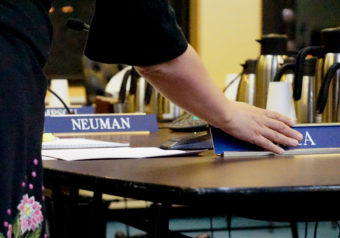
Committee aide Marta Lastufka preps a room in the Bill Ray Center for the operating budget conference committee, May 18, 2016. (Photo by Jeremy Hsieh/KTOO)

Late on Memorial Day, House and Senate negotiators completed their conference committee work on a proposed state operating budget. They were 26 hours ahead of a still looming deadline.

Now, to avoid a second year of mass layoff notices to state workers and another government shutdown scare, the pressure is on lawmakers to take the negotiated deal as-is.

Sen. Anna MacKinnon, an Eagle River Republican on the conference committee, said their plan was a bipartisan and bicameral effort “to make sure that state employees do not face pink slips tomorrow in a real tough time for Alaska. … The budget before us … addresses the need to cut, the need to invest and the need to compromise.”

The operating budget bill is now bound for the Senate, scheduled to meet at 11 a.m., and the House at 1 p.m.

Like earlier plans, the proposed budget requires cashing out a lot of state savings — $3.2 billion in this case. Lawmakers’ go-to budget reserve requires a three-quarters supermajority to use. That’s given minority Democrats in the House some leverage.

The conference committee restored some money for K-12 public schools, the University of Alaska, child care benefits, and senior and disabilities services.

Fairbanks Republican Sen. Pete Kelly, who co-chaired the conference committee, even agreed to drop an across-the-board executive branch cut worth $100 million. The committee said equivalent savings would come from criminal justice and health care reforms.

After the meeting, Kelly said the votes the votes for savings draw will be there, unless “somebody broke their word.” He called the operating budget the “first domino to fall” in a series.

Other outstanding special session dominos include a capital budget, restructuring the Alaska Permanent Fund and its earnings reserve, shoring up the health insurance market, new or increased taxes, and medical insurance for survivors of peace officers and firefighters under Alaska’s public employee retirement system.

Alaska Legislature convenes for special session

Mike Chenault, Speaker of the House, Alaska Legislature, R- Nikiski wields the gavel during the second regular session of the 29th Alaska Legislature, January 19, 2016. (Photo by Skip Gray/360 North.)
House Speaker Mike Chenault, R- Nikiski wields the gavel during the second regular session of the 29th Alaska Legislature, Jan. 19. (Photo by Skip Gray/360 North)

Alaska lawmakers are back at work Monday after failing to pass a budget by the constitutional deadline last week.

It’s the first day of a special session called by Gov. Bill Walker.

Lawmakers now have 30 days to try to do what they couldn’t in the past four months: Agree on a budget and make progress on closing the state’s $4 billion deficit.
There are several deadlines looming.

If there’s no budget in place by June 1, the administration will have to send out layoff notices to state workers.

If there’s still no budget in place by July 1, the state could face a government shutdown.

In addition to the budget, Walker has asked lawmakers to consider several bills that have so far proved immune to compromise.

Those include an overhaul of the state’s oil and gas taxes and a proposal to restructure the Permanent Fund — as well as a range of new taxes, including an income tax.

The House plans to convene at 11 a.m. Monday, followed by the Senate at noon.

Senate Passes Bill To Fund Government Through December

The Senate has overwhelmingly passed a bill that funds the government through December. The bill does not strip funding from Planned Parenthood.

Remember, some House Republicans had insisted on defunding planned parenthood before they voted to extend funding for the whole government.

NPR’s Ailsa Chang reports that the action now moves to the House. She filed this report for our Newscast unit:

“On this last day before the government runs out of funding, the Senate has teed things up to avert a shutdown.

“A short-term funding measure sailed through the Senate this morning, and is expected to pass in the House later today. After weeks of both chambers holding votes to defund Planned Parenthood and to place new rules on abortions, it appears the battle to strip the women’s health group of federal dollars has been put on hold — for now.

“Investigations into the organization are ramping up, and Republicans may re-visit the defund-Planned-Parenthood fight in mid-December, when government funding will run out again.”

We’ll update this post once the House takes action.

Copyright 2015 NPR. To see more, visit http://www.npr.org/.
Read Original Article – Published SEPTEMBER 30, 201511:37 AM ET

Senate Vote To Keep Government Funded Fails As Shutdown Nears

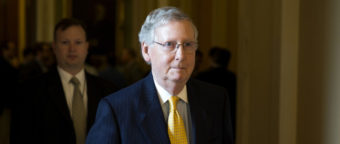
Senate Majority Leader Mitch McConnell brought a measure up for a vote Thursday that funded the government but defunded Planned Parenthood. Democrats banded together to block it. Evan Vucci/AP
Senate Majority Leader Mitch McConnell brought a measure up for a vote Thursday that funded the government but defunded Planned Parenthood. Democrats banded together to block it.
Evan Vucci/AP

Senate Democrats today blocked a Republican plan to keep the federal government open beyond next week. Their objection was that it also denied federal funds to Planned Parenthood.

With only days left before an Oct. 1 shutdown, the short-term measure that would fund the government through mid-December fell well short of the 60 votes needed advance, 47 to 52.

The vote took place just hours after Pope Francis’ speech to a joint meeting of Congress in which he urged lawmakers to come together to solve America’s problems.

This outcome was not unexpected.

Democrats had vowed to vote down any measure containing anti-Planned Parenthood language, and President Obama had threatened to veto any such bill.

Conservatives in Congress, notably Texas Sen. Ted Cruz, want to block federal dollars from going to the Planned Parenthood. The organization has been the subject of ongoing controversy since a sting video was released that alleges it profits from the sale of fetal tissue.

So the scramble continues to keep the government funded.

As the Two-Way reported last week, leaders of both parties are not itching for a shutdown. Republicans fear should a shutdown take place, a majority of Americans would saddle them with the blame, as in 2013.

Since Thursday’s procedural vote failed, Senate Majority Leader Mitch McConnell is expected to move to a vote on a “clean” continuing resolution, or CR, that leaves federal funding for Planned Parenthood intact.

As Politico reports:

“McConnell can also box out Sen. Ted Cruz (R-Texas) from attempting a filibuster if the GOP leader acts quickly after the failed vote; otherwise Cruz could try to delay McConnell’s plans to jam House Speaker John Boehner (R-Ohio) with a do-or-die vote on a clean stopgap spending bill, or continuing resolution. But Senate GOP leadership is confident they can rebuff any Cruz maneuvering.”

If the clean CR passes, as is expected, it will then go to the House, where its fate is less certain.

As The Hill reports, House conservatives could once again rally behind Cruz AS they did for the 2013 shutdown.

“Cruz’s power on Capitol Hill rests largely with House conservatives, as it did two years ago, because few Senate colleagues are willing to join him in challenging McConnell.

“If enough Republicans in the lower chamber side with Cruz, it could pressure [House Speaker] Boehner not to schedule a vote on a clean Senate-passed stopgap out of fear that it may cost him his gavel.”

Copyright 2015 NPR. To see more, visit http://www.npr.org/.
Read Original Article – Published SEPTEMBER 24, 2015 4:16 PM ET

No Deal Yet, But Maybe An Opening

Thursday saw much sound and fury about resolving, at least for the short term, the political gridlock over the debt ceiling and the partial government shutdown. But it’s not clear what, if anything, it all signifies.

Speculation is rife about what exactly went on in Thursday afternoon’s closed-door White House meeting between top House Republicans and President Obama and whether it can produce a breakthrough.

Here’s a sampling:

The New York Times:

“People familiar with the meeting said that Mr. Obama pressed Republicans to reopen the government, and that Republicans raised the possibility that financing could be restored by early next week if terms for broad budget negotiations could be reached.

Twenty Republicans, led by Speaker John A. Boehner, went to the White House at Mr. Obama’s invitation after a day of fine-tuning their proposal to increase the Treasury Department’s authority to borrow money to pay existing obligations through Nov. 22. The government is expected to reach its borrowing limit next week. In exchange, they sought a commitment by the president to negotiate a deal for long-term deficit reduction and a tax overhaul.

The president ‘didn’t say yes, didn’t say no,’ said Representative Paul D. Ryan, Republican of Wisconsin and chairman of the House Budget Committee. He added, ‘We agreed to continue talking and continue negotiating.'”

The Wall Street Journal:

“According to a Democrat briefed on the meeting, Mr. Obama asked Republican leaders why the government needed to remain closed when both sides want to have budget discussions. Republicans said they would offer specific ideas for opening the government, which sent staff working into the night to discuss components of a compromise government spending bill.”

The newspaper also noted:

“Just the glimpse of a path to avoiding an unprecedented U.S. default sent stocks soaring. The Dow Jones Industrial Average climbed 323.09 points, or 2.2%, to 15126.07. Stocks also jumped higher in Asia Friday morning.”

The Washington Post:

“After a 90-minute meeting at the White House, the two sides remained at odds over how and when to end the government shutdown — now in its 11th day — with Obama insisting that Republicans reopen federal agencies before negotiations over broader budget issues can begin.

In the Senate, top Republicans began crafting a proposal that would reopen the government and raise the federal debt limit for as long as three months — an approach closer to the terms Obama has set to end the standoff.

The developments meant that bipartisan negotiations were suddenly underway on two separate tracks Thursday after weeks of stalemate. Major questions remain, however, about the path ahead.”

And from the National Journal:

“[Who’s] making the greater concession? We’ll likely find out over the next day or so. But it’s obvious there is marginal movement toward the middle, in a foot-dragging way, from what had been two hard-line positions. Boehner, taking his cue from the tea-party sub-caucus in the House, had initially insisted on presidential concessions related to the start-up of Obamacare this month. He appears to be letting that slide, to the consternation of the tea party. Suddenly all the talk is about spending in general — entitlements and tax reform — not Obamacare, which Boehner and his team have come to accept that the president cannot budge on, given that it is his signature domestic achievement.”

Copyright 2013 NPR. To see more, visit http://www.npr.org/.
Read original article – Published October 11, 2013 7:48 AM
No Deal Yet, But Maybe An Opening
Site notifications
Update notification options
Subscribe to notifications