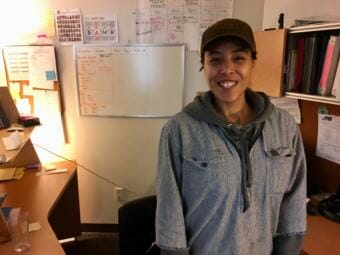
Zoe Grueskin, KTOO

An elementary school program is growing gardeners in Juneau

Nearly 200 elementary school students helped grow produce at Riverbend Elementary School in summer 2018. (Photo courtesy of Karen Goodell)

This past summer, Juneau got nearly 200 new gardeners. They were elementary school students who learned the ins and outs of growing their own food at summer camp.

Cold, gray winter may be settling on Juneau, but kids at Riverbend and Glacier Valley elementary schools are still talking about the rainbow of fruits and vegetables they helped grow this summer. Gold and purple potatoes, purple and orange carrots, red tomatoes.

Karen Goodell is director for after-school programming at the two schools, and she oversees their combined summer camp.

The gardens at Riverbend Elementary School in summer 2018 featured 8 beds of produce. (Photo courtesy Karen Goodell)

“The garden not only was a place for food production, but it was a great place to go hang out. The kids loved hanging out there, and they learned so much,” Goodell said.

The garden is a passion project for her. She said it gives kids a “friendlier” idea about healthy food.

“I think there were kids who were eating vegetables and fruits who would never typically do that. I mean, dirt and all, some of them,” she said.

Goodell said that’s because the kids feel connected to the food.

“It’s that sense of ownership,” she said. “If a kid has actually had their hands in the process of growing that carrot, they savor that carrot, because they own that carrot.”

A gardener herself, Goodell started the Riverbend garden three years ago. She wanted to create a hands-on learning experience for kids, and she hoped it would create community.

Karen Goodell and master gardener Joel Bos show off prizes from winning the Alaska DNR Farm to School Challenge, on Dec. 4, 2018. (Photo by Zoe Grueskin/KTOO)

A student might struggle in the classroom. But in the garden, Goodell said, it could be a totally different picture.

“You saw kids who might not typically be invested in your standard school activity are now super-invested. And friendships that were formed that weren’t necessarily happening on the playground, but in the environment of the playground, were happening,” she said.

Last month, the Alaska Department of Natural Resources named Riverbend the winner of their “Farm to School Challenge.” Prizes included children’s books on gardening and some “Alaska Grown” swag. Sen. Lisa Murkowski tweeted her congratulations.

Goodell said it’s nice to be recognized. She has big dreams of expanding the garden project. Maybe one day Juneau could grow its own produce.

“In the meantime, we’ve got our future, which are the kids, who are learning more about that possibility,” she said. “So even on smaller scales, if they ended up having their own personal gardens in their own homes as they move forward, I feel like we’ve made a big contribution to their well-being.”

Goodell said planning for next summer’s garden will begin in the new year.

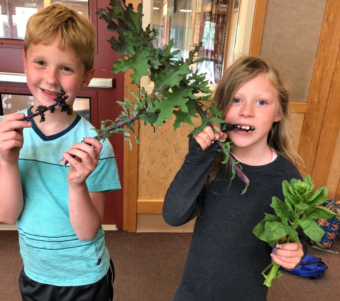
A few of the student-gardeners at Riverbend Elementary School show off the bok choy they grew summer 2018. (Photo courtesy Joel Bos)

Alaska Airlines workers rally again for higher wages, job security

John Walters helped organize a rally of Alaska Airlines workers at Juneau International Airport in Dec. 2018. Photo: Zoe Grueskin/KTOO.
John Walters rallies Alaska Airlines workers at Juneau International Airport on Saturday. Walters helped organize the rally. (Photo by Zoe Grueskin/KTOO)

Alaska Airlines workers rallied across the West Coast on Saturday, calling for job security and higher wages — and a resolution to slow moving contract negotiations.

At the Juneau International Airport, around 15 employees took part. They sported the same neon green t-shirts worn at a similar event three months ago. The front reads “$how us the money.” On the back: “United we bargain, divided we beg.”

John Walters has worked for Alaska Airlines for nearly 20 years handling bags. He said he loves his job and looks forward to coming to work each day. But he has some concerns. Pay starts at $12 per hour, and according to Walters it increases slowly. Plus, employees of the Seattle-based company work contract-to-contract.

The most recent contract technically ends this year. But negotiations for a new one between Alaska Airlines and its workers’ union, the International Association of Machinists and Aerospace Workers, have already stretched over 14 months.

Walters said this is unusual. Typically, he said, contract negotiations have gone smoothly, and rallies like the one on Saturday — and the one held in September — are rare.

Walters is a member, not a representative, of the union, but he helped organize the rally. He said he’s not shy about sharing his feelings, and right now, he’s frustrated.

“We’re still trying to get our message across,” Walters said. “I don’t think the company takes us seriously. When we sit down at the negotiating table we tell them we want livable wages, and they kind of laugh at us.”

Carolyn Sharp says she's seen "a lot of good, a lot of bad. It's a great company. It just needs to step up a little bit," during a workers' rally at Juneau International Airport on Saturday. Sharp has worked for Alaska Airlines for 31 years.
Carolyn Sharp says she’s seen “a lot of good, a lot of bad. It’s a great company. It just needs to step up a little bit,” during a workers’ rally at Juneau International Airport on Saturday. Sharp has worked for Alaska Airlines for 31 years. (Photo by Zoe Grueskin/KTOO)

In a statement, Alaska Airlines said it does not talk specifics while union negotiations are underway. The company said it pays fair, competitive wages and provides quality benefits to its employees.

Tension within the airline was aggravated in April, when the Puget Sound Business Journal published a story revealing that Alaska Airlines executives had gotten large pay raises as the company merged with Virgin America. For example, CEO Brad Tilden’s compensation jumped 35 percent to $5.7 million in 2017. The journal reported that meant Tilden was earning 115.5 times more than the company’s median employee.

Kaleb Rosa, president of the Local 2202, said that news triggered unrest among workers that’s still unfolding with events like the rally. Rosa is optimistic, but he said they had an unpleasant surprise during the last round of negotiations. That’s when Alaska Airlines proposed a new financial package, outlining everything from wages to vacation and retirement benefits.

“It was not anywhere near what the negotiators were expecting. It was a low ball,” Rosa said.

Negotiations resume Tuesday in Seattle. Rosa said airline workers there will hold another rally.

New education program is a good ‘MATCH’ for adult learners

Samantha Coronell is a student in The Learning Connection's MATCH program. Photo: Zoe Grueskin/KTOO.
Samantha Coronell is a student in The Learning Connection’s MATCH program. (Photo by Zoe Grueskin/KTOO)

Samantha Coronell said she’s always had trouble paying attention in school.

The 27-year-old was born in Juneau but moved away with her family in the third grade.

“And I moved back as soon as I could, had to come home. I didn’t realize it, but I missed the mountains. All my homework had little pictures of mountains on it,” said Coronell.

Coronell did return to Juneau and graduated from Yaakoosge Daakahidi High School in 2012.

Today she works as a carpenter apprentice, using skills she picked up at a nonprofit education center in Juneau called The Learning Connection, or TLC. It’s a program of SERRC, a statewide educational resource center.

TLC offers hands-on programs to learn a trade like construction. Right now though, Coronell is enrolled in a totally different kind of class at TLC, one in a regular classroom with whiteboards and a projector.

Called the MATCH program, for “Making Academics, Training and Careers Happen,” it combines math, reading and computer skills with lessons on how to succeed in the workplace. TLC’s offerings are typically drop-in style, meaning students come when they can. But Smith said this class is more intense.
“I think what’s different about this class is that we’ve sort of set it up as a commitment,” said Jeff Smith, the regional coordinator of the adult education program at SERRC and one of the MATCH instructors.

Students in the MATCH program meet almost every weekday for more than two months.

“We know students have busy lives, and so to commit to something long-term can be really hard. But with this class we really wanted to get a committed group so we could really help them move the bar,” Smith said.

According to Smith, the model is working. He said nationwide only half of adult education students make it to 12 hours of instruction.

“And so to have a group that eight of them started, eight of them are still with us. They’re there every single day, sometimes four to seven hours a day. Just the level of effort and commitment that they’ve shown in the class has been really amazing,” Smith said.

MATCH students range in age from 17 to 60. Smith said there’s also a wide range in what the students want out of the class. A few are studying for their GED. Two students are English language learners. And Coronell is thinking about going to college. She loves science and hopes to study genetics.

When MATCH staff learned her interest, they organized a class field trip to the National Oceanic and Atmospheric Administration’s laboratory.

Patte Harding is the other instructor in Coronell’s class.

“She kind of looked like a kid in a candy shop when we were over there,” said Harding. “Her eyes were, like, wide open. She was asking a lot of questions. She’s touching all the little creatures in the wet lab. So I think it really opened her eyes to a lot of the different types of science available right here in Juneau.”

Smith said that is exactly what the class is about.

“Just sort of that, ‘Oh my gosh, I could see myself here doing this job.’ That’s really what we want, to inspire the vision for their life,” Smith said.

TLC plans to offer the MATCH program in Juneau again in the spring.

UAS named top 10 for marine biology

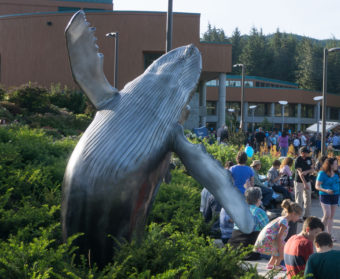
Bronze whale sculpture at UAS
A  humpback whale sculpture bursts from greenery on the University of Alaska Southeast campus. UAS was named one of 10 best colleges to study marine biology. (Photo by Jeremy Hsieh/KTOO)

The University of Alaska Southeast is one of the 10 best schools in the U.S. to study marine biology. That’s according to College Magazine, which last month named UAS number 8 in its roundup of top marine biology programs.

“We’re very proud of our program, and we know that we offer students an extraordinary opportunity during their four years here at UAS,” said Sherry Tamone, professor of marine biology at UAS and chair of the natural sciences department.

Tamone said a major strength of the program is its small size, which gives students the chance to work with professors in the lab and field.

The field, in this case, being Alaska’s Inside Passage.

“And our students can go right to the ocean and study the near shore biology and marine mammals,” Tamone said.

Five faculty at UAS are actively engaged in research in the region, said Tamone. Students can help them study things like salmon migration and commercially important shrimp and crabs.

“So our students are really engaged in research that applies to Alaska,” Tamone said.

Students have gone on to work for the Alaska Department of Fish & Game and the National Oceanic and Atmospheric Administration, according to Tamone.

UAS students can earn undergraduate degrees in both marine biology and fisheries. Tamone said around 55 students are currently working toward marine biology degrees.

Newscast – Thursday, Nov. 29, 2018

In this newscast:

  • The federal Energy Information Administration expects heating fuel costs to be higher than last year. But what happens in the lower 48 doesn’t necessarily hold true in Alaska.
  • A national climate report says the state is warming twice as fast as the rest of the country. Rural and Alaska Native communities like those in the Yukon-Kuskokwim Delta are the first to feel those impacts and are already seeing change from their front doors.
  • President Trump says he’ll shut down the government if he doesn’t get $5 billion for border security and a wall on the southern border. But if he gets his way, it could mean Alaska’s congressional delegation would lose one of its top priorities: A polar icebreaker.
Dunleavy retains Michael Johnson as education commissioner

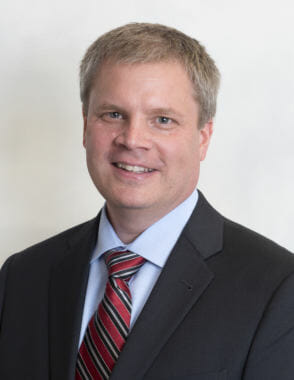
Michael Johnson is commissioner of the Alaska Department of Education and Early Development. (Photo courtesy of State of Alaska)

Gov.-elect Mike Dunleavy announced Wednesday he will retain the state’s education commissioner. Michael Johnson will continue to serve as the head of the Department of Education and Early Development.

“I am honored to serve alongside Governor Dunleavy and look forward to working with the state board and Alaskans across the state to make sure every kid’s getting a great education,” Johnson said.

Unlike other members of the cabinet, the education commissioner is not directly appointed by the governor. Instead, the choice is made by the State Board of Education and Early Development. The governor confirms the board’s pick.

Of course, as Board Chair James Fields pointed out, the governor has other options.

“As far as I understand, if the governor wanted to un-appoint board members, he could literally start over and appoint all new board members. That would be at his discretion,” Fields said.

But Fields says he doesn’t see that happening. Johnson and Fields have discussed their goals for education in the state with the governor-elect, and both said the underlying mission of their work will remain the same.

“Are there going to be changes? I’m sure there will be. Like with any administration there’s going to be some adjustment. But I think we have the right leadership, and we have a good board that can deal with those adjustments and not lose sight of making sure we’re trying to do the best we can for every student in Alaska,” said Fields.

Johnson said, “I think that’s one of the wonderful things about education. That common focus stays the same through administrations.”

Gov.-elect Dunleavy himself is a former educator and administrator.

Site notifications
Update notification options
Subscribe to notifications