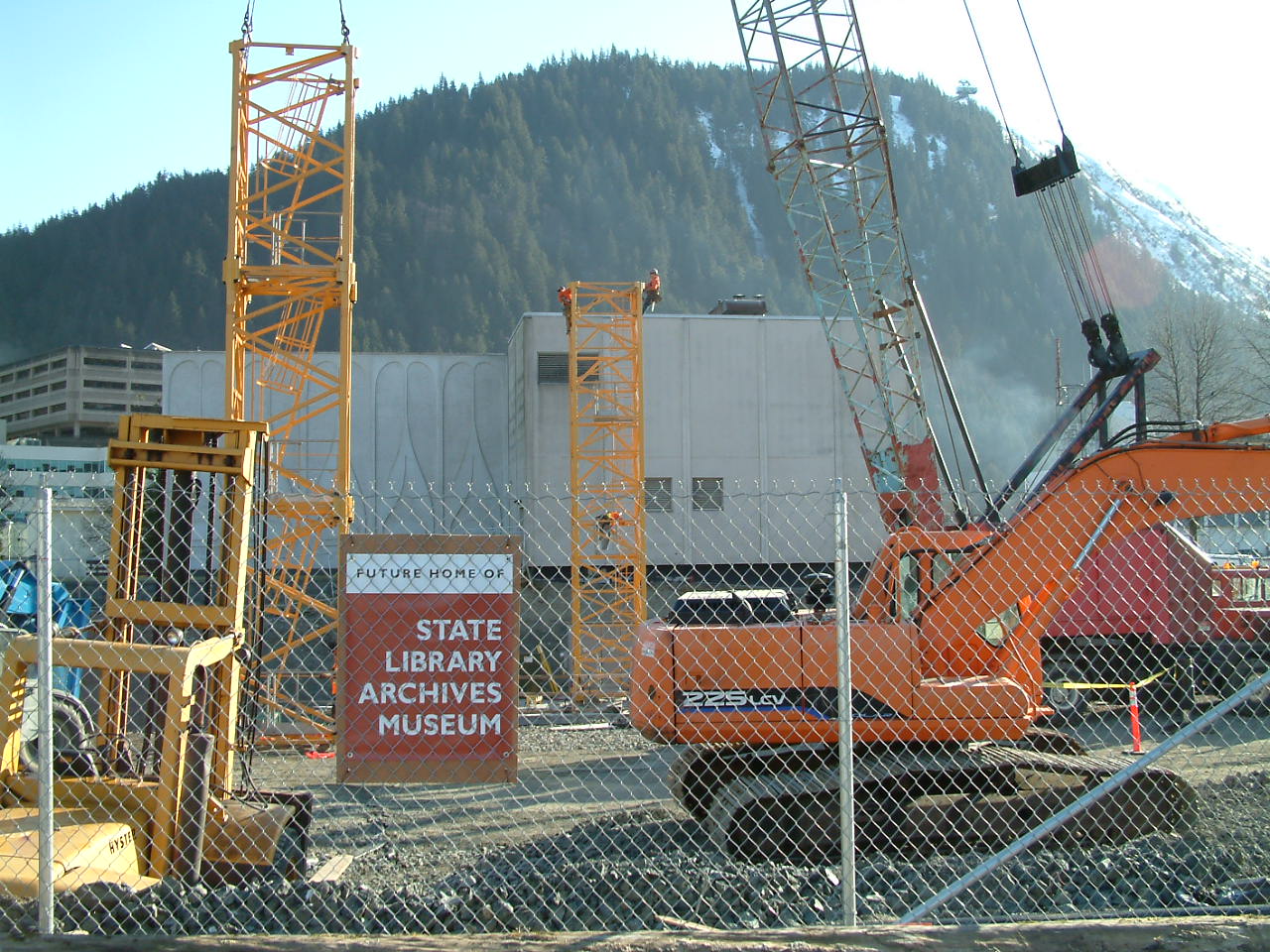
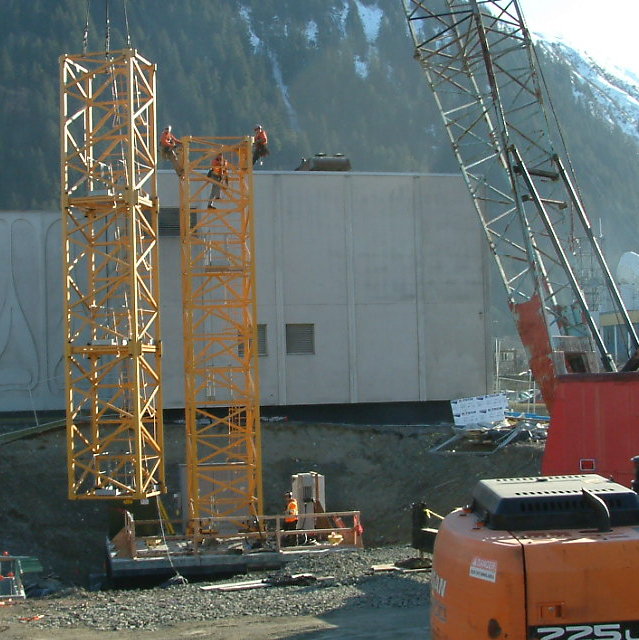
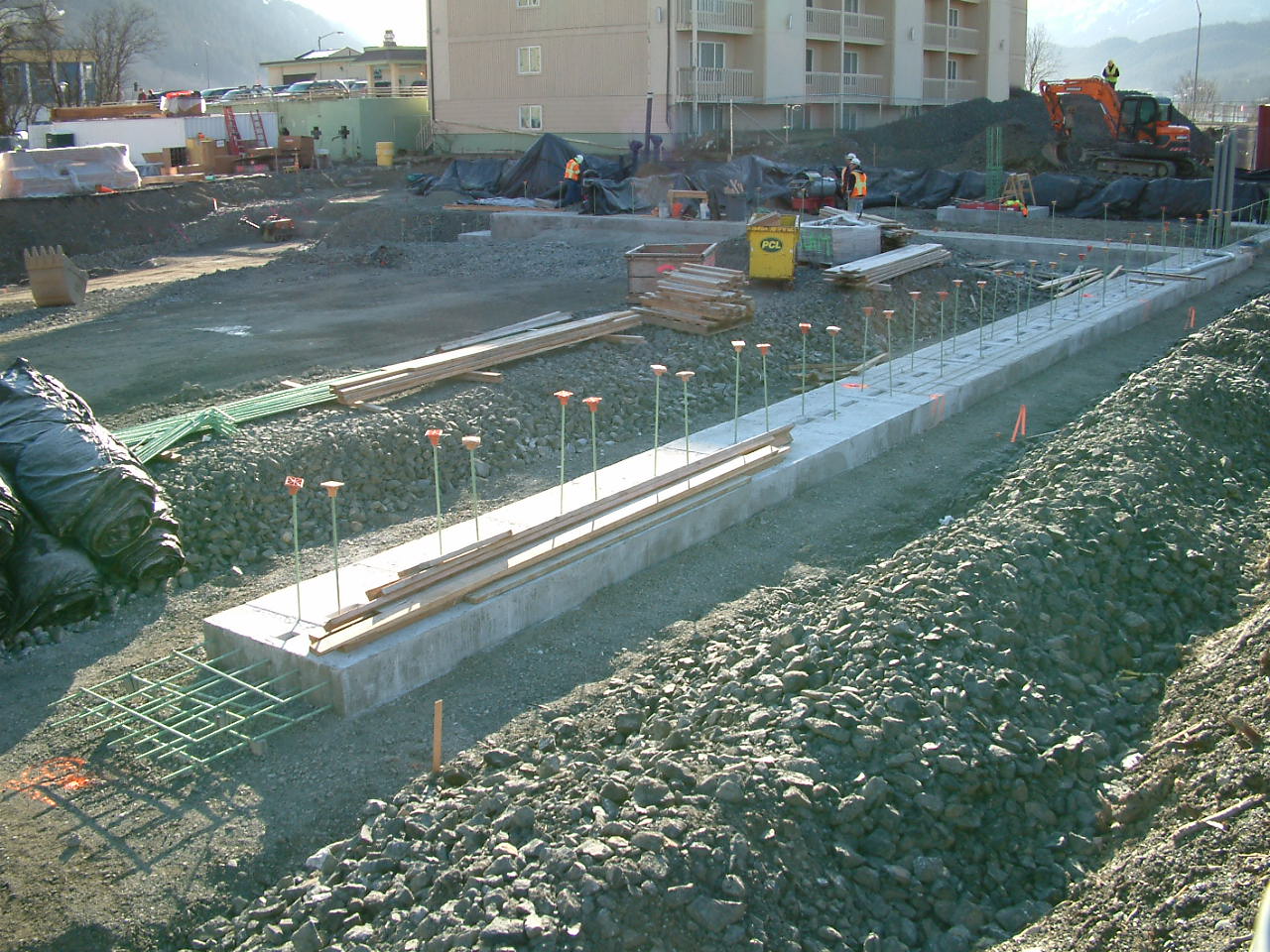
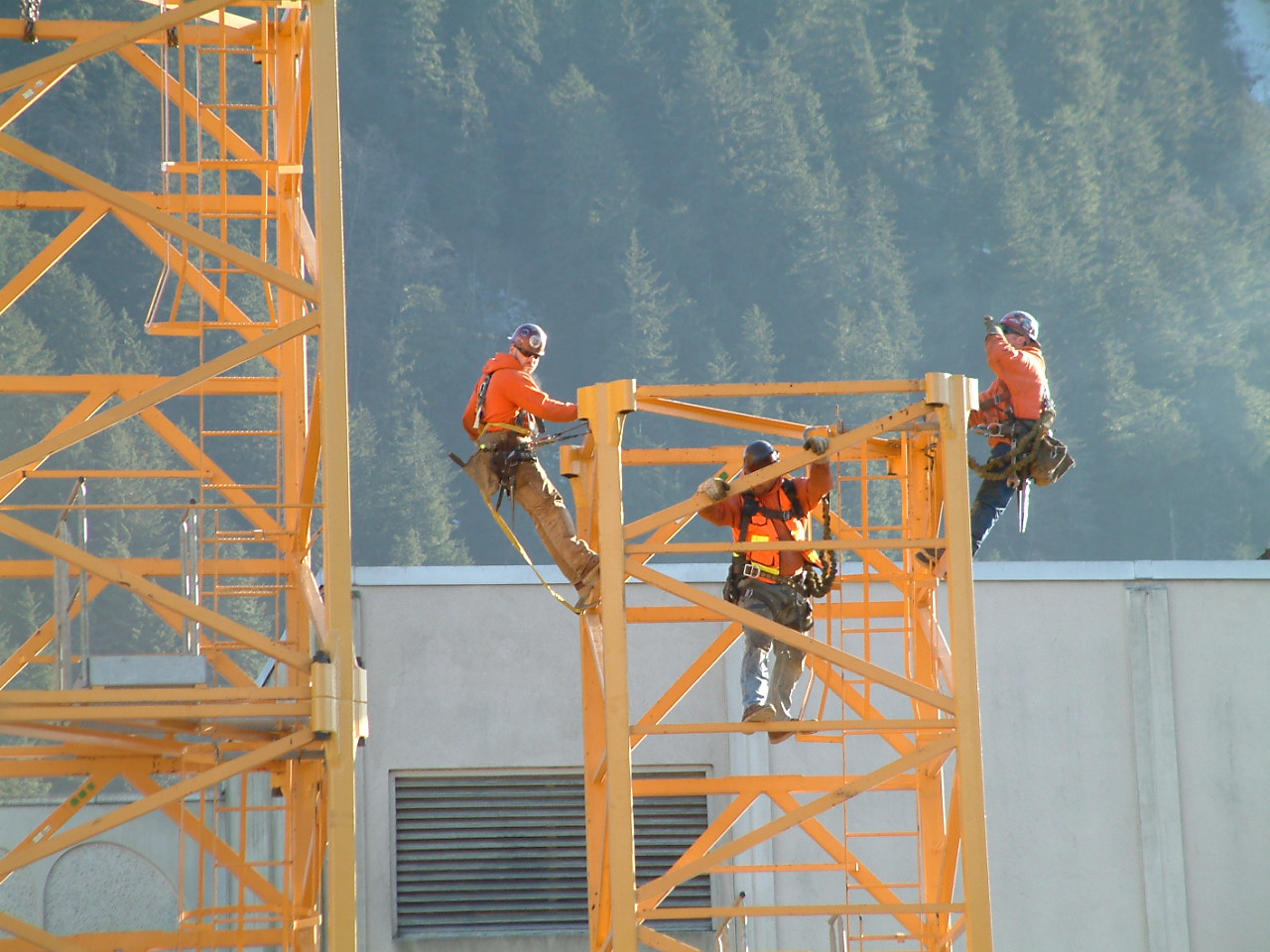
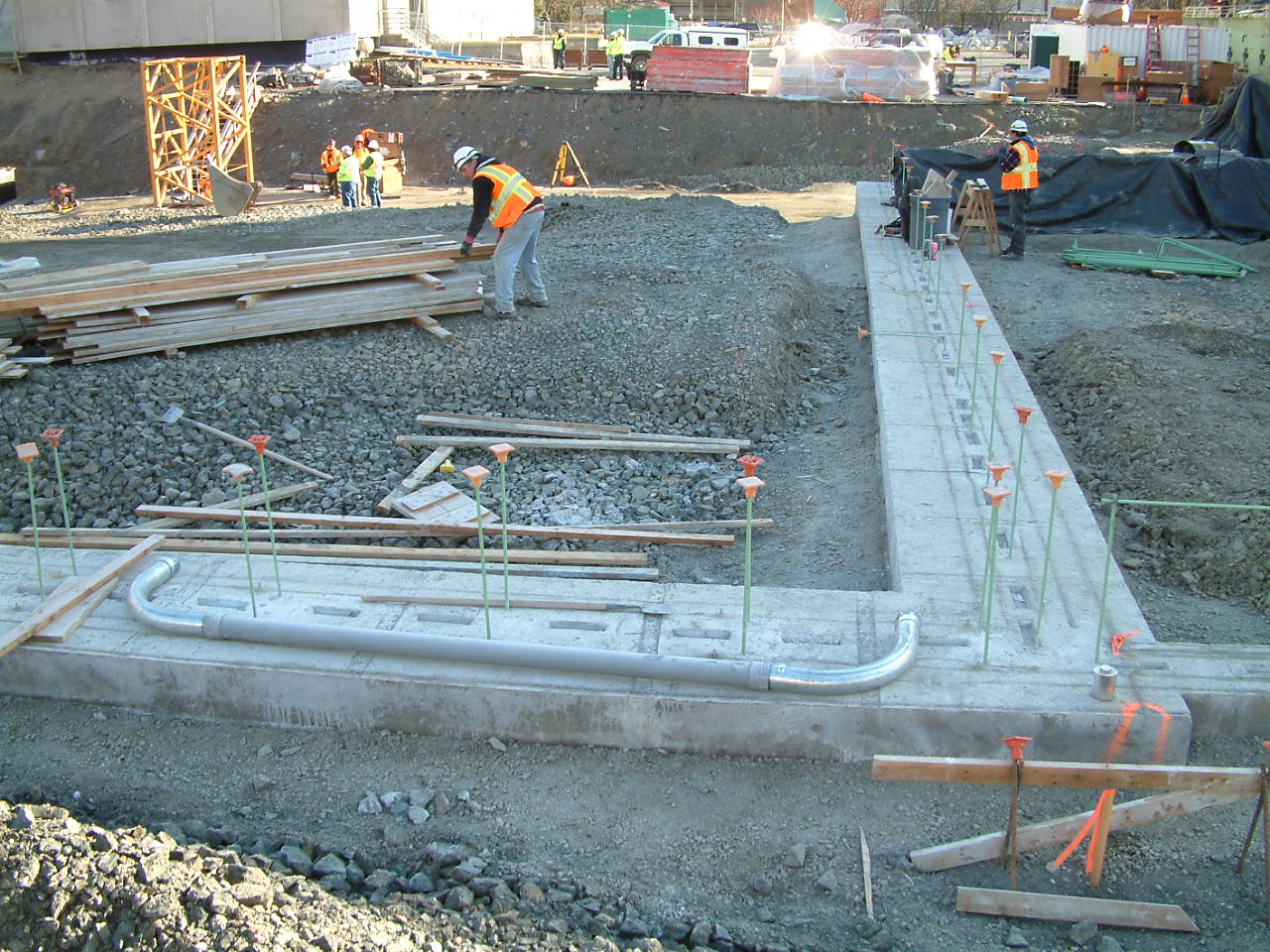
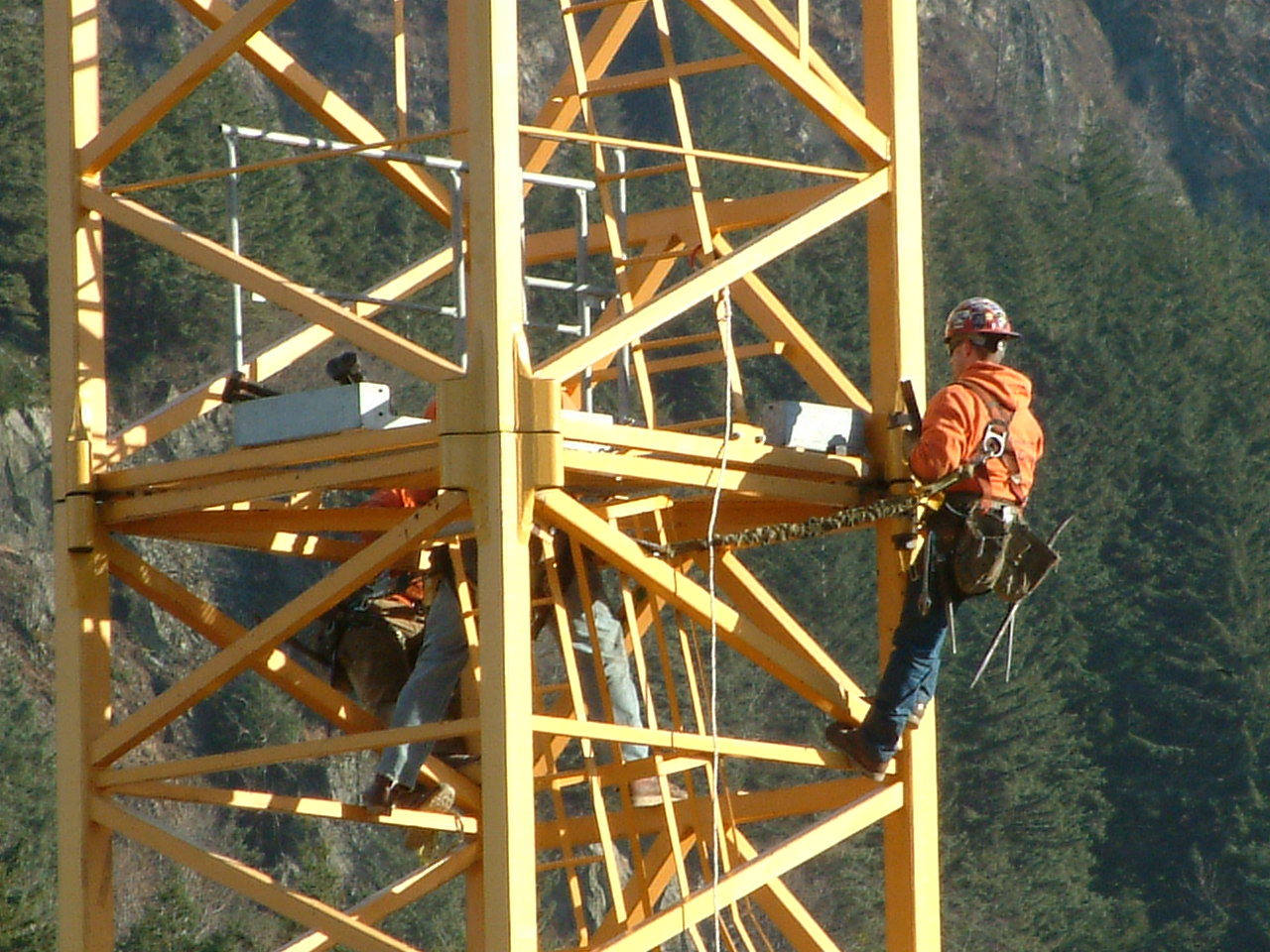
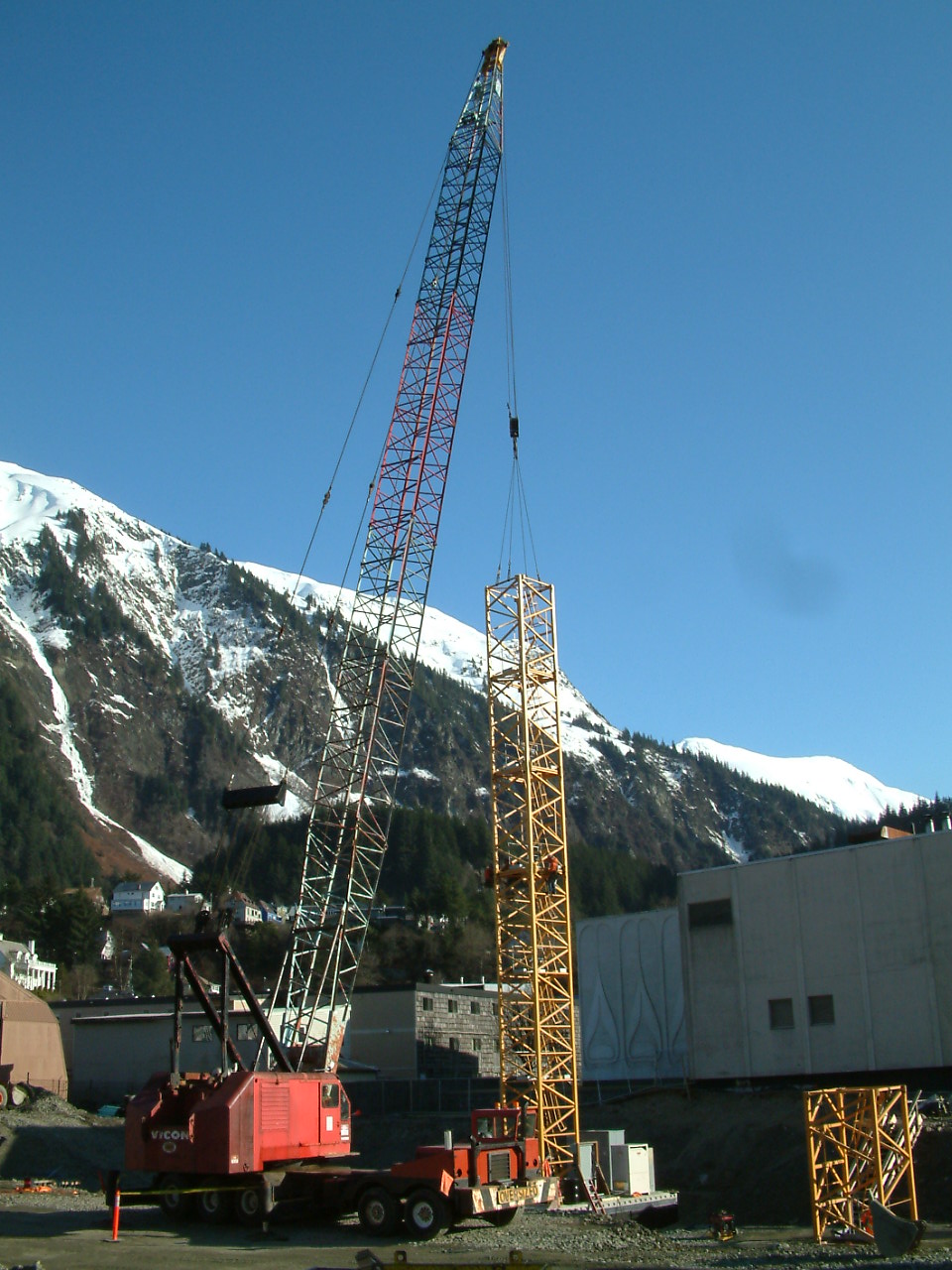
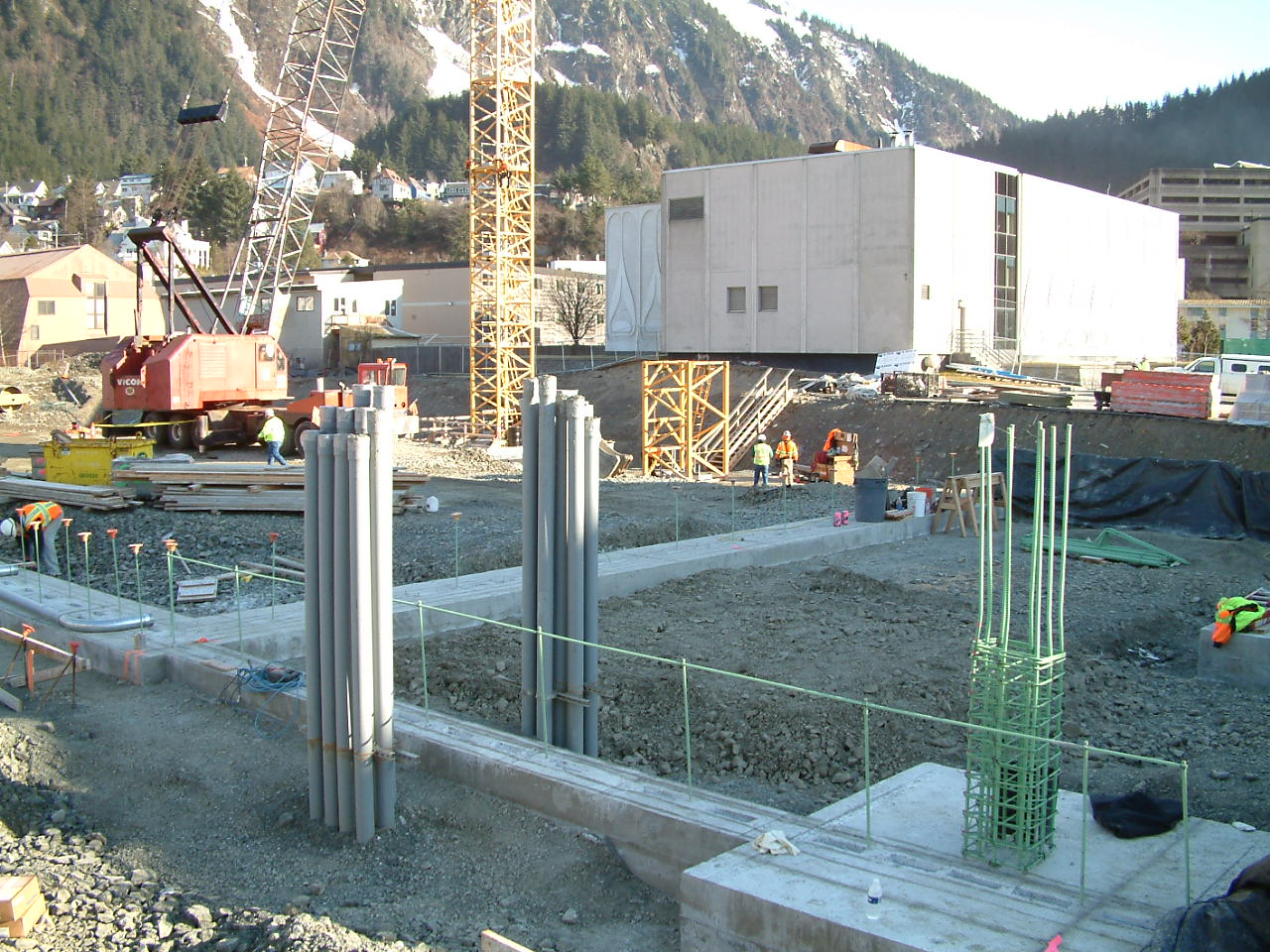
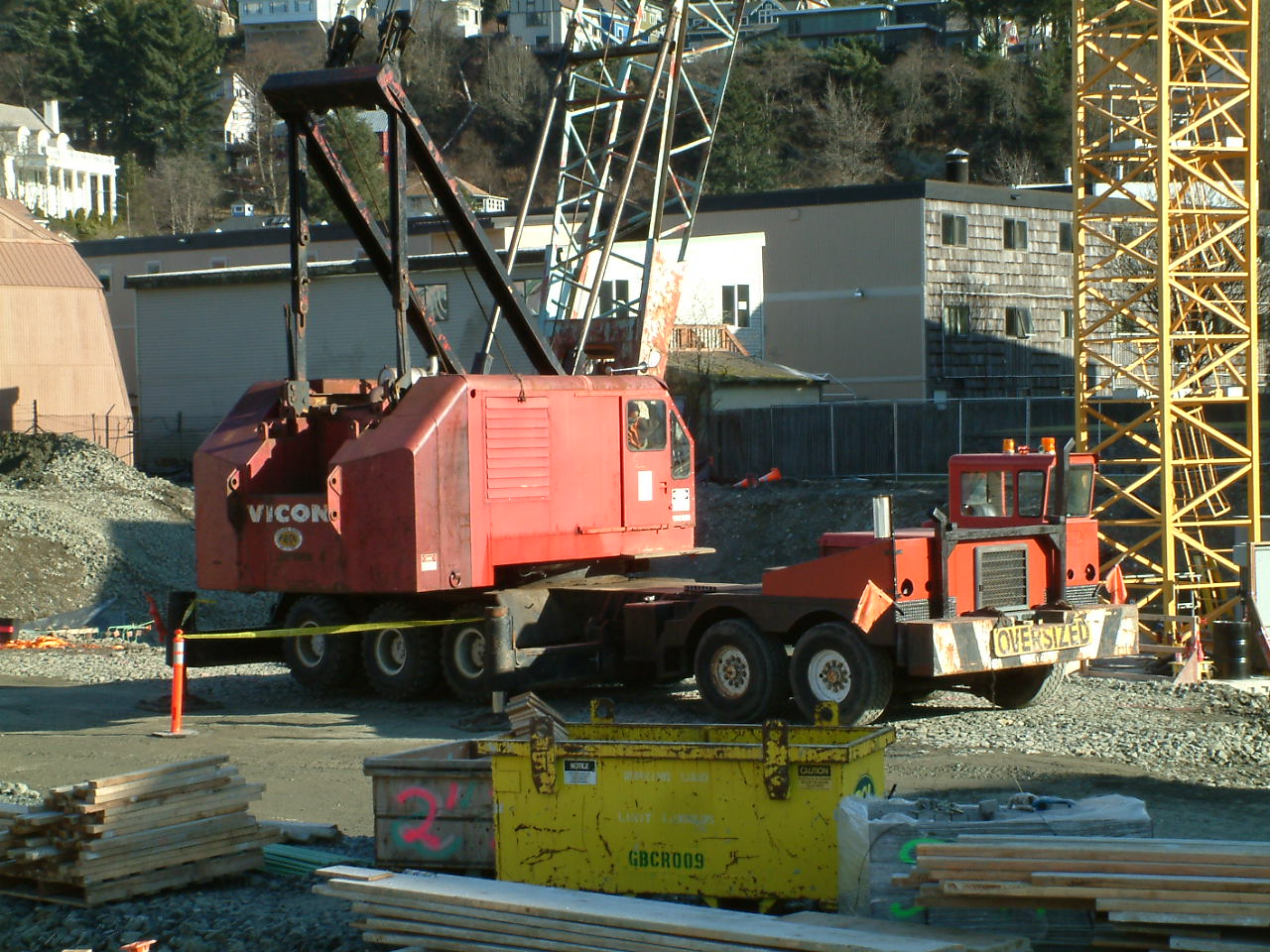
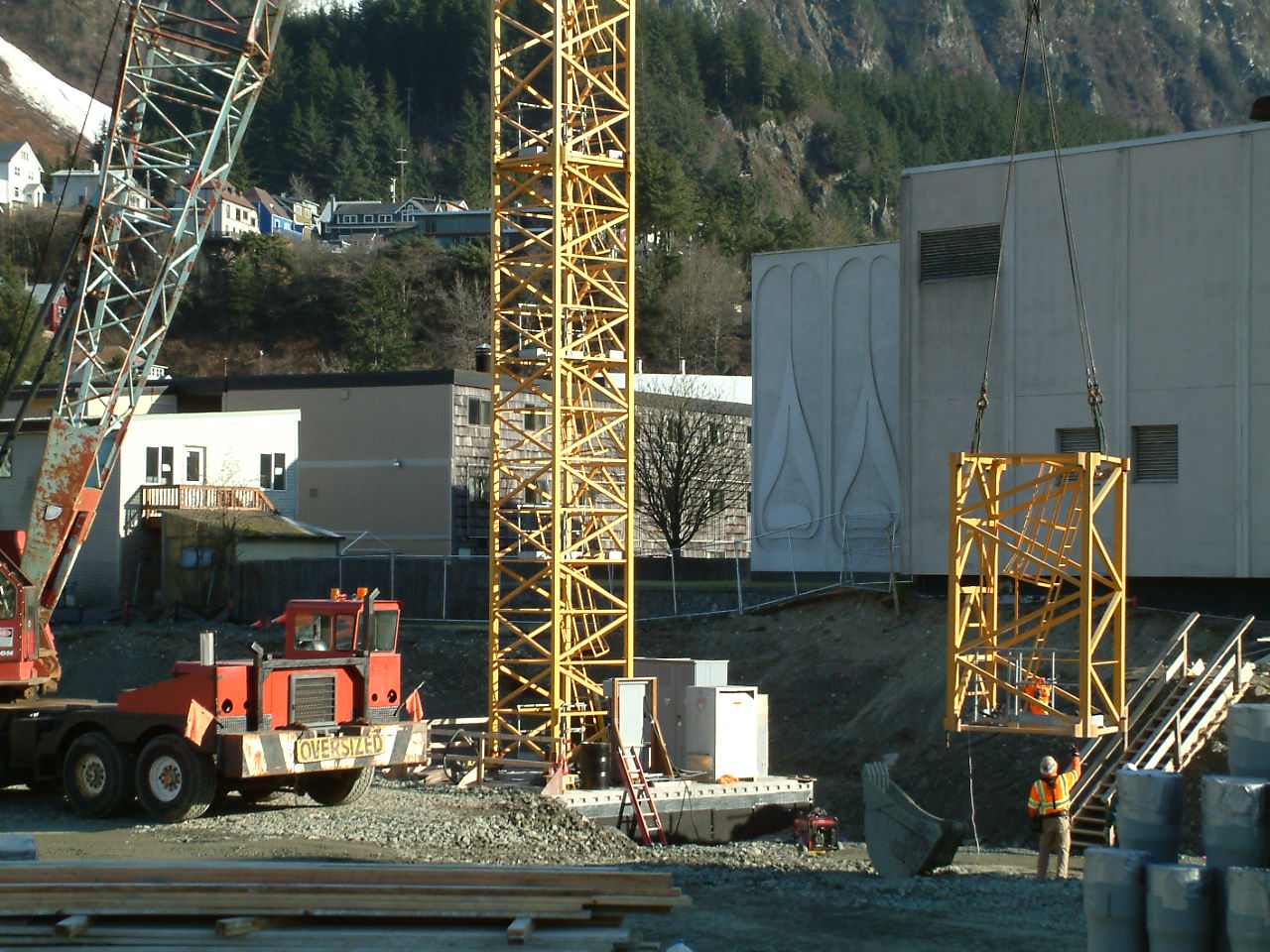
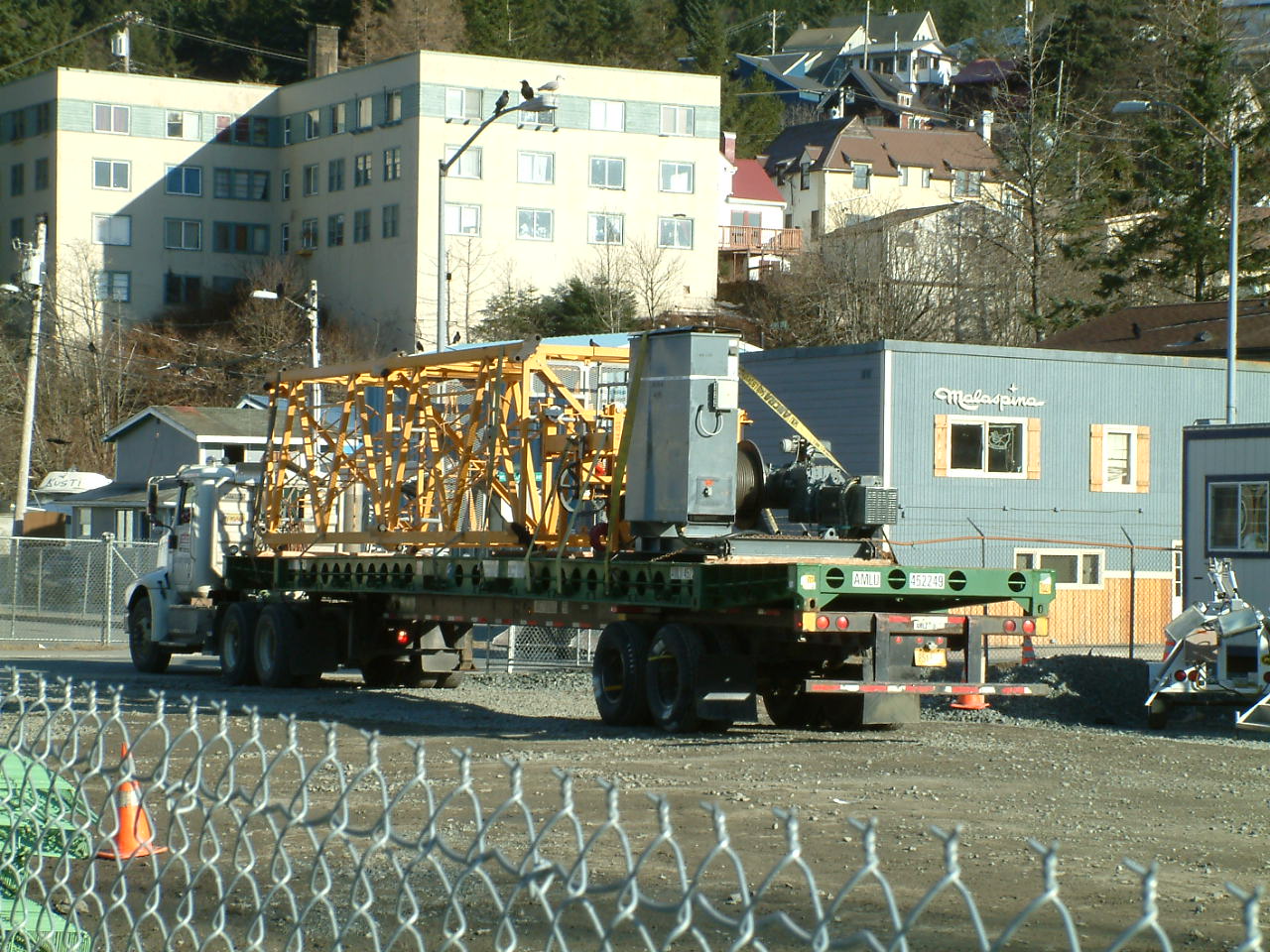
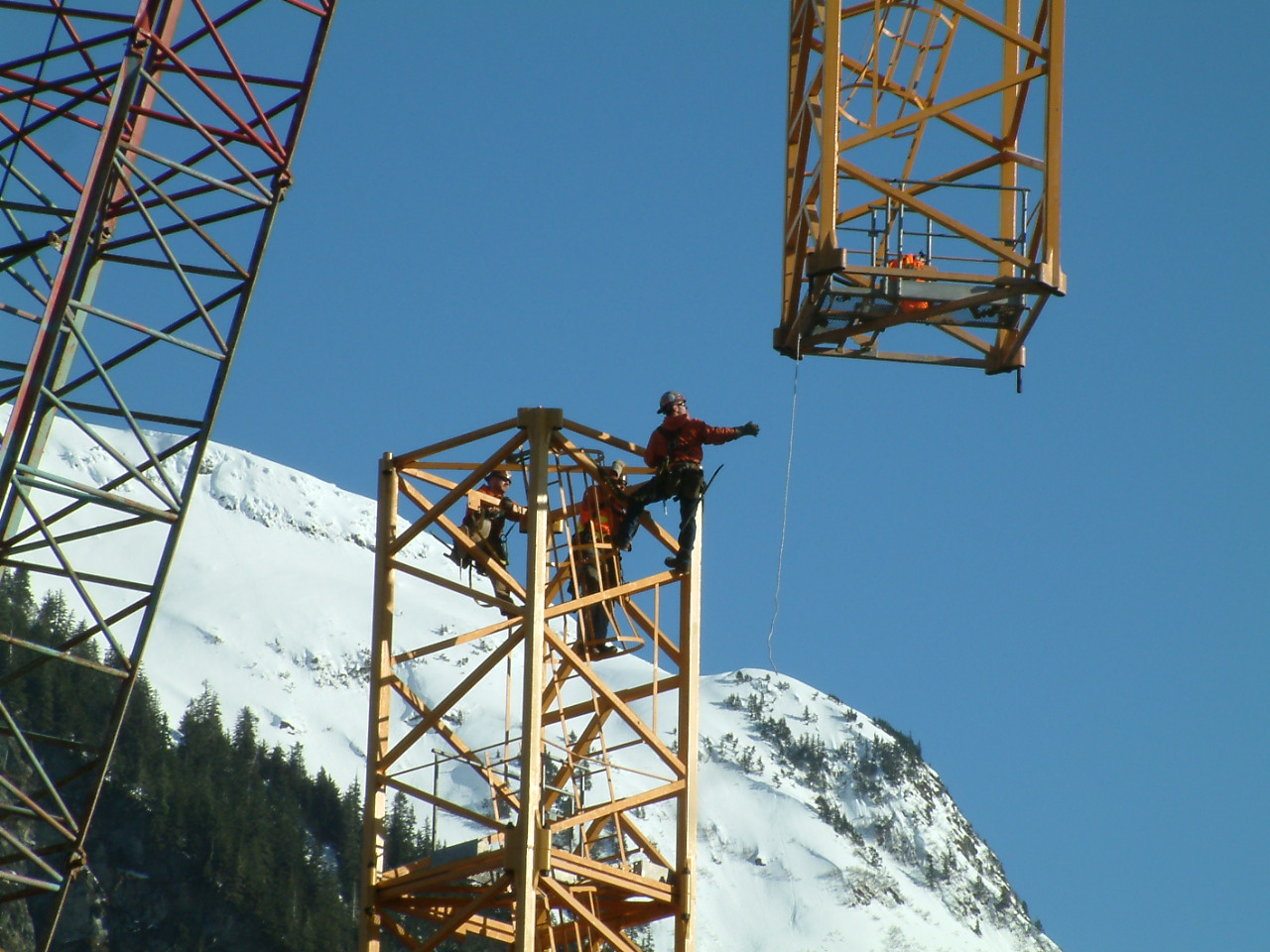
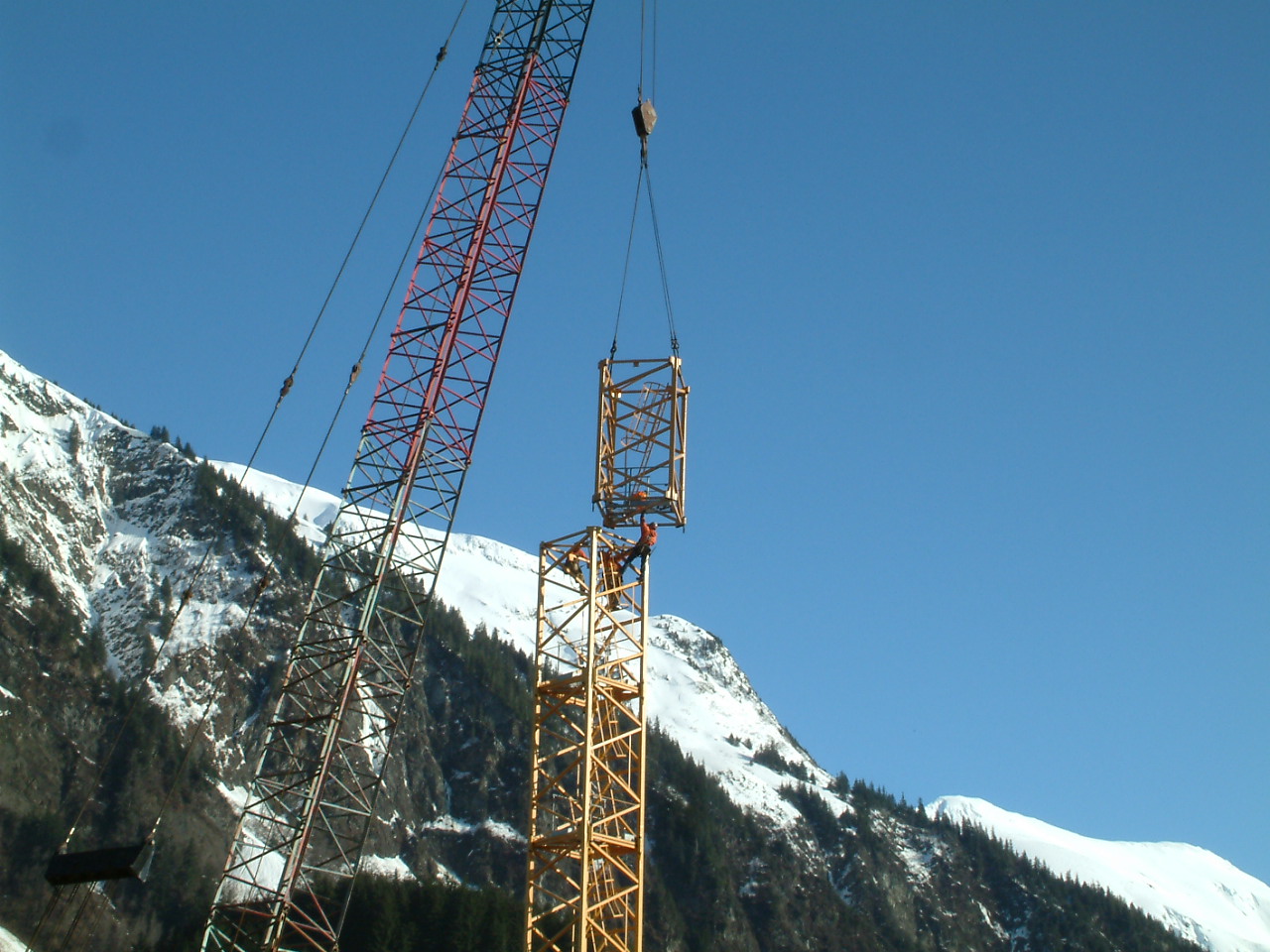
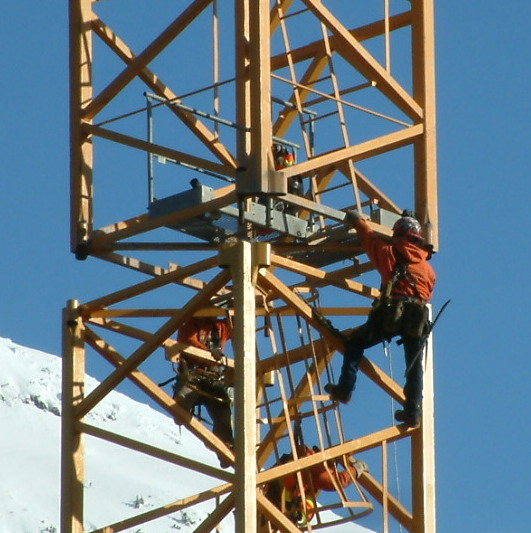
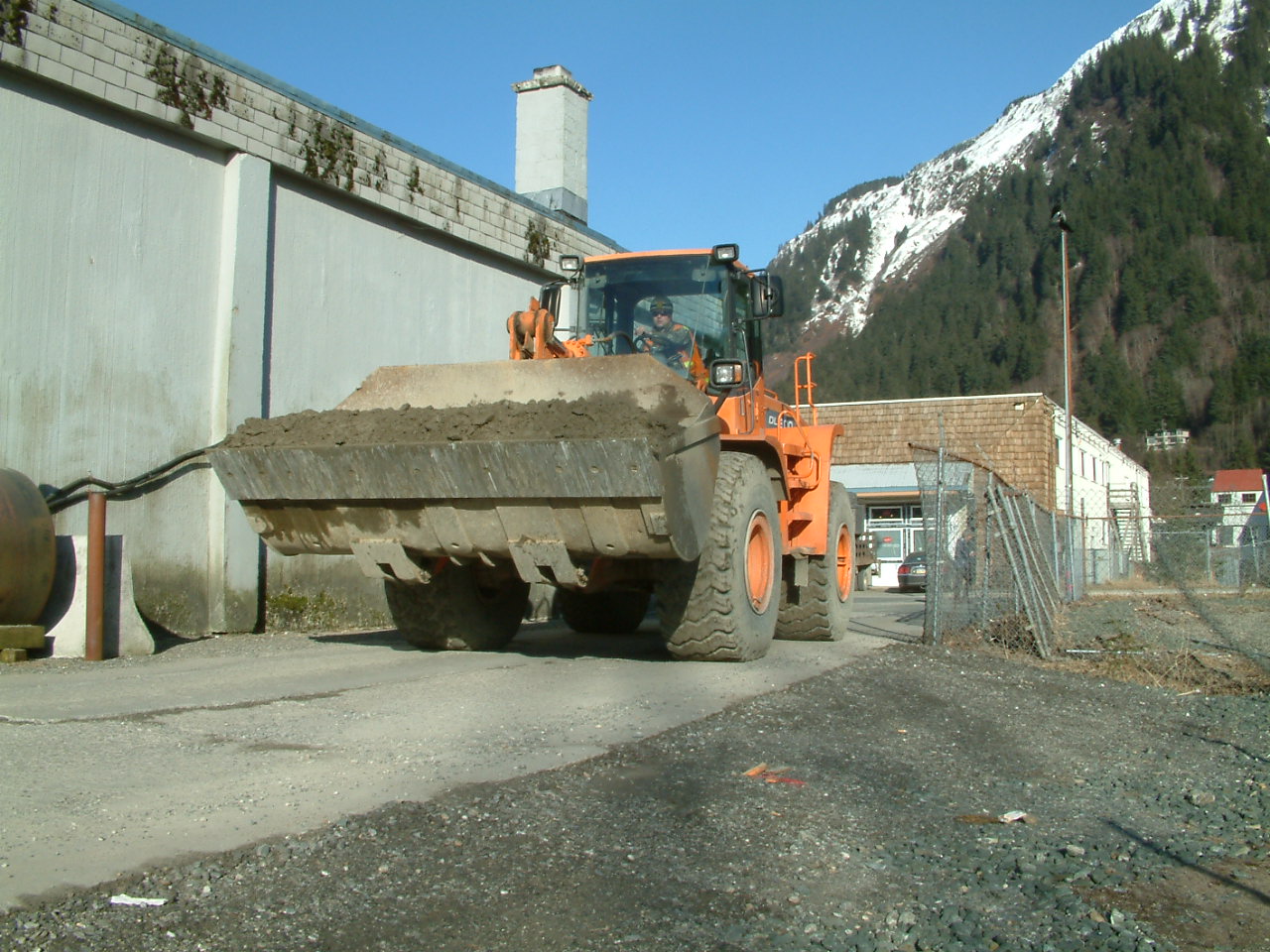
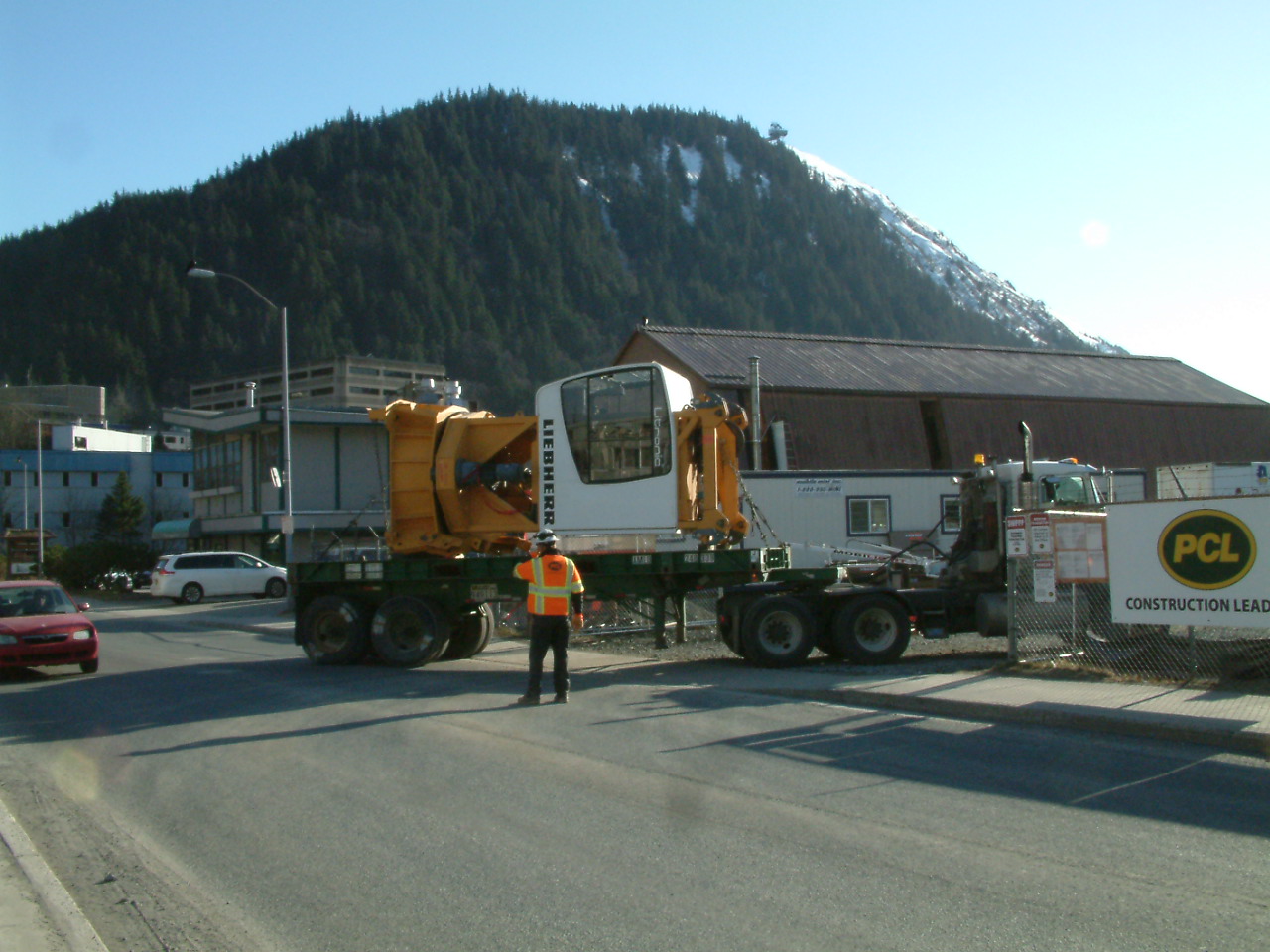
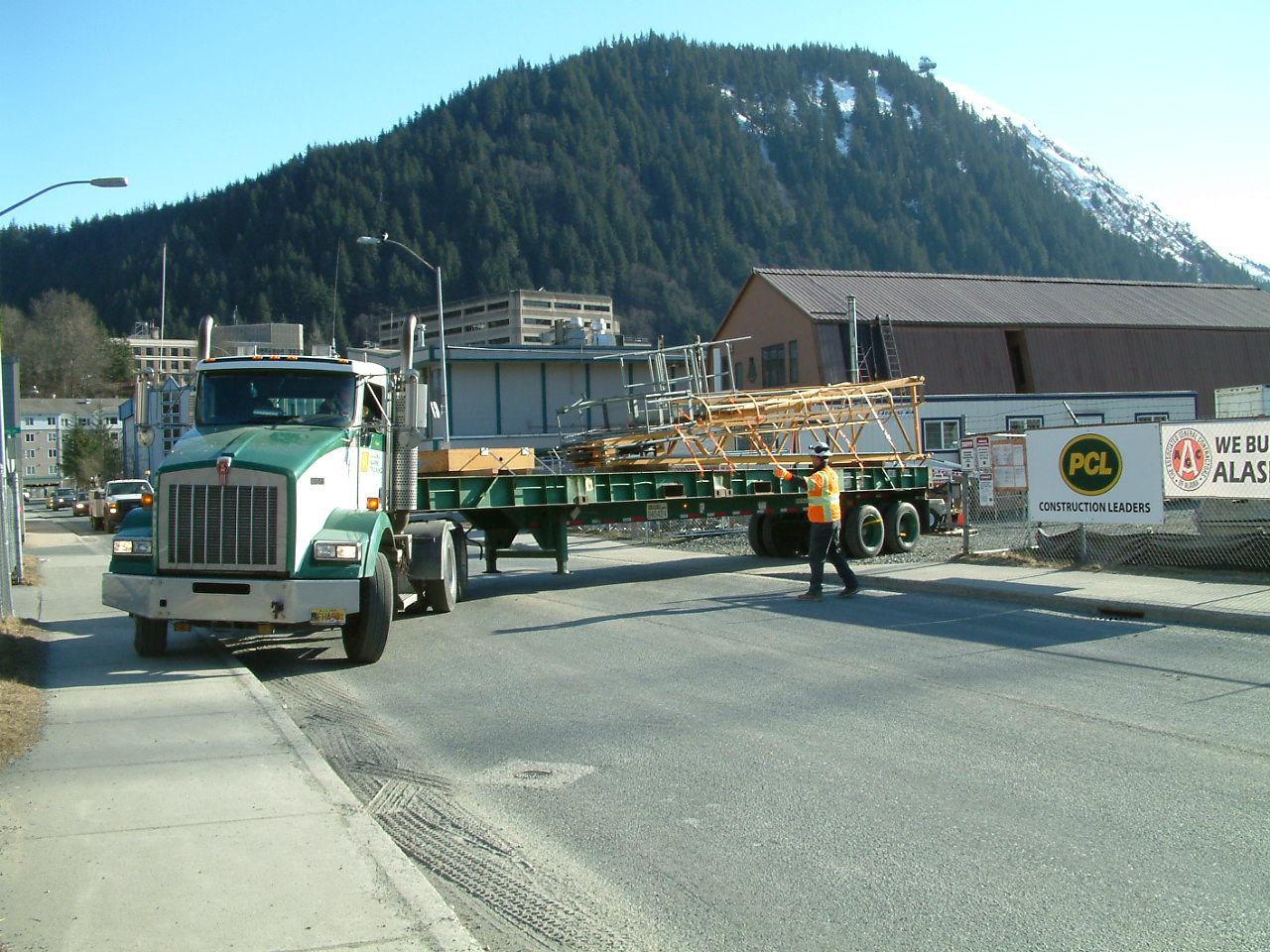
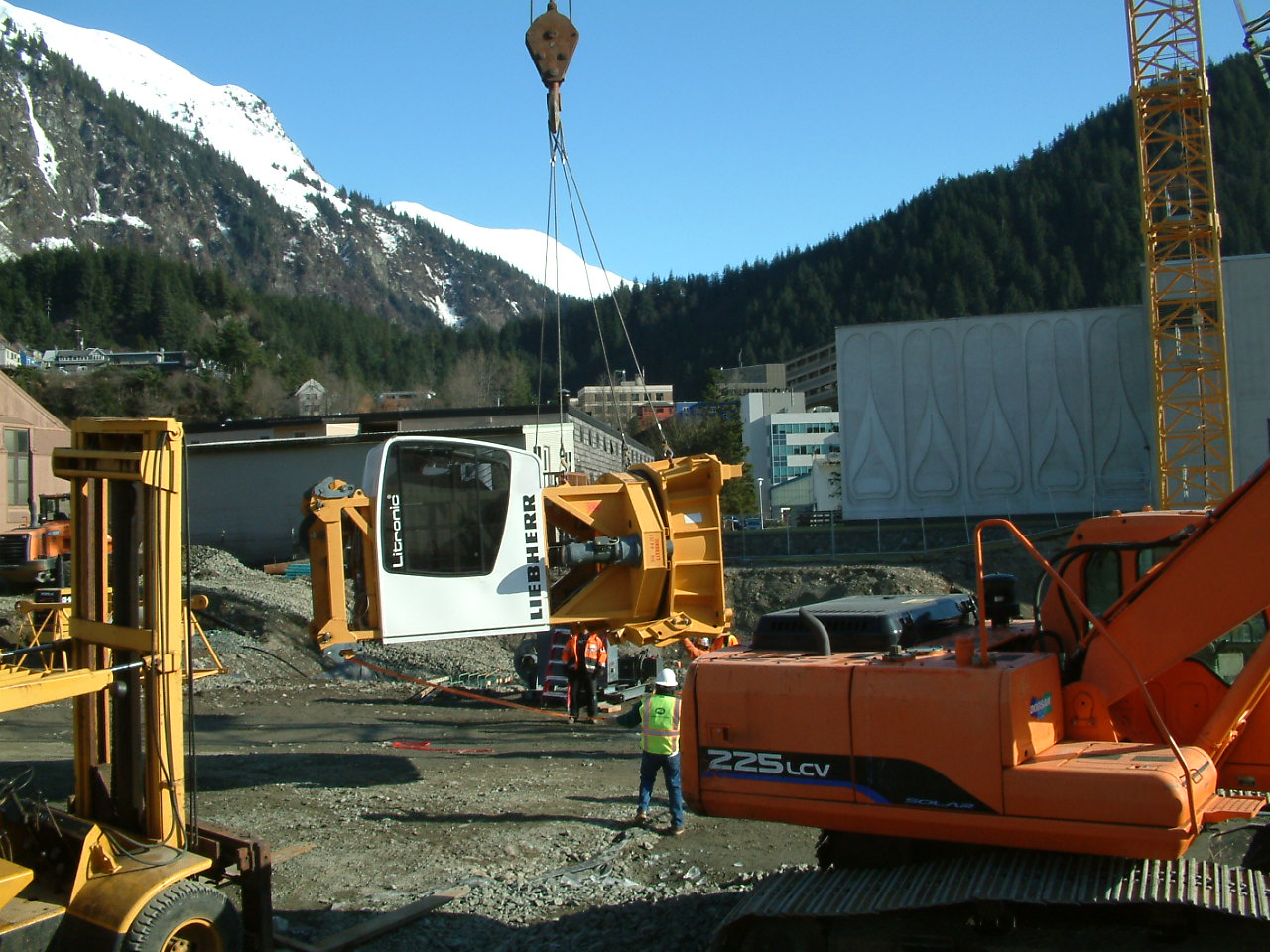
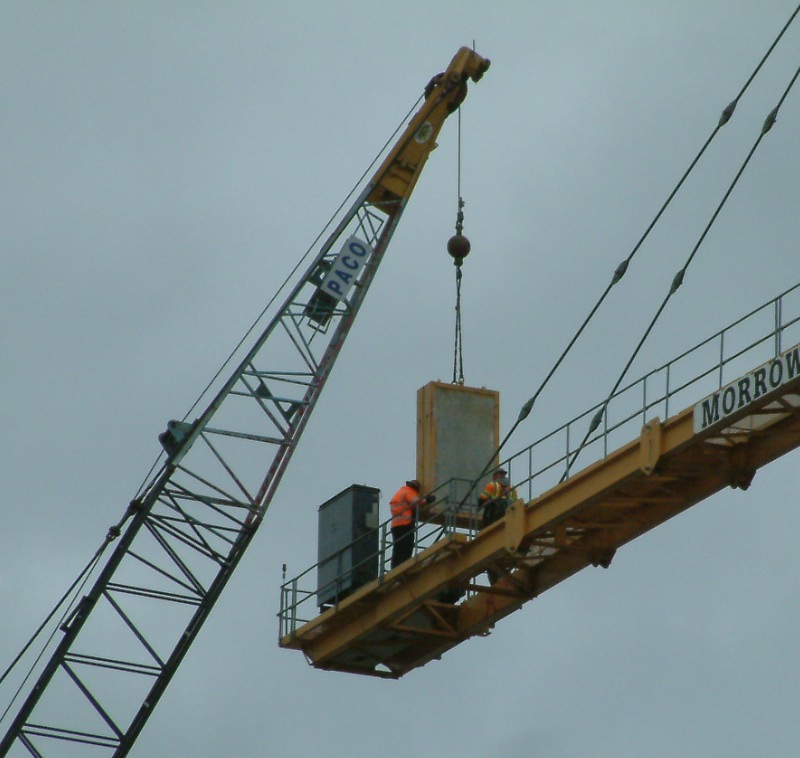
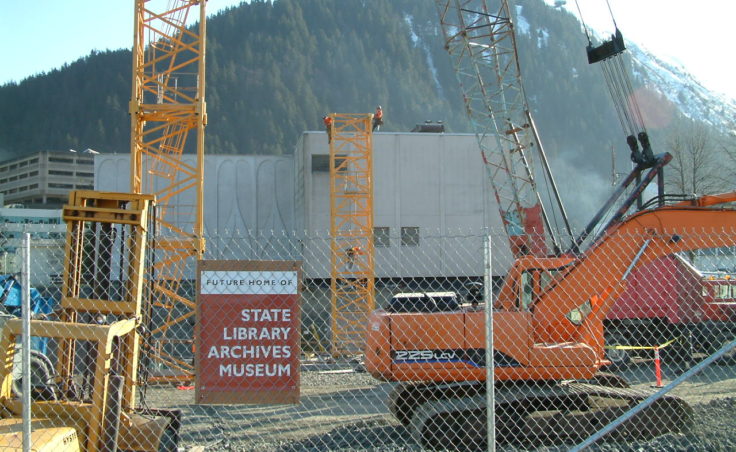
“Yeah, it’s a beast,” said a PCL supervisor on Thursday about the tower crane that’s going up in downtown Juneau. The crane is being erected for SLAM, or the State Library, Archives, and Museum project that’s underway behind the current Alaska State Museum.
PCL employees say the crane will be as high as 160 feet with the cab at about 138 feet. The crane arm will be capable of lifting a maximum load of 30,000 pounds, or as much as 6,000 pounds at the end of its 230 foot reach. The tower crane will remain on site for two years during the construction of SLAM.
Once the tower crane is erected, then the big red mobile crane currently on the construction site will be dismantled and driven away.
When finished, the tower crane will not be the tallest structure in Juneau. For comparison, the antenna on top of the Juneau Federal Building reaches as high as 221.5 feet. Building managers say the top of the penthouse is at 196 feet. According to aviation sectional maps, the Douglas Island radio tower (accross Gastineau Channel from Harris and Aurora Harbors) is 278 feet tall and the Salmon Creek radio tower is 325 feet tall.
Across-the-board federal budget cuts are coming, half from the Department of Defense budget; the other half to other federal agency budgets. But how will the cuts will affect Alaska Natives?
Cuts to the Department of Defense, budget will lead to reduced funding for Army and Air Force base operations and civilian employees likely will go on two days a month of leave without pay. DoD cuts will also affect Alaska Natives through a Small Business Administration program. Under SBA 8(a), Alaska Native for-profit corporations, federally recognized tribes across the country, and Native Hawaiians are given advantages in bidding on federal contracts. In fiscal year 2011, nationwide, SBA 8(a) participants secured $16.7 billion in contracts. Executive director of the Native American Contractors Association Kevin Allis says the upcoming cuts put those contracts in jeopardy.
“Many of our businesses are DoD contractors. So when you have this broad brush just eliminate X amount of dollars from DoD that’s going to flow down to many of these shareholders and tribal members and Native Americans not getting the resources that have flown through this program and through these companies,” Allis says.
Alaska Federation of Natives president Julie Kitka says cuts to other federal agencies – cuts to everything from housing and judicial and corrections systems to wildlife fire management and housing –will also have far-reaching impacts.
“For example the Department of Interior in which we have a lot of tribal programs they’re projecting that the tribes will lose $130 million across the nation impacting areas such as human services, law enforcement, BIA schools, economic development, and natural resources,” Kitka says.
“They’re also projecting with the Indian Health Service — because they’re not exempt from these cuts you would think common sense, hospitals, clinics, basic stuff would be exempt. They’re not exempt. They get these cuts as well. They’re suggesting that nationally about as 3,000 fewer inpatient admissions and 804 fewer outpatient visits to the whole Indian health network across the nation,” Kitka says.
Kitka says details about how the across-the-board cuts will play out have yet to be determined. She says the resulting uncertainty will drag out for months, drawing agency and public attention away from problems – such as high energy costs, and subsistence management issues – that need to be addressed. She says perhaps the most harm, however, is from the loss of faith:
“People’s confidence in the Congress to wrestle with tough decisions and make decisions has been really shaken. The public sector employees, federally recognized tribes, private sector, everybody is all rattled by the question: can they make decisions, can they resolve tough problems or does it remain in gridlock. Probably the biggest damage from the whole thing is this level of uncertainty and the level of risk that comes from that uncertainty,” Kitka says.
Kitka says Alaskans need to communicate with Congress and the lower 48 public:
“What we’re going to be doing is encouraging people to be very vocal to our delegation and others about how this program funding impacts people at the village level and how important it is and what happens if it disappears. When you look at the political process in dc they don’t think of our villages they don’t even think of Alaska they think of the big urban areas educate them about impacts. And rural Alaska doesn’t instantly come to mind. So it’s really important for us educate them about impacts, to educate them about Alaska, period,” Kitka says.
Congress enacted the bill requiring the federal budget cuts last year in an attempt to force itself and the President to reach agreement on federal budget cuts to reduce the deficit.
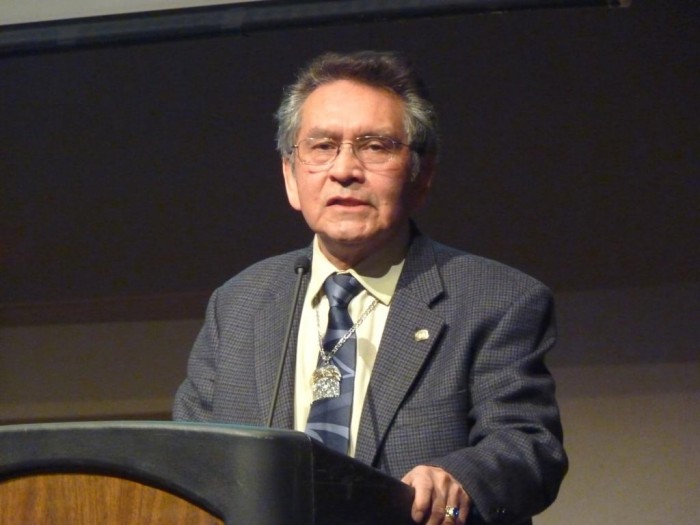
Ed Thomas, president of the Central Council of the Tlingit and Haida Indian Tribes of Alaska, addresses Southeast Conference members in Juneau Feb. 26. Photo by Ed Schoenfeld.
An influential Southeast Alaska tribal leader says he supports banning assault weapons.
Tlingit-Haida Central Council President Ed Thomas says the proposed ban should not be considered a gun-rights issue.
“We have been subsistence people from the beginning of time. And when guns came to our area, it (became) a very vital part of our subsistence way of life. We’re strong advocates for the second amendment rights,” Thomas says. “But we are not in favor of continuing the utilization of assault weapons in our society. There’s no need for it if you’re a hunter or a fisher.”
The central council is a tribal government organization that operates a vocational training center, family- and elder-support services, and a tribal court.
Thomas made his comments Feb. 26th during an address to the Southeast Conference. That’s a regional organization of business, government and tribal leaders.
He says there is no reason automatic weapons should be in general use.
“Think about why do they not allow assault weapons in the halls of Congress. How come they’re not allowed on airplanes? We’ve learned that when you have those kinds of things in important places, people get goofy,” he says.
Thomas has served as council president for about 25 years.
Corner of Front and Franklin Streets in downtown Juneau looking up Franklin to the Elks Hall (tall building in center background), circa 1913-1918. Winter and Pond photograph courtesy of Alaska State Library Historical Collections ASL-P87-0961
It was almost exactly a hundred years ago when Alaska first began to exercise a form of self-government. The Second Organic Act of 1912 allowed the creation of the Territorial Legislature.
Eight senators and sixteen representatives from around the state met on March 3rd, 1913 in the Elks Hall in downtown Juneau, the first Alaska legislative hall, for the first Alaska legislative session that lasted sixty days.
The Territorial Legislature almost immediately gave women the right to vote, and eventually passed the Bone Dry law, a precursor to national prohibition, and the Anti-Discrimination Act of 1945 which preceded the national civil rights movement by almost twenty years.
But the Organic Act hamstrung the Territorial Legislature. The federal government still retained control over Alaska’s resources and the right to legislate on some issues like divorce or the sale of liquor, and still had overall authority on the Territory’s fiscal issues.
Senator Gary Stevens from Kodiak is chair of the Alaska Legislative Centennial Commission which has put together a series of events starting this weekend marking the very first session.
First Alaska Territorial Senate, March 1913, Elks Hall in Juneau. Photo courtesy of Alaska State Library Historical Collections ASL-P461-27
Stevens credits staffer Tim Lamkin for organizing much of that program that runs March 3rd through the 5th.
Sunday, March 3rd
At 10:00 a.m. downstairs at Rockwell in the Elks Hall, a breakfast program called ‘Waffles with Wickersham: Delegate James Wickersham’s campaign for the 1912 Second Organic Act’ will feature John H. Venables.
During a lunch program at noon, former lawmakers Willie Hensley, Georgianna Lincoln, and Emil Notti will talk about ‘Equal Rights, One Man One Vote, and Alaska Native Leaders in our Legislative History.’
Then at 4:00 p.m. in the upstairs of Rockwell, Governor Sean Parnell and former lawmakers Clem Tillion and Terry Gardiner are expected to participate in the opening reception that will also feature unveiling of the 100-Years website.
Monday, March 4th
At 8:00 a.m., also downstairs at Rockwell in the Elks Hall, a ‘History of the Capitol Building’ that will feature a presentation by architect Wayne Jensen.
A noon lunch discussion on ‘Leading Women in Alaska’s Political History’ will feature Arliss Sturgulewski, Drue Pearce, Katy Hurley, Bettye Davis, and Gail Phillips.
A reception starting upstairs at 5:00 p.m. will include a presentation by Dr. Beverly Beeton on ‘Members and accomplishments of the first Alaska Territorial Legislature, including Women’s Suffrage – 1913.’
A dinner program upstairs at 7:00 p.m. will include a reenactment of the convening of the First Alaska Territorial Legislature and Passage of Women’s Suffrage that will feature Juneau actors and legislative staff.
Tuesday, March 5th
A breakfast program at 8:00 a.m. will feature Clark Gruening and Mike Miller on ‘A History of Politics and Changes’ at Rockwell in the Elks Hall downstairs.
The noon lunch program on ‘Perspectives on Accomplishments and Failures in Alaska’s Legislative History’ will feature Sam Cotten and Randy Phillips as moderators.
Happy Hour begins at 4:30 p.m. with a reception program on ‘Prohibition in Territorial Alaska’ with Dr. Terrence Cole and Rick Halford.
First Alaska Territorial House of Representatives, March 1913, Elks Hall in Juneau. Photo courtesy of Alaska State Library Historical Collections ASL-P461-26
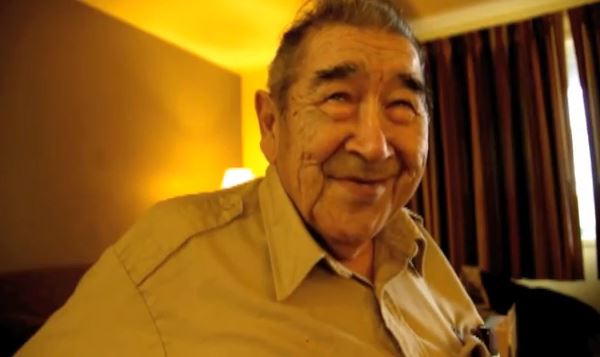
Nick Golodoff, author of the book Attu Boy, passed away earlier this month at the age of 77. His memoir about the World War II internment of the Aleut village by the Japanese brought attention to one of the most obscure corners of American history.
As he told KUCB in an interview last year, he was born on the western Aleutian island of Agattu in December 1935, while his parents were fox trapping.
“But I was really from Attu, so I grew up to the age of six in Attu, and never once lived there ever again, because Japanese took me to Japan when I was six years old.”
Golodoff remembered the day the Japanese landed. He was following an older boy toward the beach when he heard unfamiliar sounds.
“Alex Prossoff is the one I was following, and he started running and I ran after him. And I see pieces of mud flying in front of me. I didn’t know why the piece of mud was flying, until later, so much later, I found out it was bullets that were hitting the ground.”
The cover of Attu Boy.
The Japanese occupied the village for nearly three months before putting the Attuans on a freighter. They spent the whole journey in the cargo hold.
“I don’t know how long we’ve been in the hatch, but when we got to Tokyo, they let us out and look around. And then put us back down and took us to Hokkaido, and that’s where they left us.”
The villagers spent three years teetering on the edge of starvation. Although Golodoff was among the 25 Attuans who survived the internment, he never returned to the island. The U.S. government forced families to resettle in Atka, 600 miles to the east. Golodoff went to school there, and spent lots of time outdoors.
“I used to hunt every day, I used to walk all day,” Golodoff said. “Pack a whole reindeer home from miles away. I used to leave in the morning and home at dark. Until I got a boat. I built my own wooden boat, bought the oars and used to oar, row and hunt like that until I got a motor. I used to hunt all the time.”
In his teens, Golodoff started working seasonally in the Pribilof Islands, harvesting fur seals. Later on he worked at the Atka airport, and for the last 30 years was a maintenance worker at the school.
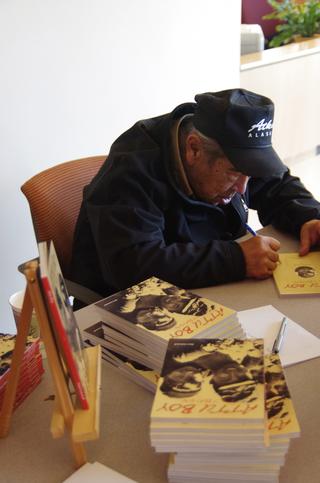
Attu survivor and author Nick Golodoff signs copies of Attu Boy. (Photo by Stephanie Joyce/KUCB)
“NG:They don’t want to fire me because they can’t find my replacement. [laughs]
SJ: Do you ever talk to the kids in the school about your experiences?
NG: No, no. Some teachers want me to do that, but I cannot speak in public, I’m not used to that. I never did that in my life, so I don’t know how to do it.”
Instead, Golodoff wrote down his story with the help of his granddaughter, Brenda Maly, and National Park Service anthropologist Rachel Mason.
Mason says the Attuans’ story never would have been told otherwise, because the older survivors didn’t talk about it.
“And his perspective was different.For example, he had very warm feelings towards Japanese people. And he’s pictured on the cover of Attu Boy as a small child riding on the back of a Japanese soldier. So the eyes of a child were really unique.”
Mason also credits Golodoff with bringing together the descendants of Attu survivors during a reunion organized by the National Park Service last year.
“At one of the events at the Attu reunion, he was signing his book. And it was just such a symbol of their pride in being from Attu, in the fact that Nick, the oldest person that had actually lived on Attu, had produced this memoir that told the story of their community. So, I think it’s a big loss, and yet I’m happy that he was able to be there and to be that symbol of unity for them.”
Studies by the U.S. Army Corps of Engineers and Government Accounting Office show increasing numbers of Alaskans will be affected by floods and erosion in coming years due to rising waters and extreme weather events. And the studies predict some communities are likely to be destroyed by 2017. Of those, Newtok is the furthest along in relocating.
But an Anchorage human rights attorney says changes are needed so agencies can more effectively help people being dislocated due to the impacts of climate change.
The Yup’ik village of Newtok, situated between the Newtok and Ninglick rivers in southwest Alaska, is facing destruction. Rising waters and melting permafrost there have lead to two floods since 2004. Water has flooded the sewage disposal area, carrying contaminated water into the village and creating a health hazard. Stanley Tom is Newtok Tribal Administrator. He says the village is losing up to 150 feet per year to erosion… and their water source is only 154 feet from the river:
“When the village safe water was doing tests and we did pick three of them and they were already contaminated with salt water. It’s the only water we have left. It’s in front line of erosion. If it’s impacted this summer, how do we get our water?” Tom asks.
Erosion has destroyed the landing where barges used to deliver fuel and other supplies, as well as the former landfill. The village no longer has enough fuel tanks to hold a year’s worth of fuel.
Robin Bronen is Executive Director of the Alaska Institute for Justice.
Drawing on her research for her PhD dissertation, she gave a January 2013 presentation to the Brookings Institution. She’s calling for the creation of a framework that allows agencies to more effectively work with communities that choose relocation over protection in place… a decision some come to only after protection systems have repeatedly failed. But Bronen says the decision on whether to move would need to come from the community.
“The controversy is that we in the world have a horrific legacy of relocations, most of forcible by governments without people making the decisions whether or not they want to relocate and we have that history in Alaska not that long ago,” Bronen says.
In Newtok, villagers began working towards relocation in the 1990s. They selected a new site nine miles away, called Mugtarvik. After years of negotiations and lobbying, it acquired title to the land in 2003.
In 2006, the Alaska Department of Commerce, Economic Development and Community Affairs organized a Newtok planning group of more than two dozen federal, state, tribal, and regional organizations with Sally Russel- Cox as its coordinator. She says the group has pooled resources – for instance, two projects have used resources from the Bureau of Indian Affairs, federal department of commerce, state department of transportation, and a Department of Defense training program. She says one of the group’s biggest strengths is it’s collaborative approach.
“I like to think of the work that we have done, with Newtok, especially as in a way following the Yup’ik model of decision-making. Because it’s definitely a group type of decision making and that’s definitely been what’s happened, everybody sitting around the table brainstorming and coming up with ideas and building consensus among themselves on how things should happen, and with the community being in the lead in all that,” Cox says.
Bronen says that collaborative process can serve as a model for communities around the world facing relocation due to climate change.
But she says for Newtok to get as far as it has, it’s taken a remarkable and extraordinary effort. Bronen describes other communities that have gone through an extended public process to pick a new site, only to have an agency say it doesn’t meet certain criteria – criteria that wasn’t spelled out beforehand. And funding is often based on population. So Newtok finds itself in a Catch 22 position – it can’t move to Mugtarvik without water, power, transportation, and communications systems. But it can’t get funding for some of that infrastructure until people are living there. Bronen says it shouldn’t be that difficult.
“The relocation effort is taking an extraordinarily long time and people need to be moved now. Their community is not safe. I know everybody wants them to be able to move as qucikly as possible to their relocation site, but there are really difficult stat and institutional challenges that government agencies are working around,” Bronen says.
Then, she says, once a village is identified as needing to be relocated, funding for infrastructure in the current village site dries up, leaving villagers to cope with deteriorating conditions. Stanley Tom says the workload of keeping Newtok running while also writing grants, coordinating activities at Mugtarvik, and lobbying for money can be overwhelming.
“I’m worried about the funding, the community. It’s a lot of things in my mind I’m worried every day, every night. I have to wake up 5- 6 in the morning and worry about my work,” Tom says.
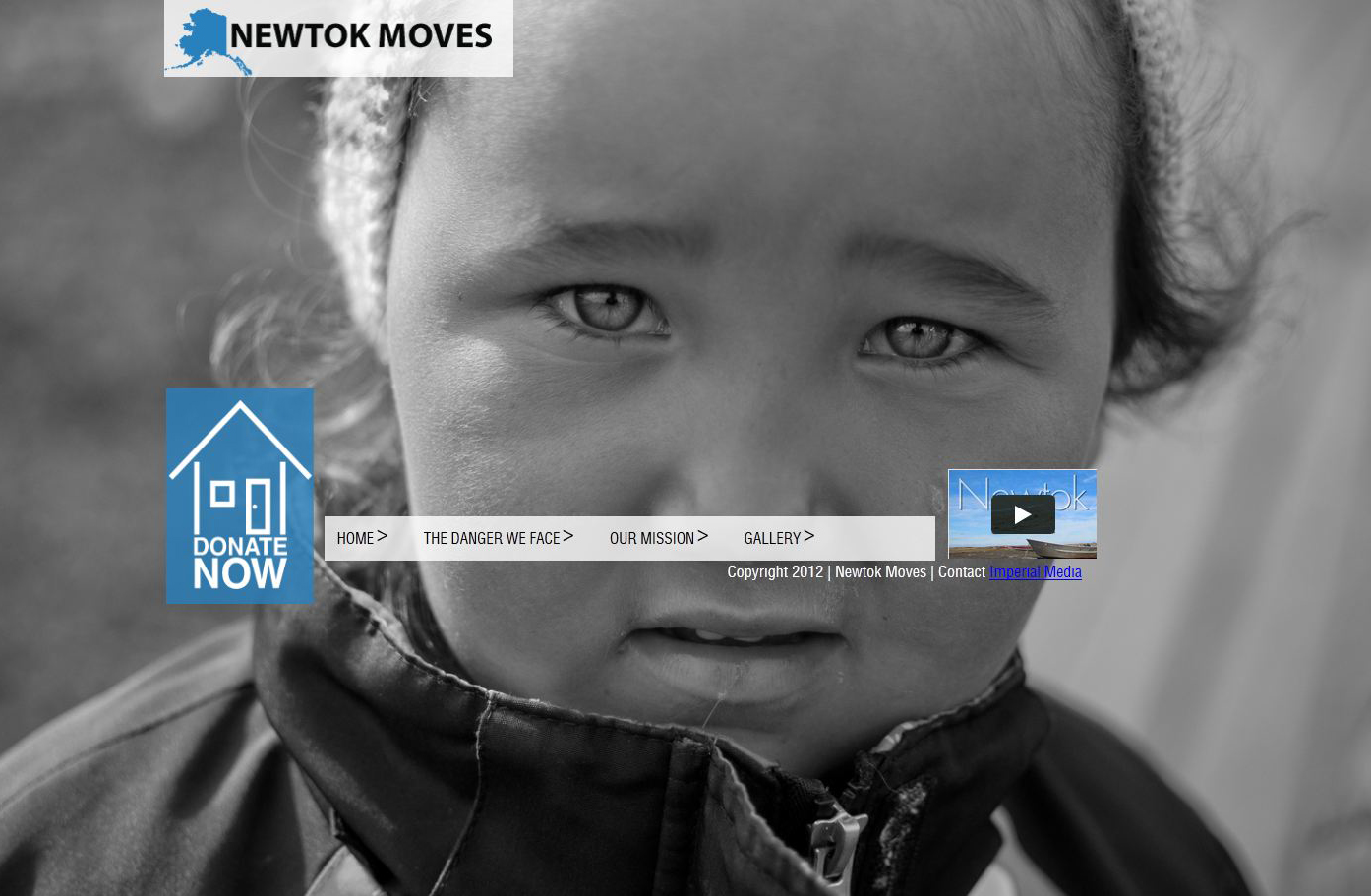
Still, Tom says the Mugtarvik village now has a barge landing, the foundation built for an emergency evacuation center, a road to the evacuation center, and six homes, He’s encouraged that the tribe has funds to build the community evacuation center at Mugtarvik, and 17 villagers trained to do the work. He’s also proud of the new website the village had created, at newtok moves.org. His next big goal is to find funding to build a total of 60 homes to accommodate the 350 or so villagers.
And Bronen applauds Newtok’s progress. She says it’s years ahead of several communities agencies forecast will no longer be viable by 2017, villages struggling against all odds to relocate.
Close
Update notification options
Subscribe to notifications
Subscribe
Get notifications about news related to the topics you care about. You can unsubscribe anytime.