Arts & Culture

Sequester has officials watching Indian Health Services closely

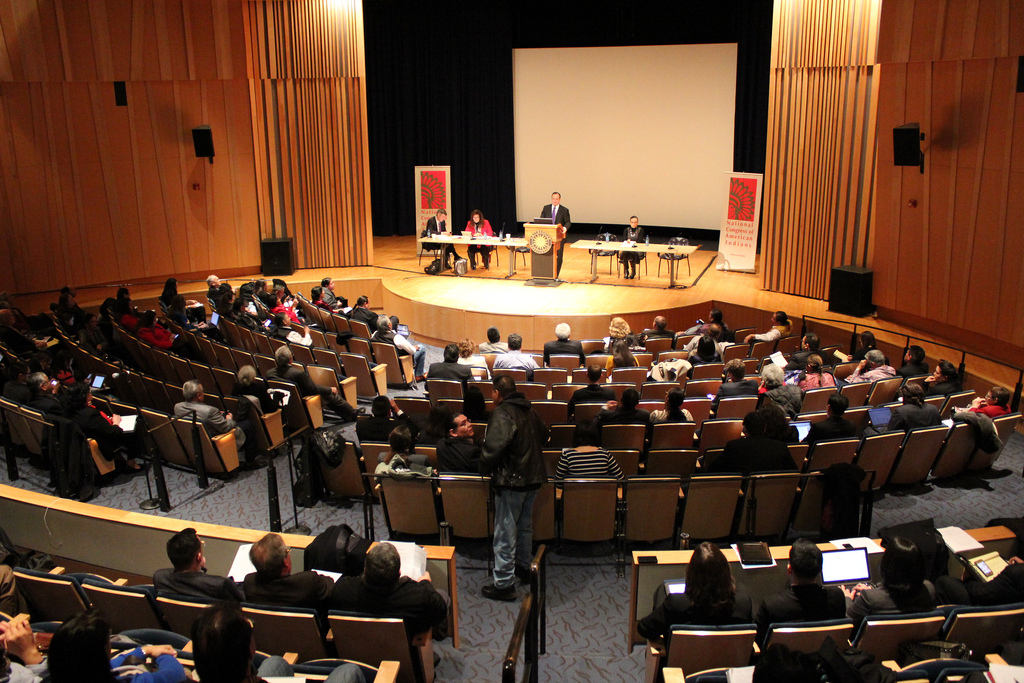
Jefferson Keel President of the National Congress of American Indians (NCAI) delivered an address to the NCAI two days after the State of the Union. (Image courtesy of the NCAI)

The state of Indian Country is strong, according to the president of the National Congress of American Indians. Today Jefferson Keel presented the State of Indian Nations Address in Washington D.C.

But despite advancements in tribal governing, leaders are worried about the coming sequester, and what it means for Indian Health Services.

Keel rattled off a long list of recent successes – from the Cobell settlement to record levels of energy production in Indian Country to stronger government to government relationships.

But he made clear the near future will be difficult.

“The trust responsibility is not a line item. And we are not a special interest group,” Keel says.

He went on, warning that the coming budget cuts could devastate essential services to Natives.

We urge Congress to acknowledge their Constitutional responsibility to honor our sacred trust by holding tribal governments harmless in the sequester and beyond. As President Obama said in the State of the Union Address, just two days ago, the federal government must keep the promises they’ve already made,” Keel says.

The sequester is set to take effect March first. On that date, government agencies will need to start cutting at least eight percent of their budgets.

Yvette Roubideaux leads the Indian Health Service. She says the sequester would slash nearly all aspects of the federal government, but the effects would hurt most in native communities. She

“3,000 inpatient admissions and 804,000 outpatient visits would have to be cut to be able to absorb the sequester,” Roubideaux says.

Keel put a more human face on the figures … saying the cuts to IHS would hit at the community level – not just jobs in Washington D.C.

“It will affect whether or not a young mother will be able to access healthcare for her unborn child. It will affect whether or not elderly people will be able to afford their medications, or whether they’ll be able to go to the doctor,” Keel says.

Keel says he’s trying to sway members of Congress to exempt Native services from the sequester. But there isn’t much time.

Haines native Jackie Pata is the executive director of NCAI. She originally thought IHS would be exempt from sequester. Now’s she’s preparing tribes for all sorts of cuts – beyond healthcare.

“We’ve been talking with tribes a lot about things like lean management, how to take on some of those principles and really scale to address our most critical needs and be efficient and effective with the federal funds we do have in our communities,” Pata says.

And regardless of what happens with the sequester, federal budgets need to shrink because of the Budget Control Act.

That means all sorts of Native services will feel the pinch. The new chair of the Senate Indian Affairs Committee, Washington Democrat Maria Cantwell, made clear that the Committee has a full docket.

But getting appropriate funding for any of them will be hard.

“The Native American Self Determination Housing Assistance Act expires this year. We have a Farm Bill that we need to reauthorize. The elementary and secondary schools act which expired in 2008 is well past its due date for reauthorization. The issue of tax reform and making sure the IRS deals with tribes in a fair way on taxation issues,” Cantwell says.

Most in Congress publicly say the sequester will happen, what’s unclear is whether it will be permanent. Congress could pass a fix once the cuts go into effect.

Juneau arts education recognized by Kennedy Center

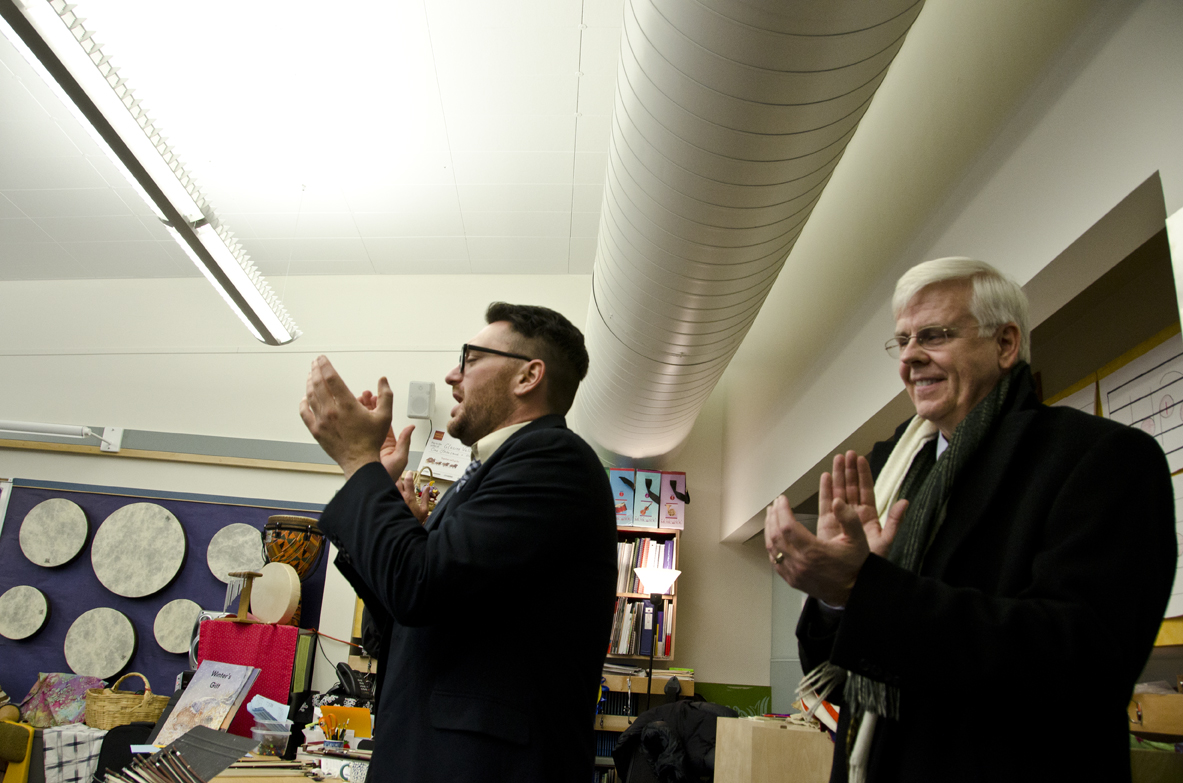
Visitors from the Kennedy Center clap after watching a performance by students at Glacier Valley Elementary.
Visitors from the Kennedy Center clap after watching a performance by students at Glacier Valley Elementary. (Photo by Heather Bryant/KTOO)

The John F. Kennedy Center for the Performing Arts is recognizing arts education efforts in Alaska’s Capital City.

The center today announced from Washington, DC that Juneau has joined its prestigious “Any Given Child” program, which promotes city-wide arts education for students in kindergarten through eighth grade.

Juneau is the 11th city admitted to the program since it started in 2009, joining much larger communities such as Sacramento, California, Portland, Oregon and Austin, Texas.

The goal of “Any Given Child” is to provide a quality arts background for all children. Kennedy Center experts will work with the Juneau Arts and Humanities Council to figure out the community’s needs and come up with affordable solutions.

Former JAHC president Annie Calkins wrote Juneau’s “Any Given Child” application.

“We wish to increase the equity across all of our schools. Some of our schools have excellent arts education happening at the elementary level and others do not have the same level of intensity or exposure and we want to make sure that across both of our middle schools there’s some equity as well,” Calkins says.

Kennedy Center Vice President for Education Darrell Ayers says the center is federally mandated to reach out to communities across the country. Any Given Child expands that reach by using chosen communities as examples for arts education.

Even though the Kennedy Center doesn’t provide any grant money, local funding can perk up after Any Given Child comes to town. Ayers says one funder gave Austin an additional $1 million.

“They see that the arts community has come together and people, rather than it being kind of a helter-skelter approach to arts education, everybody’s working now hand-in-hand,” Ayers says.

Visitors from the Kennedy Center a group of students perform a Tlingit dance at Glacier Valley Elementary.
Visitors from the Kennedy Center watch a group of students perform a Tlingit dance at Glacier Valley Elementary. (Photo by Heather Bryant/KTOO)

In December, Ayers and a colleague came to the Capital City to fact-check Juneau’s application. Second-graders at Glacier Valley Elementary School performed a violin concert and Tlingit dance. The performance exemplifies what drew the Kennedy Center to Juneau in the first place.

The violinists are part of Juneau, Alaska Music Matters, or JAMM. Lorrie Heagy started JAMM in 2011. Now those students are continuing their music education in second grade. Heagy says nearly 300 students are in JAMM.

“Their listening skills have become so fine-tuned that by the first half of the year they could identify the first four strings. But by the end of their kindergarten year in the spring, they could come up to me and say ‘Ms. Heagy, my A-string is out of tune,'” Heagy says.

Ayers says next week, the other ten communities will meet at the Any Given Child Annual Exchange. Juneau representatives will join the cross-country brainstorming session in DC next year. Any Given Child planning in Juneau begins next month.

Tlingit elder, Sealaska board member Clarence Jackson dies

Clarence Jackson
Clarence Jackson. Photo courtesy Sealaska Corporation.

Tlingit elder and original Sealaska Native Corporation board member Clarence Jackson passed away Thursday at the age of 78.

He’s being remembered for his contributions to the Native land claims movement, and for being an ambassador for Tlingit culture in both the business world and his personal life.

Sealaska Heritage Institute President Rosita Worl says Jackson relished comforting people in times of need. He served as master of ceremonies at the memorial service for the late Reverend Dr. Walter Soboleff in 2011.

“He became like our ambassador from Sealaska, where he would attend all of the funerals, all the memorials,” Worl said. “He was there to comfort clans and the family of those who had lost someone.”

Jackson was born in Kake in 1934. He lived there most of his life, attending Sheldon Jackson High School in Sitka, before moving back to the village, where he was a fisherman and operated a small store.

Worl says he was a great fisherman, who loved boats.

“We always say, it is as if the spirits of the animals know him and they give themselves to those kind of people who have those good spirits,” she said. “So, yes, he was a great fisherman.”

In the 1960s, Jackson was involved in the Alaska Native claims movement as a delegate to the Central Council of Tlingit and Haida Indians. He served as Central Council president from 1972 through 1976.

Also in 1972, Jackson signed the articles of incorporation for Sealaska, the regional Native Corporation for Southeast, created under the Alaska Native Claims Settlement Act. He was the only board member to serve continuously from the time Sealaska was founded.

Current board chair Albert Kookesh first met Jackson when he joined the board in 1975. He says they quickly became friends.

“We’re both from villages right next to each other. He’s from Kake and I’m from Angoon,” said Kookesh. “He knew my father and he knew Walter Soboleff, my uncle. So I got immediately scooped up into his little circle.”

Kookesh says Jackson was a champion of village life and traditional culture on the board, something he attributed to being raised by his Tlingit speaking grandparents.

Kookesh says his ability to speak both Tlingit and English fluently made Jackson a valuable asset to the company.

“His Tlingit background, and his Tlingit stories, and his Tlingit upbringing gave him a really good sense of oration,” Kookesh said. “Very, very articulate. Not somebody who went to college, not somebody who went to law school, not somebody who went to graduate school. But somebody who went to the upper learnings of the Tlingit culture.”

When the corporation established the nonprofit Sealaska Heritage Institute in 1980, Jackson became one of its trustees and served as chair of the Council of Traditional Scholars.

Worl says the council was instrumental in identifying the core cultural values that guide the institute to this day.

“Clarence would remind us always, this is what makes us Native people, it’s our cultural values,” Worl said.

Jackson talked about the importance of preserving those values at Celebration 2012, the biennial cultural and educational event sponsored by the Heritage Institute.

“We’re strengthening our culture,” Jackson said. “We might hear a new song here and there this Celebration. But it’s a shoring up time to not be doing anything just for show. But to show the young people, this is the way it is.”

Jackson spent much of the past two months in Seattle receiving cancer treatment. He recently returned to Alaska, and died surrounded by friends and family on Thursday.

A service will be held at the Elizabeth Peratrovich Hall (former ANB Hall) in Juneau on Saturday at 5 p.m.

A video of Clarence Jackson from Celebration 2012:

Clarence Jackson’s last address at Celebration. from Kathy Dye on Vimeo.

Original post:

Tlingit elder and original Sealaska Corporation board member Clarence Jackson died Thursday after a battle with cancer. He was 78.

Jackson was born in 1934 in Kake, where he lived most of his life. He attended Sheldon Jackson High School in Sitka, and was involved in the Alaska Native claims movement in the 1960s with the Tlingit and Haida Central Council.

He served as Central Council president from 1972 through 1976. Also in 1972, he signed the articles of incorporation for Sealaska, the regional Native Corporation for Southeast, created under the Alaska Native Claims Settlement Act.

Jackson had been the only board member to serve continuously since Sealaska was founded. He also served as a trustee for the Sealaska Heritage Institute from the time it was created in 1980.

SHI President Rosita Worl says Jackson was an ambassador of Tlingit culture in the board room and his personal life.

“He lived in the village and he said that it is our responsibility to make sure that our people can continue to live in their homeland,” Worl said. “So, even with all of our businesses and investments, even if they were doing well outside of Alaska, he was always reminding us that we had a responsibility to our people in the villages.”

After the Heritage Institute was created, Jackson not only served as a trustee, but also as chairman of the Council of Traditional Scholars.

Worl says the council was instrument in identifying the core cultural values that guide the institute to this day.

“I remember some of the almost philosophical discussions they would have about how much change is acceptable, how much change can we allow in our society before we become not Tlingit,” Worl said. “And Clarence would remind us always that this is what makes us as Native people. It’s our cultural values.”

Jackson was a lifelong commercial and subsistence fisherman, who also ran a store in Kake and served as a director of Kake Tribal Corporation.

Worl says Jackson enjoyed telling stories and making people laugh. He was often the person who helped organize memorial services for elders who died, including his longtime friend the Reverend Dr. Walter Soboleff, who passed away in 2011.

Worl says Jackson spent much of the past two months in Seattle getting cancer treatment. But he was able to make it back to Alaska, where he died surrounded by friends and family on Thursday.

Services are pending.

Mayor’s Arts Award goes to former mayor

Former Juneau Mayor Bruce Botelho has received the very arts award he encouraged.

Botelho has been named Advocate for the Arts in the Juneau Arts & Humanities Council’s Sixth Annual Mayor’s Awards.  As mayor, Botelho suggested the council create the annual awards.  He is among eight Juneau residents to receive honors this year.

Members of the Arts and Humanities Council make the selection from community members’ nominations. Nancy DeCherney is executive director of the council.

“And what we’re trying to look for is people who have made some form of serious impact,” DeCheryney says, “perhaps one that’s been unnoticed, but deserves being noticed, using the arts in some way to benefit the entire community.”

Like Botelho, who as mayor prompted the council to create the annual awards and to open the Juneau Arts & Culture Center in the old National Guard Armory. DeCherney credits his leadership for seed funding for the proposed JACC expansion. He’s been a council member, on the board of the Juneau International Folk Dancers, and part of other local arts initiatives.

“It’s kind of fun to give him the award that he kind of thought up himself,” DeCherney says.

This year’s Artist award goes to Christy NaMee Ericksen, the creator and force behind a monthly Wooosh Kinaadeiyi Poetry Slam.

Gastineau Elementary School teacher Shgen George is receiving the Arts in Education award for her use of arts to help children learn history, social studies and math.

Juneau Empire “Arts & Culture” Editor Amy Fletcher gets the Professional Leadership in the Arts award.

Violin teacher Guo Hua Xia teaches youngsters violin, including in the Juneau Alaska Music Matters program at Glacier Valley Elementary School.  He is the recipient of the Mayor’s Award for Visionary Application of the Arts.

Kathy Ruddy is the Volunteer for the Arts, for her service on numerous local arts boards over the years.

In its 39th year, the Alaska Folk Festival gets the Arts Organization award.  The Lifetime Achievement in the Arts award goes to former Juneau Arts and Humanities Council Director Natalee Rothaus.

DeCherney describes the recipients as quietly going about their work in very creative but not real public ways.  The annual Mayor’s Awards for the Arts will be presented by Juneau Mayor Merrill Sanford at the Wearable Arts Festival on Feb.  9.

Juneau Assembly moves historic district boundary to clear way for Soboleff Center

Bill Martin Freda Westman
Alaska Native Brotherhood Grand President Bill Martin and Alaska Native Sisterhood Grand President Freda Westman testify to the Juneau Assembly on January 28, 2013. Photo by Casey Kelly/KTOO.

The Juneau Assembly on Monday voted to change the boundary of the city’s historic district, clearing the way for Sealaska Heritage Institute’s proposed Walter Soboleff Center to be built as designed.

The four-story, 29,000 square foot education and cultural facility will be constructed on a vacant lot at the corner of Seward and Front Streets downtown. The property was right on the edge of the historic district until Monday, when the Assembly voted to remove it.

While the district honors the late 19th and early 20th century architecture of Juneau’s original mining period, plans for the Soboleff Center call for traditional Tlingit, Haida and Tsimshian designs with modern flourishes.

The city’s Historic Resources Advisory Committee recommended the Assembly keep Front Street as part of the historic district, a move opposed by Sealaska Heritage officials.

SHI President Rosita Worl said forcing the nonprofit to redesign the building would be costly and delay the project.

“It would take up to 20 variances in order to meet the direct district standards,” Worl said. “The architectural and engineering costs alone, those changes and modifications would require an additional $120,000 and a two to three months delay, just in the design.”

Worl also called any changes a “serious challenge” to SHI’s cultural values.

“We believe that the design of the center compliments the historic district and the history of Juneau by highlighting Native inspired architectural design and the heritage of the Tlingit Indians that is largely absent from the historic district and all other areas of Juneau,” she said.

Rosita Worl
Rosita Worl. Photo by Casey Kelly/KTOO.

Alaska Native Sisterhood Grand President Freda Westman added that the building would not just be for Juneau residents to enjoy.

“Visitors coming from the surrounding villages. They are going to want to see this building be presented intact, in the way it was designed,” Westman said. “It will honor them, and it will honor us.”

The Assembly approved the boundary change without any debate.

SHI has secured most of the estimated $20 million needed for construction. That includes $3 million in sales tax revenue approved by city voters last year. The project could break ground as soon as this year.

The facility will be named for the Reverend Doctor Walter Soboleff, a renowned Tlingit elder and scholar who passed away in 2011 at the age of 102.

The property where it will be built is the site of the former Skinner Building, which was destroyed by fire in 2004. It subsequently fell into disrepair and was known as “The Pit” until Sealaska bought it in 2010.

Alaskans attend Inauguration Day events

The President ceremoniously swore into his second term on Monday. He spoke to a crowd on the National Mall of about a million people, plus tens of millions more tuned in at home.

And while most people watched from afar, some lucky Alaskans were there to witness to it firsthand.

APRN’s Peter Granitz caught up with students from South Anchorage High School in Washington, D.C.


The fifty-seventh presidential inauguration is winding down. The last inaugural ball is Tuesday night after festivities started over the weekend. And, as APRN’s Peter Granitz reports, amid all the pomp and circumstance, some Alaska Natives are showing the rest of the country their heritage and traditions.

Below are a picture and video of the administration of the official and ceremonial oath of office as provided by the White House:

Supreme Court Chief Justice John Roberts administers the oath of office to President Barack Obama during the official swearing-in ceremony in the Blue Room of the White House on Inauguration Day, Sunday, Jan. 20, 2013. First Lady Michelle Obama, holding the Robinson family Bible, along with daughters Malia and Sasha, stand with the President. (Official White House Photo by Lawrence Jackson)
Site notifications
Update notification options
Subscribe to notifications