Arts & Culture

Place your Fat Bear Week bets starting Tuesday

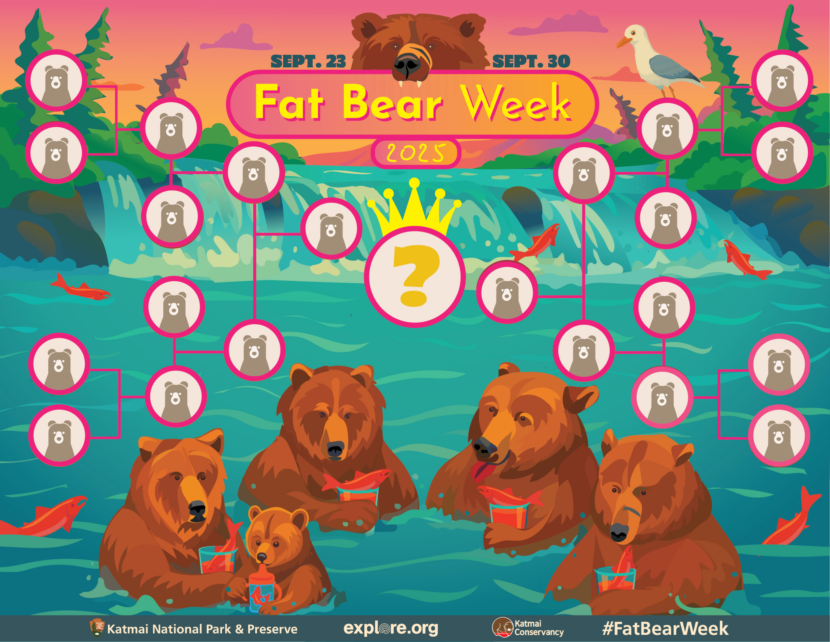
The 2025 Fat Bear Week Bracket (Courtesy of Explore.org)

Ladies and Gentlebears, welcome to Fat Bear Week 2025! 

This annual, week-long competition from Katmai National Park is a celebration of a summer’s worth of hard work, a hat tip to a healthy ecosystem and a collection of survival stories. The bears have been busy feasting on salmon and stocking up on nutrients for their winter hibernation, and they’ve got the fall bods to prove it. 

What started as a one-day event in 2014 conjuring the attention of a few thousand nature conservancy social media followers has grown into a week-long event boasting 1.2 million votes last year. There are fat bear fans in every part of the country, fat bear curriculums in classrooms, fat bear campaign posters, fat bear Spotify playlists and, of course, fat bear bets on who will be crowned the champion. 

Similar to March Madness, Fat Bear Week is a bracket-style, single elimination tournament. New to the scene? I’m here to break it down for you: 

Who’s in the bracket? 

Not all the bears at Katmai are contenders. Rangers refill the roster largely based on the availability of spring and fall comparison photos, the bear being fat, and other unknown-to-us but reasonable reasons. The much-anticipated 2025 bracket was released bear-by-bear Monday live and on Youtube. You can find the complete list of all twelve competitors, before-and-after photos as well as short biographies at FatBearWeek.org

How does it work / How do I vote?

Fat Bear Week is Tuesday, Sept. 23 through Tuesday, Sept. 30. Each day, one or two matches will be posted on FatBearWeek.org. Between 8 a.m. and 5 p.m. AKST, you may vote for one bear in each match. The winner of each match is announced that evening and advances to the next round.

Which fat bear do I vote for?

The voting rubric is different for different people. Some folks believe you should only vote for the physically, empirically, literally, fattest bear. Some believe it’s a matter of weight gain. That is, you should determine which bear was most successful in becoming a fat bear between spring and fall. Others believe that fatness is a symbol of overall survival and that one should vote on a fat bear’s skills, success and story arc. Who here is giving off main character vibes? Vote for them! 

Personally, I love Fat Bear Week for the poetry: the 230 Ben dancer in us. The 128 Grazer fierce mama in us. I love Fat Bear Week for the stories: 32 Chunk eating with a broken jaw; 503, the adoptee, who befriends all. Above all, I love Fat Bear Week for the kinship between bears, and between us and the bears. 

Whether you’re a Fat Bear Week superfan or a newcomer to the scene, I hope you find a bear to throw your weight behind. We’re zooming in on a robust ecosystem that nourishes larger-than-life bears. Surviving was yesterday; today we’re thriving. Let’s celebrate!
Ravenstail Labubus brings attention to Indigenous weaving

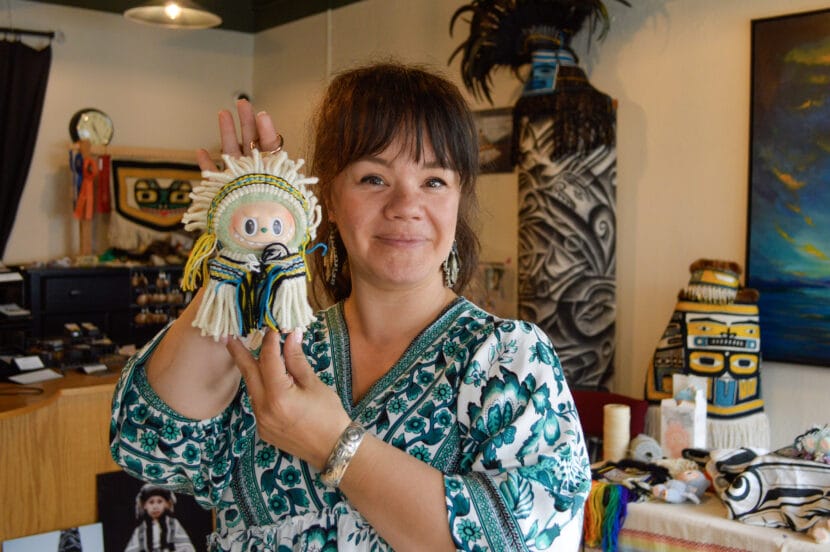
Master weaver Lily Hope holds up a Labubu decked out in Ravenstail weaving on Sept. 12, 2025. (Photo by Yvonne Krumrey/KTOO)

A Lingít master weaver is using viral monster dolls called Labubus to bring attention to Chilkat and Ravenstail weaving.

Listen:

In Lily Hope’s shop in downtown Juneau, she held up a tiny doll with an evil grin. 

“Some people are like, ‘why? Oh, please no. Why?’ It’s the you know, ‘what an ugly monster,’” she said. “And other people are like, ‘oh, please let me have one.’” 

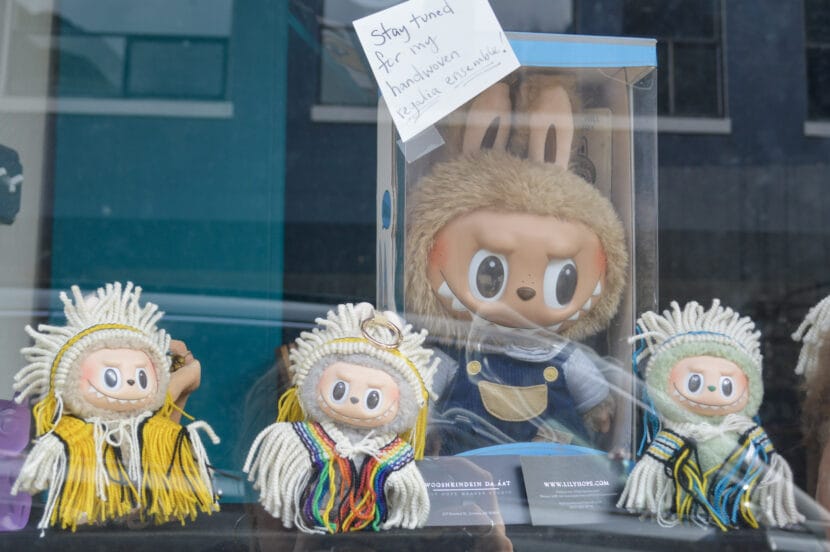
Her shop was filled with pieces of weaving: earrings, formline robes, and pictures of models in more weaving. On her desk laid a green doll wearing a Ravenstail headdress, woven in pink, white and blue yarn.

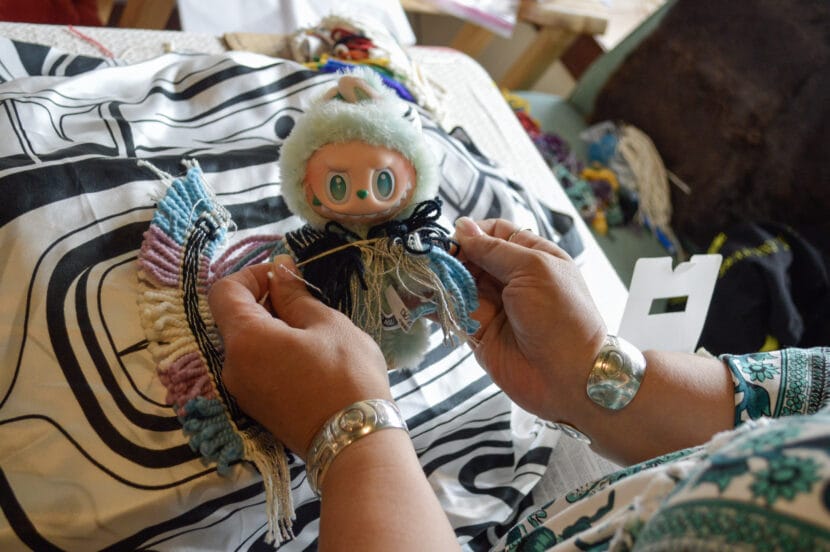
“This one is Trans Pride, requested from an art collector in New York City,” she said.

A Labubu wears Trans Pride Ravenstail regalia, woven by Masterweaver Lily Hope. Sept. 12, 2025. (Photo by Yvonne Krumrey/KTOO)
A Labubu wears Trans Pride Ravenstail regalia, woven by master weaver Lily Hope. Sept. 12, 2025. (Photo by Yvonne Krumrey/KTOO)

Hope is a master weaver. She has dedicated her life to reviving Chilkat and Ravenstail weaving, and through apprenticeships and classes, she’s helped hundreds of Alaska Native people form their own weaving practice.

She’s also a mom of five. And those two worlds collided when her kids started asking for Labubus. 

“My three small children introduced me to the dolls and said, ‘Please, Mommy, please, mommy, buy these for us,’” Hope said

You may have heard of them. The dolls are all over the internet, with their fuzzy bodies, big colorful eyes, and pointy teeth. They are based on storybook characters

Hope said they come in “blind boxes” — generic packaging that leaves the contents a mystery — so part of the fun is finding which Labubu is in the box.

“Oh, yes, this is the whole rage, right?” she said. “It’s like, ‘Oh, I got Lychee Berry. Oh, I got, I got the Green Grape. Oh, now we need to get Soy Milk, Mama, let’s get Soy Milk.”

But in the craze, she saw an opportunity to continue to push Northwest Coast weaving into the spotlight.

“When somebody sees an Indigenized Labubu in a Ravenstail regalia,” Hope said. “They can be like, ‘Oh, where does that come from? Oh, what are those? Oh, what is Ravenstail weaving? Oh, wait, it’s related to Chilkat. Let’s go.’”

Lingit regalia is sacred attire that represents ancestral heritage and cultural identity.

Hope’s doll-sized regalia sets go for more than $600, and fine arts collectors all over the country are ordering them.

Three Labubus in Ravenstail weaving on display, while a gigantic fourth one awaits his, at master weaver Lily Hope's studio on Sept. 12, 2025. (Photo by Yvonne Krumrey/KTOO)
Labubus in Ravenstail weaving on display at master weaver Lily Hope’s studio on Sept. 12, 2025. (Photo by Yvonne Krumrey/KTOO)

But for those who don’t want to shell out that much, Hope also sells kits for people who want to weave their own outfits for a doll. 

“It’s a way to get the work further into the world,” she said. “And kind of, you know, capture some people who wouldn’t necessarily come to Ravenstail weaving otherwise, but are like, ‘Oh, this is a way that I can dress my Labubu in traditional regalia, and I made it myself.’ That’s huge.” 

It’s a way of weaving your own story into the trend. And the little monsters look pretty cool, too. 

Listen: Singer-songwriter Kristen Ford plays live in the KXLL studio, discusses latest album release and upcoming tour

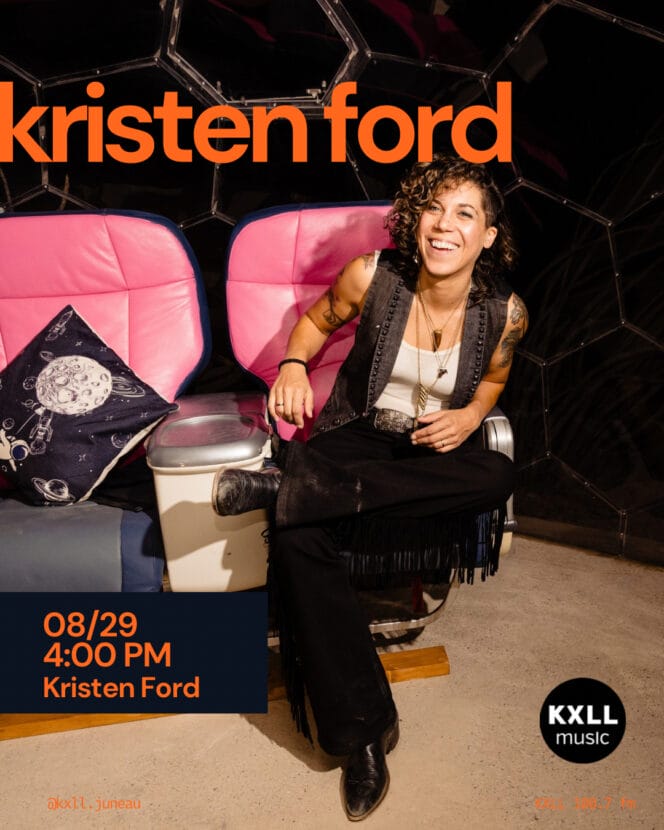
Kristen Ford, queer singer-songwriter and multi-instrumentalist, kicked off her North American tour for her latest album “Pinto” at the Crystal Saloon on August 30. Delivering a blend of indie rock and folk, the show was the first in her eight-stop tour spanning Alaska, Washington, Oregon and California.

Originally inspired by acts like Ani DeFranco and Blink-182, Ford picked up the guitar at 14 and has been crafting her own genre since.

In an interview with KXLL ahead of her show, Ford described her work.

“It is really freeing to be a solo artist. I do live looping, and a lot of different effects pedals to layer harmonies and guitar effects,” Ford said. “I don’t want to be one of those people that say ‘You can’t define my music,’ but I just like music.”

? Listen back to the full conversation below.

Annual TCLL field trip connects students to Lingít culture through foraging and language

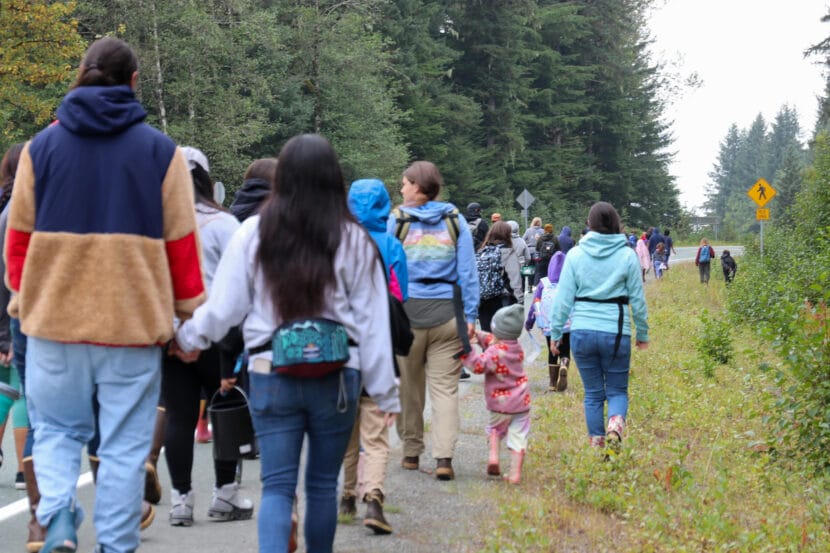
A couple holds hands in the back of a large group of people walking near a road.
Families, students and teachers hold hands and walk toward a trail to pick tea leaves next to Eagle River United Methodist Camp near Juneau on Sept. 5, 2025. (Photo by Jamie Diep/KTOO)

Listen here:

Learning outdoors is nothing new for students in Juneau’s Tlingit, Culture, Language and Literacy program. That’s what they did on their first field trip of the year, where they learned about Lingít language and values through foraging and processing local foods. 

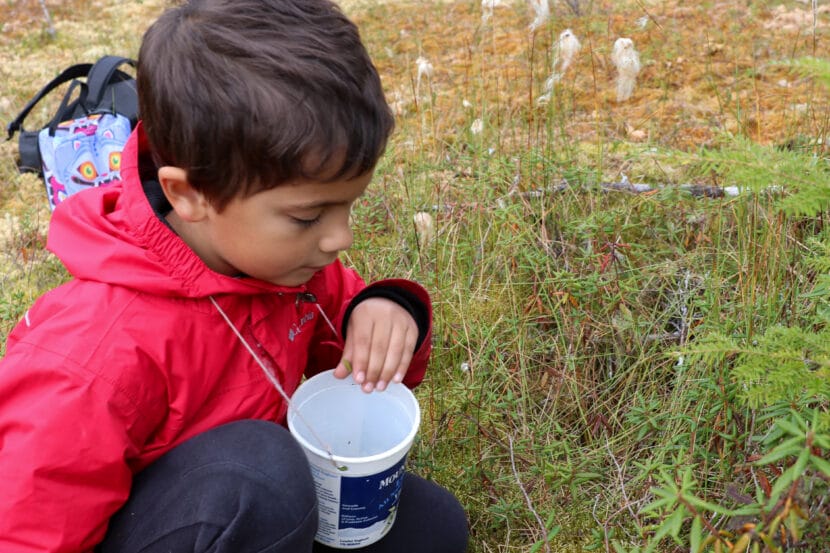
Students, teachers and families walk through squishy, mossy muskeg near the Eagle River United Methodist Camp north of Juneau. First grader Owen Roehl crouches over small, short bushes peppered throughout the area, putting green and yellow leaves into an empty yogurt container looped around his neck.

“We’re picking s’ikshaldéen, also known as Hudson Bay tea,” he said.

Owen said picking tea has been his favorite part of the day so far.

A child in a red rain jacket puts tea leaves in a yogurt carton hanging from his next on string.
First grader Owen Roehl picks s’ikshaldéen, or Hudson Bay tea, anear Juneau on Sept. 5, 2025. (Photo by Jamie Diep/KTOO)

Seventh grader Cassius Allen is one of the older students picking tea. Cassius said he thinks the tea will taste good once they process it. 

“Probably gonna have to mix it up with some other flavors so it tastes not plain and normal,” he said.

Cassius got help from eighth grader Leighton Heppner to identify the tea leaves. Leighton said he learned from friends and teachers.

“They said, ‘always make sure it’s yellow at the bottom, like fully yellow or partially yellow, and it will still work,’” he said.

Overall, Cassius appeared to have some fun while picking tea, getting part of a leaf up Leighton’s nose when holding it out for him to smell.

This is part of a longstanding field trip for students at Tlingit Culture, Language and Literacy, a Lingít language immersion school. It’s not just for the students. They’re joined by families and volunteers, as well as students from Haa Yoo X̱’atángi Kúdi, a Lingít language preschool. That’s a language immersion preschool where children primarily speak in Lingít.

Things have changed slightly after the program expanded to middle school. While it’s normally a day trip, it’s turned into an overnight field trip for the older students.

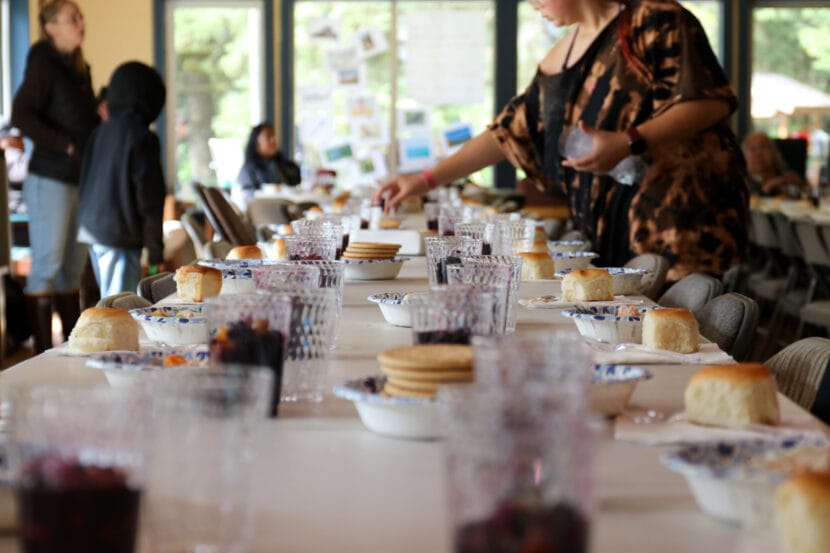
A student in a brown shirt sets clear plastic cups on a table full of individual servings of fish soup, berries and bread.
A student helps to set a table full of fish soup, bread and berries at Eagle River United Methodist Camp near Juneau on Sept. 5, 2025. (Photo by Jamie Diep/KTOO)

Naakil.aan Hans Chester is a biliteracy specialist at the school. He said getting students out of the classroom opens the door for a lot of learning. 

“In this context, it’s real living, and they hear us using the language with each other and communicating, or just even expressions, to say when you’re doing something, and it’s in context and it makes sense,” he said.

In addition to tea, students also learned to fillet salmon and make jam. Chester said the jam was going to be given to guests at a Ku.éex’ – or potlatch – the next day.

“When we do our Ku.éex’, it’s to honor our lost clan members,” Chester said. “And so, you know, it’s really important for us to teach these skills to our kids, so when they grow up and they lose their mom or their sister or their cousin or whoever that’s in their family, they’ll have these skillsets to rely on so that they can do what we do.”

Chester said this field trip makes him feel like the school is in a stronger place than it was before.

“Hearing them use the language more, some of them stepping up and becoming leaders out here, is really awesome to see”

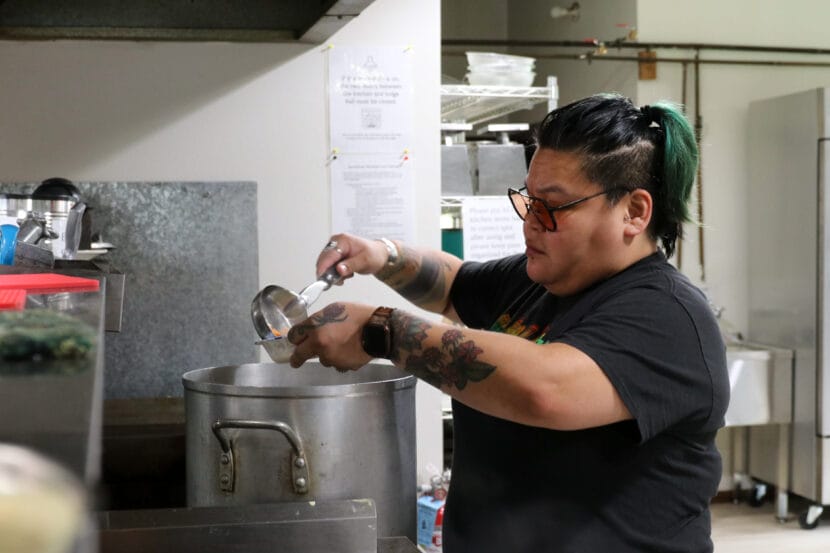
A teacher with green and black hair scoops soup from a large stock pot into a paper bowl.
TCLL teacher Nae Tumulak scoops fish soup into a bowl at Eagle River United Methodist Camp near Juneau on Sept. 5, 2025. (Photo by Jamie Diep/KTOO)

In the camp kitchen, Lingít language teacher Nae Tumulak portions out bowls of fish soup. The middle schoolers filleted coho salmon for it the night before. Tumulak said she likes getting to know the students more, both new and old.

“Just seeing them in their element, being able to witness a lot of their growths and everything like that, it’s been a lot of fun,” Tumulak said. “They’re also incredibly hilarious. So it’s been entertaining.”

Once they’re back at school, Chester said they will process the tea and give it away to community members.

International relay persists despite broken ferry, troubled international relations

A wave of the Klondike Road Relay begins on Sept. 5. (Photo courtesy of Jaime Bricker)

Last year, the Klondike Road Relay got off to a late start when a tour bus crash delayed the race, forcing participants to skip the first few legs. This year, the event celebrated its biggest gathering, despite broken infrastructure and ongoing political tension.

Half party, half grueling mountain run, the 109-mile race stretches from downtown Skagway up the Klondike Highway, all the way to Whitehorse, Yukon. It retraces the steps of the gold miners, except these participants wear wild costumes, flashing safety lights and followed by support vehicles. One of those vehicles this year was an open trailer outfitted with a working hot tub.

Julia Frost from Juneau almost missed this year’s event. It was her first time running the relay. A mechanical issue on the Alaska Marine Highway System made the long journey even more challenging.

“The LeConte broke down so our three cars that we had booked could not come,” Frost said. “So we scrambled yesterday and found one rental car and one Turo for an obscene amount of money. But we were coming, we were doing this.”

So, how much did that broken down ferry cost Frost’s team?

“The Turo was $1,300 and the rental was like $1,200 — a lot,” Frost said. “I mean, we’re sharing it with 10 people, whatever. You know, it’s the whole experience.”

Angene Johnson from Anchorage didn’t so much want the Klondike Road Relay experience as much as her husband didn’t want to run two of the ten legs. The couple flew to Juneau and made it to Skagway before the ferry mishap. But Johnson worried about how they’d get home to their two children if the vessel wasn’t restored.

“We have not had any official communication yet, but we’re trying to start making some backup plans, just in case it’s not functional,” she said. “We have a number of potential worst case scenarios.”

Johnson’s teammate, Aaron Cravez, was less concerned.

“We got plenty of beer, so we’re good,” he said.

For Yukoner Kirsten Madsen, the race was about restoring a relationship.

“I definitely had some qualms,” she said. “As we were driving, I said this is the first time I’ve crossed the border since Trump’s election. And there have been other things that we didn’t do so far this summer because of that. But this race and the kind of friendly feelings we have about Skagway made it an exception for me.”

Madsen was part of team Tiger Fire.

“We’ve got some tiger ears and a bow tie and a tail that’s affixed in a weird, not quite accurate location, but it’ll work,” she said.

Race coordinator Ryan Sikkes says this is the biggest race ever at 2,000 entries sold. One team had to cancel because of the broken ferry.

At Sitka library, Dungeons & Dragons plays a critical role in community building

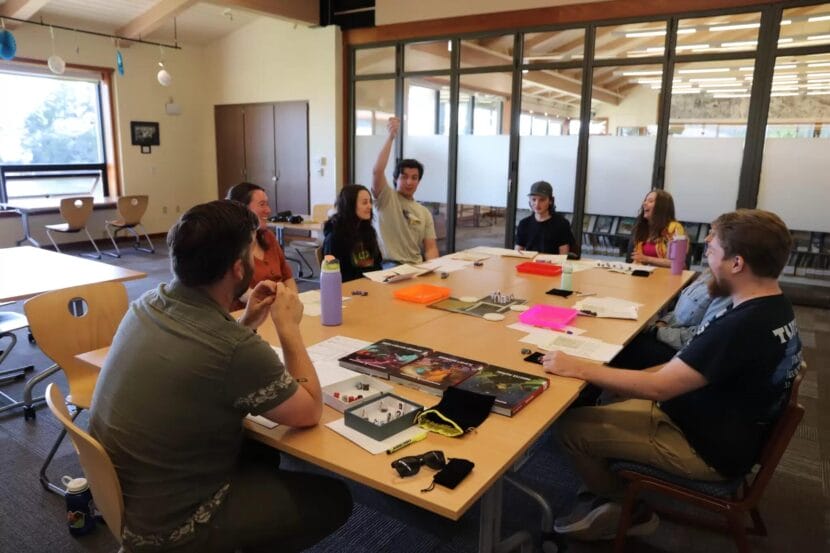
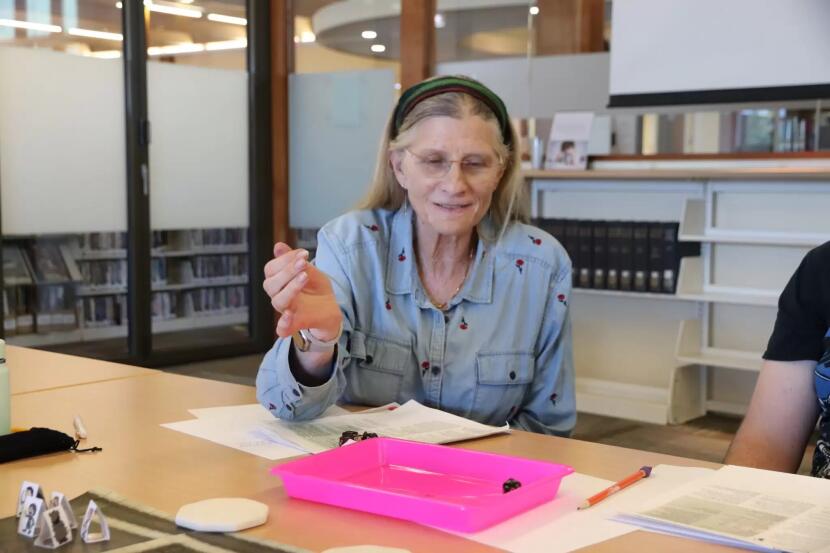
Players role-play during a session of Dungeons and Dragons at the Sitka library.
Players role-play during a session of Dungeons and Dragons at the Sitka library. (Ryan Cotter/KCAW)

On an uncharacteristically sunny day, Sitkans spread out all across town, kayaking out on the ocean and scaling mountains for a rare, clear view. However, one specific group of Sitkans is tasked with an important quest: rescuing a blacksmith’s daughter from a horde of goblins.

Armed with their gifted set of dice and assigned character sheets, the seven players wield their pencils to take notes on their surroundings. Gathered around a table at the Sitka Public Library’s multipurpose room, the players range in experience from this being the first time they have played the tabletop role-playing game Dungeons & Dragons, or D&D, to veterans with years of experience and D&D podcast recommendations under their belt.

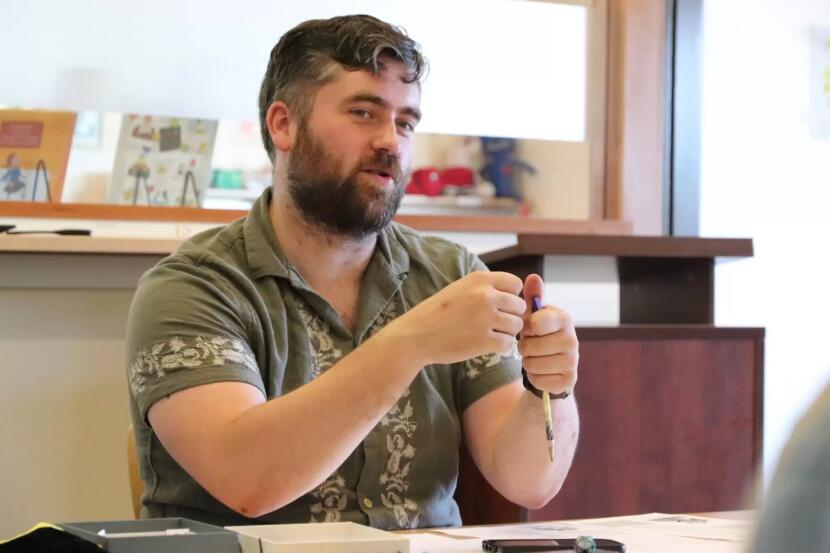
Riley Whitson is what the game deems the Dungeon Master, a storyteller who guides the players throughout the whole gameplay experience, from helping them create their characters to narrating their characters’ surroundings. Having regularly mentored middle schoolers in how to play D&D under the city’s Parks and Recreation Division, Whitson was recruited to lead a two-week workshop for adults. Having played the game for over two decades, what keeps Whitson coming back for more is D&D’s unique collaborative nature.

“Dungeons and Dragons is kind of a shared story,” Whitson said. “You’re all characters in some type of adventure going on or some activity, and everyone gets a piece to kind of make it a living, breathing story. And that’s what excites me the most.”

Riley Whitson narrates the scene of players combatting an army of goblins. (Ryan Cotter/KCAW)

After defeating the goblins and freeing both the blacksmith’s daughter and a captured paladin (played by an experienced player who joined that day), the party uncovers a statue of a knight with a mysterious riddle engraved below it:

“If you are to keep this, you must first give it to me…”

As a fantasy-game that prominently features riddles, D&D is a game that is fully dependent on the imagination of its players. As a born-and-raised Sitkan, Whitson believes that Sitka is a prime location for fueling prospective players’ imaginations.

“All I ever wanted to do as a child was leave this place,” Whitson said. “We’re very rural and isolated, and so your imagination kind of tends to take you on adventures no matter what, whether you’re imagining just going to Seattle for a weekend, or you’re off in a mythical land where it’s always sunny, you can just put yourself in a world that you want to go to.”

First-time player Carole Knuth was inspired to attend the library’s workshop by her grandson’s imagination, and wanted to learn how to play D&D in order to create an opportunity to connect with him. However, learning how to harness her imagination while learning the plethora of unique game mechanics has been a challenge.

“I’m more of a black-and-white person and to have this much — well, the numbers and the the variety and imagination was just really stretching for me,” Knuth said.

Newfound DnD player Carole Knuth rolls a 20-sided dice. (Ryan Cotter/KCAW)

While it can be an adjustment, Whitson believes that the limitless imagination D&D encourages in its players is what makes the game so special.

“All of us played pretend when we were kids, and everybody has some part of them that still wants to,” Whitson said. “And so once you see people kind of get over that initial shock of, oh, there’s numbers and probability and math and stepping outside of your own shoes, you see people just take to it.”

It is moments of learning and camaraderie that the players experienced in their session that led Adult Services Librarian Margot O’Connell to co-create this event with Sitka Parks and Recreation. She believes hosting tabletop role-playing game events are an important way to facilitate community building.

“We kind of think of ourselves as a community living room,” O’Connell said. “And I think with games like Dungeons and Dragons or board games, they are inherently very social. And so anytime we can provide a space for folks to come and build community together, learn new skills, just come and hang out, I am thrilled.”

This fall, Whitson will lead some intermediate D&D workshops, as well as some middle school and high school campaigns with Sitka Parks and Recreation.

Site notifications
Update notification options
Subscribe to notifications