VXAK, a unique collective rooted in Juneau, dropped their fifth skate film, V, earlier this month. With its signature VX aesthetic and iconic Alaskan backdrops, the project blends lo-fi street skating and raw visuals with a distinctly local voice. With a nod to DIY filmmaking and community-driven artistry, VXAK is redefining what it means to create and skate in the 49th state.
On July 2, we sat down with VXAK’s creator Stuart Wood alongside featured skaters Logan Terry and Anna Mahanor to talk about Alaska’s underground skate scene, how early 2000s nostalgia and midwest emo influence their creativity, and what it means to build community through their art across the state.
“It was fun having that community back – you’re going to the spot with all the homies and everybody’s psyching you up, and then to watch the end product be this… beautifully curated music and piece of art is really cool,” Terry said of the experience.
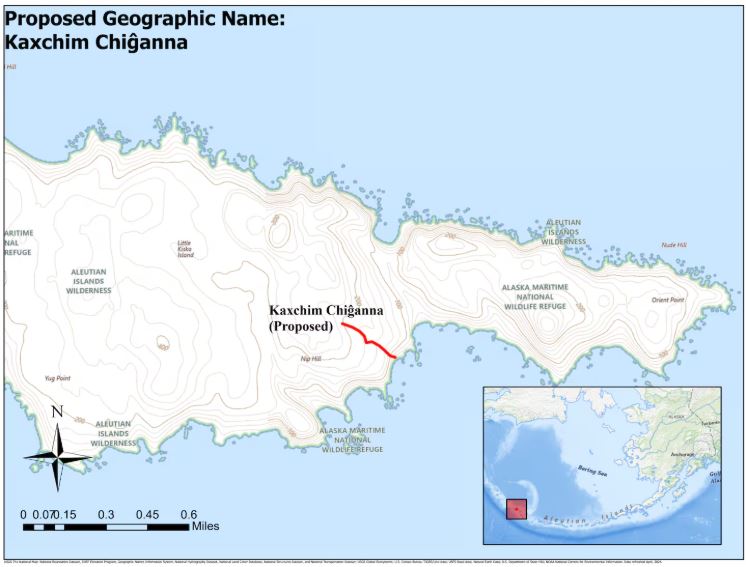
This map from the U.S. Geological Survey shows the former Nazi Creek on Little Kiska Island. (U.S. Geological Survey photo)
A small creek on Alaska’s Little Kiska Island has been renamed, more than 80 years after it was named after Germany’s Nazi Party by World War II soldiers fighting in the Aleutians.
Nazi Creek was the last landmark in the United States to bear the Nazi name. Its new name is Kaxchim Chiĝanaa, meaning either “gizzard creek” or “creek or river belonging to gizzard island” in Unangam Tunuu, the language of the Indigenous Unangax̂ people.
On Thursday, the Domestic Names Committee of the U.S. Board on Geographic Names voted 17-0 to approve the new name, without discussion.
The board’s decision allows the federal government to officially change the creek’s name in federal databases that are the official repository of geographic names. That repository is used by federal agencies and commercial companies that provide maps to the general public.
The board also approved the renaming of nearby “Nip Hill,” named by soldiers using a derogatory term for Japanese people. That hill was renamed “Kaxchim Qayaa,” or “gizzard hill,” again using the traditional name for Little Kiska Island, which is not far from Kiska Island, site of a World War II battle.
Michael Livingston, an employee of the Aleutian Pribilof Islands Association, has been working for almost two years to have the names changed. Moses Dirks, an expert on Unangam Tunuu, recommended the new names.
“I think that’s pretty awesome. I think elders … and others are happy about it. It really should have never been there in the first place,” Livingston said of Thursday’s vote.
“Like one of my teachers … used to say, if you know something that can make our community better, our villages better, be brave and stand up and say something about it, do something about it,” Livingston said.
The new names were previously recommended by the Alaska Historical Commission, which considered them in April. The changes were endorsed by local Native tribes and Native corporations, the Museum of the Aleutians, the manager of the Alaska Maritime National Wildlife Refuge, Congregation Beth Sholom of Anchorage, and the Alaska Chapter of the Japanese American Citizens League, among others.
Kiska Island is located 242 miles west of Adak, at the far end of the Aleutian Islands. The area has been mostly uninhabited since World War II, when invading Japanese forces took 42 people on Attu Island prisoner. More than half died in Japanese internment camps.
The United States forcibly relocated almost 900 Unangax̂ residents of the Aleutian Islands, housing them in unsuitable internment camps in Southeast Alaska and elsewhere. Many became sick and died from the conditions imposed by the government.
Aleutian Islands residents subsequently received reparations from the federal government under legislation that also paid reparations to Japanese Americans also interned during the war.
Livingston’s work isn’t yet complete. He’s also seeking to rename Quisling Cove, a small body of water named after the Norwegian Nazi collaborator Vidkun Quisling. That name change remains pending.
Juneau Symphony Music Director Brad Hogarth. Hogarth was appointed as the new director after a season-long recruitment process. (Photo courtesy of Juneau Symphony)
The Juneau Symphony has appointed a new music director for its next season.
Brad Hogarth is a conductor and trumpet player based out of the San Francisco Bay area. He made his conducting debut with the Juneau Symphony in April with performances in Juneau and Sitka.
The symphony announced the appointment on its website and social media Monday following a season-long process to find a new director.
Juneau Symphony Executive Director Charlotte Truitt said Hogarth has performed in Southeast Alaska in the past and has worked with local high school students as well.
“He’s very excited about getting more involved in the community and doing more in education outreach and really connecting as a community,” Truitt said.
Hogarth was one of four candidates the symphony considered. Each person conducted a concert and the decision was made after a vote from symphony members, supporters and staff.
In addition to Juneau, Hogarth also works for the Monterey Symphony, Art Haus Collective and Peninsula Youth Orchestra. He serves on the faculty of the San Francisco Conservatory of Music as well. Hogarth is working with the Juneau Symphony to finalize details for the upcoming season, which starts Oct. 18.
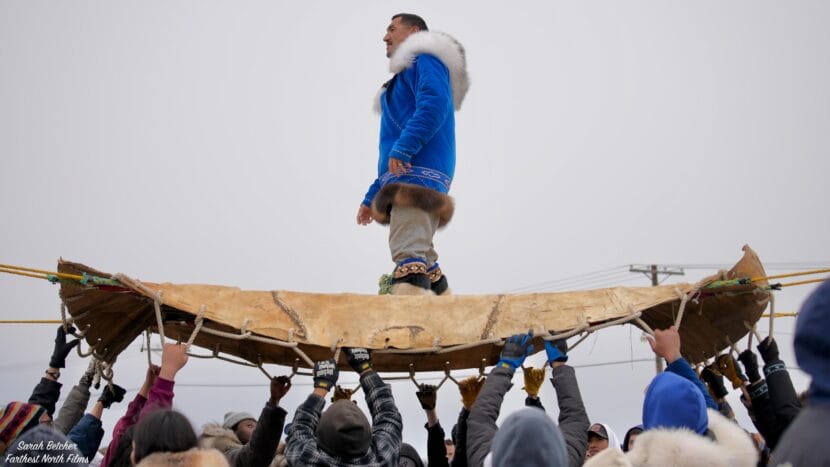
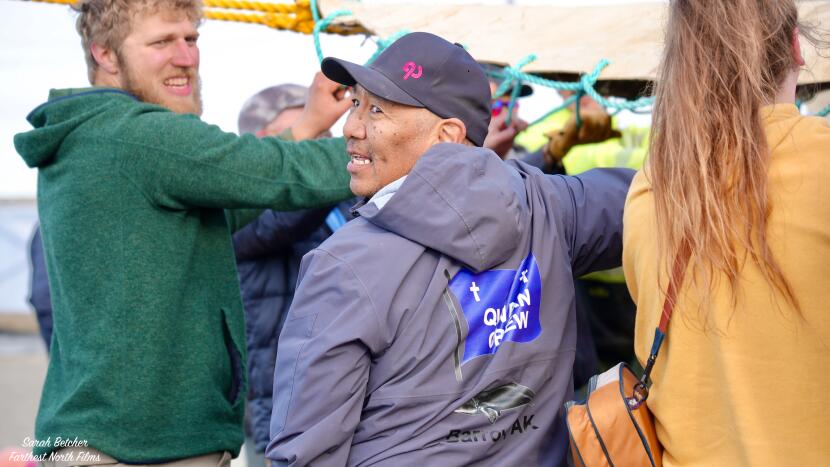
Quincy Adams prepares to jump on a sealskin blanket during Nalukataq festival in Utqiagvik in June, 2025. (Photo courtesy of Sarah Betcher/Farthest North Films)
Back in June, whaler Quincy Adams soared above a seal blanket at Simmonds Field in Utqiagvik, with a bag of candy in his hands. He leaped even higher and tossed the kaleidoscope of sweets, as the children around him whooped with joy and caught treats.
Quincy and his wife Bernadette Adams are the captains of the Aaluk whaling crew. They were among those who landed a bowhead whale this spring and threw a feast for the community – especially for elders and widows who can’t hunt for themselves.
“It’s all for the community, not just for us or our crew,” Quincy Adams said. “It’s to make sure everybody gets a bite to eat, to make sure that nobody goes hungry.”
Several coastal Arctic communities – including Utqiagvik, Point Hope, Wainwright, Nuiqsut and Kaktovik – hosted festivals throughout June to celebrate a successful whaling season. The event is often called Nalukataq, or blanket toss in Iñupiaq.
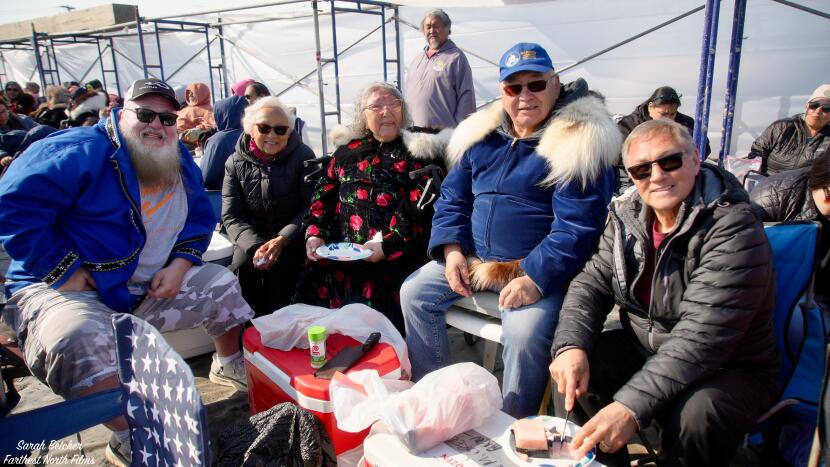
The Brower family enjoys muktuk during the 2025 Nalukataq in Utqiagvik. (Photo courtesy of Sarah Betcher/Farthest North Films)
In Utqiagvik, the festival this year spanned four days and included feasts, prayers, dance and a traditional blanket toss. Each day, the whaling crews served several courses of subsistence dishes: caribou, duck and geese soup, doughnuts, boiled whale meat, muktuk, akutaq, and a delicacy – fermented whale meat and blubber, or mikigaq.
Everyone on the crew had a task, even teenagers and children who helped serve coffee and tea. Flossie Nageak celebrated her 70th birthday on one of the Nalukataq days and said that having children participate helps them learn Iñupiaq traditions.
“We work together, trying to teach them our tradition,” she said. “We need to let them get into subsistence. They’ll be next in the future.”
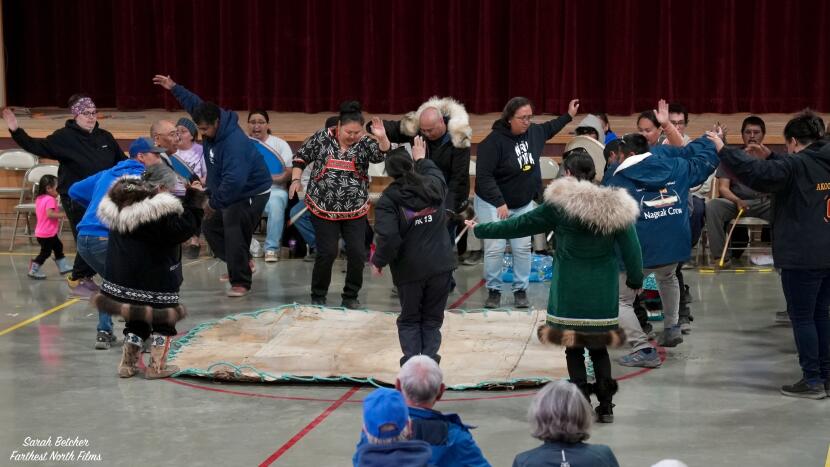
When the feast was over, the whalers stretched a sealskin blanket, inviting everyone to jump on it. Then, the crowd moved indoors and continued with Iñupiaq dancing and drumming throughout the night.
Several whaling crews join in a traditional Inupiaq dance during Nalukataq. (Photo courtesy of Sarah Betcher/Farthest North Films)
This year’s Nalukataq also had an emotional side for Adams. A young member of his crew died by suicide earlier this year, and the crew dedicated their whaling season to him. They also opened one of the days of Nalukataq with a prayer and a message of hope.
Adams said it is still hard for him to process the loss of the crew member who was hardworking and always eager to learn.
“He always liked to learn, always asking, ‘What’s next?'” Adams said. ” He was a young man just starting his life out.”
Adams said his sons were friends with the young man and are struggling too, so he is encouraging them to share their feelings.
Historically, suicide rates in the North Slope region have been high compared to more urban areas and Alaska as a whole, according to data from the borough. Adams said he is worried about young people who have a hard time seeking out help.
“It’s just something we wanted to get out to the other people and to the young people and the teens, tell them that there is hope, there is family that loves them,” Adams said. “If they need to talk to somebody, talk to somebody.”
Nalukataq festival in Utqiagvik in June, 2025. (Photo courtesy of Sarah Betcher/Farthest North Films)
Whaling captain Herman Ahsoak said that dedicating Nalukataqs to those who passed is not new. He said the event is about the community coming together.
“We put on the blanket and jump,” he said, “and let it all out on the blanket and just jump for joy.”
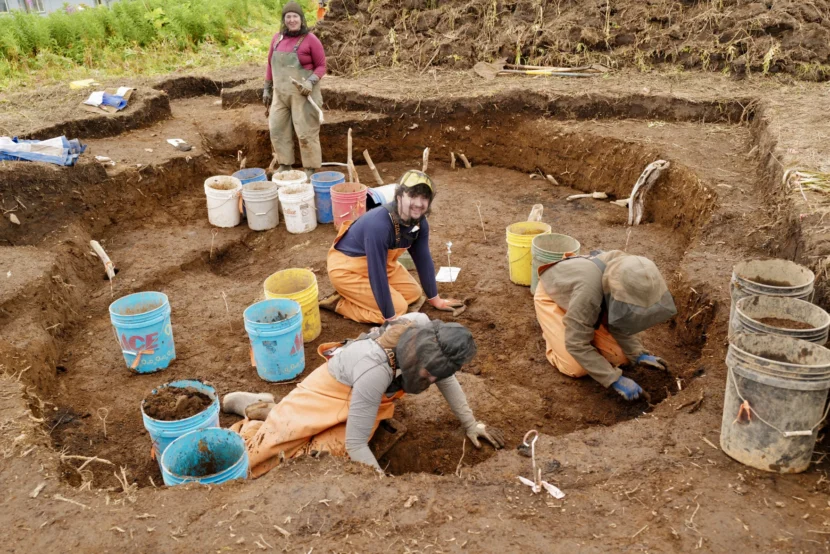
Archaeologists with the Alutiiq Museum dig into layers on layers site at Karluk Lake called site 309, which revealed a ‘super structure’. This is separate from what was surveyed on Shuyak Island. (Courtesy of Alutiiq Museum Archaeology Department & Repository)
A archaeological survey of an island near Kodiak has discovered new Alaska Native village sites, including one believed to be the island’s oldest.
Shuyak Island is one of several located in the Kodiak Archipelago and like many islands in the area has a rich history. The Alutiiq Museum’s archaeological team has been surveying sites on the island for a couple years and they have pieced together more of the historical timeline of the island’s use.
Patrick Saltonstall, the archaeology curator with the Alutiiq Museum, is heavily involved in site surveys and excavations around the Kodiak Archipelago.
This spring, Saltonstall and staff from the museum’s archaeology team finished surveying Shuyak Island, which is located approximately 54 air miles north of Kodiak.
“A lot of the old research had focused on the northwest part of Shuyak Island and we surveyed the whole island. And we found a lot of really big villages on the east side,” he said.
Last summer they surveyed the western half of the island and this year they did the eastern half. Saltonstall said they surveyed one site that dates back to roughly 7,000 years ago, which he suspects is the oldest found on that island thus far.
“I think we found that one village that had 11 house pits, probably had two to three hundred people living in it, you know, 300 years ago,” he explained. “Shuyak has always sort of been a place where I think it seems like there were fewer people up there. But finding that, you know what your preconceptions are and what you actually find often don’t match.”
Alutiiq/Sugpiaq people have inhabited areas around Kodiak Island for at least 7,500 years, according to archaeologists. And thousands of archaeological sites have been documented across the archipelago.
According to the Alutiiq Museum, Shuyak Island was an integral part of that history with at least two established Alutiiq villages. But Russian fur trader Gregorii Shelikov destroyed one of the villages and by the late 1700s there were no communities left on the island.
By the 1920s the island was home to a herring saltery and family fishing operations providing food for human consumption and animal feed for a, “growing fox farming industry.” The Sklaroff & Sons smoked fish establishment from 1892, in Port William on the south end of Shuyak Island, was turned into a fish processing facility or cannery, which was operated by the Washington Fish and Oyster Company until 1976.
After the Exon Valdez oil spill in 1989, part of the cleanup work involved surveying and protecting various archaeological sites on the island. According to Saltonstall, many of those sites were reported to be eroding and at risk of disappearing into the water.
The word Suu’aq [Shuyak] in Alutiiq means “rising out of the water”. And true to its name, Saltonstall said the island itself is rising at a faster rate than the sea level is; so the threat of eroding sites is not as prevalent today.
“What we found up there is that’s not happening anymore. All the sites are much more stable,” he said. “You see grass growing on all the beaches, and it demonstrates…the land sank in 1964 and it’s rebounded ever since, and it’s outpacing sea level rise up there.”
Molly Odell, the director of archaeology at the Alutiiq Museum, said that growth provides natural protection for the sites on Shuyak Island.
“It’s really good news that the sites aren’t eroding as much as they were even 30-40 years ago, because it means they’re stable and they’re not being lost. And it also makes them a little bit more protected from looting,” she said. “You know people going and collecting artifacts off the beach or digging them up used to be more of a problem.”
Odell adds that people should not dig in archaeological sites and should not collect artifacts, which are owned by the landowner even if they’re on the beach. [WEB: If you come across artifacts or cultural sites around the island, you can report that information and share pictures with the Alutiiq Museum by calling 844-425-8844.
Odell said the museum was doing survey work in partnership with the Shuyak Island State Park and Alaska State Parks system. Later this summer they plan to update the archaeology display at the Big Bay Ranger station on the island.
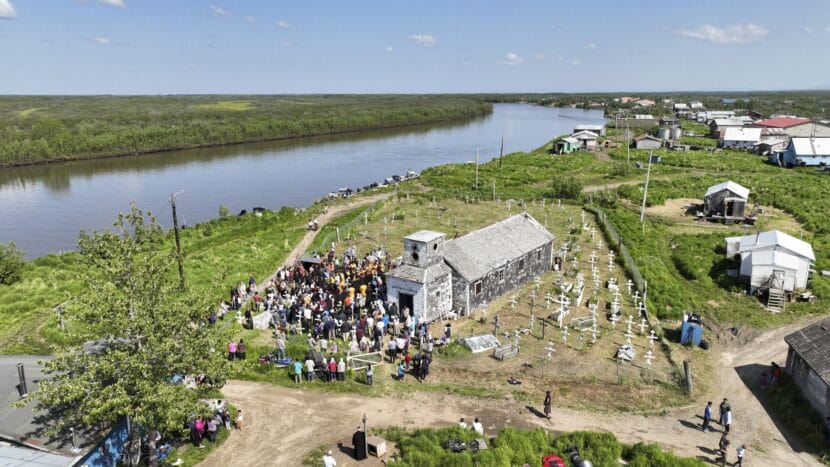
Orthodox pilgrims and clergy gather in the old St. Nicholas Russian Orthodox Church cemetery to take part in the glorification ceremony for St. Olga in Kwethluk on June 19, 2025. (Photo by Katie Baldwin Basile)
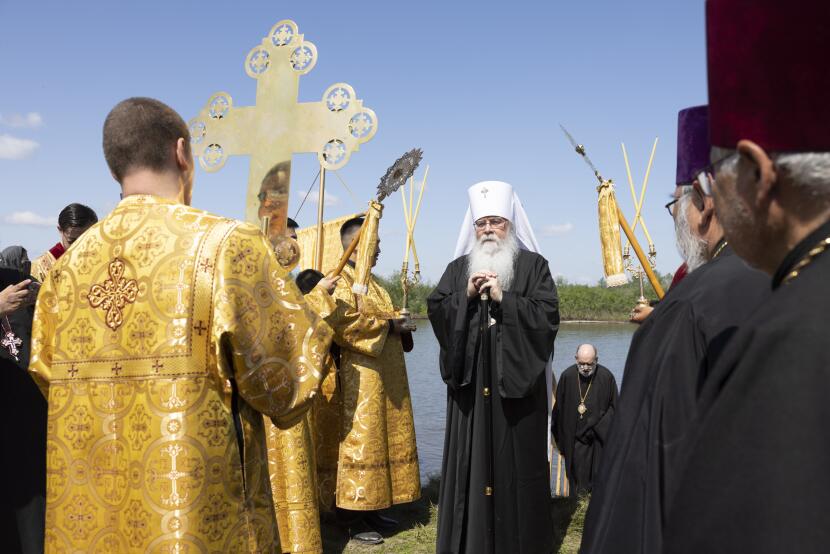
Shots rang out over the Kwethluk River as a mass of pilgrims lining the muddy banks sang a hymn of blessing on the eve of the summer solstice. At last, leaders of the Orthodox church had arrived in Kwethluk for the glorification of St. Olga – the first-ever Yup’ik saint and first female Orthodox saint in North America.
Metropolitan Tikhon, leader of the Orthoodox Church in America arrives in Kwethluk, Alaska for the glorification of St.Olga on June 19, 2025. (Katie Baldwin Basile)
For Kwethluk, the glorification is a long-awaited honor for Olinka “Arrsamquq” Michael, or Matushka Olga, a local midwife who gained a reputation as a gifted healer of deep-seated trauma during her life. Since her death in 1979, accounts of her miracles have spread throughout the Orthodox world, culminating in this historic moment.
In the crumbling cemetery of the old St. Nicholas Russian Orthodox Church, priests set Olga’s wooden casket on blocks, just feet from the spot where they exhumed her remains seven months earlier. It’s something that hadn’t been done in Alaska since the exhumation of St. Herman on Spruce Island near Kodiak in 1970.
As local priest Fr. Vasily Fisher explained, before Olga could be venerated as a saint, her final funeral rite, or panikhida, needed to be performed. Going forward, the day of her death will be celebrated instead as her birth as a saint.
“Everything is done as if going backwards; they come back to the church in the presence of life. Our faith is about life. Sainthood is about life,” Fisher said.
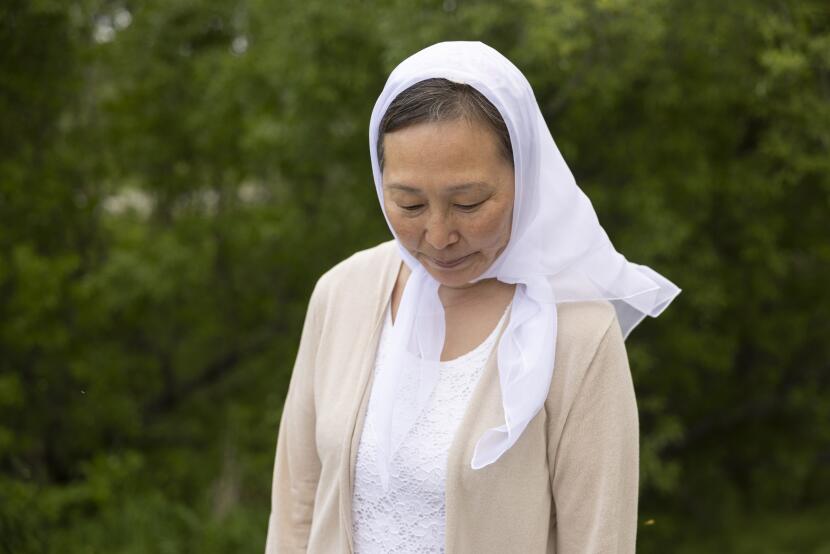
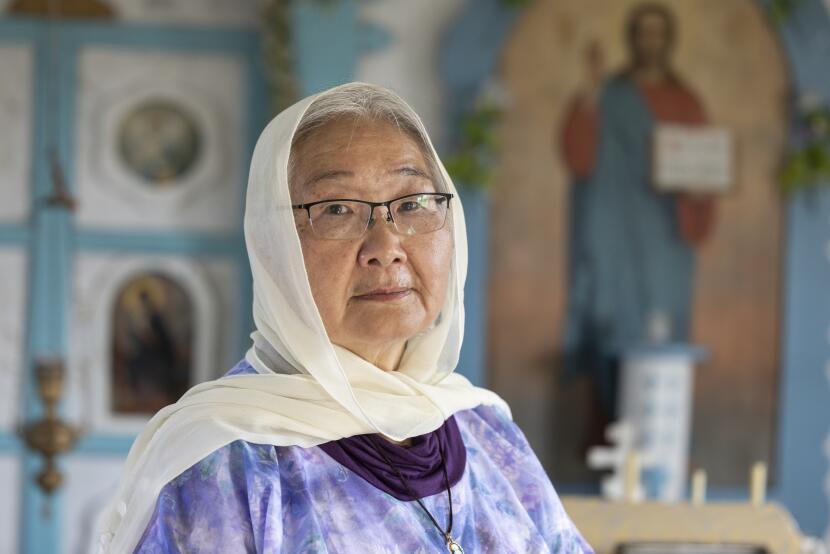
Some gathered in the cemetery had tears in their eyes. Others patted beads of sweat from their foreheads. Olga’s descendants stood transfixed among headscarved pilgrims from nearby villages and from as far away as Romania and Australia. The head of the Orthodox Church in America (OCA), Metropolitan Tikhon, traveled from Washington, D.C.
As Archbishop Alexei of Alaska read a passage from the Book of Psalms, a sudden gust of wind from nowhere cut through the otherwise still afternoon. It was hard to not get swept up in the feeling that something miraculous was afoot.
After the funeral rite, a procession featuring flowing robes, golden banners, puffs of incense, and a couple curious village dogs bore the casket along a short dusty track to the church in the section of Kwethluk known as downtown.
During the four-hour service that followed, it was standing room only, which worked out well for a religious tradition that doesn’t make use of pews. The chanting and choreography, what Alexei referred to as an “elaborate, beautiful dance,” ended when St. Olga’s casket was opened for pilgrims to kiss her sacred relics and receive her blessing.
One of Olga’s nieces, Bertha Howard, summed up her memories of her aunt succinctly.
“Ikayurluki yuut, naklegtarluni (she helped, she was compassionate), that’s all I can say,” Howard said.
For Olga’s granddaughter, Atan’ Winkelman, the inclusion of Yugtun in many of the glorification services was a highlight.
Atan’ Winkelman, granddaughter of St. Olga. (Katie Baldwin Basile)
“It’s very cool to see actual Yugtun words… to recognize the Yupik people, to use the word ‘Elders’ in song. I’ve never heard that anywhere else in any of our venerating any other saint,” Winkelman said.
As pilgrims filed by outside the church, Winkelman said that the scene was a lot to process.
“I’m finding the whole exhuming of her body, the whole glorification, canonization, very strange. Because she was an actual person to me that would hold me, and piggyback me, and we would sit and eat together, or I would sit and watch her sew,” Winkelman said.
Olga’s youngest surviving daughter, Matushka Helen Larson, remembers the many women who would pay visits to her childhood home in Kwethluk to sit down to tea with her mother.
Matushka Helen Larson is the youngest daughter of St. Olga of Kwethluk, Alaska, who was glorified as a saint in the Orthodox Church in America this past week, June 19-20, 2025. (Katie Baldwin Basile)
“They’d talk for hours, but I wouldn’t listen because she wouldn’t want me to listen,” Larson said. “But I knew she was helping someone. [They would] come in looking very heavy, you know. And then when they go, they’re lighter.”
With Kwethluk cast further into the spotlight of the Orthodox world, Larson said that she hasn’t lost perspective.
“I still think of her as just my mom,” Larson said.
For many others, Olga has become “St. Olga, Matushka of All Alaska,” a symbol of compassion, modesty, and empathy that appears to resonate just as much across the Yukon-Kuskokwim Delta as it does the world.
Katie Basile contributed reporting to this story.
Close
Update notification options
Subscribe to notifications
Subscribe
Get notifications about news related to the topics you care about. You can unsubscribe anytime.

 VXAK, a unique collective rooted in Juneau, dropped their fifth skate film, V, earlier this month. With its signature VX aesthetic and iconic Alaskan backdrops, the project blends lo-fi street skating and raw visuals with a distinctly local voice. With a nod to DIY filmmaking and community-driven artistry, VXAK is redefining what it means to create and skate in the 49th state.