Alaska coronavirus news

Live updates and information on COVID-19 in Juneau and Alaska

What to know about the new COVID, flu and RSV shots in Alaska this fall

Syringes pre-loaded with doses of the COVID-19 vaccine await injection at a clinic in Soldotna on Friday, April 16, 2021. (Nat Herz/Alaska Public Media)

Respiratory syncytial virus, or RSV, usually feels like a common cold. But it’s more risky for people over 60 years old and infants. Last year was the first year that older adults could get an RSV vaccine, and this is the first year infants can get immunized too.

Sarah Aho, the immunization program manager for the state of Alaska, said this new immunization for RSV, Nirsevimab, can reduce the risk of hospitalization by up to 80%.

“That is just an incredible reduction,” Aho said. “No one wants to see their baby in a hospital, and that can be struggling to breathe — that can be even death. So I think Nirsevimab is an incredible tool that we’ve never had before that’s available to all children in Alaska.”

Nirsevimab is recommended for babies under 8 months and up to 19 months for babies who are more vulnerable — including babies who are immunocompromised, have lung disease or cystic fibrosis, or who are of American Indian or Alaska Native heritage.

Aho said Alaskans can also expect to see new mRNA COVID vaccinations in Alaska as soon as this week. She said the vaccines are no longer considered boosters, but are a yearly formulation.

“You can think of it kind of like the flu vaccine that’s reformulated every year to match what scientists are expecting to see in the communities,” said Aho. “That’s kind of what’s happened with COVID vaccines this fall.”

Aho said the national Advisory Committee on Immunization Practices debated whether they should recommend this new vaccine only for those at high-risk of complications from COVID. But ultimately, they decided to recommend it for everyone six months and older.

Aho said flu vaccines are already available throughout the state and this year, older adults can get a higher dose of the vaccine to give their immune system an “extra boost of protection.” People under 2 and over 65 are the age groups most vulnerable to the flu.

Aho said for prevention, Alaskans should take the typical precautions. That means washing hands, staying home if you’re sick, avoiding sick people, covering your cough, and not touching your face. And Aho said it’s too early to know whether this winter will be a bad one for viruses and infections.

She said people can find out where to get vaccinations by calling their pharmacy or going to vaccinate.alaska.gov or vaccines.gov.

Lab data suggests new COVID booster will protect against worrisome variant

Lab data suggests the new COVID-19 booster shots should protect against a variant that concerns scientists. The boosters should be widely available this fall at pharmacies, like the one seen in the Flatbush neighborhood of Brooklyn borough in New York City. (Michael M. Santiago/Getty Images)

Scientists have produced the first data indicating that a variant that has raised alarm is unlikely to pose a big new COVID-19 threat.

Four preliminary laboratory studies released over the weekend found that antibodies from previous infections and vaccinations appear capable of neutralizing the variant, known as BA.2.86.

“It is reassuring,” says Dr. Dan Barouch, who conducted one of the studies at the Beth Israel Deaconess Medical Center in Boston.

When it was first spotted, BA.2.86 set off alarm bells. It contains more than 30 mutations on the spike protein the virus uses to infect cells. That’s a level of mutation on par with the original Omicron variant, which caused a massive surge.

The concern was BA.2.86, while still rare, could sneak around the immunity people had built up and cause another huge, deadly wave.

“When something heavily mutated comes out of nowhere … there’s this risk that it’s dramatically different and that it changes the nature of the pandemic,” says Benjamin Murrell, who conducted one of the other studies at the Karolinska Institute in Sweden.

But Murrell and Barouch’s experiments, along with similar studies conducted by Yunlong Richard Cao at Peking University in China and by Dr. David Ho at Columbia University in New York, indicate BA.2.86, is unlikely to be another game-changer.

“It’s reassuring that this is not a variant that’s going to pose a huge problem for our soon-to-be-released vaccines,” Ho says. “At least from this perspective, it’s not as threatening as feared.”

Murrell agrees.

“For BA.2.86 the initial antibody neutralization results suggest that history is not repeating itself here,” Murrell says. “Its degree of antibody evasion is quite similar to recently circulating variants. It seems unlikely that this will be a seismic shift for the pandemic.”

The studies indicate that BA.2.86 doesn’t look like it’s any better than any of the other variants at evading the immune system. In fact, it appears to be even be less adept at escaping from antibodies than other variants. And may also be less efficient at infecting cells.

“BA.2.86 actually poses either similar or less of an immune escape risk compared with currently circulating variants, not more,” Barouch says. “So that is good news. It does bode well for the vaccine.”

Moderna released a statement Wednesday saying the company has data indicating its new shot produces a strong immune response to BA.2.86.

The Food and Drug Administration is expected to approve new vaccines soon that target a more recent omicron subvariant than the original shots. And the Centers for Disease Control and Prevention would then recommend who should get them.

While that subvariant, XBB.1.5, has already been replaced by others, it’s a close enough match for the new shots to protect people, scientists say.

“I wish the booster was already out,” says Dr. Peter Hotez of the Baylor College of Medicine and Texas Children’s Hospital, noting that yet another wave of infections has already begun increasing the number of people catching the virus and getting so sick that they’re ending up in the hospital and dying. “We need it now.”

Copyright 2023 NPR. To see more, visit https://www.npr.org.

Transcript :

ARI SHAPIRO, HOST:

Today, we have some good news about the pandemic. New data indicate that a variant that has raised alarm is unlikely to pose a big, new threat. NPR health correspondent Rob Stein has the details.

ROB STEIN, BYLINE: When scientists first spotted the new variant, known as BA.2.86, it set off alarm bells, even though it’s rare. That’s because BA.2.86 had mutated like crazy – on par with the original omicron, which caused a massive surge – raising fears BA.2.86 could sneak around the immunity people had from all their infections and vaccinations and cause yet another huge, deadly wave. Ben Murrell has been studying the variant at the Karolinska Institute in Sweden.

BEN MURRELL: When something heavily mutated comes out of nowhere, and there’s a lot of uncertainty, and there’s this risk that it’s dramatically different, then it changes the nature of the pandemic.

STEIN: But the first studies to analyze how well our immunity can neutralize the variant came out over the weekend and indicate BA.2.86 is unlikely to be another game-changer. At least four preliminary laboratory experiments all found that antibodies people have in their blood from getting vaccinated or infected with one of the more common variants that are already circulating widely can effectively block BA.2.86.

MURRELL: For BA.2.86, the initial antibody neutralization results suggest that history is not repeating itself here. Its degree of antibody evasion is quite similar to recently circulating variants, and it seems unlikely that this will be a seismic shift for the pandemic.

STEIN: Because, it turns out, BA.2.86 doesn’t look like it’s any better than any of the other variants at evading the immune system. In fact, it appears to be even less adept at escaping from antibodies than other variants and may also be less efficient at infecting cells. Dr. Dan Barouch has been studying the variant at the Beth Israel Deaconess Medical Center in Boston.

DAN BAROUCH: BA.2.86 actually poses either similar or less of an immune escape risk compared with current circulating variants, not more. So that is good news. That is reassuring. It does bode well for the vaccine.

STEIN: The Food and Drug Administration is expected to approve new vaccines soon that target a more recent omicron subvariant than the original shots, and the Centers for Disease Control and Prevention will then recommend who should get them. While that subvariant, called XBB.1.5, has already been replaced by others, it looks like a close enough match to protect people. Dr. Peter Hotez at the Baylor College of Medicine hopes as many people as possible will get the new vaccines as quickly as possible.

PETER HOTEZ: I wish the booster was already out. That’s – my only concern is we need it now.

STEIN: Because yet another wave of infections has already begun, increasing the number of people catching the virus and getting so sick that they’re ending up in the hospital and dying.

Rob Stein, NPR News.

(SOUNDBITE OF STATIK SELEKTAH SONG, “TIME”) Transcript provided by NPR, Copyright NPR.

A new clue to the reason some people come down with long COVID

Protesters march outside the White House to call attention to those who have long COVID. (Nathan Posner/Anadolu Agency via Getty Images)

Stéphanie Longet is an immunologist and a COVID researcher at the University of Saint-Etienne in France, and just like 10-20% of adults who were infected with the virus, she continues to have symptoms well after her infection has resolved – a condition known colloquially as long COVID.

“I got COVID one year ago and I developed some persistent symptoms,” she says. “I cannot work too long. My legs are quickly exhausted. In the morning it feels like I had run a marathon during the night, and I didn’t do anything, I just slept.”

Longet and other scientists don’t exactly know why some people develop long COVID while others don’t, but preliminary research released in medRxiv in July suggests that genetics plays a role.

The new research, which was an international collaboration between dozens of scientists, describes how some people carry a version of a single gene, FOXP4, that is associated with developing long COVID. Longet calls the new research an “important element” in understanding why some people’s COVID symptoms seemingly never resolve.

A surprising finding about long COVID

Long COVID only affects a small percentage of people who are infected with SARS-CoV-2, but the scope of the pandemic means that many millions of people are suffering. Roughly 25 million people in the U.S. and over 17 million people in Europe have long COVID symptoms, with many more in other parts of the world.

There isn’t a universally agreed upon definition for what is considered long COVID – people experience a range of different symptoms including “fatigue, muscle pain, intestinal disorders and brain fog” and for different periods of time according to Longet, who was not involved in the new research. That’s made the disease difficult for scientists to fully understand.

But the new research adds to the growing body of work showing that genetics can influence COVID outcomes. It was only a few weeks ago when NPR reported that genetics might make some people resistant to developing any COVID symptoms at all.

Jill Hollenbach, an immunologist at the University of California, San Francisco, was one of the scientists who led the research on asymptomatic COVID. She says she was “surprised and excited” about the new long COVID findings.

“The fact that the authors were able to detect this association [between the FOXP4 gene and long COVID], I think, is spectacular,” Hollenbach says.

Hollenbach also thinks that the new research on long COVID is refreshing because “there’s a lot of frustration on the public’s part around progress” of understanding the disease and how to treat it. “There can be a perception out there amongst some people who are involved in advocacy for long COVID that it’s being dismissed [by the scientific community] and I don’t think that’s true.”

The gene that may be connected

The new study looked at DNA from 6,450 people who developed long COVID and compared it to the DNA of those who did not. Not everyone who reported long COVID symptoms in the study had a clinical diagnosis so the research team used a broad definition of long COVID as self-reported symptoms of COVID that affect day-to-day life three months after the initial infection.

When that data was analyzed, only one connection between a person’s genes and whether they developed long COVID stood out – the FOXP4 gene.

The FOXP4 gene is what biologists call a “transcription factor,” meaning that it helps regulate processes throughout the body but isn’t responsible for any one thing in particular. The new research shows that the gene is active in the lungs and mentions that other studies have found an association between FOXP4 and lung cancer.

However, the research does not point to FOXP4 as a smoking gun. “If you have the variant of FOXP4, in theory, you could have a higher probability to develop long COVID,” Longet says. “But it doesn’t mean if you have the variant that you will have long COVID.”

Hollenbach, who published similar work on asymptomatic COVID in the journal Nature, says the new work is “methodologically extremely sound” and that “the result appears to be really clear.”

But Hollenbach is also quick to point out that the genetic effect of the FOXP4 gene is relatively small – though that’s not entirely surprising. “It’s uncommon to see extremely strong genetic effects,” she says. “What we find in studies like this gives us insights into what the underlying pathophysiology is.”

The new research hints at “some underlying immune dysregulation in the lung itself,” Hollenbach says, suggesting an abnormal immune response to COVID might be causing the long-term harm. “We need to just continue to follow these breadcrumbs and see where they lead us.”

That might partially explain why so many people with long COVID are having lung problems, but for other common long COVID symptoms, like brain fog and fatigue, the activity of FOXP4 doesn’t provide much of a clue, meaning there’s more work to be done in order to understand all facets of the disease.

Why your genes may not fully dictate your COVID destiny

The latest research shows that there are clear connections between a person’s genetics and how they respond to COVID. So does this mean that every individual’s COVID fate was set in stone from the day they were born?

Hollenbach doesn’t think so. “I don’t believe that we are unnecessarily subjected to some kind of pre-destiny according to our genes,” she says. “There’s going to be many genetic and non-genetic factors that are going to be in play here.”

One thing that Hollenbach says the scientific community agrees upon, and that this new research reinforces, is that, “you’re more likely to have long COVID If you’ve had a very severe bout of COVID.”

Which is why, according to Hollenbach, “vaccination is still our greatest tool” in the fight against COVID because it can prevent or reduce the severity of a COVID infection, reducing the chance someone develops long COVID.

In the meantime, however, there doesn’t seem to be any imminent relief for those who are already dealing with the effects of long COVID. Longet suggests that people, “find different ways to organize your life. It’s what I’ve done a little bit.”

Working different hours, making diet modifications and trying light breathing exercises are all little things researchers have found to help manage symptoms.

Despite the lack of immediate help, Longet still believes that scientists will soon figure out a way to help resolve her symptoms and the symptoms of others with long COVID. “I’m hopeful because now there are quite a lot of studies and a lot of researchers who are working on this,” she says. “I believe in science, so I’m quite hopeful.”

Copyright 2023 NPR. To see more, visit https://www.npr.org.

The CDC sees signs of a late summer COVID wave

Hospitalizations for COVID-19 are ticking up. But even if illnesses keep rising, it appears unlikely that they will hit previous summer peaks. (EMS-Forster-Productions/Getty Images)

Yet another summer COVID-19 wave may have started in the U.S., according to the Centers for Disease Control and Prevention.

“After roughly six, seven months of steady declines, things are starting to tick back up again,” Dr. Brendan Jackson, the CDC’s COVID-19 incident manager, tells NPR.

The amount of coronavirus being detected in wastewater, the percentage of people testing positive for the virus and the number of people seeking care for COVID-19 at emergency rooms all started increasing in early July, Jackson says.

“We’ve seen the early indicators go up for the past several weeks, and just this week for the first time in a long time we’ve seen hospitalizations tick up as well,” Jackson says. “This could be the start of a late summer wave.”

Hospitalizations jumped 10% to 7,109 for the week ending July 15, from 6,444 the previous week, according to the latest CDC data.

The increases vary around the country, with the virus appearing to be spreading the most in the southeast and the least in the Midwest, Jackson says.

Rise in cases looks like a jump at the end of ski slope

But overall, the numbers remain very low — far lower than in the last three summers.

“If you sort of imagine the decline in cases looking like a ski slope — going down, down, down for the last six months — we’re just starting to see a little bit of an almost like a little ski jump at the bottom,” Jackson says.

Most of the hospitalizations are among older people. And deaths from COVID-19 are still falling — in fact, deaths have fallen to the lowest they’ve been since the CDC started tracking them, Jackson says. That could change in the coming weeks if hospitalizations keep increasing, but that’s not an inevitability, Jackson says.

So the CDC has no plans to change recommendations for what most people should do, like encourage widescale masking again.

“For most people, these early signs don’t need to mean much,” he says.

Others agree.

“It’s like when meteorologists are watching a storm forming offshore and they’re not sure if it will pick up steam yet or if it will even turn towards the mainland, but they see the conditions are there and are watching closely,” says Caitlin Rivers, an epidemiologist at the Johns Hopkins Bloomberg School of Public Health.

Immunity from vaccinations and previous infections helps

Even if infections, emergency room visits and hospitalizations continue to rise to produce another wave, most experts don’t expect a surge that would be anywhere as severe as those in previous summers, largely because of the immunity people have from previous infections and vaccinations.

“We’re in pretty good shape in terms of immunity. The general population seems to be in a pretty good place,” says Dr. Céline Gounder, an infectious disease specialist at New York University and an editor at large for public health at KFF Health News.

Some are skeptical the country will see a summer wave of any significance.

“Right now I don’t see anything in the United States that supports that we’re going to see a big surge of cases over the summer,” says Michael Osterholm, who runs the Center for Infectious Disease Research and Policy at the University of Minnesota.

Right now the CDC says people should continue to make individual decisions about whether to mask up while doing things like traveling or going to crowded places.

Older people remain at higher risk

People at high risk for COVID-19 complications, such as older people and those with certain health problems, should keep protecting themselves. That means making sure they’re up to date on their vaccines, testing if they think they are sick and getting treated fast if they become infected, doctors say.

“It’s always a changing situation. People are becoming newly susceptible every day. People are aging into riskier age brackets. New people are being born,” says Jennifer Nuzzo, who runs the Pandemic Center at the Brown University School of Public Health. “The work of protecting people from this virus will continue for as long as this virus continues to circulate on this planet, and I don’t foresee it going away for the foreseeable future.”

Scientists and doctors think there will be another COVID-19 wave this fall and winter that could be significant. As a result, the Food and Drug Administration is expected to approve a new vaccine in September to bolster waning immunity and to try to blunt whatever happens this winter.

Some projections suggest COVID-19 could be worse than a really bad flu season this year and next, which would mean tens of thousands of people would die from COVID-19 annually.

“It will still be in the top 10 causes of death, and I suspect that COVID will remain in the top 10 or 15 causes of death in the United States,” says Justin Lessler, an epidemiologist at the University of North Carolina at Chapel Hill, who helps run the COVID-19 Scenario Modeling Hub.

Copyright 2023 NPR. To see more, visit https://www.npr.org.

FDA advisers back updated COVID shots for fall vaccinations

The COVID-19 vaccine will be updated in hopes of targeting the strains of omicron that will be circulating later this year. (Esteban Felix/AP)

A panel of expert advisers to the Food and Drug Administration voted unanimously Thursday to recommend that the COVID-19 vaccine be updated to target emerging subvariants of omicron.

The COVID shot that’s currently available is known as a “bivalent” vaccine because it was tailored to target both the original strain of the coronavirus and the omicron subvariants that dominated last winter.

But the FDA panel recommended that drugmakers abandon the bivalent design and instead move to a “monovalent” vaccine that only targets omicron subvariants. The idea is to roll out the newly formulated shots in anticipation of a possible uptick in cases this fall.

The committee specifically supported targeting the subvariant XBB.1.5, which accounts for about 40% of new infections in the U.S.

In an analysis, FDA scientists said data from vaccine manufacturers indicate that an updated monovalent formulation that targets XBB subvariants “elicits stronger neutralizing antibody responses” against XBB strains than current bivalent vaccines.

“There doesn’t seem to be any particular advantage to a bivalent vaccine,” said Dr. Eric Rubin, a professor of immunology and infectious diseases at Harvard who is also a member of the advisory committee.

While there was wide agreement about moving to a monovalent vaccine, there was considerable debate among committee members over whether the COVID-19 vaccine should be handled like the influenza vaccine, which is revamped every year in anticipation of flu season.

“People understand a yearly influenza vaccine,” said Dr. Peter Marks, director of the FDA’s Center for Biologics Evaluation and Research. “At this point it may not be yearly, but, for all intents and purposes, it looks like by next fall there will be further drift from this [strain] and we may have to come back here.”

But some worried that drawing too close a parallel to influezna could actually lead to confusion among Americans.

“This is not the flu,” said committee member Dr. Paul Offit, a professor of pediatrics at the Children’s Hospital of Philadelphia. He pointed out that many Americans already have some protection against severe illness from COVID-19 because of prior infection, vaccination, or both.

“I’m all for updating this vaccine, but I think we need to define… who really benefits from booster dosing? Because it’s not everybody,” he said.

It’s not yet clear who federal officials will recommend should get the updated omicron vaccine.

During the meeting, the CDC shared data that shows that, since last April, COVID hospitalizations and deaths have been low in most groups. But they have been disproportionately high in people who are 75 or older, suggesting this group might need extra protection. Those with health issues like chronic lung disease or diabetes might also have higher risks.

The FDA is now going to consider the committee’s discussion and will likely issue an official recommendation about the vaccine formulation within a few days, which will give vaccine makers a path to follow.

If all goes according to plan, it’s expected the new vaccines should be out in the fall — by around late September or early October.

Copyright 2023 NPR. To see more, visit https://www.npr.org.

Petersburg sees wave of COVID cases after large gatherings

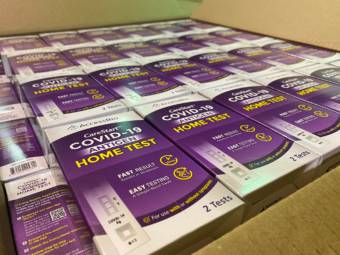
home COVID-19 tests kits
(Photo courtesy of City and Borough of Juneau)

The small island community of Petersburg is dealing with a new wave of COVID-19 cases in the wake of several large public gatherings. Jennifer Bryner is the chief nursing officer at Petersburg’s medical center. She said it’s impossible to know the exact number of cases in town because of the widespread use of home test kits — but from what she’s witnessed in the past few weeks, she knows it’s a lot.

“We’ve definitely seen a lot of new COVID activity,” said Bryner. “I would say it’s probably quite widespread in the community. We’re definitely seeing more people calling and letting us know that they have COVID-19, or asking for Paxlovid treatment.”

Many people who catch the virus choose to test and recover at home. But a lot are getting diagnosed in the emergency room with more severe symptoms — fever, cough, sore throat, fatigue and loss of smell. Bryner said the influx of COVID-19 patients coincides with large numbers of people traveling in and out of town in early summer.

Petersburg hosted the Little Norway Festival in May, which drew huge crowds. Then hundreds more came out for two weddings that took place on the first weekend of June. Bryner said COVID-19 patients are arriving in Petersburg from visiting cruise ships as well.

“We’ve definitely had cruise ship passengers and crew,” said Bryner. “I’m not saying that that’s how it’s getting here — but there are definitely a lot of people who we see from the cruise ships.”

Bryner said Petersburg Medical Center is prepared to handle the wave of patients. They’re well-staffed and well-stocked with Paxlovid, and there have been no COVID-19 hospitalizations so far this month. But she encourages locals to stay vigilant.

The Alaska Department of Health recommends one of the updated booster shots for everybody 6 months and older. Those who are immunocompromised or over the age of 65 may be eligible for a second dose.

Bryner said those who have been exposed to the virus or are developing symptoms should take a test, although some home tests may not turn positive immediately.

“It takes sometimes a while for you to get enough of the virus in your nasal area to turn the test positive,” said Bryner. “The main story is that if you have symptoms, you should stay clear from people — versus just saying, ‘Oh, I had a negative test, and I’m free.’ You might turn positive tonight or the next day.”

Free take-home test kits are available at Petersburg’s Public Library and at the front desk of the Medical Center.

Site notifications
Update notification options
Subscribe to notifications