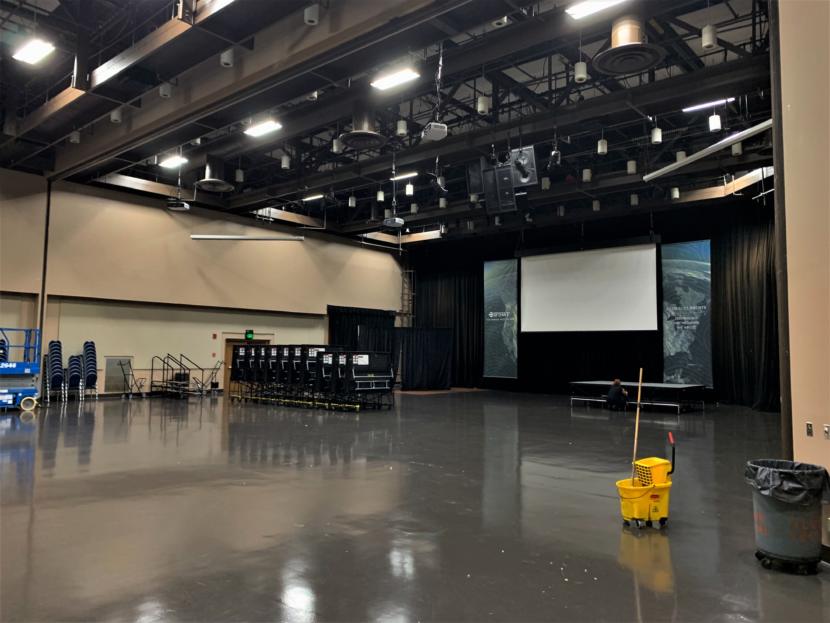
The interior of Centennial Hall. The facility has multiple rooms and large movable walls that divide the main room. (Photo by Adelyn Baxter/KTOO)
The City and Borough of Juneau is setting up a facility for residents who are unable to isolate or quarantine in their own homes.
The plan is to use Centennial Hall to isolate people who have tested positive for COVID-19 but do not require hospitalization, and to quarantine those who may have been exposed.
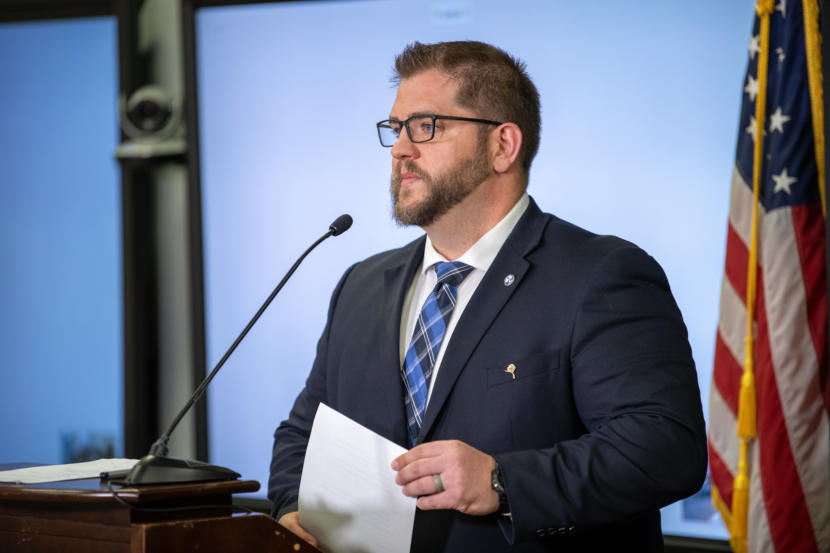
“We certainly don’t need it today, but the emergency planners are doing that effort, and I think the general theory is: Prepare for the worst,” Watt said.
The facility will be split into two separate areas. One will be for people who have already tested positive. The other area is for those who may have been exposed to the coronavirus, whether through travel or close contact with someone who has tested positive. Those individuals will remain quarantined for 14 days to make sure that symptoms don’t develop.
So far, most people who have been tested for COVID-19 or recently traveled outside of Juneau have been able to quarantine at home. But Watt said that may not be the best option for everyone.
“In a lot of cases, it may not be practical for people to quarantine themselves in their home, just because too many people, one bathroom, small space,” Watt said.
Mount Jumbo Gym in Douglas will be used as a temporary facility until Centennial Hall is ready to open. Once operational, staff will be on site at all times.
Beth Weigel is the spokesperson for the city’s Emergency Operations Center, which is coordinating the local COVID-19 response. In an email, she wrote that the Douglas gym has 20 cots set up.
The city is working with multiple community partners to open the facility. A food task force is working on coordinating meals for people in quarantine at home or in the facility. Kensington Gold Mine has donated a portable shower trailer.
According to the state’s latest figures, 14 people in Juneau had tested positive for COVID-19 as of Tuesday. According to the city, seven of those people have recovered so far.
Alaska state health officials and the Dunleavy administration have moved to suspend elective abortions during the coronavirus emergency.
That procedure is listed along with dozens of others in an addendum to a mid-March mandate that health care facilities and clinicians prioritize urgent and emergency visits and procedures to conserve medical equipment and personnel for response to the COVID-19 pandemic. That mandate is supposed to last for three months.
State officials put out a list on Tuesday that clarifies which procedures are classified as “elective” and guidance on how long they could be delayed — ranging from weeks to months. Abortion is on that list. According to the state’s guidance, when a pregnancy threaten the life or physical health of the mother, an abortion can still be performed.
The state’s mandate lists abortion as a surgery that could be delayed “for a few weeks.”
Crum said there is no specific timeline on how long the procedure could be delayed.
“We’ll leave it up to the health care providers’ choice,” he said.
The state’s list includes several other types of surgeries — including cancer, cardiac and children’s procedures such as circumcisions — that could be postponed.
With the first case of coronavirus confirmed in Southwest Alaska, state officials and tribal health consortiums are
Registered Nurse Avelina Chung runs through protocol with a YKHC employee at the COVID-19 drive-thru test site on March 25, 2020, in Bethel, Alaska. (Photo by Katie Basile / KYUK)
ramping up testing capabilities in rural Alaskan communities.
During an evening press conference on Tuesday, state officials [April 7] acknowledged the challenges facing villages that rely on air travel to deliver mail, medical and food supplies.
RavnAir Group’s decision to abruptly suspend all operations and declare bankruptcy left rural health care organizations, state officials and airlines scrambling to fill in the gaps.
The Alaska Native Tribal Health Consortium has sent 40 rapid testing machines to rural communities. Those should allow same-day test results for coronavirus.
“The thing about these machines is that they don’t test a lot of cases at once but they can return results in location so we don’t have to send them to state labs,” said Chief Medical Officer Dr. Anne Zink.
Zink said the state is working with health aides in villages to make sure they have enough testing supplies.
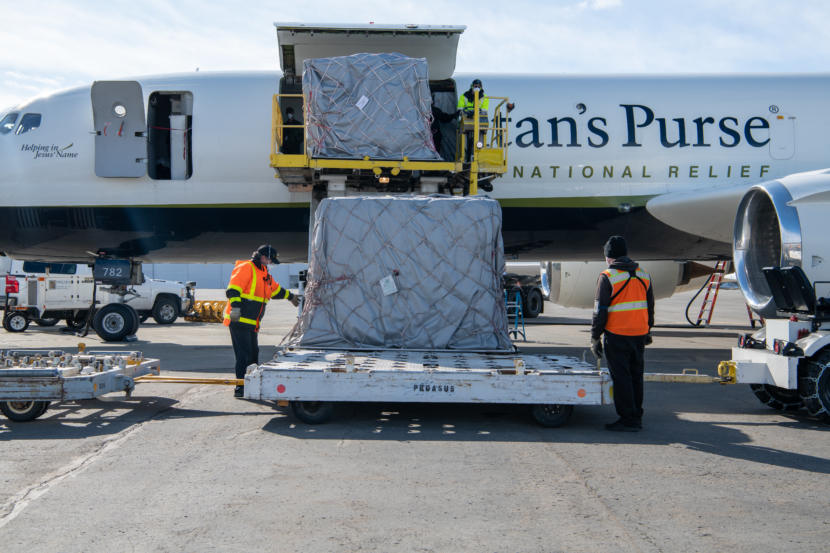
Gov. Mike Dunleavy and members of his administration meet with the Christian aid organization Samaritan’s Purse before it delivers 17,000 pounds of supplies to rural parts of the state on April 6, 2020, in Anchorage, Alaska. (Creative Commons photo by Office of Gov. Mike Dunleavy)
But beyond identifying supply needs, the state has been limited in its emergency response to rural communities. Crum said that they have worked closely with tribal health organizations to set up 19 alternative care sites to help hubs like Bethel deal with an outbreak. That includes infrastructure and lodging to accommodate residents in villages who need to self-isolate or quarantine.
“As far as quarantine housing, a lot of regions around the state, we’ve identified possible quarantine items as necessary if people can’t be safely quarantined in their home area or if they are stranded,” Crum said.
He did not say when the state will deliver that infrastructure.
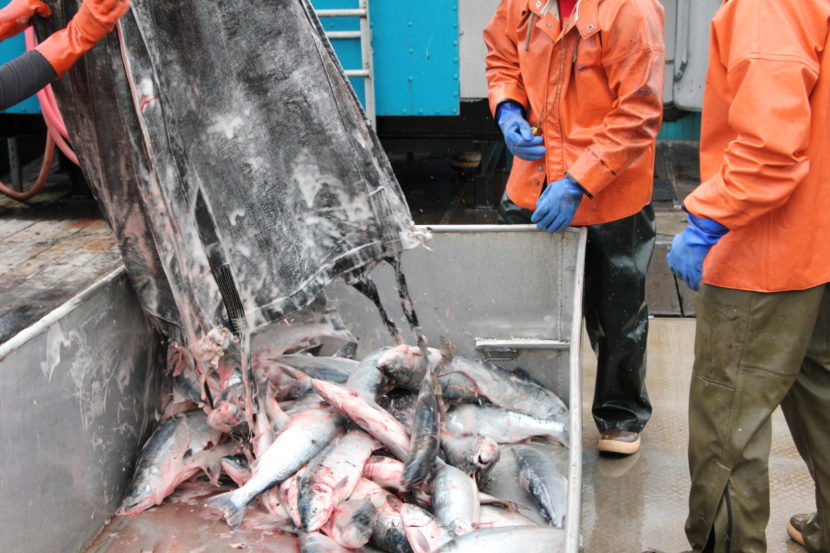
Sockeye salmon delivered in Bristol Bay. It’s the largest fishery of its kind in the world, bringing thousands of workers into the region every year. The City of Dillingham and the Curyung Tribal Council are asking Gov. Mike Dunleavy to close the commercial fishing season to prevent the spread of coronavirus. (File photo courtesy KDLG)
Meanwhile, commercial fishing is another top concern for coastal communities like the Bristol Bay region.
Bristol Bay’s summer fishing season includes the largest sockeye salmon fishery in the world. Ever year, thousands of fishermen and processing workers flood into small communities around the region.
Crum said state officials are in talks with stakeholders to see how to move forward.
“So we’re going to make sure that the local communities understand what the proper response is,” Crum said.
And traveling through rural Alaska could present new challenges to state officials trying to help villages prevent the spread of coronavirus.
Tribes have started restricting travel within their communities to limit transmission of the virus. Those restrictions vary in severity, with some tribes recommending people don’t enter communities. Others are outright banning all outbound and inbound travel unless it’s for medical or emergency reasons.
Dunleavy said he’ll address those community-level restrictions should they limit state response to an outbreak or essential businesses.
“Again, we don’t want to come up with this hard and fast rules that make people in Alaska not want to help out,” Dunleavy said.
Original story
Gov. Mike Dunleavy’s latest COVID-19 press conference is scheduled for 5 p.m.
The governor, Health and Social Services Commissioner Adam Crum and Chief Medical Officer Dr. Anne Zink have been holding these briefings almost daily since March 10.
During Tuesday’s briefing, they’ll be discussing the state’s COVID-19 response plan in rural Alaska.
At these news conferences, administration officials have shared updates on the number of people in the state with confirmed cases, announced public health mandates and explained the administration’s strategy and rationale.
They’ve imposed 12 public health mandates that have reshaped daily life across Alaska to combat the spread of the virus. Those mandates and other Alaska-specific COVID-19 resources and information are available at coronavirus.alaska.gov.
There have been few positive cases of the virus identified in rural Alaska. A resident of the Western Alaska hub of Bethel has tested positive on Monday and is self-isolating at home.
According to KYUK, the Yukon-Kuskokwim Health Corp. — which operates a hospital in Bethel and clinics in many of the surrounding villages — has conducted about 70 COVID-19 tests. The results of 25 are still pending.
The hospital says it has enough test kits to meet the needs in the region now.
The Anchorage Daily News reported on Monday that the Yukon-Kuskokwim Health Corp. had planned to launch village-based testing by April 1. But those plans were complicated by the bankruptcy announcement of the RavnAir Group — the only air carrier in many of the villages. That means there are no available flights to carry swabs from some villages to hub communities for testing.
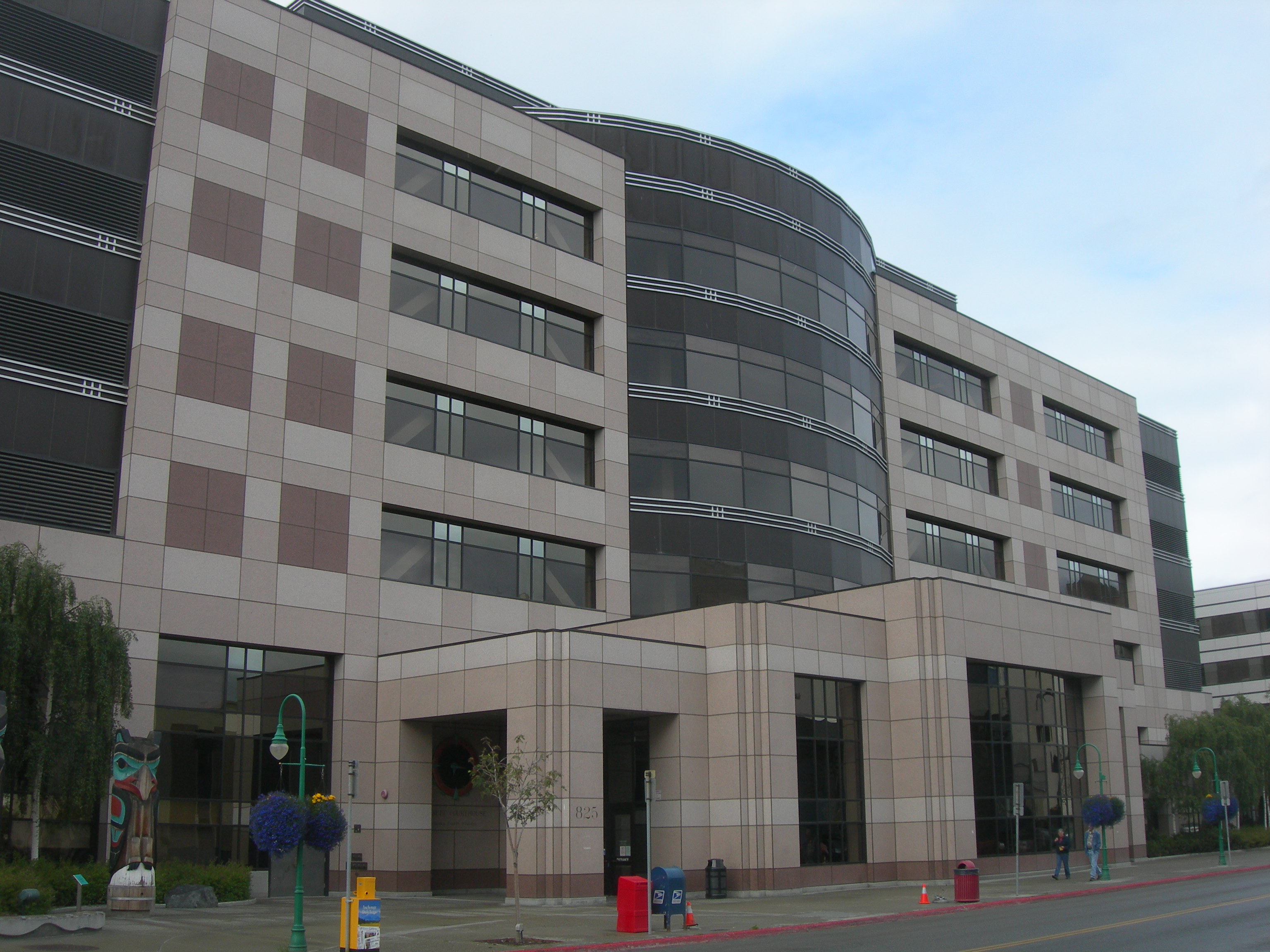
Constructed in 1996 beside the previous courthouse, the Nesbett Courthouse holds the trial courts for Anchorage. (Creative Commons photo courtesy Jimmy Emerson)
Police around Alaska are under temporary, coronavirus-related orders to not jail anyone on misdemeanor charges except for domestic violence or stalking.
And for inmates seeking release from jail, it is now possible to request a bail hearing due to concerns over coronavirus or the disease it causes, COVID-19.
That’s according to two different court orders both aimed at reducing the number of people in Alaska’s jails, citing fears that coronavirus will be hard to control behind jailhouse walls, where close contact is unavoidable.
One order, signed March 27 by the presiding judges for all four Alaska judicial districts, sets a temporary bail schedule for misdemeanor crimes. It says anyone charged with a misdemeanor, other than domestic violence or stalking, is to be released on their own recognizance.
According to the order, an arrest for a misdemeanor and the subsequent booking and court hearings could create unnecessary health risks by putting more people in contact with each other.
The presiding judges wrote in the order that the temporary bail schedule balances the health risks against the potential risk for alleged offenders to be a danger to the public.
“I would hope that it is not seen as a signal that they can get away with more,” said Deputy Attorney General John Skidmore, head of the state’s Criminal Division. “I would hope that it’s an indication that courts have set bail schedules in an attempt to help navigate the waters we’re in, in terms of COVID.”
An arresting officer or a prosecutor can still ask a judge to modify bail and hold someone in jail if they feel it’s necessary. Also, anyone charged with a crime while intoxicated is to be released to the care of another person or held until their breath-alcohol level tests below 0.08 grams of alcohol per 210 liters of breath, the legal limit to drive.
Skidmore said the state Department of Law is not going to fight the order in court.
“It’s not really my place to say whether or not I agree or disagree with it,” he said. “They certainly have the authority to issue this. Whether or not it turns out to be a good public policy decision is one that I’m sure people will look at, and there will be significant discussions about in the future.”
The presiding judges’ order setting a temporary bail schedule only affects misdemeanor crimes, and police officers are still supposed to arrest anyone charged with a felony. But for some defendants already in jail, whether on felony or misdemeanor charges, the coronavirus pandemic has also provided a new avenue for getting out.
In a March 24 order, the Alaska Court of Appeals overturned earlier trial court decisions and said the existence of the coronavirus pandemic can be considered relevant in a defendant’s request for a bail hearing.
The order also says trial court judges should consider the context of the pandemic when hearing the defendants’ proposals for release. Those proposals often include asking a judge to reduce the monetary amounts for bail, to remove requirements for third-party custodians or to approve plans for electronic ankle monitoring outside of jail.
One such defendant is Donald McQuade, 63, charged just last year in the 1978 murder of Shelley Connolly in Anchorage. McQuade is seeking reduced bail and release on ankle monitoring due to concerns about his underlying medical issues and increased health risk from contracting COVID-19.
A judge reduced McQuade’s bail last week but did not approve his entire plan for release.
The Court of Appeals judges wrote that a trial court’s analysis of the risk to public safety, or the risk of a defendant running away and not showing up to court, is different now because of coronavirus.
“Incarcerating a defendant under conditions that do not permit compliance with widespread health directives designed to halt the spread of the virus poses significant health risks not only to other inmates and to correctional facility staff, but also to the rest of the public,” the order says.
But some say the health risk for the jail population does not outweigh the safety risk to the public or victims of crime, who might be re-victimized if a perpetrator is not jailed.
Taylor Winston, director of the Alaska Office of Victims’ Rights, said her office has long opposed bail schedules if they lead to judges not considering a victim’s input on bail, since the outcome is largely already a foregone conclusion.
And Winston said she worries that judges might not scrutinize bail requests by incarcerated defendants as heavily as they should.
“Certainly, there are many violent offenders who should not be released out into the community, because of the types of crimes they’ve perpetrated,” Winston said. “And sometimes we’re talking lethal danger, OK? Like killing people or harming people for life. So, I think that you have to keep a balance, right?”
Skidmore, the head of the state Criminal Division, said prosecutors have been much busier lately with coronavirus-related bail hearings. He said there used to be between five and 10 bail hearings in a typical day in one jurisdiction, where, recently, there have been as many as 40 in a day.
“But I don’t know that that means that 40 people are being released,” Skidmore said. “I think it just means that the courts are doing what they’re supposed to do, which is grant hearings.”
That increase might also be due, in part, to the courts having more time available for bail hearings, Skidmore said. In March, the Alaska Supreme Court issued special orders to halt many other Superior and District court proceedings and postpone all trials and grand jury proceedings.
Meantime, in its efforts to prevent the virus’s spread in Alaska’s jails and prisons, the Department of Corrections continues to check correctional officers’ temperature at the start of each shift, and a policy of no visitation for inmates remains in effect.
According to Department of Corrections spokesperson Sarah Gallagher, 13 inmates in Alaska correctional facilities have been tested for the virus as of Monday, with 10 tests coming back negative and three still pending results.
The Arctic Slope Regional Corp. headquarters in Utqiaġvik, January 2018. (Photo by Ravenna Koenig/Alaska’s Energy Desk)
Alaska’s largest private-sector employer, Arctic Slope Regional Corp., has laid off employees and cut charitable giving due to the collapse in oil prices and the economic shutdown caused by the global coronavirus pandemic.
That’s according to an April 3 letter from the chair of ASRC’s board of directors, Crawford Patkotak, to the company’s 13,000 shareholders. An ASRC spokesperson would not say how many employees were let go.
ASRC’s letter to shareholders said the corporation had cut “many of the charitable programs in our region,” eliminated all corporate bonuses and incentives for executives, and reduced the board of directors’ compensation — in the form of a stipend — by 30%.
“It’s a challenging time for a lot of businesses right now, and let’s hope we can all weather the storm and get back to a new normal soon,” ASRC spokesperson Ty Hardt wrote in an email.
Hardt declined to answer any further questions about the cuts.
“Unfortunately, the total impact of the COVID-19 response (and low oil prices) isn’t quite known yet and it could get worse before it gets better,” Hardt wrote, referencing the disease caused by the coronavirus.
Hardt said ASRC has 15,000-plus employees in Alaska and the Lower 48, and in its most recent available annual report, from 2018, it reported revenues of more than $3 billion.
The Alaska Native corporation is heavily invested in oil and gas, including ownership of an oil refining business, and represents residents and descendants of Iñupiat communities on Alaska’s North Slope, from Point Hope to Kaktovik.
ASRC paid out dividends of $7,000 to each shareholder with 100 shares in 2018, according to its report for that year.
In its letter to shareholders this month, ASRC said it was cutting spending in areas that were not generating revenue the corporation needs to pay shareholder dividends.
“In 2020, it is likely we will have to decrease the amount of the ASRC dividend disbursements, but we do not yet know by how much or for how long,” the letter says.
The letter says ASRC will continue plans to expand into the Lower 48 and diversify its investments away from oil and gas.
Commenters on a private Facebook group for ASRC shareholders had mixed responses. Some felt the corporation’s board was too highly compensated and had not done enough to cut at its higher levels of management. A few vowed to vote out the current board members.
Others thanked the board for making difficult decisions to keep the corporation afloat during tough economic times.
Alaska’s Energy Desk reporter Nat Herz contributed reporting to this story.
This scanning electron microscope image shows, in yellow, SARS-CoV-2 — the coronavirus that causes COVID-19 — isolated from a patient in the U.S., emerging from the surface of cells, in blue and pink, cultured in a lab. (Image courtesy of National Institute of Allergy and Infectious Diseases – Rocky Mountain Laboratories)
The number of Alaskans diagnosed with COVID-19 rose by 22 on Monday — the largest one-day increase in reported cases in the state.
The Yukon-Kuskokwim Delta region also recorded its first case of the disease, according to the state Department of Health and Social Services.
In total, 213 Alaskans have been diagnosed with COVID-19, the disease caused by the coronavirus.
Of the 22 newly-diagnosed Alaskans, 11 are from the Fairbanks North Star Borough, 10 are from the Municipality of Anchorage and one is from Bethel, according to the health department.
The new cases stem from midnight to 11:59 p.m. on Monday. The state health department is reporting the new COVID-19 cases in Alaska from the prior 24-hour cycle by noon each day.
Nearly 7,000 people had been tested for COVID-19 in Alaska by the end of the day Monday.
The state health department reported no new deaths or hospitalizations. Six Alaskans have died after they were diagnosed with COVID-19 and 23 have been hospitalized. At least 29 Alaskans have recovered from the disease, according to the department.
Of the total number of confirmed COVID-19 cases in Alaska, the largest percentage — 20.19% — are in Alaskans ages 30 to 39, followed by 19.72% in Alaskans ages 50 to 59.
Most of the Alaskans diagnosed with the disease are from the Municipality Anchorage, with 98 cases. The Fairbanks area has 65 cases, and state officials have described the Interior Alaska community as a coronavirus “hot spot.”