Anchorage Daily News employees are getting paychecks that are 20% smaller. The company cites losses due to the coronavirus. (Photo by Liz Ruskin/Alaska Public Media)
Employees of the Anchorage Daily News are receiving smaller paychecks after a sudden coronavirus-related drop in revenue.
Beginning March 30, the company cut pay for salaried employees by 20% and cut full-time hourly workers to a 32-hour week.
In an email to staff, President and CEO Ryan Binkley cited drastic losses that COVID-19 has inflicted on the company’s revenues from advertising and events.
“This is not fair and not your fault,” Binkley wrote. “Nobody expected an event like this.”
He said the reductions are temporary and that in mid-April company leaders will reassess the need to continue them.
Binkley also announced that seven Daily News employees had been laid off. The email did not say what departments the layoffs came from.
In a letter to readers on March 28, Daily News editor David Hulen noted many Alaska businesses are in worse shape right now.
“But here’s the thing,” Hulen wrote. “This is happening at a time when our coverage has rarely, if ever, reached as wide an audience or delivered as much impact.”
Hulen said in recent days the paper had seen “among the biggest spikes in digital subscriptions at ADN ever,” and asked readers who hadn’t yet subscribed to “consider joining your neighbors in supporting local journalism.”
The Alaska Department of Labor and Workforce Development is now asking self-employed, independent contractors, and gig-economy workers to apply for regular unemployment benefits, even though they will likely be denied. (Read more)
Original story
Self-employed workers or those working in the gig economy who lost work due to the coronavirus will have to wait at least four weeks before applying for benefits, Alaska’s Department of Labor and Workforce Development said.
In 2018 over 43,000 Alaskans were classified as self-employed, according to information from federal income tax fillings. Those workers are ineligible for unemployment insurance benefits, which can pay up to $370 per week, because they don’t pay the employment security tax when they file their federal income tax.
But, for the first time ever, the recently-passed CARES Act will provide unemployment insurance for self-employed workers or workers in the gig economy.
Alaska Department of Labor officials said Monday those those workers will have to wait before the program can be properly implemented — at least four weeks, and possibly longer, according to Cathy Muñoz, the deputy labor commissioner.
“The reason for that is we’re standing up a brand new system. We’re putting into place the IT upgrades, the changes to the computer system, the income verification methods,” she said in a phone call.
The department will have to train new staff and negotiate implementation with the federal government, which funds the program. Muñoz says that guidance from the federal level to states didn’t come in until late Sunday.
For now, self-employed workers affected by closures will have to wait.
“Everybody is working very hard to get this done, and to do it so that the rollout is done successfully. And to do that, a number of things need to happen for it to be successful,” she said.
The federal program, called Pandemic Unemployment Assistance, will pay an additional $600 per week, depending on income, plus $74 for each dependent.
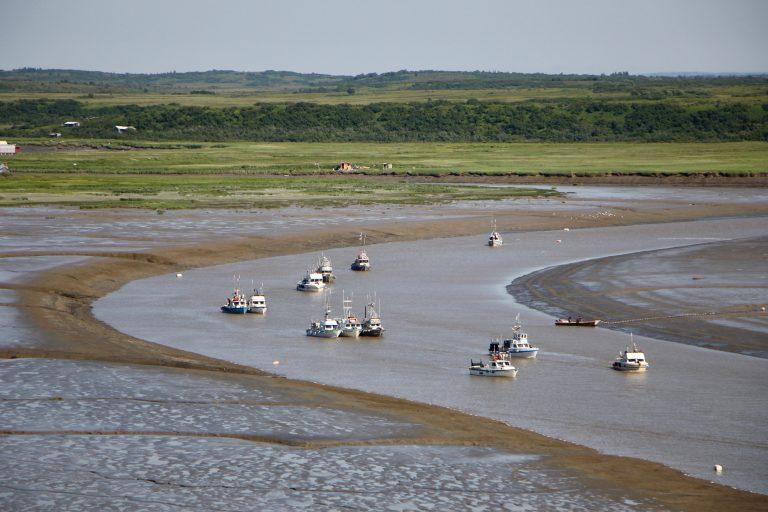
Boats in the Nushagak District. June 24, 2019. (Alex Hager / KDLG)
The City of Dillingham and the Curyung Tribal Council urged Governor Mike Dunleavy Monday to consider closing Bristol Bay’s commercial fishery to protect the community from the coronavirus pandemic.
Bristol Bay’s summer fishing season brings with it an influx of thousands of fishermen and processor workers into small communities around the region. The sockeye fishery is the largest in the world. Last year its preliminary ex-vessel value was the highest ever, at $306 million.
In the letter, the tribe and the city said that there was no way to limit the communities’ exposure to the virus, even with the current requirement for processors to submit quarantine plans for their workers.
“Our communities will be the FIRST to be impacted by a huge influx of processing workers,” they wrote, continuing, “There is no way to prevent a potential mass disease situation when a few hundred people are in close proximity with each other.”
The region has limited health care resources to care for its permanent residents, if they should become ill. It can’t handle additional Outside patients, they said.
“We must decide now whether those resources should be devoted to current residents or instead to a temporary labor force?” they wrote.
The state has designated fishermen as “critical infrastructure,” and required processors to submit health and safety plans in order to operate. The city and tribe wrote that while they appreciate that processors have shared plans with them, they do not want to rely on corporations to ensure residents’ safety.
“We should NOT have to rely on the courtesy of industry to be included in such a critical exercise,” they wrote.
The city and tribe emphasized that no regional entities have the ability to limit the movements of fishery workers.
“This is unacceptable and places us in an impossible situation. If your office is not prepared to address this critical problem, then we may find the need to do so. We don’t want to find ourselves in conflict with the State of Alaska, especially when our objectives are the same,” they wrote.
They urged the governor to act immediately.
“Acting now will allow us to consider the following; should we devote our limited resources to attempting to control the fishery or, instead, should we devote our attention to mitigating economic impacts of not having a fishery,” they wrote. “There are economic stimulus efforts on the national, state and local level that might be mobilized to mitigate the impact to the industry, to the state and to individuals.”
In a press conference late Tuesday, the state’s Department of Health and Social Services Commissioner Adam Crum said that the state has reviewed the plans of many large processors, and was in an “ongoing conversation” with fishermen and processors about the protocols and procedures for the fishery.
“So we’re going to make sure that the local communities understand what the proper response is, what the mitigation plans — and that individuals coming in understand that we want to make sure that we protect Alaskans, and if we can’t do that in a safe way, then we’re going to have to find alternative means to actually deliver this work. To get creative on how this works,” Crum said.
Two weeks ago, the Curyung Tribe declared a state of emergency and disaster for the tribal community. The city council passed a resolution Thursday restricting travel into Dillingham. There are no reported cases in the region as of Tuesday morning.
Mike Barnhill answers a reporter’s question about the state operating budget last year in the governor’s cabinet room in the Capitol in Juneau. On Monday, Barnhill — now the deputy commissioner of the Department of Revenue — said the spring revenue forecast was delayed by market volatility. The forecast is for the state to have $1.3 billion less in revenue over this year and next year than was previously forecast. (Photo by Skip Gray/KTOO)
Alaska’s state government can expect $1.3 billion less than it previously forecast, largely because of the drop in oil prices.
That’s according to the spring revenue forecast released by the state Department of Revenue on Monday.
With oil prices expected to stay under $30 per barrel through June, that will mean roughly $500 million less for the budget ending in June than expected. Compared with what the department forecast in December, there’s $800 million less for the next budget.
Deputy Revenue Commissioner Mike Barnhill explained why the forecast was released three weeks later than usual.
“The markets have been extremely volatile, and so we’ve been waiting for some of the volatility to smooth out,” he said. “With the passage of the (federal) CARES Act a week ago, the investment markets have smoothed out a bit, and oil prices are rebounding somewhat.”
This new estimate is roughly $200 million less than the numbers the Legislature used when it passed the budget just over a week ago. That means the budget is now projected to draw down savings even further, leaving the Constitutional Budget Reserve with less than $300 million.
Revenue Chief Economist Dan Stickel said this was one of the most challenging forecasts to produce in the 16 years he’s worked on them.
“I’d say this is definitely one of the most extreme periods of uncertainty that I’ve been involved in, in producing a forecast,” Stickel said.
The forecast didn’t adjust the amount the state expects to draw from Alaska Permanent Fund earnings. That number will be available after the new budget year starts.
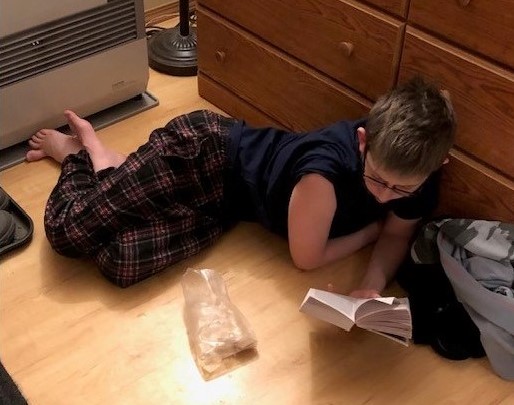
14-year-old Jack Roberts reads in his home. His mom Jamie homeschools him and his 16-year-old sister Renee. (Courtesy of Jamie Roberts)
With schools closed statewide until at least May 1, many parents have been thrust into the unexpected role of being guiding their children’s day-to-day education. But parents who homeschool their kids have been doing this for years, fine-tuning the intricacies of the complex and important task.
Jamie Roberts, a mother of two, has some tips. Her biggest piece of advice? Let go of the wheel and be kinder to yourself.
Roberts has homeschooled her two kids for 11 years now. Along with working at the pool, she’s the full-time parent and teacher for her daughter and 14-year-old son Jack. When the oldest was ready for kindergarten, Roberts wondered how to get Renee to and from school. It would have been for just a few hours of instruction anyway. Plus, she still had a toddler at home.
“My philosophy was ‘I’m not waking a sleeping child’,” Roberts said.
So, staying at home made sense. And every year since, it’s still the best option for her family. She likes the flexibility, being able to travel and fit in different activities.
“It allows my kids to do extra things without being super sleep deprived,” she said. “So they can, you know, take music lessons; they can be swimmers and travel for swimming and not feeling like they’re stressed to fit it all in.”
But Roberts has worked out the kinks over the years. She feels for parents who are suddenly having to spend all hours with their kids and be in charge of their education. Knowing it’s an adjustment for the kids, makes it even more difficult.
“As a kid, it’s like, their whole schedule just got disrupted,” she said.
Staying home from school is one thing, but having the whole family cope with this COVID-19 pandemic is another.
“ I think about young kids, it’s like, how do you explain to them? Yes, sorry, you can’t go to school and no, you can’t go out and play on the playground. And if it’s your birthday, no, you can’t have friends over,” she said.
So yes, things are chaotic, on you and your kids. Roberts says give yourself and your kids some slack, everyone deserves it.
Start with letting go of control. Roberts admits she struggled with this. As a self-described recovering control freak, she says she believes if you’re too rigid, kids will be resistant to adapt.
“It usually doesn’t end well. Someone’s going to cry. Someone’s gonna say something they didn’t, you know, mean to say,” she said.
Instead, let the kids help decide on the schedule and activities. Roberts says they’ve figured out together that it’s best to have a snack before tackling math. Kids need to have their opinion heard and it lets them buy into that day’s goals.
Socializing is just what teens do. But now, 16-years-old Renee Roberts has few opportunities to connect with peers. She’s missing out on swim practice and youth group. She texts her friends to stay in touch.
But Roberts is not missing out on school as she knows it. She doesn’t walk the hallways of Wrangell High School and sit in classrooms. Her mom asks Renee’s advice for kids who might not be used to staying home as much.
“I think just to focus on the positive things,” Renee said. “Instead of focusing on the fact that you have to stay home and possibly missing out on things that you had planned.”
Roberts’ second tip: do not compare yourself to others. Maybe that’s other parents. For Roberts, it was the public school system.
“They go to school for a set number of hours a day. And I was thinking, ‘okay, that’s the number of hours we have to focus on doing work in our home.’ And if my kids got done with all of their work for the day, in two hours, I kind of felt like we’re not doing enough,” she said.
She reasons that teachers spend so much time corralling 20 to 30 students in one session. Of course, it’s going to take longer to meet individual needs in that setting, than it would at home.
Roberts also recommends a few resources. She loves this one podcast from producer Julia Bogart, who just released an episode titled “Suddenly-at-Home Schoolers.”
While it’s unclear just how long the current scholastic situation will continue, it’s likely to be a matter of months, not years. So Roberts says to remember that your success as a parent doesn’t really ride on the next few months, it’s also about what you’ve done over the years and what you will do in those to come.
Update — Andrew Kitchenman, KTOO and Alaska Public Media
Gov. Mike Dunleavy said Monday that Alaska is in better shape than other states in terms of the number of people infected by the virus.
He said the administration is constantly looking to see if it should change what it’s doing to slow the spread.
There were six new confirmed cases announced on Monday, bringing the total to 191. Three of the people live in Anchorage, with one each in Fairbanks, Soldotna and Petersburg.
Dunleavy said during his daily news briefing that the relatively low number of cases appears to be primarily due to the actions Alaskans are taking to minimize the spread. He said the administration will review what it’s doing later this week to determine if it should make changes.
Dunleavy thanked the organization Samaritan’s Purse, a Christian group led by the Rev. Franklin Graham, for providing medical supplies for eight rural hub communities around the state. He said the supplies will help prepare for the arrival of the virus in rural communities.
Dunleavy said there will be a governor’s day of prayer and hope held on Friday.
The governor also said the state will provide more details over the next several days on how the Bristol Bay fishing season can still occur safely.
Alaska Chief Medical Officer Dr. Anne Zink noted there have been three more hospitalizations. She thanked the Alaska Native Tribal Health Consortium for distributing coronavirus tests in rural areas.
Bryan Fisher, the COVID-19 incident commander for the state’s emergency operations center, said the state is working in different communities to prepare for the possibility that hospitals will be overwhelmed, by preparing space in other buildings.
Fisher said the state will submit plans to the federal government to move patients around the state, including to Anchorage, if needed.
Alaska Gov. Mike Dunleavy speaks about the state’s COVID-19 response from the Atwood Building in Anchorage on Friday. (Creative Commons photo by Alaska Governor’s Office)
Original story — Jeremy Hsieh, KTOO
Gov. Mike Dunleavy’s latest COVID-19 news conference is scheduled for 5 p.m.
The governor, Health and Social Services Commissioner Adam Crum and Chief Medical Officer Dr. Anne Zink have been holding these briefings almost daily since March 10.
They’ve shared updates on the number of people in the state with confirmed cases, announced public health mandates and explained the administration’s strategy and rationale.
In Monday’s briefing, the governor will be joined by Zink and Incident Commander Bryan Fisher, who will talk about preparations the state is making for Alaskans infected with COVID-19.
Alaska-specific coronavirus resources and information are available at coronavirus.alaska.gov.