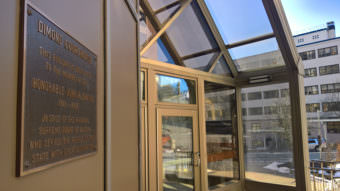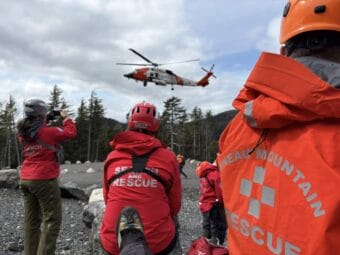
A video team from NBC records a Juneau-Douglas High School: Yadaa.at Kalé football team on Sept. 20, 2025. (Photo by Yvonne Krumrey/KTOO)
Juneau’s Crimson Bears high school football team is slated to be featured in the most-watched sporting event in the United States this weekend — the Super Bowl.
In September, a team of five reporters and cameramen from NBC Sports visited Juneau and filmed their game against Anchorage’s Dimond High School at Adair-Kennedy Memorial Park.
This week, NBC released a short film featuring Juneau’s team — and others across the U.S. — in the lead up to Super Bowl Sunday, when millions of people will watch the Seattle Seahawks and New England Patriots go head-to-head during the National Football League’s 60th championship game in Santa Clara, California.
The film examines the impact of football across the U.S. and features longtime NFL sports reporter Peter King.
“The dedication of some players goes further. Noah Ault plays receiver and safety. He punts, he returns punts and kickoffs, and the aspiring athletic trainer even tapes ankles before the game,” King says, talking about wide receiver Noah Ault in the film.
King interviewed the Juneau-Douglas High School:Yadaa.at Kalé senior on the field.
“I just fell in love with this sport, and it just makes me happy every day,” Ault said.
A healthy mountain goat kid and adult pictured in the Haines area. (Photo courtesy of Alaska Department of Fish & Game)
A Juneau resident took home a sick mountain goat kid with crusty skin lesions after hiking Perseverance Trail last weekend and contacted the Alaska Department of Fish & Game. Officials say the goat had a highly contagious viral skin infection that can transfer to humans and pets.
“It’s very important that people — if they see a sick or a dead wild animal — that they call Fish and Game, and not try to take it home themselves,” said Kimberlee Beckmen, the wildlife health veterinarian at ADF&G. “It’s also illegal to pick up wildlife and take it home.”
Beckmen said the goat had contagious ecthyma. It’s not always fatal in sheep and goats, but it’s usually more severe and deadly in lambs and kids. It causes skin lesions to develop around openings in the body.
“When it covers their face, their eyes, their mouth, they can’t eat,” she said. “This recent case — the poor animal was starving to death and was completely dehydrated. It could not see out of its eyes.”
She said the goat probably would have died from the infection within a couple of days, and ADF&G euthanized the animal over the weekend.
In people, the infection is called orf and it’s typically mild. A lesion usually appears within a week of exposure. Beckmen said it’s not fatal to humans or dogs, and the lesions typically go away on their own after several weeks. The virus can transfer when the scabs make contact with openings in the skin.
A mountain goat with contagious ecthyma that wandered into a Juneau neighborhood and later died. (Photo courtesy of Alaska Department of Fish & Game)
But Beckmen said hunters can still eat the meat of an infected animal if it’s handled properly.
“We recommend that people wear gloves when they’re harvesting their animal and butchering it, and if they see any lesions on the skin or anything unusual, they want to make sure that they clean their knives off before they cut into the meat,” she said.
ADF&G officials said they get calls about the infection popping up every once in a while. Carl Koch, the department’s area biologist in Juneau, said his team collected a dead goat kid with ecthyma near the Flume Trail in December. He said the department received a call in October about twin goats with the early stages of an infection, and thinks the two that died recently could be them.
Beckmen said this is not an outbreak or an unusual occurrence. Sporadic cases have appeared in Dall sheep and mountain goats across Alaska since the 1980s, and she said the state is not currently concerned about it affecting those populations.
ADF&G requests that people report ecthyma cases to the wildlife disease surveillance hotline at 907-328-8354, by emailing dfg.dwc.vet@alaska.gov or calling the local ADF&G office. People can also report sick or injured wild animals through the department’s web form.
Koch said the person who took the goat home last week had called the department and left a message while out on the trail, but didn’t get a response since it was Saturday. He said people can call the police non-emergency number at (907) 586-0600 if they don’t hear back from ADF&G about a time-sensitive wildlife issue over the weekend.
People walk past City Hall in downtown Juneau on Thursday, Jan. 22, 2026. (Photo by Clarise Larson/KTOO)
The Juneau Assembly has some big financial decisions to make in the coming months. That’s because the city faces a multimillion-dollar budget hole that could result in cutting some city services in order to stay afloat.
Along with figuring out how to balance the city’s budget, the Juneau Assembly will need to decide in the coming months whether a temporary tax and two bond debt proposals will appear on October’s municipal ballot.
“I think at the end of the day why we put things on ballots are to give voters the choice. If they don’t want to fund these things then they won’t. We don’t lose anything because of that,” said Christine Woll, an Assembly member and finance committee chair.
At a finance committee meeting Wednesday night, the Assembly discussed whether to ask voters to renew a 3% temporary sales tax currently in place, along with putting two bond packages on the ballot to fund critical repairs and upgrades to Juneau schools and the city’s water and sewer systems, which proponents say are sorely needed.
Juneau currently charges 5% in local sales taxes. That’s made up of both permanent and temporary taxes.
Of that 5%, 3% is a temporary tax, which Juneau has had in place for decades. Voters approved extending it for five years in 2021. It expires in mid-2027. The money collected from that 3% tax currently goes toward numerous city services, like police and fire, street maintenance and snow removal, and general government operations.
City Finance Director Angie Flick said the money is fairly flexible.
“Really your roads, drainage, retaining walls, sidewalks, stairs, and we’ve been doing some utility work in that realm as well,” she said.
At the meeting on Wednesday, some Assembly members were hesitant about whether to put the questions on the ballot. That’s because tax questions dominated last fall’s election and because the city is in a time of budget uncertainty.
When it comes to bonds, Juneau voters approved adding nearly $23 million to the city’s debt in 2024 for public health and safety improvements. But last year, the Assembly narrowly voted against putting school and water and sewer systems bonds on the 2025 ballot because of how crowded the ballot was already.
Assembly member Paul Kelly said he is still undecided on whether he wants to put them both on this year’s ballot, but he’s interested in approving at least one.
“I’m interested, for sure, in the general obligation bond for schools,” he said Wednesday.
Despite the initial discussion, the temporary tax and bond packages still need to go through a few committees before the Assembly votes on whether to put them on the ballot. This year’s municipal election is on Oct. 6.
The Dream Band members from left to right: Lindsay Clark, Spencer Edgers, Sam Roberts, Avery Stewart and Clay Good. (Courtesy of Spencer Edgers)
A Juneau jazz musician canceled a show that was meant to be a part of a festival in town this week. The show was advertised as a fundraiser for the ACLU of Alaska, but the organization who planned the festival said it didn’t agree to that.
Spencer Edgers plays the saxophone with other local musicians in the Dream Band. Local nonprofit Juneau Jazz and Classics tapped his band to play a show during its annual Jazz Fest in town.
But recent national events — like immigration enforcement ramping up efforts and shooting civilians — led him to decide to approach this show differently.
“Knowing I had this show coming up, I personally felt uncomfortable promoting a show taking up bandwidth on the internet during a time where people are sharing resources and looking out for each other,” Edgers said.
So Edgers decided to make the show a fundraiser for the ACLU of Alaska. The rest of his band were on board, and he cleared it with the venue — the Alaskan Hotel & bar — which was paying the band.
“The plan was to have our tip jar, pass it around to people,” he said. “The tip jar was going to go to the organization.”
He also planned to pass around flyers with links to report immigration enforcement activity, and resources for forming safety plans. But Edgers didn’t clear it with Juneau Jazz and Classics. He said the organization hadn’t really been communicating about the event.
“I assumed that they would not have a problem with it,” he said. “And did not seek the consent for that collaboration.”
Edgers said festival leadership called him and expressed concerns about bringing politics into the festival. But Interim Director Alex Serio said fear of political pushback was not part of their concerns.
“This went to the board,” he said. “And the board decided that we’ve never had any outside fundraisers before.”
Serio said the board also expressed frustration at not being informed of the fundraising aspect. But if Edgers chose to ask for donations for the ACLU on stage, and not in advertising, that would have been his right.
“Everybody has freedom of speech,” Serio said. “Everybody can voice what they believe in, and we respect that.”
But the organization’s board didn’t want their branding on the same poster that advertised an ACLU fundraiser, Serio said.
“We just didn’t want the two of them together saying that we formally endorse an outside fundraiser,” he said.
So the board asked Edgers to remove its logo from the poster, but said he could carry on with the show.
“I think the board hoped that there would be a compromise, that he would still be able to ask people, and he would still play,” Serio said. “We could still include community members, but he decided to do it independently, and we totally support that.”
But Edgers said continuing without the organization’s support didn’t feel right and he canceled the performance.
“I would have not felt good about compromising my values in this way,” he said. “I would not have felt good with going through with it.”
Edgers posted about the cancellation on his personal Facebook account, and the post garnered dozens of comments, some from local musicians and artists in support of his decision and admonishing the organization’s decision.
Edgers said he understands he sprung the change on Juneau Jazz and Classics at the last minute, and said he plans to communicate earlier in any future shows.
But he also wants the board to consider the organization’s role in the Juneau community — and that protest is inherent to jazz.
“One of the things I encouraged them to do is to reflect on the history of the music and the nature of it,” Edgers said. “And how it was born out of adversity and originated basically as protest music.”
Serio says Juneau Jazz and Classics plans to have conversations about that history more in the coming months.
The Dream Band still plans to hold a fundraiser for the ACLU of Alaska sometime in March.
Disclosure: KTOO Morning Host Mike Lane sits on the Juneau Jazz and Classics board and was not involved in producing this story.
An aerial view of Berners Bay, where the state is proposing to build the Cascade Point Ferry Terminal. (Photo by Alix Soliman/KTOO)
More than 90% of the comments submitted to the state reject the Cascade Point ferry terminal proposed in Juneau. Many of the comments opposing the project suggest the purported benefits to ferry passengers are disingenuous, and the project looks instead like a fast-tracked subsidy for mining companies.
Dozens of commenters said that the public process to approve this project is lacking, with the comment period and a highly criticized economic analysis coming after the state already signed a $28 million contract for the first phase of construction, set to begin this summer.
The plan includes developing an access road from the end of Glacier Highway north to the site — roughly 30 miles north of the existing Auke Bay Ferry Terminal — and a staging area for future construction.
Leaders in Skagway and Haines oppose the project. Members of the Alaska Marine Highway Operations Board have also questioned the motives behind it and said it doesn’t fit into their long-range plan for the Alaska Marine Highway System.
Public funds for private industry
The Juneau Assembly hasn’t taken an official stance on the state’s plan, but Assembly Member Maureen Hall wrote a comment objecting to it.
“I oppose the use of public funds to construct a remote State of Alaska ferry terminal when the facility’s apparent primary purpose is to function as an ore dock for private industry,” Hall wrote. “This represents a blatant misuse of public resources and raises serious concerns about the appropriateness and legality of such expenditures.”
Of the more than 500 comments opposing the project, a majority said the project would mainly benefit mining companies with holdings nearby and Goldbelt Native Corporation, which owns the land where the terminal would be built. Thirty-three commenters called the project a “boondoggle” outright, including Juneau resident Bjorn Wolter.
“There is just no reason at all to build a new terminal,” Wolter wrote. “This project has all the potential to be another South Mitkof or Coffman Cove boondoggle.”
Those ferry terminals on Mitkof Island and Prince of Wales Island cost millions of dollars. They were built far from the population centers they were meant to serve and close to logging sites 20 years ago. Two years after they were built, the Inter-Island Ferry Authority stopped running routes to them, and both have since satunused.
The Cascade Point ferry terminal stands to benefit the New Amalga gold mine proposed near the face of Herbert Glacier by Grande Portage Resources Ltd., a Canadian company. In December, Grande Portage announced that it is working with Goldbelt to design an ore barge dock alongside Cascade Point.
Ian Klassen, president and CEO of the company, was one of the 49 people who commented in favor of Cascade Point. He wrote that the plan will “create possibilities that currently do not exist north of Juneau for the reliable movement of cargo and commerce.”
Steve Ball, general manager of Coeur Alaska’s Kensington Mine, located across Berners Bay from the proposed site, also wrote in favor.
“The twice-daily boat trips to the Kensington Mine would depart from the new Cascade Point Ferry Terminal, resulting in reduced risk for our workforce, contractors, and visitors by shortening the distance of the boat run and exposure to the Upper Lynn Canal,” Ball wrote.
Coeur Alaska contracts with Goldbelt to transport miners to Kensington, mainly from Yankee Cove and from Echo Cove during inclement weather.
Ferry users weigh-in
The state has been pushing for the new terminal for several years and has said it would benefit travelers in Southeast by reducing operating costs and travel time between Juneau, Haines and Skagway.
But hundreds of commenters said building a second terminal in Juneau doesn’t solve the problems that the Alaska Marine Highway Service faces, including an aging fleet, crew shortages, reduced sailings and a lack of funding to address those issues.
Robin Ross is treasurer for the Organized Village of Kake, the tribal government for the village, and secretary for the Kake City School District. She commented that the project fails to address ongoing transportation needs in Southeast. She said a ferry cancellation disrupted a mammogram van service that provides cancer screenings for women there, and while flights were arranged for some women, not all were able to travel.
“The unfortunate reality is that a recent breast cancer diagnosis in October may have been
detected sooner had the ferry service not been canceled in May,” Ross wrote. “The ferry service serves as a critical lifeline.”
DOT’s FAQ page says, “terminal projects like Cascade Point are a critical step toward a stronger, more resilient system while new vessels are planned and funded through separate processes.”
But members of the Alaska Marine Highway Operations Board told the Anchorage Daily News that the project has been foisted upon AMHS and will create operational challenges they have to deal with. Last year, Gov. Dunleavy vetoed state legislators’ plan to divert funding from Cascade Point.
Southeast residents said that while a ferry ride from Juneau to Haines might be shorter, the burden will be placed on drivers and walkers to get to and from the new terminal, which is much farther from the city center. The city bus system already does not extend to the Auke Bay ferry terminal — it’s about a two-mile walk along the highway shoulder from the last stop.
Sean Powell, a current AMHS crew member, commented that commuting to Cascade Point would be much more difficult. “The increased distance, combined with weather conditions and other unforeseen disruptions, would add unnecessary challenges for crew members,” he wrote. “I believe funding would be better spent improving our existing infrastructure.”
Emily Mesch drives for rideshare services in Juneau during the summer and commented that it’s already difficult to make money driving people to the Auke Bay ferry terminal since it’s not centrally located. “I would never pick up a passenger there,” she wrote of the Cascade Point location, “unless the fares were about as high as a ferry ride, itself.”
According to the Alaska Department of Transportation, Goldbelt has committed to running a shuttle service from Cascade Point to Auke Bay and the Mendenhall Valley, but hasn’t set a ticket price yet.
DOT said that increasing snow plow service along Glacier Highway would cost about $30,000 if ferries operate out of Cascade Point in the winter. But after back-to-back snowstorms slammed Juneau this winter, some commenters said they’re not confident that plow service would be reliable.
“DOT and the city are both overwhelmed when we get snow, let alone the storms that have hit at the end of December and into January,” wrote Morgan Ramseth. “Placing necessary services at the end of a poorly maintained road seems completely out of touch with reality.”
Others said increasing traffic farther out the road would stretch the city’s emergency services thin.
The comment period for the first phase of the project ended on Jan. 9. The Alaska House Transportation Committee will hold a hearing with the Alaska Marine Highway Operations Board and DOT on Thursday, Feb. 5 at 1:30 p.m.
Students exit school buses outside Juneau-Douglas High School: Yadaa.at Kalé on Aug. 15, 2025. (Photo by Jamie Diep/KTOO)
The Juneau School Board will take public testimony Thursday as it works on building out a budget. This comes as a preliminary budget projects a $5.37 million dollar deficit.
Nicole Herbert is the CFO for the district. She said during a board retreat last month that the deficit could be covered in a couple of ways. One method is taking from savings.
“We’re looking at needing about $5.3 (million) in fund balance and/or reductions in services provided to maintain our current level,” she said.
The preliminary budget includes all budgeted positions from the current fiscal year and assumes all employees will opt into the district funded health insurance plan. But some of those positions are not filled, and not all employees enrolled in the insurance plan this year.
That means there are unspent funds that can go into the district’s savings, which is projected to be $7.8 million at the end of the fiscal year in June. Those funds are not used to cover any expenses in the preliminary budget yet.
The projection also doesn’t include how union contracts and non-personnel costs could affect the budget. The district has not yet reached a new agreement with two unions representing teachers and support staff.
The preliminary budget makes a couple assumptions when it comes to city funding: one, that the City and Borough of Juneau will fund the maximum of what state law allows, which is about $35.8 million. And, two, that the city will also allocate more than $2 million for non-instructional programs, including student activities, transportation, food services and preschool.
The city is looking at an estimated $10 to $12 million gap in its own budget beginning this July. Because of that, Superintendent Frank Hauser said it’s uncertain how much money the city will contribute to the school district.
“The city might not have as much money to support the school district,” he said. “And so we’re not sure if that instructional funding is going to be coming back to the district, or even if maximal contribution is going to be coming to the district.
The board also decided to take universal free breakfast out of the preliminary budget. The board approved a budget without the program for this school year and added it back in September after the Alaska Legislature restored about $50 million in education funding through a veto override.
The public forum will take place Thursday at 5:30 p.m. at Thunder Mountain Middle School. Community members can also testify online through Zoom and by emailing the district at budgetinput@juneauschools.org.
During the forum, the district plans to give a presentation on the budget before taking testimony from school principals and the public. Chief of Staff Kristin Bartlett said in an email the district also plans to release Balancing Act next week, but no date is confirmed yet. The online tool allows people to try building a balanced budget and provide feedback for how they think the district should be funded.
According to the budget calendar, the board plans to approve the budget by March 12. City code requires the board to submit a budget to the Juneau Assembly by April 5.
Close
Update notification options
Subscribe to notifications
Subscribe
Get notifications about news related to the topics you care about. You can unsubscribe anytime.