National News

Like Facebook, Apple Says It Was Attacked By Hackers

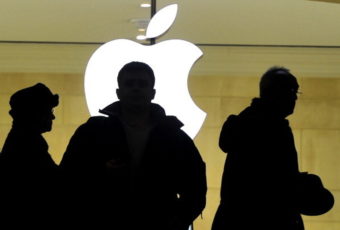
People walk past the Apple logo at the Apple Store at Grand Central Terminal in New York. Timothy A. Clary /AFP/Getty Images

Apple said today that the computers of some of its employees were attacked by hackers, who used the same vulnerability to access computers at Facebook.

All Things D reports:

“‘Apple has identified malware which infected a limited number of Mac systems through a vulnerability in the Java plugin for browsers,’ the company said in a statement to AllThingsD. ‘The malware was employed in an attack against Apple and other companies, and was spread through a website for software developers. We identified a small number of systems within Apple that were infected and isolated them from our network. There is no evidence that any data left Apple. We are working closely with law enforcement to find the source of the malware.’

“The company noted that it has been shipping Macs without Java since the release of Mac OS X Lion, and that it also has a software mechanism that disables Java if it goes unused for 35 days. Apple is also releasing an updated software tool to detect and remove Java-related malware.”

Last week, Facebook said their systems had been breached in January. Both companies said that no user data had been compromised.

Reuters points out one of the interesting quirks of this hack: This is the “highest-profile cyber” attack to target Mac computers.

“Hackers have traditionally focused on attacking machines running the Windows operating system, though they have gradually turned their attention to Apple products over the past couple of years as the company gained market share over Microsoft Corp.,” Reuters reports.

This news comes the same day that an American security company revealed it had connected hacks targeting 141 American companies to the Chinese government.


Read original story

Like Facebook, Apple Says It Was Attacked By Hackers

‘It Felt Like An Earthquake’: One Still Missing After Kansas City Explosion

Fire fighters and utility workers at the scene of a massive gas explosion and fire Tuesday night in Kansas City, Mo. Orlin Wagner/AP

“It sounded like thunder, but it felt like an earthquake,” Tracey Truitt, a lawyer who was working in a nearby building, tells the Kansas City Star about an explosion Tuesday evening that leveled a restaurant in the city’s Country Club Plaza.

At least 16 people were injured and as of early this morning one person remained missing, the Star says.

Our colleagues at KCUR report that “Missouri Gas Energy released a statement Tuesday night regarding the fire, saying: ‘Early indications are that a contractor doing underground work struck a natural gas line, but the investigation continues.’ ”

According to the Star, the blast happened at JJ’s restaurant shortly after 6 p.m. local time. “The force knocked out windows at least a half-block away and was felt nearly a mile away. Flames soared two-thirds higher than the building into the evening sky. Bricks and broken glass were strewn around.”

KCUR says that a strong gas odor had been reported before the explosion, and that customers had been evacuated from the restaurant. It adds that:

“The initial blast was felt at least 5 blocks away and shattered windows in the block adjacent to the restaurant. The restaurant building is for practical purposes destroyed — the roof caved in.”


Read original article

‘It Felt Like An Earthquake’: One Still Missing After Kansas City Explosion

Newtown Shooter May Have Taken Cues From Norway Massacre

Investigators trying to piece together a motive in December’s killings in Newtown, Conn., believe that 20-year-old shooter Adam Lanza may have been inspired by a similar 2011 massacre in Norway.

The Hartford Courant and CBS News report that authorities searching through Lanza’s belongings after the shooting at Sandy Hook Elementary discovered several news articles about Anders Behring Breivik, who killed 77 people in Norway in July 2011.

CBS, citing unnamed investigators, reports that Lanza saw himself in direct competition with Breivik, who set off a bomb in Oslo and also shot dozens of teens at a youth camp. CBS says Lanza was obsessed with topping Breivik’s body count.

According to The Courant, this is just one theory that investigators are pursuing.

CBS also reported that Lanza, who shot his way into Sandy Hook, gunning down 20 students and six staff members before shooting himself, had targeted the school because it was the “easiest target.” Earlier, he had shot and killed his mother, Nancy Lanza.

In a joint investigation by The Courant and the PBS investigative program Frontline, reporters interviewed friends and family of the Lanzas and sifted through a decade’s worth of Nancy Lanza’s emails.

According to the newspaper:

What emerges in this exploration of a still unfolding story is a portrait of a mother, apparently devoted but perhaps misguided, struggling to find her son a place in society, and a boy, exceptionally smart in some areas, profoundly deficient in others, who never found a place in the world.

The paper also confirmed that during a search of Lanza’s belongings, authorities had found “thousands of dollars worth of graphically violent video games.”

And detectives working the scene of the massacre are exploring whether Adam Lanza might have been emulating the shooting range or a video-game scenario as he moved from room to room at Sandy Hook, spewing bullets, law enforcement sources have told The Courant.


Read original article

Newtown Shooter May Have Taken Cues From Norway Massacre

Quite A Haul: $50 Million Worth Of Diamonds Stolen In Lightning-Fast Heist

Diamonds. Yves Herman /Reuters /Landov

In a heist right out of movies such as The Italian Job, eight masked gunman drove on to the tarmac at Brussels’ international airport Monday night, sped to a plane being loaded with diamonds and made off with about $50 million worth of the precious stones, authorities say.
It was all over in just a few minutes.

“What we are talking about is obviously a gigantic sum,” says Caroline De Wolf of the Antwerp World Diamond Centre. She says the diamonds were “rough stones” being transported from Antwerp to Zurich.

According to The Guardian:

“The raid at Brussels airport happened just before 8 p.m. … The heavily armed men drove through the airport security fence in two vehicles, a Mercedes van and a car, and made straight for a Brink’s delivery van. The staff were loading safes full of diamonds on to a … plane bound for Zurich. The gunmen quickly filled their vehicles with the boxes and fled through the same broken security barrier. No shots were fired. A burned-out van was later found nearby. The raid lasted just three minutes.”

Now, what will the thieves do with their loot? If the past is any guide, they won’t get anywhere near $50 million — provided they aren’t caught. They may already have made arrangements with some less-than-scrupulous dealers who will try to unload the diamonds at a deep discount.

In November 2011, the New York Postprofiled FBI Special Agent Dan McCaffrey, the bureau’s “expert on gems and the crooks who steal them.” The Post wrote that:

“When $14 million in loose diamonds vanished in Belgium, McCaffrey became part of the pack of investigators chasing the thieves around the world.

“McCaffrey soon zeroed-in on a diamond dealer who had set up shop on W. 47th Street, in the Diamond District, and who was selling stones at 30% of market value.

“He discovered that the Manhattan jeweler had been hired to unload the hot rocks by the son of the Belgian who reported the theft. McCaffrey locked up the son and his fence, recovered the diamonds — and personally flew them back to Belgium and the rightful owner.”


Read original article

Quite A Haul: $50 Million Worth Of Diamonds Stolen In Lightning-Fast Heist

Clues Connect Global Hacking To Chinese Government, Security Firm Says

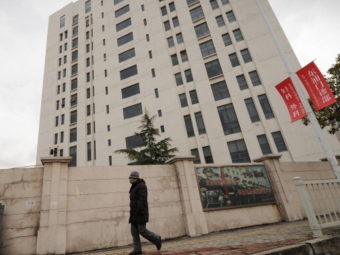
Cyberattack headquarters? The 12-story building in a Shanghai suburb that American investigators say houses an operation responsible for hundreds of cyberattacks on companies around the world. Peter Parks /AFP/Getty Images

“Hundreds of investigations convince us” that the Chinese government is at least aware of, and likely sponsoring, cyber thieves who have stolen massive amounts of information from companies around the world, including American defense contractors, a U.S. security firm reported Tuesday.
Virginia-based Mandiant Corp., which posted its findings online, says that its analysis leads it to conclude that “Advanced Persistent Threat 1,” as it calls the operation, “is likely government-sponsored and one of the most persistent of China’s cyber threat actors.”

According to Mandiant, since 2006 it has “observed APT1 compromise 141 companies spanning 20 major industries.”

The firm writes that:

“We believe that APT1 is able to wage such a long-running and extensive cyber espionage campaign in large part because it receives direct government support. In seeking to identify the organization behind this activity, our research found that People’s Liberation Army (PLA’s) Unit 61398 is similar to APT1 in its mission, capabilities, and resources. PLA Unit 61398 is also located in precisely the same area from which APT1 activity appears to originate.”

For its part, as The Associated Press says, “China’s Foreign Ministry dismissed the report as ‘groundless,’ and the Defense Ministry denied any involvement in hacking attacks.”

On Morning Edition today, NPR’s Frank Lanfitt reported that Mandiant’s Dan McWhorter says most of the companies targeted by the hacking have been American. The cyber thieves’ goal, says McWhorter, is to steal information in order to benefit Chinese firms.”In China, the government is very intimately involved in industry,” McWhorter said. “So I think the PLA is motivated to take these documents for huge economic gain.”

Tracking the hacking to the PLA wasn’t that hard, McWhorter said, because the volume was enormous. “We just followed the data, followed the bread crumbs,” he said. “All the network communication kept going back to Shanghai again and again. … And so then we started doing our research, as far as what kind of organizations could be that large doing this type of activity. And that’s what lead us to discover unit 61398.”

The New York Times, which broke the news about Mandiant’s findings, writes that “a growing body of digital forensic evidence — confirmed by American intelligence officials who say they have tapped into the activity of the army unit for years — leaves little doubt that an overwhelming percentage of the attacks on American corporations, organizations and government agencies originate in and around the white tower” on the outskirts of Shanghai where PLA Unit 61398 is headquartered.

What is Mandiant? Last May, NPR’s Tom Gjelten looked at the company, which was “founded in 2004 by Kevin Mandia, a former Air Force officer with a background in security consulting. The company distinguished itself early by helping companies learn more about who was attacking them, as opposed to protecting the companies from the malicious software, or malware, the attackers were using.”

Read original article

Clues Connect Global Hacking To Chinese Government, Security Firm Says

Get A Social Security Check? Treasury Says It’s Time To Go Electronic

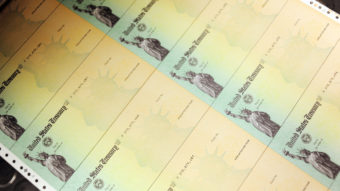
  U.S. Treasury checks are run through a printer. William Thomas Cain/Getty Images
U.S. Treasury checks are run through a printer. (Image by William Thomas Cain/Getty Images)

Every month, the government sends out about 5 million checks to Americans who receive federal benefits. On March 1, the Treasury Department is making those paper checks a thing of the past.

Since May 2011, all new Social Security recipients are required to get direct deposit of their benefits. Some 93 percent of all recipients now do.

But there are still holdouts, so the Treasury Department started a campaign and a website, Go Direct, in an effort to convince the remaining 7 percent.

The department is prodding people to switch for one big reason: cost. Treasury spokesman Walt Henderson says the government will save $1 billion over 10 years by not having to print paper checks.

“It costs us about a little over a dollar to issue a paper check. It costs us 10 cents for an electronic payment,” he says. “There’s the postage, the production and the cost of the paper and so on that won’t be needed with electronic payments.”

The government wants all benefit recipients to switch to electronic payments, including those who get Social Security, veterans benefits and federal employee retirement checks. Folks who don’t will still get their checks, Henderson says, but they’ll also get some personalized attention from Treasury.

“We won’t interrupt the payment. We want to see how many people comply and reach out to people in a more direct way through the mail and see if we can assist them in complying with the requirement,” he says.

As an alternative to direct deposit, recipients can get debit cards, although there are fees.

AARP has another worry. “We’re very concerned about fraud,” says Cristina Martin Firvida, the senior lobby’s director of financial security.

“To be fair, fraud is a problem whether you have a paper check or whether you have direct deposit or a debit card,” she says. “Changing from a check to debit card merely changes the schemes for the fraud.”

Firvida says AARP is in talks with the Treasury Department over how to increase safety for the debit cards.

The department says debit cards and direct deposit are actually more secure than paper checks, which get stolen and fraudulently endorsed.


Read Original Story

Get A Social Security Check? Treasury Says It’s Time To Go Electronic

Site notifications
Update notification options
Subscribe to notifications