An illustration of what asteroid 2012 DA 14 may look like as it approaches Earth. NASA/JPL-CalTech/EPA /LANDOV
NASA calls it a “small near-Earth asteroid.”
And though “2012 DA14” will come within about 17,000 miles of our planet and be closer than some satellites, the space agency assures everyone that “there is no chance that the asteroid might be on a collision course with Earth.”
Still, if what we read about this rock and our calculations are correct, the asteroid that comes whizzing by around 2:24 p.m. ET on Friday:
— Will be about the same weight as 318 fully loaded Boeing 747s.
— Will set a record for “close[st] approach for a known object of this size,” according to NASA.
So, if somebody’s miscalculated it’s path …
Let’s just not go there.
Though, if you really want to calculate what an asteroid like that would do to the planet if it did hit, Purdue University has a handy “Impact Earth” calculator.
Oh, and sorry folks in the U.S. You won’t be able to see it. (We hope.)
After more than five years of recession and painfully slow recovery, President Obama has sent a powerful signal that he thinks the U.S. economy is now in much better shape — good enough, at least, to provide workers with raises.
In his State of the Union address Tuesday night, Obama called upon Congress to boost the federal minimum wage to $9 an hour by 2015, up from the current $7.25. The wage would rise in steps, and after hitting the maximum in two years, would thereafter be indexed to inflation.
In the president’s first term, the unemployment rate was very high, peaking at 10 percent in October 2009. And during those four years, Obama never seriously pushed Congress for legislation to force employers to pay more.
Tuesday night, he changed direction, saying in his State of the Union speech that he wants Congress to drive up wages for millions of workers by forcing up the benchmark minimum wage. Even though only a relatively small percentage of workers make $7.25 an hour, that pay level serves as a wage floor for all workers. When it moves higher, other wages ratchet up too.
In other words, if Congress were to boost the minimum hourly wage, then a person currently making $9 likely could move up to $10 or even $11 an hour as employers adjusted pay scales to higher levels to compete for the better low-wage workers.
‘Honest Wages’
The White House says 15 million workers would benefit directly from a higher minimum wage, but many economists say that millions more would gain too after taking into account the ripple effect as the whole wage scale moves up.
“We know our economy is stronger when we reward an honest day’s work with honest wages,” Obama said. “But today, a full-time worker making the minimum wage earns $14,500 a year.”
He said that’s not enough money to keep a family above the poverty line. “Let’s declare that in the wealthiest nation on Earth, no one who works full time should have to live in poverty, and raise the federal minimum wage to $9 an hour. This single step would raise the incomes of millions of working families.”
The president’s focus on the minimum wage came as something of a surprise, even to longtime supporters of a pay increase. Sen. Amy Klobuchar, D-Minn., said in an interview Wednesday morning that while she agrees with the president, “I didn’t know he would bring it up.”
Given that the wage push was unexpected, she said she did not know how Democratic lawmakers might put together their strategy for getting the legislation passed. For many years, it had been Massachusetts Democratic Sen. Edward Kennedy who led congressional battles for higher wages. But with his death in August 2009 — one month after the last minimum wage hike took effect — supporters will need a new champion in Congress to marshal the troops.
Opponents already are gearing up for the fight. At a press conference this morning, House Speaker John Boehner, a Republican, made it clear he would work against minimum-wage legislation.
“When you raise the price of employment, guess what happens? You get less of it,” Boehner said. “At a time when the American people are still asking the question, ‘Where are the jobs?’ why would we want to make it harder for small employers to hire people?”
Congress last passed a bill establishing a series of minimum wage increases in 2007 — before the Great Recession began. The last of those increases took the pay up to $7.25, where it has remained frozen.
Higher Existing Minimums
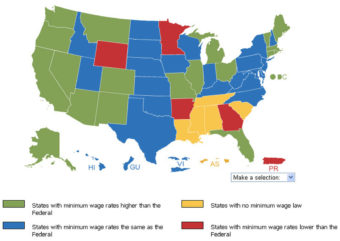
Nineteen states plus the District of Columbia have minimum wages above $7.25. For example, in Washington state, the pay is now up to $9.19 an hour — the highest minimum in the country. If the federal level were to rise, many of those 19 states would most likely pass new legislation to exceed it.
If the past is any indicator, business groups — particularly the National Restaurant Association — will put up a fierce fight to block any federal minimum wage increase.
Another group backed by the restaurant and hotel industries says an increase in the minimum wage can hurt the economy. “The President’s minimum wage hike ignores both simple economic logic as well as the overwhelming scholarly consensus on minimum wage hikes,” Michael Saltsman, research director of the Employment Policies Institute, said in a statement. The institute says research “points to a loss of job opportunities following a minimum wage hike.”
But many economists point to studies that show a higher minimum wage does little to hurt job creation. Instead, these economists argue that a higher wage reduces income inequality and puts more money into the hands of the consumers who can spend it. So, the argument goes, while a pizza-shop owner might have to spend more on his payroll under new wage legislation, he also would see a boost in revenues as customers find themselves enjoying bigger paydays.
A Hot-Button Issue
The minimum wage has been a hot-button issue with business groups since its introduction in 1938. They argue that a federal minimum wage is inflationary and represents an unnecessary government intervention in the labor market. They say labor supply and demand alone should set wages, not lawmakers.
Supporters disagree. They say inflation is very low, while income inequality is growing. Working people lack of spending power, and that’s what is inhibiting economic growth, the argument goes.
“We applaud the president for expressing support for raising the minimum wage and tying it to the cost of living,” Richard Trumka, president of the AFL-CIO, said in a statement on behalf of the labor organization. He said the economy is not suffering from high wages but rather from “wage stagnation and growing inequality.”
Between 2000 and 2010, U.S. median income fell 7 percent after adjusting for inflation, according to census data. Over the past year, the unemployment rate has hovered at or just below 8 percent.
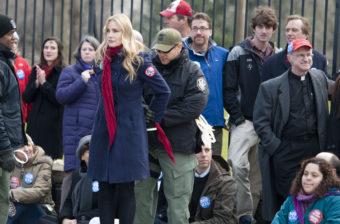
Daryl Hannah is handcuffed and arrested during the Keystone XL Pipeline Protest at Lafayette Park in Washington on Wednesday. (Leigh Vogel/Getty Images)
Dozens of environmentalists were arrested, today, after they strapped themselves to the gate surrounding the White House.
NPR’s Elizabeth Shogren filed this report for our Newscast unit:
“The protesters want President Obama to reject the Keystone XL pipeline. It would carry a dirtier kind of oil from Canada to refineries in the United States.
“Sierra Club’s Executive Director Michael Brune says it’s so important that his group decided for the first time in its 120 year history to participate in civil disobedience.
“‘What we need right now is the president to really seize this moment on Climate change,’ he said.
“Bill McKibben of 350.org was there too.
“‘It’s the rarest of opportunities to actually stop something before it happens and leave a huge pool of carbon in the ground,’ McKibben said.
“They were arrested along with actress Daryl Hannah, Robert Kennedy Jr. and more than 40 other people.”
As we’ve told you, since Nebraska approved a new route for the pipeline, it is now up to the U.S. State Department to green light or put a stop to the project.
The decision could be one of the Obama administration’s most controversial on the environment. And feelings are fervent on both sides of the issues: Republicans have accused the president of delaying a project that would create jobs and further America’s energy independence, while environmentalists have said that pipeline is in direct opposition to getting climate change under control.
The number of people filing first-time clams for unemployment insurance fell by 27,000 last week, to 341,000 from 368,000 the week before.
The Employment and Training Administration also reports that the “4-week moving average was 352,500, an increase of 1,500.”
That average, in theory, gives a better picture of the trend. According to Reuters, the drop last week was larger than expected and points to “a continued steady improvement in labor market conditions.”
The slight uptick in the 4-week average, though, underscores that the improvement appears to be slow.
A little more than a week after an Alabama kindergartener was freed from an underground bunker by a FBI special team, his mom has reached out to Tv personality Dr. Phil McGraw for help in dealing with her son Ethan’s emotions.
Jennifer Kirkland appeared on Wednesday’s Dr. Phil episode. The show says she asked for help in talking with her son “about the frightening experience….How might it affect his mental and emotional health in the future?”
Ethan was in the 6-by-8 bunker when the FBI team stormed it, killing his captor, Jimmy Lee Dykes, who had held him there for a week. The agents went in, after they saw through a hidden camera that Dykes had become more agitated and was carrying a gun. Ethan had already seen Dykes kill his bus driver, Charles Poland, Jr. before he was kidnapped.
During the week-long ordeal, Ethan’s mom wanted to talk to Dykes herself, but she was urged not to by authorities. Kirkland says the situation was so delicate, she also stayed away from reporters as the situation developed. Dykes had access to television and the internet and officials didn’t want Ethan to overhear his mother in interview and become agitated.
“I didn’t want Ethan to see me and break down, and then Mr. Dykes see Ethan break down, and not knowing how he would react to that,” she says.
But Kirkland also wanted Dykes to be helped. She told a sheriff’s deputy, “I understand that man is sick. Don’t hurt him.” And she says she saw Dykes as a man who cared for her son, who cooked chicken for him and asked for toys that were given to him.
Kirkland says, “From the very beginning, I had already forgiven Mr. Dykes, even though he still had my child. I could not be angry through this because my job was to be the mother, the concerned mother that I needed to be. and want to get my child back. And with hatred in me, I could have never made it through it.” “I asked that he not be hurt, but if it came down to it, you know, of course I want my child safe,” she added.
Kirkland says Ethan is showing some signs of sleep disturbance. Counselors tell the Associated Press that the child will need to be evaluated for nightmares.
When President Obama used his State of the Union address to affirm “we have kept Congress fully informed of our efforts” to target terrorism suspects overseas, national security experts wondered exactly who on Capitol Hill got the scoop about secretive U.S. drone strikes.
Today, Sen. Dianne Feinstein, a California Democrat who chairs the Intelligence Committee, filled in some of the details. Feinstein said in a written statement that her committee “receives notification with key details of each strike shortly after it occurs.” She said her committee holds regular briefings in which it reviews the drone attacks, examines how effective they are and verifies “the care taken to avoid deaths to non-combatants.”
Feinstein added that staff members have held 35 monthly oversight meetings to review video footage and other records of the drone strikes. But all of those actions take place in closed sessions, far away from the public. The Obama administration has been the subject of fierce criticism for the secrecy surrounding the program.
Last week, after lawmakers threatened to hold up the president’s nominee to lead the Central Intelligence Agency, the White House gave the House and Senate Intelligence Committees two classified legal memos that justify killing U.S. citizens who have gone to work with al Qaeda or its affiliates.
But Feinstein said Wednesday she still wants to see seven other legal opinions “that we believe to exist on targeted killings.” And Sen. Ron Wyden, a Democrat from Oregon, told NPR’s All Things Considered last week the administration couldn’t get away with a “just trust us” approach to drones.
The debate is more than an academic one.
News reports have tied the American government to a September 2011 strike in Yemen that killed radical cleric and U.S. citizen Anwar al Awlaki. The ACLU and the Center for Constitutional Rights have sued top American officials over the attack, which they argue was carried out without due process under the law since no courts or outside authorities had checked the executive branch action.