The U.S. House has approved a measure that would allow the historic and decommissioned Coast Guard cutter Storis to possibly become a floating memorial and museum in Juneau. Now, the legislation moves on to the U.S. Senate for their consideration.
Congressman Don Young’s office said in an emailed release that the action came Tuesday, along with a measure that authorizes the service’s spending for fiscal years 2012 through 2014. Spending would total $8.49 billion and increase to $8.7 billion over those three years.
That larger funding bill also decommissions the Coast Guard’s two heavy-duty icebreakers. That’s something that Young says came out of frustration of the Administration’s inability to prioritize icebreaking needs and he believes it forces the administration’s hand. Young says he’s introduced a measure that allows the service to lease icebreakers.
The Storis legislation is House Resolution 1220. It was incorporated into House Resolution 2838 that was approved by the U.S. House on Tuesday.
The Alaska State Council on the Arts has hired a new executive director. Shannon Daut of Denver takes over from the retiring Char Fox in January.
The 37-year old Daut is currently the deputy Director of the Western States Arts Federation, a thirteen state western regional arts organization. She’s worked there for the last twelve years. Her education and preferred medium includes rhetoric and film, but her experience with the Federation includes a wide range of artistic disciplines. Some of her work as deputy director included cultural policy and technology.
Daut’s hiring marked the end of three month national search, according to a release issued by the Council.
The Alaska State Council on the Arts operates under the state Department of Education, is funded by the Legislature, National Endowment for the Arts, and Rasmusen Foundation, and councilmembers are picked by the Governor.
Char Fox’s official retirement date is February 1, 2012.
Anthropologist Tom Thornton. Click to enlarge. (Photo by Casey Kelly/KTOO)
Alaska Native Corporations display a strong ethos of corporate responsibility, according to an anthropologist who studies the organizations.
Tom Thornton is a senior research fellow for Environmental Change and Management at Oxford University. He presented some of his current research yesterday (Tuesday) at Sealaska Heritage Institute’s annual Native American History Month lecture series.
Thornton says Native Corporations make especially interesting subjects for social scientists.
“The big reason is that they are very unique hybrid institutions,” he says. “They’re not like regular corporations, and obviously they are major cultural institutions as well.”
Thornton says the corporate responsibility ethos is evidenced by many of the corporations’ mission statements, which refer to “sustainability.”
“Probably like all corporations, not every Alaska Native Corporation lives up to its ideals and its mission statement. But the fact that they’re articulated with a certain set of values is quite interesting,” Thornton says. “Because we’re all looking for the right model of sustainable development, if that’s not an oxymoron or a non-sequitur. If there is sustainable development, it obviously has to incorporate some key cultural values into it. It can’t just be an economic model.”
Thornton’s current project is looking at how ANCs have transformed institutional relations between Native people, state governments, ecosystems, and economies.
Since the corporations were created by the Alaska Native Claims Settlement Act, they have adapted to changing cultural, economic and political circumstances. He points to Southeast Alaska, where Native people traditionally lived and survived by the ocean. But under ANCSA – where the settlement included land – virtually all Southeast Native Corporations have been or are involved in timber.
“You move from people who were fishermen to forests. There wasn’t a lot of experience at the beginning. This lack of experience led to mistakes, or people taking advantage, and this set a lot of particularly small corporations off to a bad start,” Thornton says. “They either harvested their timber too quickly, they didn’t get a good price for it, or they didn’t really consider their own values in terms of what they really wanted to do with their natural capital to support their cultural capital.”
In some cases Thornton says Native corporations have done well by moving away from natural resource industries, and into businesses like tourism. One example is Huna Totem Corporation’s Icy Strait Point tourist attraction in Hoonah.
“You have 130 people employed by Huna Totem Corporation in tourism. That would seem to be sustainable if you can get one ship per day in there throughout the summer,” he says.
But there’s still a strong desire on the part of ANC leaders to combine traditional ways of living with newer models. Thornton says one Hoonah fisherman suggested to him that they develop niche economies.
“In the summer, you have tourism, major industrial tourism, that is your form of sustainable development. But in the winter and spring, maybe people could still fish there,” he says.
Thornton’s research is still in the preliminary stages. He says it will eventually compare the development of Southeast Native corporations with those in the Bering Straits region.
Sealaska Heritage Institute’s Native American History Month events continue today (Wednesday) with a luncheon to recognize ANCSA at the Alaska Native Brotherhood Hall.
The lecture series resumes tomorrow (Thursday) with a talk by Tlingit and Haida Central Council President Edward Thomas on the relationships between tribes and corporations.
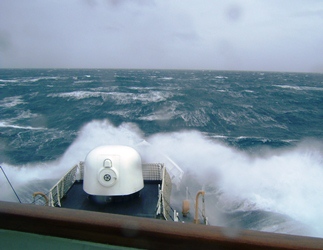
Bering Sea before the storm. Courtesy Capt. Joseph Hester
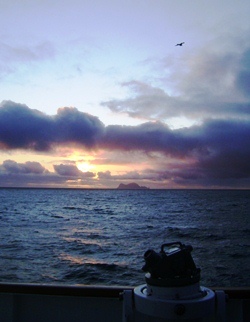
Alaska news has been full recently of stories about the huge storm that battered the state’s west coast last week.
While the U.S. Coast Guard Cutter Sherman figured prominently in helping a nearly disabled catcher-processing ship, those reports had few details.
The Sherman’s Commanding Officer, Captain Joe Hester, is fond of telling sea stories. Hester recounted a number of them when the cutter stopped in Juneau in September on its way to the Bering Sea for a three-month patrol.
Sunrise on the Bering Sea after the storm. Courtesy Capt. Joseph Hester
As the big storm developed over the Bering last week, KTOO checked in by email. After the storm had subsided and the crew of 180 had had a good night’s rest, Capt. Hester followed up with a phone call. Rosemarie Alexander brings us the rest of the story of the Rebecca Irene.
There was a distinct public safety theme to a handful of items approved by the Juneau Assembly last night (Monday).
Members appropriated more than 131-thousand dollars in grant funds related police or fire services.
The largest chunk was a $94,575 dollar expenditure that will allow the city to hire two new police officers. City Manager Rod Swope explained that the amount covers the first six months of a three-year grant from the US Justice Department.
“This grant will fund two police officers for three years free of charge, and then we will be obligated to fund those positions the fourth year and thereafter if we want to keep them on the force,” said Swope. “So, in total this grant’s worth $567,452.”
Swope said the officers would be assigned to JPD’s downtown patrol.
“Which, I think given all the issues we’re having to deal with recently, will really be a good thing,” he said.
The assembly also approved $6,615 for a software program that will give police the ability to do three-dimensional reconstructions of car crashes. Funding for that item came from an Alaska Department of Transportation and Public Facilities grant.
Another expenditure of $30,583 dollars will allow two members of Capital City Fire and Rescue’s Hazmat Team to go to a training seminar in Fairbanks. That item was courtesy of a grant from the Alaska Division of Homeland Security and Emergency Management.
The assembly last night also approved a $6.6-million dollar appropriation for continued funding of the Juneau Airport’s runway safety area project, with $6.3-million that was provided by a Federal Aviation Administration grant. The rest is coming from the Alaska Department of Transportation and Juneau Airport operating funds.
Assembly members also approved a climate action plan for the city and borough, which sets a goal of reducing Juneau’s greenhouse gas emissions by 25 percent by the year 2032.
Pint-sized Juneau songstress Anna Graceman was honored by the CBJ Assembly last night (Monday).
The 11-year-old singer-songwriter caught the nation’s attention earlier this year, when she made it to the semi-final round of NBC’s America’s Got Talent.
Mayor Bruce Botelho read from a proclamation recognizing Graceman’s many achievements.
“Anna found her musical gift at an early age, singing complete songs at 18 months, performing for audiences at the age of two, and playing the piano by the age of four,” it read. “At the advanced age of six she wrote her first song, entitled “So I Cried” – a song based on the experience of her brother being very sick when he was little.”
Graceman is performing in Denver this week, and was represented at the assembly meeting by her great-grandparents, Roy and Pat Varni. Roy Varni talked about how much Juneau has meant to Anna’s success.
“Juneau with its unparalleled beauty has provided much of the inspiration for Anna’s prolific songwriting,” he said.
Varni praised Anna’s teachers at the Juneau Montessori School for being particularly instrumental in her creative development.
Anna Graceman – “Superstar”:
Close
Update notification options
Subscribe to notifications
Subscribe
Get notifications about news related to the topics you care about. You can unsubscribe anytime.