Aleutians

Weather watchers wait to see if this week’s Bering Sea storm sets low pressure record

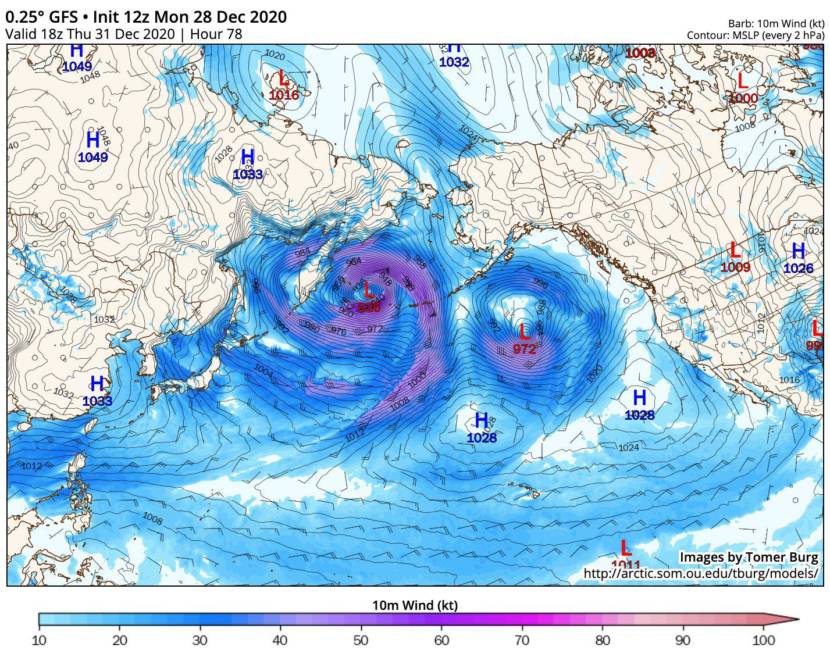
The storm will dissipate as it crosses into the eastern Aleutians and heads towards the Alaska Peninsula, according to Rick Thoman. He said it will likely be a typical storm for Unalaska, recording short-lived 50 to 70 mph winds. (image courtesy Rick Thoman)

The collision of a warm, wet weather front with a mass of cold air from Siberia could set a new record: the lowest barometric pressure recorded in the North Pacific. That could mean hurricane-force winds and high seas in the southwest Bering Sea.

“This storm is generating a lot of interest from weather watchers around the world,” said climate specialist Rick Thoman of the University of Alaska Fairbanks.

He said the storm — which is expected to reach Unalaska by Thursday night — will be comparable to Typhoon Nuri in 2014, and to another record storm that touched down near Adak in 2015, causing wind damage in Unalaska and the Pribilof Islands.

Anchorage-based National Weather Service Climatologist Brian Brettschneider said current models show the barometric pressure plummeting to as low as 920 millibars on Thursday. The current North Pacific record low is 925.

That’s the kind of reading you would expect in a pretty strong hurricane in the tropics, said Brettschneider.

“You have the ingredients that could come together to have the storm kind of explosively develop,” he said.

The places that could be hit hardest are western Aleutian islands like Shemya and Attu. But the heart of the storm could also center on the community on Adak, which has a population of about 100, and Atka, a community of about 50 people located 100 miles further east. National Oceanic and Atmospheric Association forecasts show winds up to 75 mph in Adak.

Thoman said it won’t be as severe in the more-populated fishing port of Unalaska.

“Because this storm is going to be very far west, like the 2014 ex-typhoon Nuri, we’re not expecting those kind of damaging winds to move into the eastern Aleutians or the Pribilofs. But you certainly will notice the weather front,” he said.

Low pressure will likely create more of a typical storm for Unalaska — short-lived 50 to 70 mph winds. Another effect could be waves as high as 40 feet in the western Bering Sea, said Brettschneider.

“That’s going to be a major issue for commercial fishing, for ocean transport. Those are some serious waves,” he said.

The system is caused by the convergence of a deep high-pressure cold front from Siberia with the warm, tropical low pressure from the South Pacific. Parts of Siberia have been recording temperatures in the minus-70s Fahrenheit, said Brettschneider.

“When you have cold air and warm air meeting together, it provides a lot of energy for the storms, for the low pressure to really deepen,” he said

Mainland Alaska likely won’t see any of the winds from the storm, but Brettschneider said there will be indirect effects. A low-pressure system in the Bering Sea will push a high-pressure system over the Yukon.

“It means we’re going to have an easterly flow which is going to bring colder temperatures. And so paradoxically, we may cool down, over the next week, in part because of that low pressure,” he said.

If the pressure does set a record, Brettschneider said, there won’t be any fanfare in the weather world other than the recording in the charts. But he said keeping track is still important.

“We’re monitoring the state of the climate regionally and globally and how these things are changing. And the intensity of storms is going to be a marker of the changing climate,” he said.
Adak under lockdown after finding first case of COVID-19

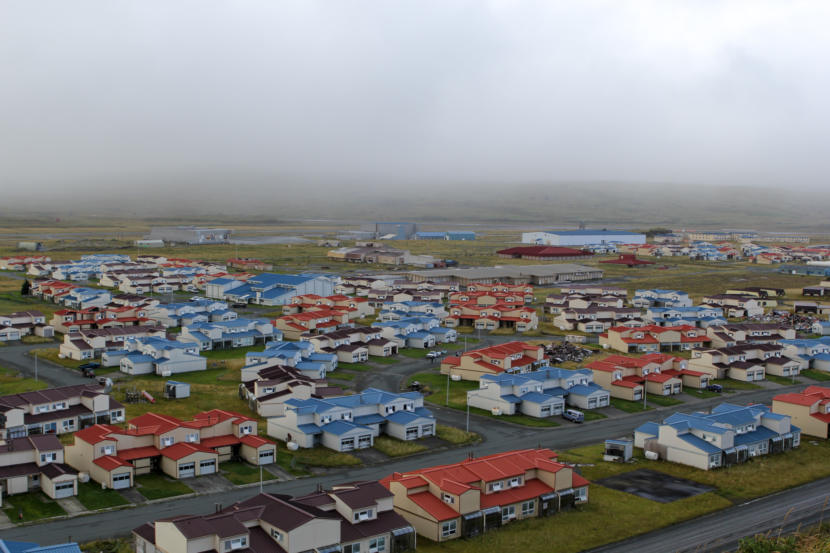
The city of Adak. (Photo by Zachariah Hughes/Alaska Public Media)

The westernmost community in the U.S. is under lockdown after an arriving visitor tested positive Saturday for the coronavirus.

Adak’s mandatory stay-at-home order and the closure of all-but-essential businesses went into effect Saturday evening. It’s expected to be lifted on Tuesday.

The visitor is the first confirmed case of COVID-19 in the community of about 100 people, according to Adak City Manager Layton Lockett.

“Hopefully, it’s just a traveler that can stay isolated,” Lockett said on Monday. “This is truly a test of our travel restrictions. Are the mandates working? What do we need to do to adapt those? How this goes will dictate whether we will need more restrictions or whether we can continue to have the same program we’ve had in place.”

Under the lockdown order, Lockett said all residents must stay home unless “performing duties related to immediate public health and safety,” in order to allow state health officials to conduct full contact tracing and determine the level of risk of community transmission.

“We don’t expect that there was significant community transmission,” Lockett said. “But again, until [public health officials] can finish their contact tracing, we won’t know for sure. So that’s the reason we’re asking for people to stay at home, pretend like it’s a really bad storm coming through and try to keep everyone safe by staying indoors and not interacting with folks outside their household.”

The city also ordered all businesses to remain closed — with the exception of those necessary for public health and safety — until the order expires.

The Adak City Council passed an ordinance last month to continue restrictions on travel into the community through at least Jan. 26, 2021. All travelers must make arrangements to take a COVID-19 test at the Adak Medical Clinic within 24 hours after arrival, regardless of whether a test was taken as part of the state’s Health Order 8.

Investigation into fatal PenAir crash in Unalaska finds mechanical problem, change in airline safety culture

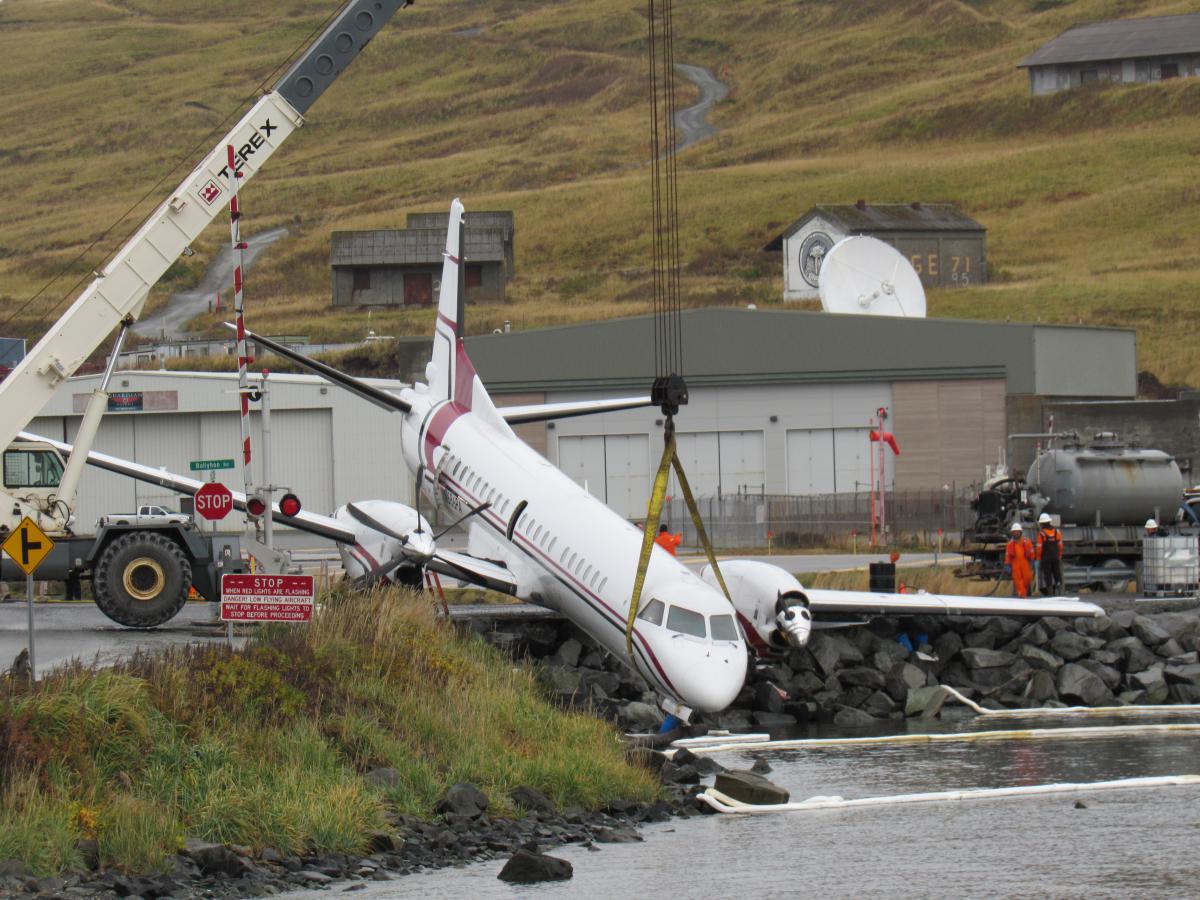
A crane lifts an airplane from a rocky drop near the runway.
An effort got underway Friday, Oct. 18., to move a PenAir plane that had gone off the runway at Unalaska’s airport. One passenger died as a result of the incident. (Photo by Laura Kraegel/KUCB)

It was a blustery fall day at Tom Madsen Airport. A PenAir flight from Anchorage was making its second attempt to land in Unalaska. Gusting tail winds made the landing extra challenging. As the plane touched down it failed to slow down, broke through the airport’s chain-link fence, crossed a road and hit a rocky embankment just short of the frigid waters of Iliuliuk Bay.

Steve Ranney was among the 39 passengers on flight 3296.  He’s a commercial pilot with 20 years of experience and still trying to understand what went wrong that day.

“I just don’t think that we can flat accept that there’s going to be accidents like this,” Ranney said. “I think that’s really one of the more important things. I know people make mistakes, but in the air carrier world, these things should not happen. This shouldn’t have happened at all.”

Ranney is still recovering from his injuries. A passenger to his left fared much worse; 38-year-old David Oltman was fatally injured in the crash. There were at least nine people hurt. Oltman’s death on Oct. 17, 2019 was the second fatality for a commercial airline in the U.S. in the last decade.

Ranney was traveling with his son who was competing with the Cordova school swim team. He is grateful the students escaped serious injuries.

“I’ll take the hit for the boys,” Ranney said.

On Wednesday, the National Transportation Safety Board released more than 2,000 pages of documents related to the crash. Ranney has already begun to comb through the files.

“A lot of people really get frustrated with how long it takes,” Ranney said. “But I’m actually kind of surprised at how much information they’ve gotten and how close it is to wrapping up.”

Here’s what the federal investigators initially found: A faulty wiring job may have kept an anti-skid device from working properly. And that could have contributed to the plane overshooting the tarmac.

But they also heard from PenAir pilots concerned that the airline was reducing the amount of experience its pilots needed to land on Unalaska’s notoriously challenging runway.

PenAir historically required pilots to have a minimum of 300 hours in a Saab 2000 before they could captain a flight to Unalaska. But after the Seybert family sold the airline to RavnAir Group in 2018, that rule was being reviewed.

In fact, NTSB investigators were told by PenAir pilots that in early summer 2019 a conversation was held where the chief pilot and Ravn vice president of flight operations discussed relaxing that rule.

The captain of flight 3296 had been flying into Unalaska for about three months. On the day of the crash, he had logged 131 hours in a Saab 2000 — less than half the historical requirement for PenAir pilots responsible for bringing flights into the Aleutian city. His first officer had a few hours more. Both had been hired by the company in May of that year.

The NTSB’s investigation describes the airline’s safety culture following PenAir’s sale to RavnAir Group. Ravn’s safety director told investigators he considered the overall safety culture as “still good,” but admitted that pilots had approached him saying they were “not as comfortable anymore” speaking freely about their concerns.

A Ravn VP of flight operations told investigators the requirement was not consistent with how other commercial air carriers operated in the Lower 48.

“I’m not convinced that it’s necessary because it’s not done elsewhere,” the VP said. “There are mountains around the country, around the world. Air is air. Physics are physics. Why is this different?”

So what happens now? Now that fact-finding is mostly complete, NTSB’s Clint Johnson in Anchorage said investigators hope to wrap up their work within the next year.

“The analysis portion is crunching all the information that we have here and ultimately driving towards a probable cause and analysis,” Johnson said. “Also most importantly, probably recommendations will come out of this accident investigation to keep it from happening again.”

The five presidentially appointed members of the National Transportation Safety Board may vote to hold a public meeting to review this investigation and determine a probable cause for the accident. Most accidents don’t have board meetings. The last time this happened for an Alaska investigation was for a fatal Togiak crash from 2016 operated by another RavnAir Group subsidiary, Hageland Aviation.

Johnson said board meetings are similar to a court hearing.

“Each one of the investigators and each one of the disciplines are questioned by the board members,” he said. “At the end of that process, the board members right there in the board meeting will determine probable cause [of this accident].”

PenAir is no longer flying. Its parent airline RavnAir Group declared bankruptcy in April and sold its assets this summer. A Southern California commuter airline bought some of its planes and two of the operating certificates. The company resurrected the name Ravn Alaska and rehired some of its crew. In November, it resumed scheduled flights to Unalaska, under new ownership but with the same old name.

KUCB in Unalaska and ProPublica are investigating aviation safety across Alaska. They are interested in hearing about people’s experiences flying or working for airlines in the 49th state and would particularly like to hear from people who have been in plane accidents or lost loved ones in fatal plane crashes.

If you have something to share, contact KUCB reporter Zoe Sobel via email or via phone call or text at 907-359-1888.

A string of volcanoes in the Aleutian Islands might actually be one mega volcano, scientists say

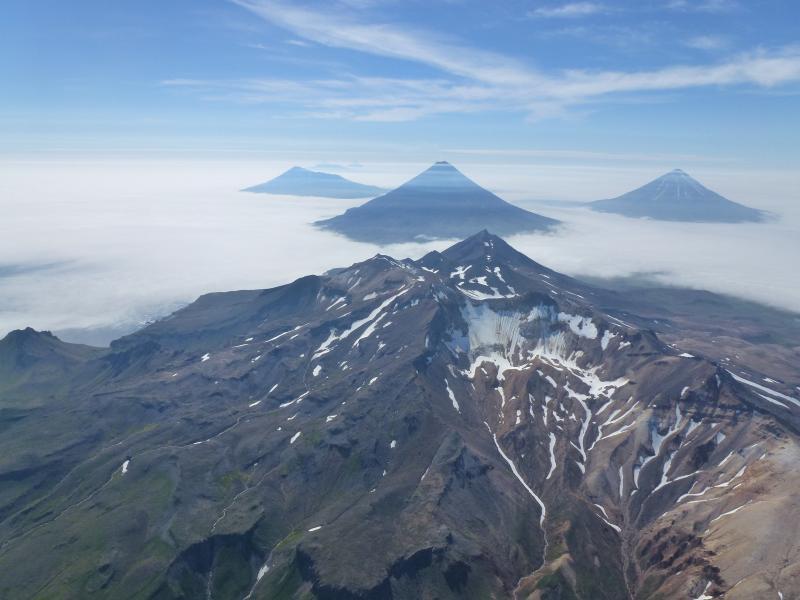
Aerial photograph of volcanoes of the Islands of Four Mountains. Mount Tana is in the foreground and Mount Herbert, Mount Cleveland and Mount Carlisle are shown left to right in the background. (Photo courtesy of John Lyons/USGS)

In a new study, scientists say a group of volcanic Aleutian Islands could be part of a massive, single, undiscovered volcano.

While scientists have been compiling their research for six years, there’s still a lot to piece together, according to Diana Roman, a volcanologist with the Carnegie Institution for Science in Washington, D.C.

“This is a little bit like trying to put together a 2,000-piece jigsaw puzzle, where half of the pieces are missing, and you don’t have the box, so you don’t know what it’s going to look like,” she said.

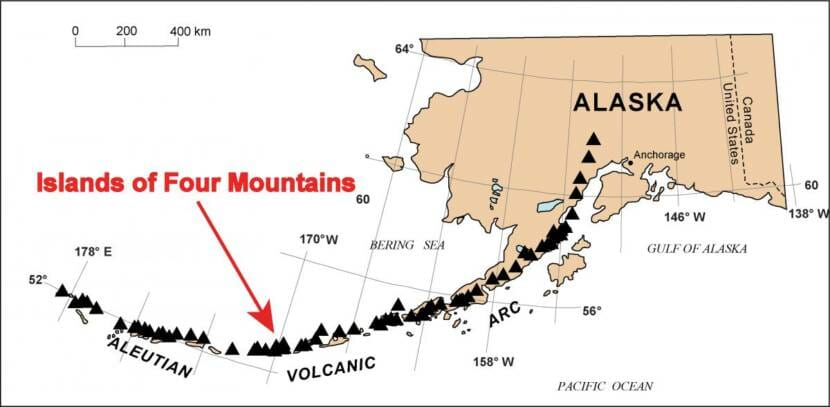
Roman is one of a number of scientists from across the country studying whether a giant volcano is hiding beneath the Islands of Four Mountains — a string of eight volcanic islands in the central Aleutians, about 170 miles west of Unalaska.

Map of the Aleutian Volcanic arc showing the positions of volcanoes (black triangles) and the location of the Island of Four Mountains. (Image courtesy of The Alaska Volcano Observatory)

On Monday, researchers presented their findings at the American Geophysical Union’s fall meeting.

John Power is a geophysicist with the U.S. Geological Survey at the Alaska Volcano Observatory, who also led the presentation at the virtual conference this week. He said the research in the Islands of Four Mountains started in 2014 because of the frequent eruptions at Mount Cleveland, which occupies the entire western half of Chuginadak Island.

“Mount Cleveland, over the last 20 years, and perhaps much longer, has been the most persistently-active volcano in North America,” Power said.

Scientists at the AVO have struggled with how to do a better job of warning people about potential eruptions at Mount Cleveland because it is so active, according to Power. But after studying the large stratovolcano and the other five located nearby, multiple pieces of evidence led them to the conclusion that there might be a 12-mile-wide caldera — a large volcanic crater — or a number of calderas, hidden underwater beneath the group of islands, which might help explain the frequent explosive activity seen at Cleveland.

Power said the evidence includes a type of rock scientists found there — called ignimbrites — that’s formed from large, catastrophic caldera-forming events, a slight change in gravity where they think the caldera might be, the extensive geothermal and hot springs throughout the islands, the earthquake activity there — and most notably, he said, the semi-circular arrangement of the islands which might form the caldera’s rim.

“There are multiple pieces of evidence that have come together, that make us think that this is also a very large, caldera-type volcano, which was previously unrecognized for two reasons. One is that we all know the Islands of Four Mountains are very remote, and the volcanoes there have not received a lot of prior study,” Power said. “And, in this case, much of the caldera structure is likely under the Bering Sea, so it’s been hard for people to identify.”

But Power and Roman say the caldera’s existence is not yet proven. To find out if the islands form one big caldera or whether there are multiple calderas side by side, or even if there’s a caldera there at all, they’ll have to return to the Islands of Four Mountains to gather more evidence to fully test their hypothesis.

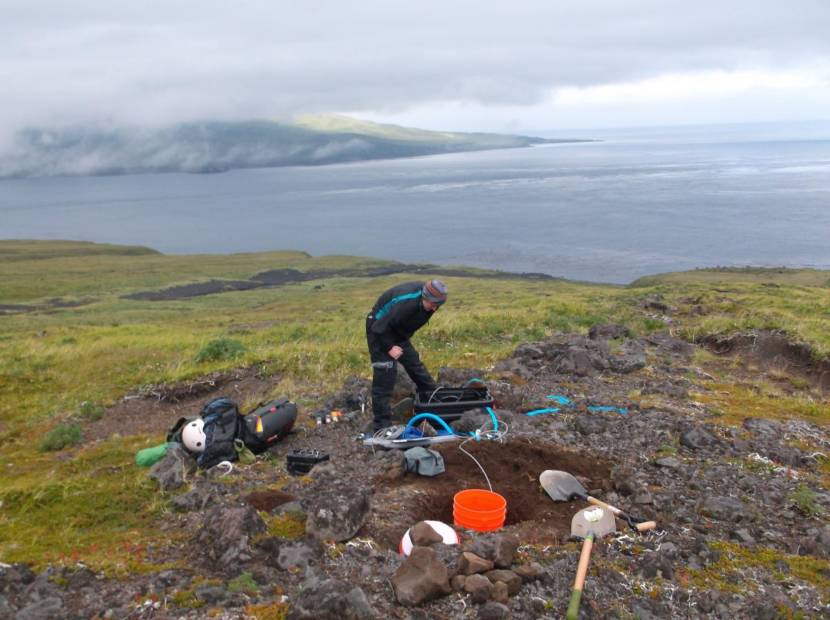
Former Carnegie postdoc Amanda Lough inspects a seismic station on Cleveland Volcano. (Photo courtesy of Carnegie Institution for Science)

If the researchers’ suspicions are correct, the newfound volcanic caldera would become the first caldera to be discovered in the Aleutians that is hidden underwater. It would also belong to the same category of volcanoes as the Yellowstone Caldera and others that have had super-eruptions with profound global consequences.

One of those, Power said, was the eruption of the Aleutian volcano, Okmok, in the year 43 B.C., which was recently implicated in the fall of the Roman Republic.

“If you look at some of the other large caldera-forming eruptions — such as Okmok  — you do see that these have resulted in cooling of the climate,” Power said. “In 1815, there was a very famous eruption at [Mount] Tambora in Indonesia, about this size, that resulted in what’s called the ‘year without a summer’ — there were crop failures, pandemics.”

According to Power, understanding where and when large volcanic eruptions occurred is important in understanding the global impacts they can have.

But, he said, there’s no immediate cause for concern that there will be a super-eruption at the site of the caldera in the Islands of Four Mountains. Rather, he said, knowing that there is potentially a caldera system there will help agencies such as the AVO anticipate eruptive activity moving forward and identify the types of hazards it may pose to overflying aircraft, fishermen and nearby communities such as Nikolski and Unalaska.

“It does not mean that there will be a huge eruption coming from this caldera anytime soon,” Power said. “It may be thousands of years or potentially never.”

Scientists are currently planning their next expedition to the Islands of Four Mountains, which could be several years out, Roman said. The last major expeditions to the islands were in 2014, 2015 and 2016.


During final trip of the season, nearly entire fishing boat crew tests positive for COVID-19

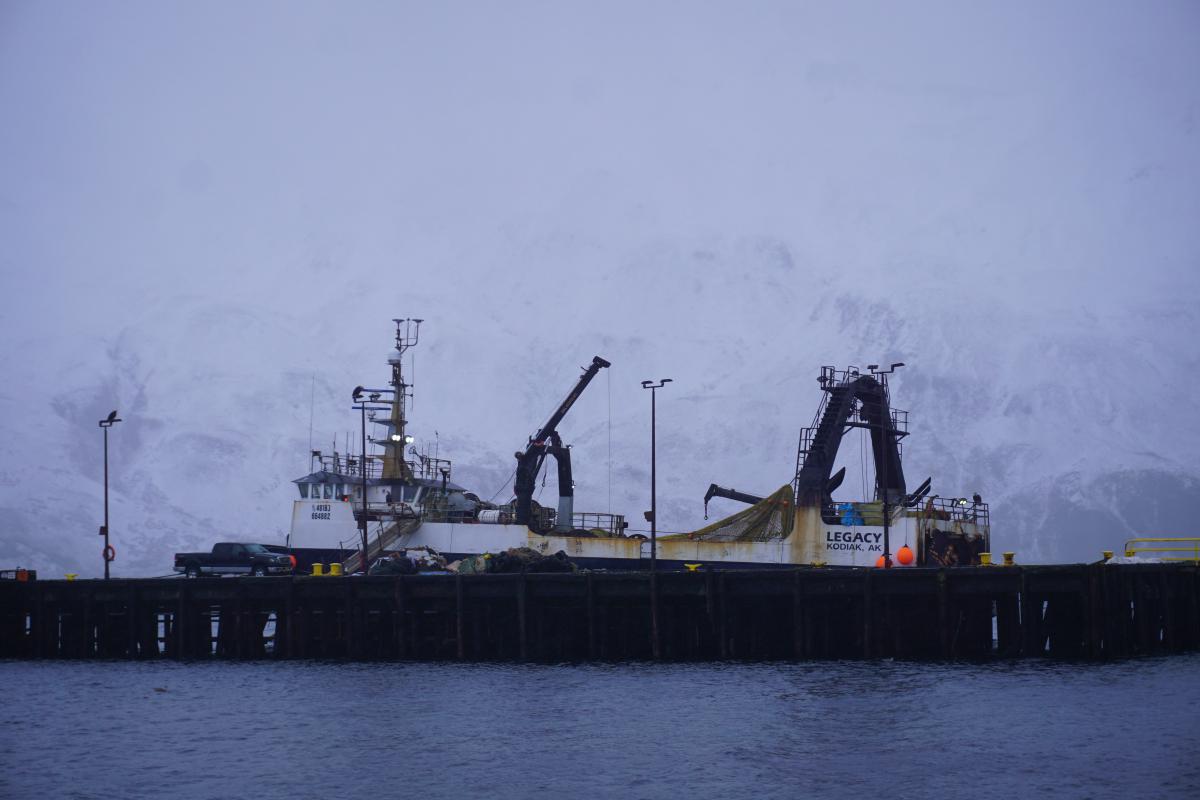
The F/T Legacy at North Pacific Fuel's dock on Captains Bay Road in Unalaska
The F/T Legacy at North Pacific Fuel’s dock on Captains Bay Road in Unalaska on Friday, Dec. 4, 2020. All but one of crew on board tested positive for COVID-19. (Hope McKenney/KUCB)

While wrapping up their season fishing for Pacific Ocean perch in the Bering Sea, nearly the entire crew of a United States Seafoods trawler tested positive for COVID-19, marking the first cases of the coronavirus for the Seattle-based company.

Two crew members of the trawler Legacy tested positive for the virus on Thursday, according to the City of Unalaska, prompting providers from the local Iliuliuk Family and Health Services clinic to test the rest of the 25-person crew. When the results came back on Friday, they showed that 22 more individuals were also positive.

All crew members remain on board, with the one negative individual segregated from the remaining crew, the city said in a statement.

“This is quite a disappointment to have weathered storms of COVID all year, and to literally have this trip us up on our last day of the last port call of the season — it takes the wind out of your sails,” said Dave Wood, chief operating officer of U.S. Seafoods.

The 132-foot catcher-processor was last in Unalaska about two weeks ago and a small number of crew members left to go home, while a few new crew members joined the boat, Wood said.

“When the boat was in town and picked up those folks awhile back — since then it’s been completely at sea,” said Matt Upton, an attorney who manages vessel operations for the fishing company.

In advance of the summer fishing season in Alaska, seafood companies developed rigorous mitigation plans to prevent the spread of COVID-19 as it swept across the globe.

U.S. Seafoods was no exception. The Seattle-based processor filed a plan with the State of Alaska in March covering all seven of its vessels,  according to Mark Fina, a fisheries analyst for the company.

“Each crew member quarantines for 14 days prior to travel,” he said. “Very near the end of the quarantine, they do a COVID-19 test. Then they travel to Dutch Harbor. And then once they’re on the boat, we do twice-daily screenings for the new crew for the first 14 days.”

Those screenings involve a symptom check and a temperature check, Fina added.

Public health officials in Unalaska warn that the upcoming winter fishing season will likely cause a surge in COVID-19 cases, as the population of the island doubles from the influx of fisherman and seafood processing workers.

As U.S. Seafoods prepares to bring its fleet back to the Bering Sea in January, the company is thinking about ways to improve their ability to keep the virus off their boats.

“We’re definitely trying to talk with other folks and think of what the best practice is, as we learn more about the transmission, and think about if there’s any changes to how we’re approaching screening, or having people on the boat when they’re working,” said attorney Matt Upton. “Those are all things that we’re looking at. Probably the single biggest thing that we’ve been focusing on is just trying to keep the people on our boats safe and the communities that we work with safe. I think besides this incident, we’ve done pretty well this year. But at the same time, we always have to still be vigilant.”

U.S. Seafoods, clinic personnel and the State of Alaska Public Health are planning next steps for the F/T Legacy, the city said in a press release on Friday evening.

After ‘potential widespread exposure,’ Unalaska closes schools and considers hunkering down

The first cruise ship of the 2019 season is scheduled to arrive in Unalaska on May 6.
Unalaska on May 6, 2019. (Berett Wilber/KUCB)

Unalaska’s classrooms will close Tuesday as the district moves to distance learning.

That’s after city officials confirmed two new COVID-19 cases from community spread Monday and said there’s “potential widespread exposure” to the virus in the community.

The city has also raised the COVID-19 risk factor to “high.”

Two unnamed people arrived in Unalaska last week and tested positive Monday at the local clinic, according to City Manager Erin Reinders. One had direct contact with multiple other people in the community over the holiday weekend, Reinders said.

“That creates a situation of potential widespread exposure, and that’s where we triggered that higher risk level,” she said.

Authorities are now tracing the infected people’s contacts, she added, but declined to say how many close contacts they’ve identified.

Now that the community is at the high risk threshold, its next step is twofold, Reinders said: Organizations and city facilities will enact their COVID-19 mitigation plans, and the City Council will consider imposing additional health mandates.

City facilities like the parks and recreation building and the library will close to the public, and departments will be open by appointment only, Reinders said. The landfill will remain open, and the police and fire departments’ 24-hour operations will continue as well, she added.

The city is planning a special city council meeting Tuesday at 6 p.m. Reinders is recommending that councilors consider three additional health measures.

“Specifically, we’ll be looking at a community hunker down order — basically staying at home as much as possible,” she said. “We’ll be looking at limiting the size of public gatherings — so keeping your meetings small, and that sort of thing. And then also looking at temporarily closing in-person services at bars and restaurants and really stressing the curbside pick up or takeout orders. We’re trying not to close everything, but kind of limit that face-to-face contact as much as possible.”

Unalaska City School District Superintendent John Conwell announced the closure of local schools in an email to families Monday afternoon, a measure triggered by the community’s high risk threshold.

School staff will be calling or emailing students and families to discuss schedules and expectations, Conwell added.

“We sure hoped to have made it all the way to Christmas break. I’m feeling a little disappointed that we’re having to do this,” he said. “But we’re ready and we’ve been planning for it, and we appreciate people’s patience.”

The district is still in the process of putting modems in students’ homes so they can access the school’s network, with about 75% of installations completed as of Monday, Conwell said.

He said he hopes Unalaska will follow public health advice to help get students back to their classrooms.

“I’m hoping that we can get back on track,” he said. “That we can get folks to follow quarantine, wear masks, regularly wash their hands, keep their distance and we can tamp this down.”

Conwell recommended that students and families remain flexible, calm and patient as they start with distance learning, and he asked that they wait for teachers to reach out with further instructions.

Reinders echoed Conwell’s recommendation to follow local protective measures and CDC guidelines to reduce the spread of the virus.

“I think it’s important to remain calm, and to recognize that we are really positioned well, and we have been behaving in a safe way for a long time now,” she said. “We really have protective measures in place that I think have served our community well, and now is the time to really remember that and fully embrace them and to remain diligent in doing them.”

Monday’s announcement comes as cases surge across the state and hospital capacity runs tight. It’s important that Unalaskans remain diligent and remember that Unalaska is the largest community in the state without a critical access hospital, Reinders said.

“We’re all connected here, throughout the state and, frankly, the nation and the globe,” she said. “So when there’s a real draw on the health care system in Anchorage — which includes the hospitals, which includes the medevacs — that has a trickle down impact on all of us that are more remote and need to depend on some of the services that Anchorage provides.”

Unalaska confirmed its first case of community spread earlier this month, which would have triggered a move to the high risk threshold under the community’s original response plan.

But Unalaska’s Unified Command chose to stay at a medium risk level and adapted its risk thresholds because they determined that the positive case was an isolated event.

The city will consider stepping back down to the medium risk level once two weeks go by without a new COVID-19 case stemming from community spread, Reinders said.

Site notifications
Update notification options
Subscribe to notifications