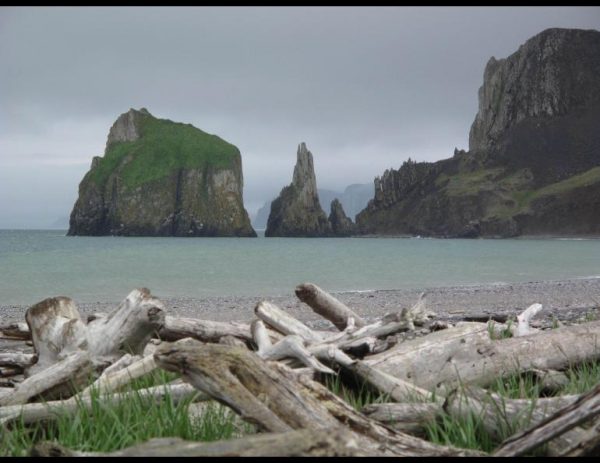
St. Matthew is a sliver of an island that sits in the Bering Sea nearly 200 miles from any human settlement. It’s been described as the most remote place in Alaska.
Humans have found their way to St. Matthew from time to time, but none for very long.
Writer Sarah Gilman went to St. Matthew last year on the research vessel Tiĝlax̂. Gilman’s “The Island That Humans Can’t Conquer” appeared recently in Hakai Magazine.
As Gilman told Alaska Public Media’s Casey Grove, it was a 60-hour ship ride to get to St. Matthew. And that was after flying to Adak, way out in the Aleutian Chain.
The Alaska Supreme Court heard oral arguments in State of Alaska, Dept of Revenue v. North Pacific Fishing , et al. on October 21, 2020. At stake is a raw fish tax that’s shared with coastal fishing towns across Alaska. (Screenshot by Jacob Resneck/CoastAlaska)
Since the 1990s, Alaska has taxed seafood caught by factory trawlers and floating processors through the fisheries resource landing tax. Even though the fish is caught outside the 3-mile line in what’s considered federal waters, it’s often brought to Alaska fishing ports before being loaded on cargo vessels and shipped overseas.
But the Washington state company, Fisherman’s Finest, is now challenging the state’s tax in court, arguing it violates a pair of provisions of the U.S. Constitution that restrict coastal states from imposing tariffs or duties on goods brought into and out of a state.
“Yet the state is here today, asking this court to uphold a state tax assessed directly on goods in export transit,” he said.
Fisherman’s Finest won a lower court decision last year saying the fish tax is unconstitutional. But the State of Alaska has appealed.
Assistant Attorney General Laura Fox told the justices that the framers of the U.S. Constitution weren’t interested in giving some taxpayers preferential treatment.
“Catcher/processor operations take advantage of Alaska to further their business and Alaska’s landing tax merely requires them to pay their fair share for doing business in Alaska like other businesses do,” she said.
“I think they should pay,” Unalaska’s vice mayor Dennis Robinson told CoastAlaska on Wednesday. “They use our services to be able to get their product to market.”
The port city in the Aleutians collected about $4.6 million from the raw fish tax in 2019. Adak was a distant second, receiving about $150,000 during that same period. Robinson said if the tax is struck down, Unalaska could establish its own excise tax. But that wouldn’t do much for the rest of the state.
“As a city, we’d like to see that tax remain in effect,” he said. “And not only for our own interest, but for the interests of the state of Alaska.”
The Supreme Court justices asked only a few questions on Wednesday. It’s not clear when they’ll rule whether Alaska’s fisheries resource landing tax is legal under the U.S. Constitution.
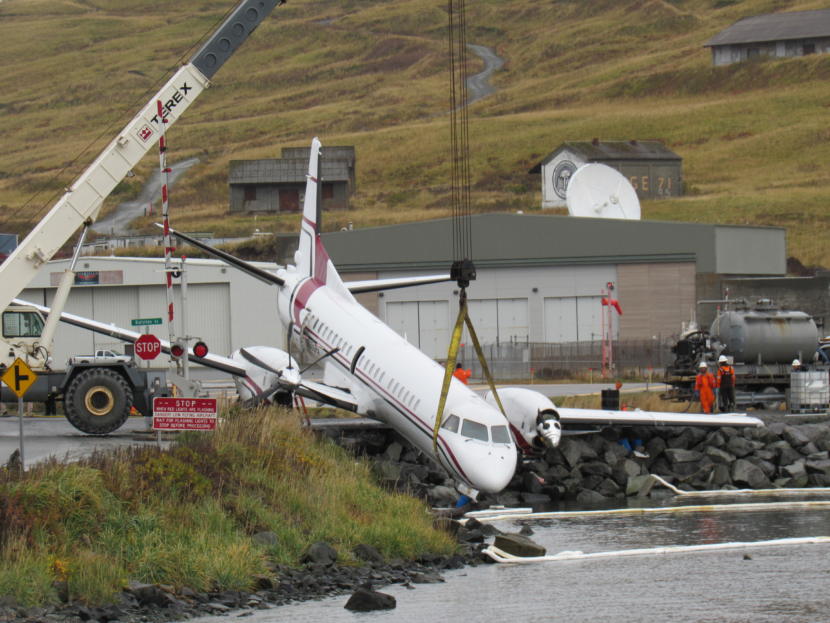
A crane hoists PenAir’s Saab 2000 airplane on Oct. 18, 2019. One person was killed and multiple people were injured when the plane went off the runway while attempting to land the evening before. (Photo by Laura Kraegel/KUCB)
On Oct. 17 of last year, the Saab 2000 plane went off the end of Tom Madsen Airport’s runway. Forty-two people were on board, more than 10 were injured and one passenger died.
The crash was a tragic event for the island and those involved. It marked the start of an unstable relationship and ongoing struggle with access to airline service on and off Unalaska.
“There’s challenges to traveling off the island because of weather conditions and canceled flights,” said Unalaska City School District superintendent John Conwell. “We’ve all gone through that. We’ve had ferry service that’s been disrupted in the past. So, this last year, that’s just been magnified a lot.”
Conwell said the crash amplified many of the concerns local travelers face living on a remote Aleutian island.
He said he is thankful that more people were not killed in the crash, but he also recognized that the event was still traumatic for everyone involved, including the Cordova swim team that was onboard at the time.
Conwell said he’s proud of the way the community supported the students who were stuck on the island overnight, after the crash.
“People started showing up with cases of Gatorade and potato chips and snack food — comfort food that teenagers like,” he said. “And Unalaska students were loaning their cell phones to the Cordova team members so that they could call their families, and so just immediately, people started pulling together.”
In the weeks following the crash, when the island was cut off from commercial air service, the community also pulled together through social media. Andy Dietrick, who owns a drone business called Aleutian Aerials and tourism company Aleutian Excursions, is the administrator on the Facebook group Unalaska Plane Charter Coordination. The group launched about a week after the fatal plane crash. Dietrick said it originated organically, through the needs the community was voicing on Facebook.
“It was mainly just so people could connect with each other when they were trying to coordinate a flight on or off the island in the absence of regularly scheduled air service,” Dietrick said. “Since much of rural Alaska is so prolific with their Facebook usage, it made sense to use that platform.”
Bernadette Oller Namasivayam said the Facebook group is an essential means of coordinating flights for the community. After the crash, Namasivayam said she was frustrated with the airline problems on the island and saw an immediate need for another form of transportation.
“Somebody needs to fly here and help us,” Namasivayam said. “Something needs to be done. I mean, there’s got to be a way.”
So she reached out to several different charter companies, asking them to charter flights on and off the island. Namasivayam said Dena’ina Air Charters was the only company that agreed to help.
She said she offered to help fill planes and coordinate flights and now, with the help of her children, she runs Dena’ina’s local operations.
Namasivayam said she plans to continue coordinating charter flights, even though Ravn Alaska said it hopes to start providing commercial service between Anchorage and Unalaska soon. Last week, the Federal Aviation Administration granted Ravn permission to begin flying charter flights on and off the island. But Ravn currently sits in a two-week window for anyone to show cause that the air carrier is not fit to provide scheduled flights before it can begin serving the area commercially.
Despite Ravn flights on the horizon, Namasivayam said she remains skeptical of larger airlines like Ravn coming to the island.
“The trust is not there,” Namasivayam said. “It’s the fear of not knowing. Are they going to set up a new company again, and then what’s going to happen next?”
Conwell said he looks forward to the convenience of consistent and reliable commercial air travel.
“I just think that it really improves the quality of life out here,” Conwell said. “And I know, as a superintendent who’s responsible for staffing the schools, it’s going to make my job easier, attracting qualified teachers and support staff to come out here and live because it’s a great place to live. There are just a few challenges with travel.”
For Dennis Robinson, who sits on both the Unalaska City Council and Qawalangin Tribal Council, the airport plays an essential role in life on the island.
“The airport is the single largest choke point of this community,” Robinson said. “It affects everything we do. And its ability to function is required in every aspect of island life.”
Robinson said that expanding the airport runway and providing access to safe and reliable air service is paramount to improve the quality of life in Unalaska — from access to comprehensive healthcare to basic comforts like movie theaters or gyms to creating an affordable cost of living.
On Wednesday, the Alaska Department of Transportation and Public Facilities will hold an airport master plan virtual meeting. The agency is seeking public feedback on issues related to future air service in Unalaska.
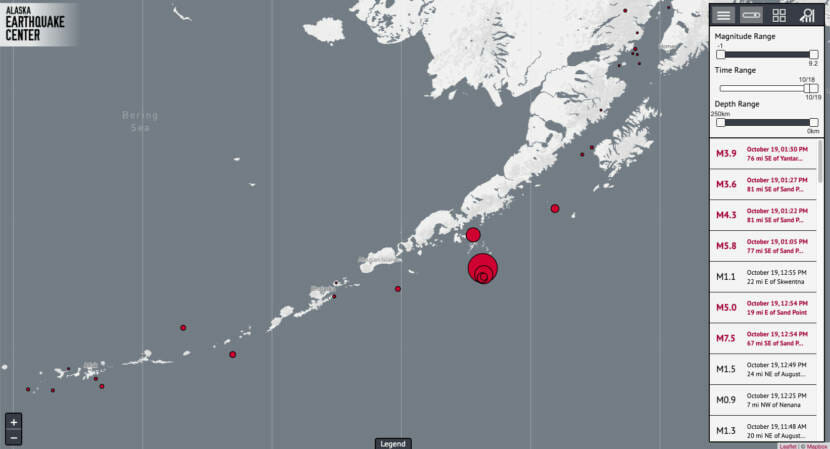
Residents of coastal Alaska, from Sand Point to Kodiak, scrambled for higher ground and motored boats into deeper water Monday afternoon after a magnitude 7.5 earthquake hit near Sand Point and triggered a tsunami warning.
Large waves did not appear, but life in the communities was disrupted by the emergency.
Residents from Unalaska to the Kenai Peninsula reported to the USGS that they’d felt the earthquake. The National Weather Service downgraded the warning to an advisory toward the end of the afternoon.
Raynelle Gardner, who works at the Sand Point School, said residents felt the violent shaking of the first quake. She hadn’t felt any aftershocks because she had been driving, but as she spoke on the phone, she watched the Alaska Earthquake Center website as it ticked off one that rippled through the area.
In the first hour after the quake, the center reported ten aftershocks, including seven of magnitude 5 or greater. The largest was amagnitude 5.9 at 1:45 p.m.
The Sand Point School is the evacuation point for the eastern Aleutian fishing community of just under 1,000 people.
Austin Roof teaches there and is also general manager at the community’s radio station, KSDP-AM.
“The community mostly evacuated to high ground, so it’s hard to tell if any tsunami came,” Roof said. “The last earthquake, there was a small, one-foot tsunami that did happen, so it would have been really hard to tell if that had happened from where we were.”
The National Tsunami Warning Center reported that a small tsunami, measured at two feet, had reached Sand Point at 2:25 p.m., and a smaller wave in King Cove.
A #tsunami with a height of 1.5 ft/0.45 m has been observed at King Cove in addition to the 2 ft/0.6 m wave seen at Sand Point, AK. The tsunami warning remains in effect for South Alaska and the Alaska Peninsula.https://t.co/bJE81DXqcz
Roof said this isn’t the first time they’ve been through the drill this year.
“I guess from the last earthquake we’re all kind of ready for it,” he said. “So it is what it is.”
The “last earthquake” Roof is talking about was another major earthquake that struck near Sand Point on July 22. Today’s earthquake was about 50 miles southwest of that earthquake. According to Alaska’s Earthquake Center, Monday’s earthquake could be an aftershock of that quake.
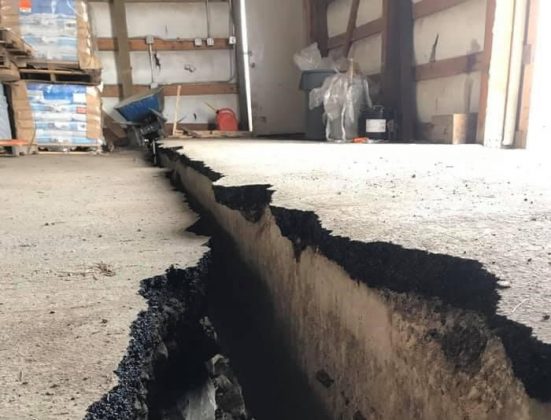
Damage at a warehouse at the old dock in Sand Point (Photo courtesy of David Walls)
Just south of Sand Point, Cold Bay was also under a tsunami warning. Former mayor Candace Nielsen remembered the July earthquake all too well. She said Monday’s quake felt different.
“The earthquake — it was pretty significant. My house was rattling pretty hard,” she said. “It didn’t seem as roll-y as the last one. It was kind of more of a shaker then — the last time, it felt like we were on a wave. And this time, it was just kind of vibrating, roughly.”
Nielsen said Cold Bay’s tsunami warning sirens did not go off.
She found out about tsunami warning through a King Cove Nixle alert on her phone and by monitoring the Tsunami Warning Center’s Facebook page.
“We were surprised. But we’re happy to have one another and be together. And I think mostly just okay. We’ve been having aftershocks. We were all together during the last big earthquake. And so it’s kind of like, ‘okay, you know, here we go again. We’ve done that before.’”
State Seismologist Mike West said the two earthquakes are definitely related. And in this part of the world, it’s not surprising to get earthquakes — even of that large magnitude — relatively often.
It’s one of the world’s major tectonic plate boundaries, where each year the Pacific Plate shoves a few inches under the North American plate that Alaska sits on.
“We build up a whole lot of strain,” West said. “In some sense, yes, we anticipate, we are almost never surprised by a magnitude 7 earthquake — most anywhere along that boundary.”
And while it’s not exactly routine, residents of coastal communities know what to do when they feel an earthquake.
“We know to grab our important stuff and grab the dog and whatever and where to go,” said Kodiak resident Maggie Wall. “We’ve been through it. We’ve had a lot of practice runs.”
Kodiak residents evacuated to the high school during a tsunami warning on Jan. 23, 2018. (Photo by Mitch Borden / KMXT)
Wall said she felt the earthquake from her home about 12 miles outside of town. She works at the public radio station, KMXT.
As Kodiak’s new tsunami warning sirens blared all around her, Wall drove into town.
“There were not very many people on the road,” she said. But, coming up to an area known as Dead Man’s Curve along the coastal highway she found a group of people who had been in the airport.
Airport staff told them to evacuate, shooed them all out and locked the doors, Wall said.
Further along that highway, she saw some boats evacuating as well, motoring out into deeper water — though the vast majority stayed in the harbor.
Most people headed for higher ground near the town’s high school. When Wall got there, she said there were “lots of people milling around.”
The tsunami warning was downgraded to an advisory a few hours after it was issued.
And it’s not the first time this year that’s happened. For the last few years, residents on the coast have felt the quake, gone running for the high ground and waited for a large, destructive wave that ultimately hasn’t appeared.
That routine is something that State Seismologist Mike West worries about.
“I think we’ve had four coastal, yeah we’ve had four tsunami warnings in Alaska since 2018. And none of them happened to generate a deadly tsunami,” he said.
He thinks Alaskans may be lulled into a false sense of security.
“I would strongly caution people not to try and second guess and do their own education about whether or not maybe a large tsunami is coming. That’s what the warning means,” he said. “There really shouldn’t be any questions remaining when the warnings are issued.”
“The plates are locked together and they’re pushing together. They build up a couple of inches, couple of inches and then eventually it ruptures in an earthquake,” West said.
And that process of earthquakes relieving pressure happens all across the Aleutians and southern Alaska. It happens in patches along the plate boundary — on one end and then the other. Then maybe one in the middle.
From the 1930s to the 1960s, through a series of huge earthquakes, West said almost the entirety of the Aleutians and southern Alaska ruptured and readjusted in one way or another — and there were a lot of destructive earthquakes that came out of that, including the 1964 earthquake.
But while all of those earthquakes were happening, there were two places where they didn’t. One is near Yakutat, and the other was the Shumagin Islands, where Sand Point is located.
West said they called it the “Shumagin Gap.” And scientists were essentially waiting for it to crack.
And sure enough, the earthquake that happened in July ruptured that gap. It was the largest earthquake on the planet so far this year.
West said a lot of the scientific community has been debating lately about that massive earthquake and the Shumagin Gap.
“Well, did the whole gap rupture? Did just a little bit of it rupture? Maybe there’s still a little piece that hasn’t ruptured. It’s a tricky place,” he said.
But West said he doesn’t think Monday’s earthquake fits neatly into the picture of the Shumagin Gap resettling. Most of the big earthquakes in this area happen as the tectonic plates grind past each other. But Monday’s earthquake didn’t happen along that boundary — rather, it happened inside the Pacific plate. It’s the same kind of conditions that created the 2018 earthquake that struck Anchorage.
And West said a 7.5 earthquake is nothing to sneer at.
“You know, these are massive earthquakes and we talk about them very casually,” he said. “It turns out in Alaska, the vast majority of our earthquakes happen far away from people, far away from significant infrastructure … so I do think we get lulled into this idea, ‘oh (a magnitude) 7.5 that’s probably not a big deal. That’s probably not a tsunami.’ I do think we dodge a bullet more often than most people just because of our expanse. ”
This is a breaking news story that has been updated.
Rashah McChesney, Ian Dickson of KTOO and Hope McKenney of KUCB contributed to this report.
Correction: Previous versions of this story listed the wrong call letters for the Sand Point radio station – they are KSDP.
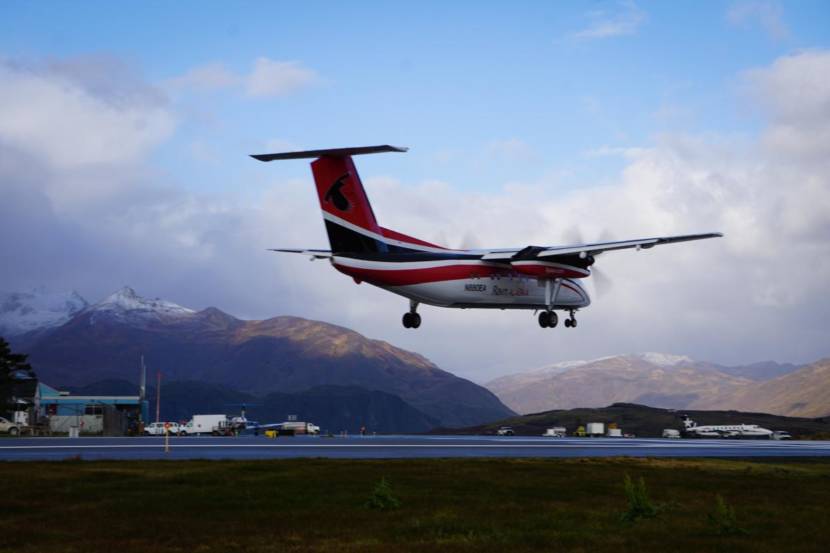
On Friday — for the first time since RavnAir Group filed for bankruptcy earlier this year — a DeHavilland Dash 8 landed on Tom Madsen Airport’s short 4,500-foot runway. (Hope McKenney / KUCB)
Ravn Alaska says it could resume scheduled flights between Anchorage and Unalaska in two weeks, but there’s at least one hurdle left to overcome.
On Friday — for the first time since RavnAir Group filed for bankruptcy earlier this year — a DeHavilland Dash 8 airplane landed on Tom Madsen Airport’s short 4,500-foot runway. And the appearance of a Ravn-branded aircraft could be a sign that regular commercial flights between Anchorage and Unalaska are on the horizon.
On board the aircraft was a nine-person delegation of Ravn executives and Federal Aviation Administration officials. Rob McKinney, CEO of Ravn Alaska, was among them. He leads the company that bought RavnAir Group’s core assets in the wake of its sudden bankruptcy.
“We’ve invited the Federal Aviation Administration to fly with us out here to Unalaska — one of our more challenging destinations — to make sure that they’re comfortable and happy and can see that we are offering a safe service to the flying public,” McKinney said.
It was a dry run to test the Aleutian route before giving the embattled airline the go ahead to resume scheduled air service.
Rob McKinney is CEO of Ravn Alaska, the company that bought RavnAir Group’s core assets in the wake of its sudden bankruptcy. (Hope McKenney / KUCB)
McKinney said he originally hoped to relaunch operations in mid-August. But due to a number of hurdles getting FAA and Department of Transportation approvals in place, the airline shifted the timeline to mid-September and eventually continued pushing the relaunch back.
But on Tuesday, the FAA granted permission for the airline to finally begin flying charter flights, and the DOT issued what’s called a “show cause order,” which opens a 14-day window for anyone to show cause for the DOT not to find the air carrier fit, willing, and able to provide scheduled air service.
The FAA declined a request for comment.
While regulators take public input during the two-week window, McKinney said larger companies will be welcome to charter the 37-seat Dash 8 aircraft round-trip from Anchorage to Unalaska.
“So we’ll be able to, at least, start moving fishermen out here and get prepped for the next season coming,” McKinney said. “So that’s something. It’s not all that we’d hoped for, but at least it’s a little bit of service to get the community back connected.”
McKinney said Ravn has planes and flight crews ready to go, and the airline could start serving places like Unalaska in just two weeks if no formal objections are lodged during the 14-day window.
The airline hasn’t published ticket prices on its website, but McKinney said Ravn is working to codeshare with Alaska Airlines to allow customers to purchase tickets through Alaska Airlines’ mileage program.
“I talk with Alaska Airlines about every week, and they’re eager to start working with us,” he said. “But they want to make sure that safety is what it needs to be. So they’re going to come in and do their own audit of everything that we do and fly on our flights. And then, when they’re ready, they will give us the blessing. But they’ve said it’s their intention in the future that they are going to re-partner with Ravn.”
According to McKinney, the initial plan is to fly Dash 8 airplanes between Anchorage and Unalaska. Eventually, he said, they hope to use larger aircraft — but he ruled out deploying a Saab 2000, the model involved in a fatal plane crash that killed one passenger and injured more than a dozen others on Unalaska’s runway last year.
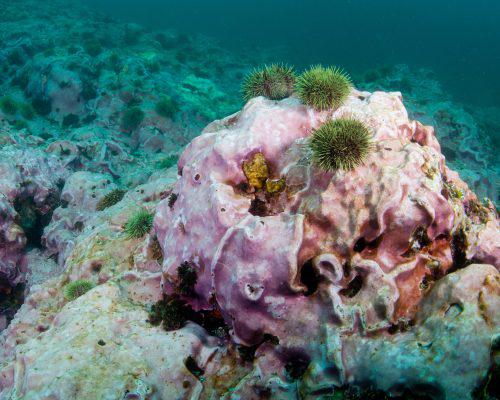
Sea urchins dine on a reef in the Aleutian Islands. Urchins, which boomed after sea otters disappeared, destroyed many kelp forests on the reefs and are now eating the algae-filled reefs that have been weakened by ocean acidification. (J. Tomoleoni / U.S. Geological Survey)
Sea urchins are devouring the massive limestone reefs surrounding the central and western Aleutian Islands — a process exacerbated by climate-driven changes in the marine environment, according to a new study published in Science.
In Unalaska, the largest community in the 1,200-mile Aleutian archipelago, rich kelp beds and curious otters line the island’s shores.
“We’re pretty lucky here — especially in Unalaska Bay — we have a very healthy and, what appears to be, growing sea otter population which is able to keep the sea urchins in check,” said Melissa Good, the local marine advisory agent with Alaska Sea Grant.
According to Good, there are two healthy sea otter populations in the Aleutian Islands — in Unalaska Bay and in Clam Lagoon in Adak. She said the reason the population is healthy in Unalaska is that the otters are protected from orcas due to the infrastructure from the multi-billion dollar fishing industry.
“We see the sea otters swimming around and hanging out, sleeping in the kelp reefs right here in Unalaska Bay, especially in the inner harbor areas which means that orcas are not likely to come in and predate on them,” Good said. “They have protection.”
But in other parts of the central and western Aleutians — starting west of Samalga Pass and the Islands of Four Mountains — a sharp decline in the otter population from killer whale predation starting in the 1990s has led to a boom in sea urchins, according to Brenda Konar, a professor of marine biology at the University of Alaska Fairbanks.
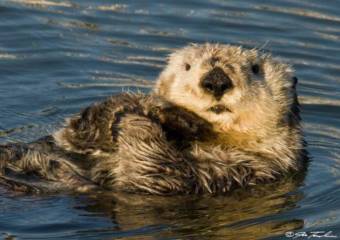
Sea otters are the primary natural predators of sea urchins. (Photo courtesy J. Tomoleoni / U.S. Geological Survey)
Konar says the theory is that killer whales used to eat many of the “great whales,” 13 extremely large Cetacean species. But as many of the great whale species were hunted down, killer whales were forced to switch their prey. So they switched from eating whales to eating Steller sea lions, fur seals and harbor seals, and continued down the marine mammal food chain until they eventually got to sea otters.
In the central and western Aleutians, the otter populations plummeted.
Now uncontrolled by sea otters, their natural predator — the urchin population — boomed both in body size and density.
“The sea urchins can be ridiculously dense,” Konar said. “In a 3-foot by 3-foot section, you can find 400 of these urchins just sitting there, trying to eat away at the kelp.”
Those sea urchins, which are “tremendous grazers” according to Konar, began eating more kelp that grows on the reefs, decimating the vast kelp forests that went on for miles in the Aleutian archipelago.
“And so now you’ve lost the habitat that organisms were normally coming into and living there, reproducing there and eating there,” said Good. “You can think of seaweed-like plants on land as the base of the food web. And so when you have a lot of seaweed out there, you also have a lot of food. And so when you completely get rid of that you’ve eliminated the space for other animals. You have basically clear cut the forest of the sea.”
Having decimated the kelp, urchins are now eating Clathromorphum nereostratum, the algae that create the reefs.
“So first, the kelp forests disappeared,” said Konar. “Now, the reef underneath the kelp forest is disappearing.”
Konar began diving in the Aleutians in the 1990s, just as the Aleutian sea otter population began to crash. She is also a co-author of the new study in Science about what’s happening to Aleutian reefs.
“And what’s happening is, it’s not just that there’s a lot of sea urchins out there eating and digging away at these coralline biogenic habitats, but it’s also that the warming temperature and ocean acidification is weakening these coralline plants and making it even easier for the sea urchins to erode them away,” Konar said.
The research shows that sea urchin grazing has become much more lethal in recent years due to the emergent effects of climate change, according to Doug Rasher, a senior research scientist at Bigelow Laboratory for Ocean Sciences in Maine and lead author of the study.
Large urchins are chomping away at a faster rate than the algae can grow.
“Ocean warming and acidification are making it difficult for calcifying organisms to produce their shells — in this case, the algae’s protective skeleton. This critical species has now become highly vulnerable to urchin grazing, right as urchin abundance is peaking. It’s a devastating combination,” Rasher said.
In some places, reefs that are meters thick and thousands of years old are crumbling from urchins burrowing through the weakened calcium carbonate structures.
“These coral reefs live hundreds and hundreds and hundreds of years,” Konar said. “And so if they’re being eroded as much as they are in just a couple of years, and it takes them a few hundred years to regrow that amount, even if everything stopped today and the otters came back, the urchins got eaten up and everything became rosy again, it would take these coralline crusts a really long time to come back.”
Despite Konar’s uncertainty, Rasher said their study indicates that restoring sea otters to the central and western Aleutians would result in a decline in sea urchins and the recovery of kelp forests.
Close
Update notification options
Subscribe to notifications
Subscribe
Get notifications about news related to the topics you care about. You can unsubscribe anytime.