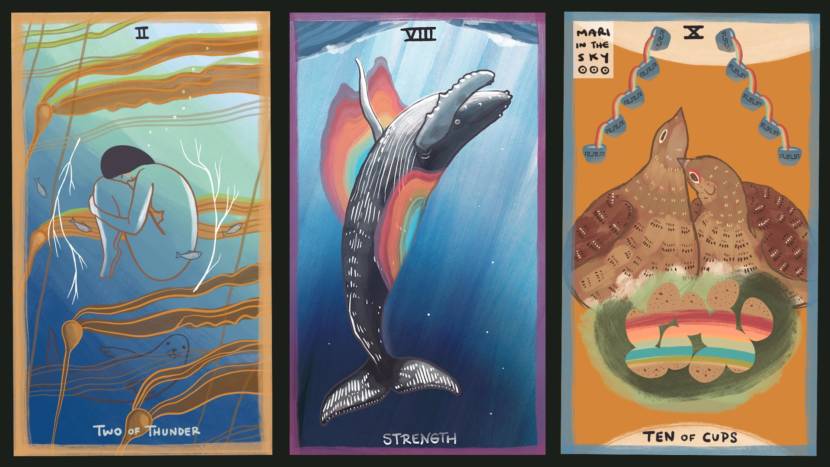
Tovar calls her deck “The Gentle Tarot.” She created it, in part, because she’s been practicing tarot herself for many years and hadn’t come across a deck with artwork that reflected the unique support and warmth she seeks while practicing. (courtesy Mariza Tovar)
People have been practicing tarot for centuries, looking to the cards for guidance and reflection.
And today, you can find any number of themed tarot decks, from cat tarot, to Star Trek tarot, to tiny tarot and tarot for kids.
But local artist Mariza Tovar is putting together a tarot deck filled with humpback whales, grizzly bears, red-faced cormorants and sea kelp — a deck uniquely Alaskan.
“Courage, resolve, patience and tolerance, kindness, the softer power of a loving approach,” said Tovar. “I couldn’t think of a better being than a humpback whale for this tarot card. The rainbow is the cosmic strength that we all have within us.”
Tovar angles her tablet, gesturing softly as she frames the image of a humpback whale draped in a rainbow. She recites the description of the strength card, which features the humpback. It’s one of the 78 cards that make up the tarot deck she has been illustrating since July.
“Our oceans are hurting with rising temperatures and acidification,” continued Tovar. “These gentle giants with their grace and mass — every time, I’m lucky enough to see them they remind me of their soft resilience. This piece is a heart full. I hope you love it.”
Artist Mariza Tovar said the concept for the tarot deck took shape while she was counting sockeye salmon out at the Cape Wislow fish weir this summer — about 20 miles from Unalaska, in Reese Bay. (courtesy Mariza Tovar)
Tovar calls her deck “The Gentle Tarot.” She created it, in part, because she’s been practicing tarot herself for many years and hadn’t come across a deck with artwork that reflected the unique support and warmth she seeks while practicing.
“Every time I’m at a weir, it’s a super creative time of the year, probably the most creative time for me,” said Tovar. “And I used to make a lot of music out at the weir. You’re off grid, you don’t have reception, no distractions.”
Tovar currently works for the Alaska Department of Fish and Game in Dutch Harbor, but spent about three summers working at weirs in Kodiak, one summer at Orzinski Bay on the Alaska Peninsula and now two summers near Unalaska, at Cape Wislow.
She said she’s inspired by what is around her. And while a lot of her tarot deck features Aleutian scenery, she hopes to represent other parts of Alaska as well. Tovar said she is glad to draw from a variety of flora and fauna from her experiences across the state, and specifically to incorporate some larger animals, like bears, which are not found on Unalaska or Amaknak islands.
Courtesy Mariza Tovar
“I feel an energy, and I’m like, what animal would that be?” said Tovar. “So it’s nice to actually have more options.”
Tovar’s creative process is built on patient reflection and research. She said when she’s working on a card, especially when she is out at the weir, she’ll often read a description or two of a specific card before bed and then let that narrative “soak” in her thoughts, overnight.
“And then in the morning, it’s almost like it just kind of shows up in my head,” explained Tovar. “And then I’ll research it a little bit more, like, why do I see a humpback whale? And then maybe I’ll learn more about humpback whales. It’s like we know how to spell out a vocabulary word, but don’t even know what it means, but it’s in there somewhere. It’s kind of like that.”
Tovar’s creative process is built on patient reflection and research. She said when she’s working on a card, especially when she is out at the weir, she’ll often read a description or two of a specific card before bed and then let that narrative “soak” in her thoughts, overnight. (Courtesy Mariza Tovar)
Tovar said that while the deck is a display of what has been immediately around her in recent years, it also translates a unique depiction of the practices and ceremony she grew up with as an Indigenous woman, which are centered on balance with and reverence for nature. And she said she hopes that her deck inspires a similar harmony and reciprocation for those who end up practicing tarot with her deck.
“Like the image for the Two of Thunder, where she’s underwater — it’s like she’s at home in the ocean,” explained Tovar. “It’s reciprocal. She’s held and she’s taken care of there. And we also need to hold and take care of the ocean. I want it to be fluid, the connection.”
Tovar is using kickstarter to fund the tarot project. She said she essentially has 33 days to meet her goal of $12,000. And she’s hoping at least 300 people commit to buying a deck.
While her artwork can be found across the island — at the Museum of the Aleutians, Grand Aleutian Hotel, and even on Etsy — she said this is her first big project, and her first time using crowdfunding. She said she’s hoping to have the project in production by mid-October and to have the final deck, which will come with a unique tarot guidebook written by Tovar, in hand by December.
Tovar said she will be donating a percentage of the proceeds from her Gentle Tarot to ocean and climate change research and planting two trees for every pledge she receives.
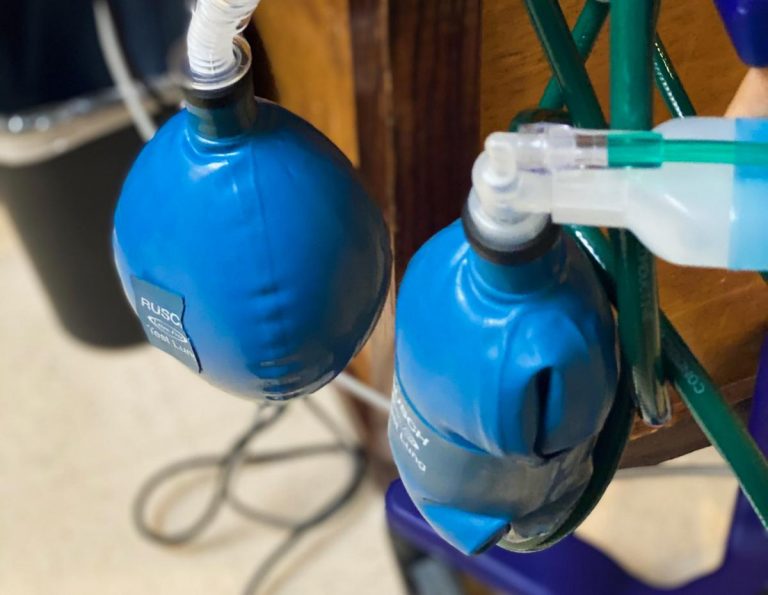
Early on in the pandemic, many medical professionals were saying patients with COVID-19 needed to be put on a ventilator immediately, said Spelsberg. And it seemed like Unalaska, being such a busy fishing port with a highly transient population, would face a shortage of the critical breathing machines, with only three ventilators on island — four, if the LifeMed airplane is in town. (Photo courtesy of Sarah Spelsberg)
Unalaska is the largest community in the state without a critical access hospital, with a population of 4,500 year-round residents that more than doubles during peak fishing seasons.
Early on in the COVID-19 pandemic, medical workers and politicians were unsure how bad the pandemic would get. And concern over the availability of ventilators intensified.
In Unalaska, there are three ventilators at the community’s clinic, and Anchorage’s hospital is a three-hour medevac flight away.
As of Thursday, the island has seen 103 cases of the coronavirus, all of which are travel-related, according to the city. And as the island anticipates the arrival of community spread, Sarah Spelsberg, a physician assistant at Iliuliuk Family and Health Services, has developed a way to double the island’s ventilator capacity through ventilator splitting.
“As I started getting horror stories from my friends [in the medical field], I started panicking a little bit about what are we going to do here if our plan doesn’t work? And if [COVID-19] comes here, and we get a lot of really sick people? What if [we end up like] New York? What are we going to do?” said Spelsberg, as two sets of blue-colored plastic lungs filled with air on a ventilator machine standing next to her at Unalaska’s clinic. “And so I just started reading everything I could find and playing with T-adapters and PVC pipe until I was able to make it work.”
Early on in the pandemic, many medical professionals were saying patients with COVID-19 needed to be put on a ventilator immediately, said Spelsberg. And it seemed like Unalaska, being such a busy fishing port with a highly transient population, would face a shortage of the critical breathing machines, with only three ventilators on the island — four, if the LifeMed airplane is in town.
Spelsberg, who has worked in emergency and wilderness medicine since 1996, decided to take matters into her own hands. She started reading about vent splitting, buying PVC pipe and glue at Alaska Ship Supply to make a prototype, and even reached out to Dr. Lorenzo Paladino, the emergency medicine physician she calls “the Godfather of vent splitting.” Paladino is one of the authors of the 2008 sheep study in which he and several colleagues kept four adult sheep alive on a single ventilator for 12 hours.
“He responded from New York, from the middle of the pandemic, in one of the busiest ERs,” Spelsberg said. “And he responded with ‘Wow, we’re lucky that we actually haven’t had to split vents yet. Anyone who’s needed a vent has gotten a vent. But, man, if anyone’s going to have to do it, it’s going to be you guys.’”
Spelsberg said her work has been a complete “MacGyver situation.”
The clinic first tried to make the ventilator splitter parts on a 3D printer that belongs to the city. But they were unable to achieve the correct taper needed to secure the parts to the machine’s tubing. That’s when Steve Vandeventer, who works for the city’s vehicle maintenance division, was asked to make the pieces on his lathe.
“We make things work,” he said. “And it’s not just me. The whole city does this. If something comes up and it isn’t available, or we can’t find it, we make it or we make it work — one of the two. We don’t say ‘No, I don’t have the part, I can’t do it.’ We come up with a way to do it. We will do it. We have to do it.”
The ventilator splitters make it possible to fill two sets of lungs from each machine, which typically could only support one person. Spelsberg said similar-sized people with similar lung capacity can be hooked up on each side, and it delivers each of them the same amount of air pressure.
While the island has yet to see its first case of community spread, Spelsberg said she hopes the clinic never has to use the equipment. But she’s grateful they’re prepared.
“This could have been so much worse, so much faster for us,” she said. “And because everybody’s working together as a team, we’re doing okay. I feel like we might be New Zealand, and we might be able to catch everything and contain it. That would just be amazing, if we could do that.”
Between the city’s COVID-19 task force, it’s quarantine and testing plan, prepared clinic staff, and the island’s seafood processing plants implementing and sticking to strict mitigation strategies, Spelsberg says the community is as prepared as it can be.
“My friends have always marveled at me that I’m not afraid of anything,” said Spelsberg. “I climb high things. I’m the person who rappels 900 feet down to the car crash. I’ll catch the spider for you. I’ll catch the roach for you. People ask, ‘What are you afraid of?’ And I have always answered, for my entire adult life, ‘A viral pandemic.’ The scariest movie I ever saw was Contagion. Because I was like, ‘Yep, that could happen. And I don’t know what we would do.’ And it’s here. So my job is to try to figure out what’s the worst-case scenario and prevent that, and try to keep as many people safe as possible, and to preserve as much life as possible. From the get-go of this, I just started reading everything, I talked to every expert I know, I built what I thought we would need and I just tried to be ready. And I do feel like for what we are, and where we are, we’re as ready as we can be.”
After a hard year in the community — between a fatal plane crash, the loss of multiple young people, natural disasters and now a global pandemic — Spelsberg said she’s proud of the teamwork that went into splitting the ventilators and preparing for the worst.
“It’s been a crazy year,” she said. “But I feel like it has also shown how amazing the Unalaska Fire Department is, and how quickly they respond, and how well we all work together. They roll into the clinic with a patient, and in any other facility, the paramedics are like, ‘Alright, bye,’ and they roll out the door. Here they stay: One of them’s manning the phones, one of them’s helping us write stuff down and another one’s starting a second IV. I feel like, as awful as it has been — and if I had a magic wand, I would erase all of it, but I can’t do that — so looking at the silver lining of it, it really has given people an opportunity to show us how amazing they are.”
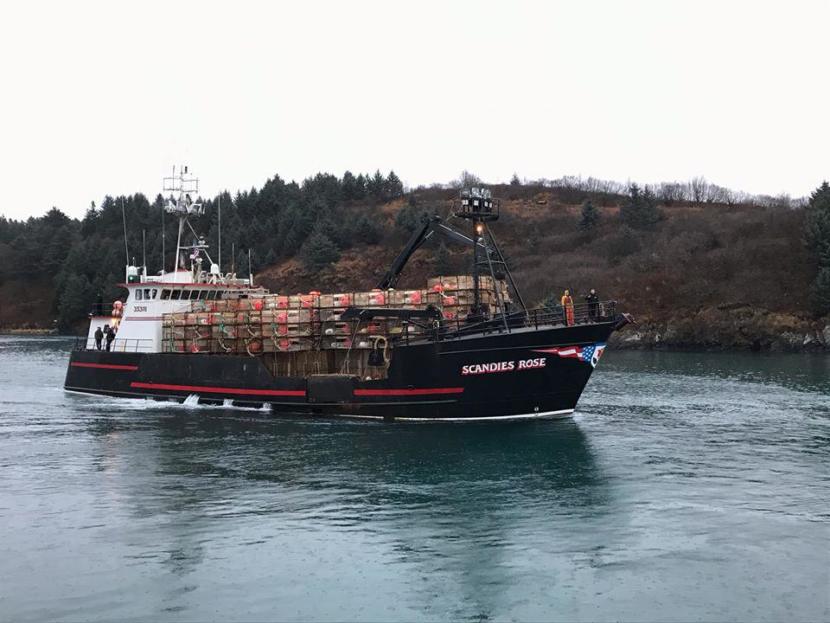
The F/V Scandies Rose, a 130-foot crab fishing vessel based in Dutch Harbor, sank on Dec. 31, 2019 with seven crew members aboard. (Photo by Gerry Cobban Knagin)
The U.S. Coast Guard is seeking help from the public in its investigation of a Dutch Harbor-based fishing vessel that was lost off the Alaska Peninsula along with five crew members.
The F/V Scandies Rose sank on New Year’s Eve about 170 miles west of Kodiak Island while en route to fish for Pacific cod. Two fishermen were rescued wearing gumby survival suits in a life raft. The other five crew members and their 130-foot crab boat were never found.
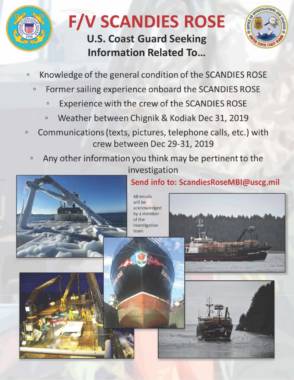
A Coast Guard flyer asks for information about the sinking of the Scandies Rose.
Coast Guard investigators would appreciate anyone with information about the vessel or conditions around the time the ship was lost to come forward, according to Petty Officer Janessa Warschkow.
“Whether that is former sailing experience on board the Scandies Rose, experience with the crew of the Scandies Rose, if you know the weather between Chiniak and Kodiak on December 31 of 2019,” she said. “Any information is helpful for the ongoing investigation.”
Warschkow said the intent of crowdsourcing information from the public is to gather facts to determine what happened, why it happened and identify any corrective measures which can be taken to prevent future tragedies.
“In this day and age, with social media being a very big platform to use for information, we do use social media and this type of thing to try and gather information from the public,” Warschkow said.
The Coast Guard has released very little information about its findings so far. And according to Warschkow, the investigation could take months or even more than a year to conclude. Eventually, she said, the agency will release its findings.
Anyone who has information on the sinking of the Scandies Rose last New Year’s Eve is asked to email ScandiesRoseMBI@uscg.mil.
Correction: A photo caption has been updated to reflect the correct date that the Scandies Rose sank. It was December 31.
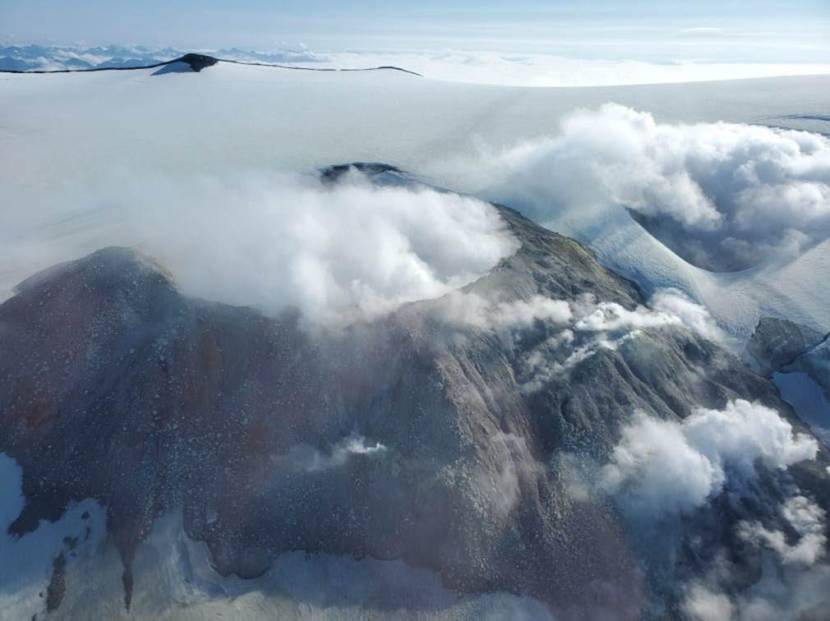
Ounalashka Corp./Chena Power estimates the Makushin Geothermal Project will begin operations in the final quarter of 2023. (Givey Kochanowski / U.S. Department of Energy)
A decades-long effort to bring geothermal power to Unalaska is finally moving forward. On Thursday, the city signed a 30-year power purchase agreement with Ounalashka Corp./Chena Power, LLC for 30 megawatts of geothermal-produced electrical energy from nearby Makushin Volcano. Officials from the U.S. Department of Energy said that if it’s successful, Unalaska would be the first community in the nation completely powered by geothermal energy.
Unalaska has been trying for nearly four decades to find an affordable way to build a geothermal power plant for the city at Makushin. But the plans of private developers have fallen through, largely due to high start-up costs. The last attempt was abandoned in 2015.
“It’s been a long-time priority of the city council to really explore alternative energy sources for electricity,” said City Manager Erin Reinders, who signed the agreement on Thursday. “And this project in particular has been on various radars since the 1980s, at least. So it’s pretty exciting to have the project be as far as it is, and I’m looking forward to seeing what the future holds.”
In 2019, Ounalashka Corp. — the island’s Native village corporation — and Fairbanks-based Chena Power formed Ounalashka Corp./Chena Power, LLC, a partnership to develop the geothermal resource located about 13 miles from Unalaska’s current power grid.
“What makes this [time] different is that we’ve put together a team of Alaskans with a common vision and proven local, national and international business and technical leadership,” said Chris Salts, CEO of Ounalashka Corp. “We know this can be transformational for our community and our future role in the world and we’re all pulling in the same direction to see it realized.”
Negotiations have been underway since early January between the city and OCCP to develop the purchase agreement, which is required to obtain financing for the Makushin Geothermal Project. According to the agreement, the City of Unalaska will purchase electrical energy for $16,300,000 per year from OCCP. Each successive year during the term, the fixed payment will increase by one percent plus an amount equal to the local tax paid by OCCP during the previous year.
But it’s still unclear how geothermal would stack up to Unalaska’s diesel powerhouse, which has been the island’s only electricity provider since World War II. Community members and city leadership have expressed concerns about the financial risk of the project to ratepayers and that seafood processing plants (self-producers of energy) are unable to make a long-term commitment and haven’t come on board.
“Ultimately, this is a public utility that’s paid for by the ratepayers,” Reinders said. “So, there’s a potential that the rates would increase moving forward, so we can pay our bill. But ultimately, those would be discussions that would be held at the [City] Council level.”
According to Mike Hubbard, a city consultant from the Financial Engineering Company, sales to the processors are key to the economics of Makushin. In a report to the council on July 17, he said that the effect Makushin is projected to have on city retail rates as compared to continued use of diesel generation are dependent on a number of assumptions about future events, most notably the cost of fuel.
“If actual fuel prices are greater than the breakeven price, the project would provide benefits to the ratepayers,” he said in the report. “Conversely, if actual prices are less than the breakeven price, the project would result in additional costs to the ratepayers.”
Givey Kochanowski, Alaska senior advisor for the U.S. Department of Energy Office of Indian Energy, helps tribes and Native corporations advance energy interests and promotes energy sovereignty for tribes. He said while fossil fuel rates fluctuate, the beauty of renewable power is that you’re hedging against future rate increases.
“If you look at your average cost of energy here, in general, the trend line is that it’s going to rise in the future,” Kochanowski said. “The beauty about renewables is once you’ve installed the hardware, you have a fixed cost for the fuel, whatever it is — whether it’s the wind, the sun with solar, or geothermal.”
Bernie Karl, co-founder of OCCP, and self-proclaimed “imagineer” of the Makushin Geothermal Project, started the first geothermal power plant in Alaska at Chena Hot Springs in 1998 and will be moving to Unalaska to head up the project at Makushin. He said he’s not “in the least bit worried” about the processors not wanting to buy power.
“It’s just so simple, build it now and they will come,” he said. “I don’t blame the processors for not wanting to sign a 30-year agreement.”
In the long run, Karl said, purchasing geothermal power from the city will be more reasonable for processors than maintaining and running diesel generators. And the more power OCCP sells, the cheaper it gets for the city, and the cheaper it gets for them.
“I think they’re going to be wanting more power maybe than we can produce,” he said. “I think they’re going to want to grow. I think they’re going to want to expand. I think they’re going to see other opportunities, and we will work closely with them to help them with the new opportunities that they see.”
U.S. Rep. Tulsi Gabbard of Hawaii visited Unalaska in late August in her capacity as a major in the U.S. Army Reserve. She came as part of a Department of Defense Innovative Readiness Training mission to assess the island’s future infrastructure needs: everything from what to do with the city’s brimming landfill and the airport’s short runway to shortcomings in health care and slower than average internet speeds.
Gabbard also introduced the Off Fossil Fuels for a Better Future Act, or OFF Act, in Congress in 2017 to promote a “just transition” away from fossil fuels to 100 percent clean energy by 2035. She said she’s excited about the opportunity for geothermal as a clean, renewable source of energy for Unalaska.
“I come from an island state in Hawaii. So I understand uniquely the food security and energy security challenges that exist when you live on an island, where you have maybe five to seven days of food supply at any given time, and where you’re reliant on external sources for energy,” said Gabbard. “The opportunity allows you to increase your food security through being able to power greenhouses and allows you to grow food here year-round. And it’s also directly tied into the security component of this island chain being centrally located in the Arctic region that is now becoming more and more active.”
Kochanowski similarly recognizes the strategic location of the island and believes the first step towards national security is energy security.
One of President Donald Trump’s objectives is to be “energy dominant,” said Kochanowski — a doctrine Trump has championed since the early days of his presidency to reduce reliance on foreign locations for energy sources and instead develop the country’s natural gas, coal and petroleum sources.
Although Trump’s plan attempts to roll back environmental regulations, Kochanowski said the objective of developing domestic energy security is a necessary one. He said it’s especially important in the Aleutians, which are gaining strategic importance as Russia and China work to expand their influence in the Arctic and commercial and leisure/tourism ship traffic increases across the Bering Strait.
“At some point, as we just saw in the news with the Russians being in American waters these last couple days, there’s going to be a need for a stronger security posture up here,” Kochanowski said.
According to the Coast Guard, the Russian ships were in international waters, not American waters, but within the U.S. “exclusive economic zone” — an area that reserves fishing rights for American boats.
The U.S. Department of Defense (DoD) is the nation’s largest energy user and has a goal of producing or procuring 25 percent of its electricity from renewable sources by 2025. According to Kochanowski, Unalaska is making a good effort to engage with the military and key federal agencies that have a say in the community’s security and future, as well as national security due to the island’s location. But, he said, military installations and security points in Alaska require safe, secure and reliable energy.
“When it comes to power, geothermal will bring us the opportunity that none of this other stuff can do for us right now, and that’s bring a diversification of our economy,” said Vice Mayor Dennis Robinson during a City Council meeting in late August where councilors approved a resolution in a 5-1 vote to allow Reinders to sign the purchase agreement. “If we hope to have the military come here in some capacity, green power is going to be required.”
State legislators, city officials and tribal and community leaders have been discussing a greater military presence in the Aleutian Islands. And for the first time in more than 30 years, the U.S. Navy and Marine Corps have held large-scale exercises in the Aleutians designed to test their capabilities in a cold-climate environment.
Kochanowski said there’s a lot happening in Unalaska, between the purchase agreement, the Innovative Readiness Training mission being on the island, a trilateral agreement between the city, tribe and Native corporation. He said although those things may seem independent, they point in a common direction.
“If the Navy were to come here full-time, one of the things that the military looks for — one of the requirements — is to have 25 percent renewable power for their installations. And you’re already on the path with this geothermal project,” he said.
According to Kochanowski, the purchase agreement benefits all parties involved, and cheaper power brings development.
If you look historically, Kochanowski said, major industries come to places that have lower cost of energy: the Tennessee Valley Authority, established in 1933 as one of President Roosevelt’s Depression-era New Deal programs; the ALCOA facility outside of Knoxville; Boeing’s relocation during WWII; the Manhattan Project — they were built in areas with cheap power.
“This community has a great economy with fishing, and an extremely low unemployment rate, but it’s a single focus economy, and I think other economic sectors could potentially come with lower cost energy,” Kochanowski said.
OCCP is now working on securing building permits for the Makushin geothermal project, and on financing the project through a loan through the Department of Energy and through private firms and investment capital, according to Karl.
He estimates that the project will begin operations in the final quarter of 2023.
Unalaska pictured after high winds tore across the island in the early morning hours on August 30, 2020, with gusts recorded as high as 120 mph. The Department of Public Safety issued a travel advisory at 8:30 a.m. due to, “extremely high winds and large flying debris.” (Hope McKenney / KUCB)
A storm early Sunday morning in Unalaska recorded high gusts of 120 mph. The strong winds toppled boats, threw shipping containers into the bay and even blew the windows out of American President Lines’ crane.
The rapidly developing storm, which moved from the North Pacific and across the Eastern Aleutians, was an intense storm for this time of year, according to climatologist Rick Thoman.
“It appears this was the strongest storm to affect Alaska during the month of August on record,” said Thoman, who works for the Alaska Center for Climate Assessment and Policy.
He said in addition to the widespread reports of high wind gusts across Unalaska, there were gusts of around 80 mph reported farther northeast along the Alaska Peninsula and even into upper Bristol Bay.
Thoman said the origin of this storm has been the topic of considerable discussion within the Alaska weather community over the past 24 hours. The storm might have been fueled by Typhoon Bavi, Thoman said, which moved into the Korean Peninsula late last week.
“It raised eastward from north of Japan across the North Pacific, and then crossed the Aleutians near Unalaska,” he said. “The question that we’ve been discussing is was this in any way a piece of, or sparked by Bavi? It certainly wasn’t a classic typhoon turning into a big Aleutian storm, but Bavi may have supplied some energy for this storm that impacted the area.”
This kind of storm is out of the ordinary for the summer months, according to Thoman. He said Unalaska may see similar events happen in October, November or December, but Sunday’s event appears to have had the lowest atmospheric pressure of any August storm on record for the state — which likely contributed to the very high winds across the Eastern Aleutians and Alaska Peninsula. And, he added, a changing climate could also be a contributing factor.
“Most of the North Pacific Ocean surface temperatures are warmer than normal: virtually the entire Bering Sea ocean surface temperatures are warmer than normal,” Thoman said. “It’s not a lot warmer than normal, but with water, even a small difference supplies extra moisture and energy to the atmosphere. So that could have played a role.”
Thoman said the rapidly-moving storm is a good reminder that we’re moving into the storm season. And while he said he doesn’t necessarily expect a repeat of this combination of events, it’s always good for Unalaskans to be prepared.
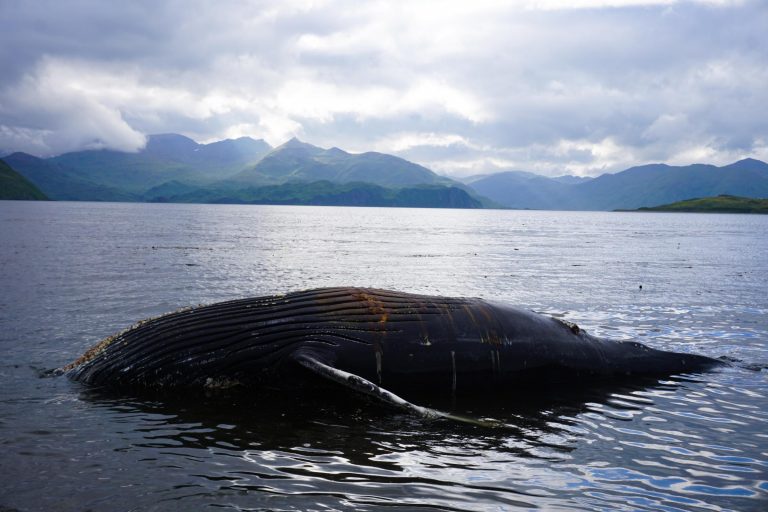
A juvenile humpback whale was spotted in Unalaska Bay on Sunday night. Alaska Sea Grant biologist Melissa Good took tissue samples, but was unable to perform a full necropsy. (Hope McKenney/KUCB)
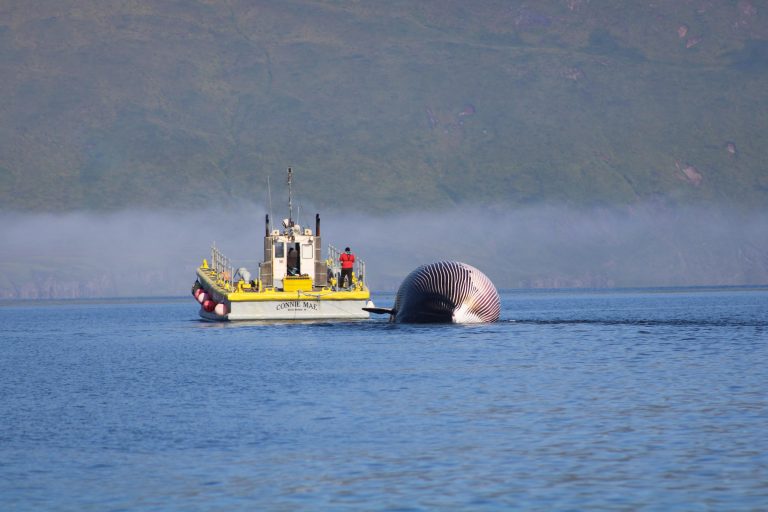
Two dead whales have washed up on Unalaska’s shores in the past week: an adult fin whale — which is the second largest mammal in the world — and a juvenile humpback.
While local biologists hoped to determine the cause of deaths of both whales, they likely won’t be able to because of COVID-19.
That’s because it takes a large team of individuals to do a whale necropsy — or animal autopsy — which would make protecting public health and adhering to social distancing requirements impossible, according to Melissa Good, the local marine advisory agent with Alaska Sea Grant.
“Human safety is always the number one priority,” Good said. “Other places have difficulties with doing necropsies, whether the animal floats into a remote area or there’s bears in the area — you’re always putting human safety first and then going, ‘okay, can we get a sample after that?’ Right now, it happens to be that COVID-19 is at the forefront of all of our minds. And it’s something that we all need to be cognizant about, and continue to protect ourselves and the community. So we just can’t take those risks.”
Unalaska typically sees about one dead whale wash up on its shores every year, according to Good. When that happens, a team of biologists often perform a necropsy to determine the cause of its death.
But when the dead fin whale showed up floating in the waters of Captains Bay near Westward Seafoods on Friday, and a juvenile humpback washed up on the shores of Unalaska Bay on Monday, Good said biologists were unable to do the necropsies because COVID-19 prevented a large enough team from coming together to perform the task.
Good said that, with support from the Alaska Department of Fish and Game and NOAA Office of Law Enforcement, she was able to collect skin, blubber, and muscle samples from both whales, as well as some fluid from the juvenile humpback’s eye, to send to the state pathologist.
“We weren’t able to do a full necropsy,” she said. “I was able to take a tissue sample [of] skin and blubber, and we’ll be able to look at the skin and get DNA work off of that, and you can get some toxins from the blubber. So we’ll have a small bit of information on the whale.”
Good said the biologists looked for signs of human interaction with both baleen whales that would indicate human involvement in their deaths. But, she said, they didn’t see any fishing lines wrapped around them or any obvious signs of scarring or cut marks due to an entanglement.
“We could have missed something because we couldn’t see the whole body. But there wasn’t really anything obvious right up front,” Good said. “That certainly doesn’t eliminate other human interactions like vessel strikes or anything like that. But we just weren’t able to get that close of a picture of it.”
The juvenile humpback did have a small 5-inch rupture along its throat region, Good added. She said she’s not sure if the rupture was caused by gas buildup as the whale decomposed, or whether it was caused by human interaction, like a vessel impact.
Although they chose not to in these cases, the Qawalangin Tribe often harvests meat and blubber from whales that wash up on shore, which Good said could have provided a great opportunity to get samples to see if paralytic shellfish poisoning or other toxins were a factor in the whales’ deaths.
“We could have gone in with a very small team and possibly gotten some samples that could have been telling,” she said. “I would have been really interested in fecal samples or urine or stomach samples to see if PSP was an issue in this case. That would have been some information we would have looked for and sought after, but we just didn’t have that opportunity.”
In July, Alaska state and local health officials started warning of dangerously high levels of toxins in shellfish after a person died of PSP from mussels and snails in Unalaska. And, Good said, larger mammals like whales can die from ingesting algal toxins.
She said she would have some concerns about people harvesting these two whales for subsistence because they don’t know when or how they died. And, she added, because they were unable to perform necropsies, they probably never will.
Good considered it a missed opportunity. While a dead humpback generally washes ashore once a year, she said she hasn’t seen a dead fin whale in Unalaska since she took her position with Alaska Sea Grant six years ago. Although Unalaska is within their natural range, she said fin whales tend to stay offshore and don’t generally come into the bay.
The fin whale was towed to Wide Bay after biologists took blubber and skin samples to send to the state pathologist. (Maggie Nelson/KUCB)
“Outside of COVID times, we could have flown in a very experienced veterinarian team that would really help us get down and make sure we’re collecting the right samples,” Good said. “And I know there’s a lot of willing people here in the community that would step in and help out with the necropsies — the Qawalangin Tribe would certainly step in and help with that. And so we have the people here that can do it, and it’s definitely a missed opportunity. But no matter what we do, human safety is always the number one priority.”
Although this marks two dead whales washing up in Unalaska in the past week, Good said she can’t speculate if the two deaths are related.
According to the state pathologist, they will process the samples from the two dead whales to confirm things like species and sex, but they will likely be unable to determine cause of death without a necropsy.
Close
Update notification options
Subscribe to notifications
Subscribe
Get notifications about news related to the topics you care about. You can unsubscribe anytime.