High water on the Mendenhall River and erosion may force the Juneau park officials to close the Kaxdigoowu Heen Dei Trail, aka the Brotherhood Bridge Trail.
Erosion is occurring very close to the paved trail, about 500 feet from the trailhead, according to a Juneau Parks & Recreation release.
Park staff are monitoring the situation. For now, they advise using caution and staying on the paved trail in the area.
If it becomes unsafe, it may be closed and an alternative route made. The trail will be posted with directions if conditions change.
Contact on-call Parks & Rec staff at 957-6650 with concerns. For more information, call 586-5308.
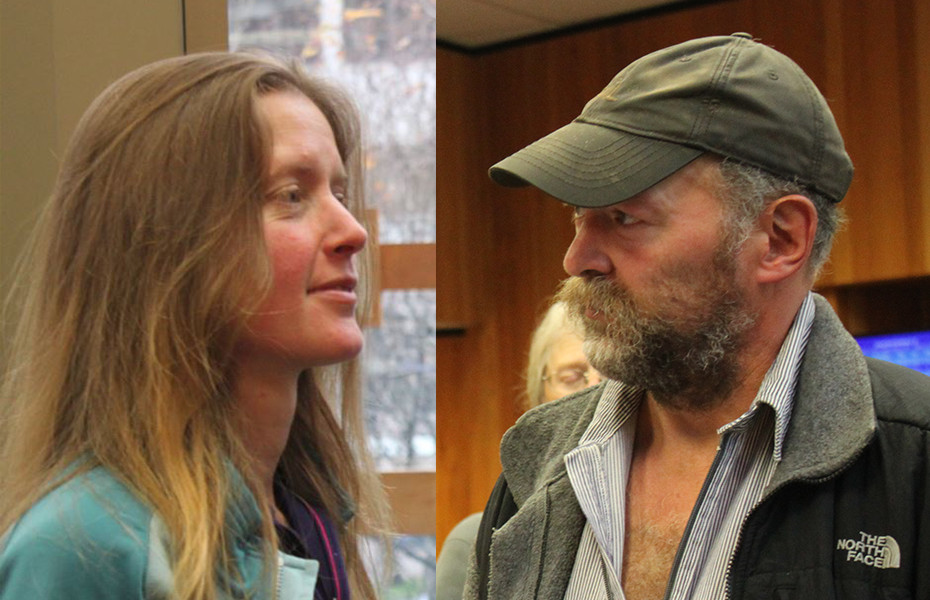
A photo composite of hiker Kathleen Turley and trapper John Forrest. (Photos by Lisa Phu/KTOO)
In a small claims case between a trapper and a trap springer, a judge found the trap springer liable, but didn’t award any damages to the trapper.
Trapper John Forrest sued hiker Kathleen Turley for springing his lawfully set traps on Davies Creek Trail in Juneau. Turley had made headlines in January for also freeing a bald eagle from two traps.
In his decision, Judge Thomas Nave addresses each trap Kathleen Turley admitted to springing last December.
Nave wrote that Turley was justified in springing the marten trap closest to the unintentionally caught eagle she was freeing.
Regarding the other trap near the trailhead that she sprung twice over two days, the judge didn’t find Turley justified. In her concern for dogs and other hikers, Nave wrote, “Other alternatives existed.”
Even though Nave found Turley liable, he stated John Forrest failed to prove his damages during the small claims case that took place over two days. Forrest had testified he was owed up to $750 but Nave wrote he offered no evidence, like a weekly log of what animals he traps.
Forrest’s lawyer Zane Wilson asked for an additional $500 in punitive damages. That was denied as well because he didn’t prove Turley sprang the traps out of malice.
Turley saw the decision as a win-win. She was relieved because she doesn’t have to pay anything toward what started out as a $5,000 complaint. And she hopes it’ll make Forrest and other trappers happy.
“They wanted to make a point that it’s not OK to spring people’s traps and they’ve made that point because they won as far as that goes,” she said. “And for me, it’s more important that I didn’t have to pay anything.”
Turley said the whole experience has been frustrating and stressful and she’s glad it’s over. She stands by what she did, but said, “I definitely don’t condone springing traps. (The) situation I did it in were extreme circumstances but I don’t condone springing traps just because they’re inconvenient to you or because you feel like they shouldn’t be there.”
Her lawyer Nick Polasky, who took the case pro bono, called the judge’s decision “splitting the baby” and wrote in an email “each side has something to be pleased with.”
Neither Forrest nor his attorney Zane Wilson returned calls for comment. Pete Buist, a spokesman for the Alaska Trappers Association, was pleased with the decision, “As a trapper, as a guy who occasionally speaks for trappers, I think it’s pretty good.”
Buist said it’s unfortunate Forrest didn’t get an award for damages, but he calls the decision fair.
“The bottom line was this was not about an eagle, nor was it about money. It was about showing the defendant–and the DA for that part–that we’re a country of laws. There’s a law that you can’t do those sorts of things and she ignored the law and went ahead and did it,” Buist said.
Alaska Wildlife Troopers originally cited Turley for illegally hindering lawful trapping, but the district attorney asked for the judge to throw out the case.
Buist said the whole situation has spurred interest for trappers in Juneau to organize.
“They held a little meeting in Juneau about forming a formal trappers association or a chapter of ATA in Juneau so people could sort of stick together,” Buist said.
He says it would help trappers to communicate with each other, help coordinate efforts to work with other trail users, educate trappers about where they should and shouldn’t trap and educate the public about the law that says you can’t just go around springing traps.
The Juneau teachers’ union and the school district Wednesday night reached a tentative agreement on a one-year teachers’ contract. It includes a 2 percent pay increase, though the district won’t say what the budget impact would be.
Sara Hannan is a teacher at Juneau-Douglas High School and the bargaining representative for the Juneau Education Association. She said the 2 percent pay increase isn’t that much, but she hopes it’s something the union members will be happy to see.
“I’m pleased that the district recognizes that when you are in the business of educating people and your biggest cost is your professionals, you have to keep them moving forward even if it’s a little tiny bit because that negativity translates into people leaving and underperforming. So, it’s not a huge increase, but it still makes them feel like we’re moving forward,” Hannan said.
Of the 2 percent increase, 1 percent applies to the pay schedule and 1 percent is temporary for this fiscal year.
Hannan said the tentative agreement also includes a change in how years of experience are counted for certain specialists, like school psychologists and physical therapists–positions the district has trouble filling.
The district’s pay schedule for teachers is based on years of experience–the more experience, the more pay.
“But we only counted years of experience in a school setting. So if you worked at the hospital and been a speech pathologist, that didn’t count, and now it will. So we do think it’s going to make us a much more competitive district,” Hannan said.
Another change will affect teachers of students with Individualized Education Programs, or IEPs. These teachers have to attend many meetings, often outside of the work day. Now, they’ll receive some compensation for that time.
“For many, many years when we’ve discussed it with the district, the dialogue has surrounded, ‘This is your professional responsibility,’ and we’ve all acknowledged that, but what we’ve come to find is that it’s not an equal responsibility. There are some people who it’s not a once in a while kind of thing, it’s a very regular, perhaps weekly kind of obligation,” Hannan said.
Something the union wanted but did not get was more class prep time for elementary teachers. High school teachers get up to 75 minutes, middle school teachers get 90. Elementary teachers only get 30.
“No elementary teacher is only preparing 30 minutes a day. They’re preparing hours and hours each day. They’re only being compensated for 30 minutes of it and the rest of it is coming out of their sleep time. I go to the pool every morning between 6 and 6:30 a.m. and when I drive by Harborview Elementary School, there are classroom lights on,” Hannan said.
To negotiate, the district and the teachers’ union used a new process called interest-based bargaining, or IBB, which is more collaborative and discussion-based. Hannan said it’s too soon to say if it went well, since she doesn’t know yet if the teachers will be happy with the tentative agreement. Ted VanBronkhorst, human resources director for the Juneau School District, said he liked the process and hopes to continue it when bargaining starts again in the spring.
“It’s been a while since JEA and the school district have been able to come to an agreement without the assistance of an outside mediator. So I think the IBB process worked for us. We’re very pleased with how that was successfully implemented in this case and we’re hoping to build on it in the future,” said VanBronkhorst.
VanBronkhorst did not say how this contract would affect the school district’s overall budget. He said that information could prejudice the union’s vote.
Members of the teachers’ union will see the tentative agreement next week and they have one week to look at it. If the union votes it through, it then goes to the school board for approval.
Editor’s note: A previous version of the story had inaccurately stated the tentative agreement was reached Tuesday night; it was actually reached Wednesday night.
Judge Thomas Nave has sided with the trapper John Forrest in the small claims case against a woman who sprung his traps. While he sided with the trapper, he didn’t impose any cash award. Nave wrote that Forrest failed to prove any damages.
The trap springer, Kathleen Turley, was pleased with the outcome.
Each side is responsible for their own attorneys’ fees.
Original story | 12:00 a.m.
A Juneau judge heard closing arguments in a small claims case between a trapper and a trap springer Thursday afternoon.
On Thursday, only the lawyers spoke. Forrest is being represented by Fairbanks attorney Zane Wilson. Turley’s lawyer is Juneau-based Nick Polasky.
Wilson questioned Turley’s honesty; Polasky questioned whether Forrest’s traps were set in a safe manner. Both had a different interpretation of the statute on hindering lawful trapping.
An opinion by District Court Judge Thomas Nave is forthcoming.
“When you read it, no matter who you are, please keep in mind the fact that it will represent what the law requires. It will not represent any notions of approval or disapproval on my part of trapping or any passion or particular point of view consistent with Ms. Turley’s. It will be a strict application of the law and I hope that when you read it, it will be self-evident that it’s objective and fair,” Nave said.
Turley has admitted to springing a total of three traps. She said she did it out of safety for hikers and dogs. She also freed a bald eagle that was caught in two other traps belonging to Forrest.
Alaska Wildlife Troopers had originally cited Turley in January for hindering lawful trapping, which carries up to a $500 fine and 30 days in jail, but the state dropped its case.
Forrest is asking for an award of $1,000-$1,250 in damages.
Nave says he’ll have the written opinion out around noon Friday.
From the stage at the 2013 Grand Slam. (Photo courtesy Christy NaMee Eriksen/Woosh Kinaadeiyi)
The 5th annual Woosh Kinaadeiyi Poetry Grand Slam is Saturday. Spoken word poets have been competing for the last year and now the best of the best will perform and vie for the top spot.
You can begin to misbehave by starting small.
Stroll the city and don’t use the crosswalks. Talk to strangers. Bite hard candies. Check out a huge stack of books from the library and disregard the due dates. Bring a dozen rainbow-sprinkled doughnuts to work and don’t share them.
These are words from Woosh K co-founder Christy NaMee Eriksen’s “A Good Girl’s Guide to Misbehaving.”
Christy NaMee Eriksen. (Photo by Daniel Kantak)
After awhile,
you can try staying up past your bedtime.
When your alarm goes off, push snooze every 5 minutes for an hour.
Transition into the morning by daydreaming. Have ideas with your coffee.
While she won’t compete this Saturday, she’ll voice this piece as one of several opening performers at the Juneau Arts and Culture Center.
“It sounds so aggressive, the idea of a poetry slam. But it’s actually kind of been dubbed the friendliest competition in town. It really is about being able to share our word, share our stories in a very supportive, inclusive environment,” she says.
Eriksen says there can be differences between traditional poetry and what people can expect to hear at the grand slam.
“Spoken word is written with the intent to share it with others. So it’s different than maybe what you write in a diary and hide under your pillow. It’s work that you are willing to give to an audience and are willing to kind of perfect it in a way that makes sure that what you’re trying to convey gets conveyed,” she says. And its roots are varied.
“It’s come out of really rich traditions of hip-hop, resistance and social justice, so a lot of times spoken word poetry has been used as a voice for people who maybe don’t otherwise feel like they have a voice in community, or artistic circles—in the literary scene—whatever. And for that reason is why spoken word has always kind of been a hook for me personally. It’s been kind of my language of liberation is what I often say. I can say things in poetry that I can’t say in English, you know, sitting with someone,” she says.
On stage, Eriksen will be joined by hosts Conor Lendrum and KXLL’s Annie Bartholomew, the Woosh K House Band, Dee Jay De Rego, Amy Pinney, Caroline Garcia, Ziggy Unsicker, Erika Bergren, Fysh Houck, Mike Christenson, David Parish, Maureen Longworth and Christina Apathy.
The Grand Slam begins at 7 p.m. Saturday at the Juneau Arts and Culture Center. Admission is pay as you can.
Listen to Eriksen read “A Good Girl’s Guide to to Misbehaving” here:
Close
Update notification options
Subscribe to notifications
Subscribe
Get notifications about news related to the topics you care about. You can unsubscribe anytime.