Juneau

Thane Campground closes for winter, displacing homeless

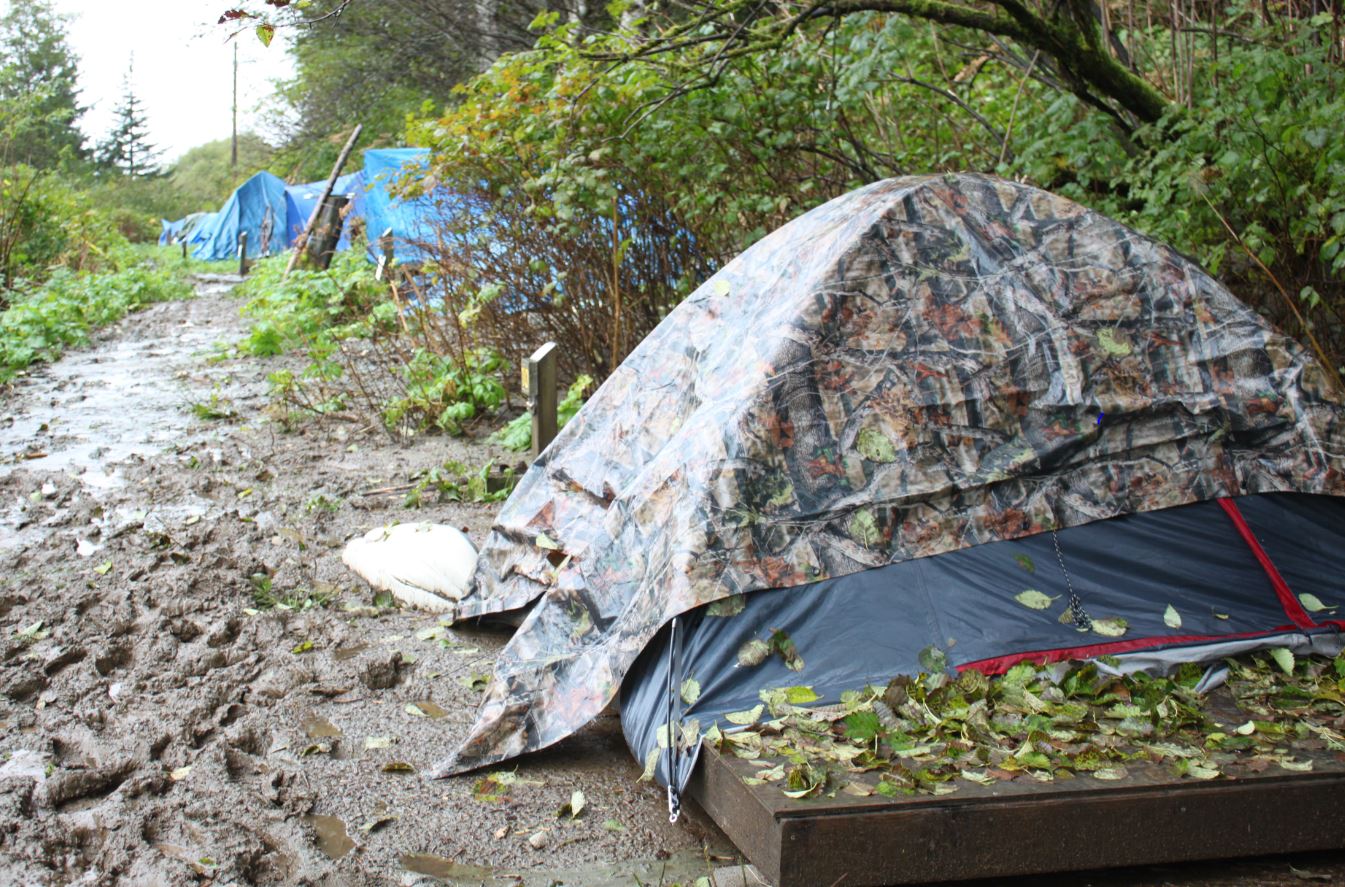
The Thane Campground is primarily used for housing, not recreation. It closes for the season Oct. 15. (Photo by Lisa Phu/KTOO)

Several of Juneau’s homeless live at the city-run Thane Campground. For $25 a week, it may be the cheapest rent in town. Today, the campground closes for the winter, leaving some occupants wondering where to go.
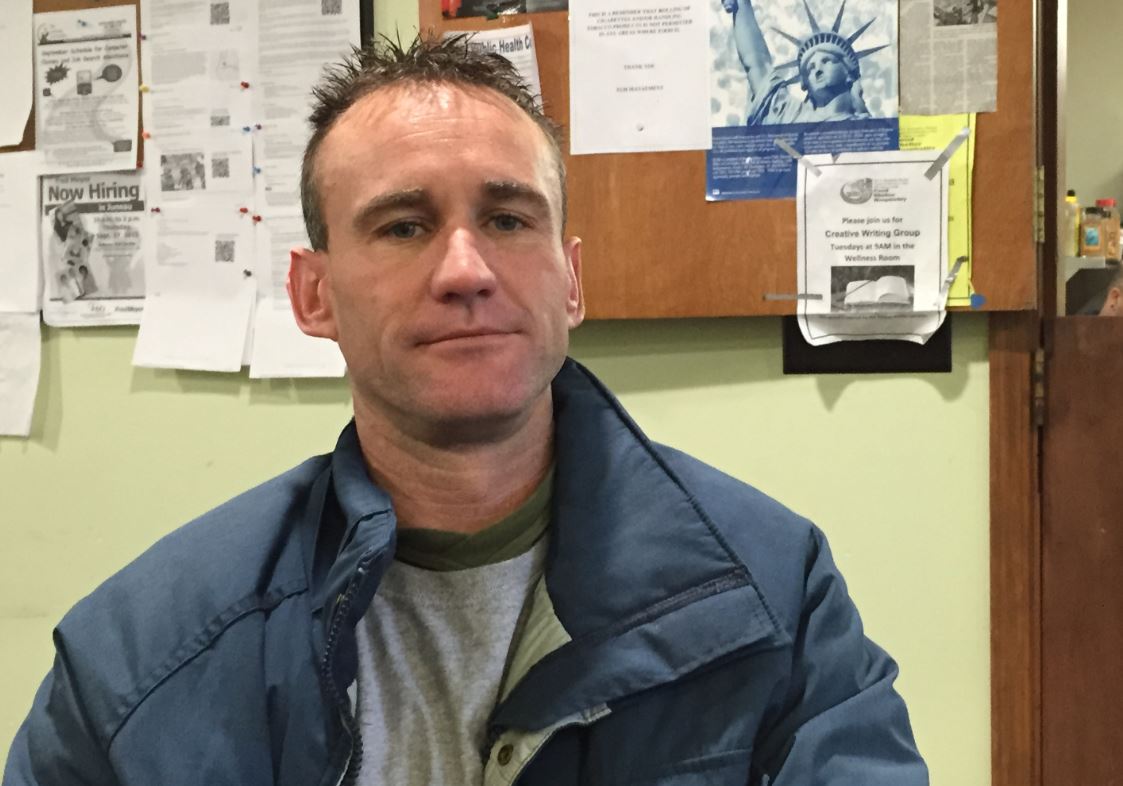
Elliot Scott spent this past month living at the Thane Campground. (Photo by Lisa Phu/KTOO)

Elliot Scott, 33, moved from his hometown of Bakersfield, California, to Juneau in April.

“It’s a good place to get a new start, to be able to better your life,” Scott said.

In 2004, Scott was arrested for a felony in California. After serving three years, he found himself in and out of jail more than 20 times for parole violations, “It just happens over and over and over and over and over, until you finally get out of the system.”

Scott got off parole in April. He took a job with Alaska Canopy Adventures and lived at the Prospector Hotel for an employer-subsidized rate of $450 a month. When the tourist season ended, so did the housing.

With a tent, a tarp and a sleeping bag, Scott moved to the Thane Campground about one and a half miles from downtown Juneau.

Scott works at Western Auto Marine, takes a marine transportation class at University of Alaska Southeast and wants to get his captain’s license. He’s paying out of pocket because the course doesn’t qualify for financial aid.

“Going back to school cost me $1,100 and being homeless,” Scott said.

On top of tuition, Scott is paying off criminal fines in California.

“If you add that into the equation of housing and gas and food, it’s like a house payment,” Scott said.

He does laundry and takes showers at the downtown laundromat.

“When I go to work, I’ll go take a shower and I get nice and cleaned up. Nobody ever knows,” Scott said.

At about $8 for a load of laundry and $2 a shower, “It adds up quick, but you got to do what you have to do.”

When the Thane Campground closes, Scott isn’t sure where he’ll live.

The City and Borough of Juneau leases the Thane Campground land from AJT Mining Properties, owned by Avista. According to the lease, the purpose of the campground is to provide campsites with proper facilities for seasonal housing during the temperate months of the year. Its primary goal is to provide housing, not recreation.
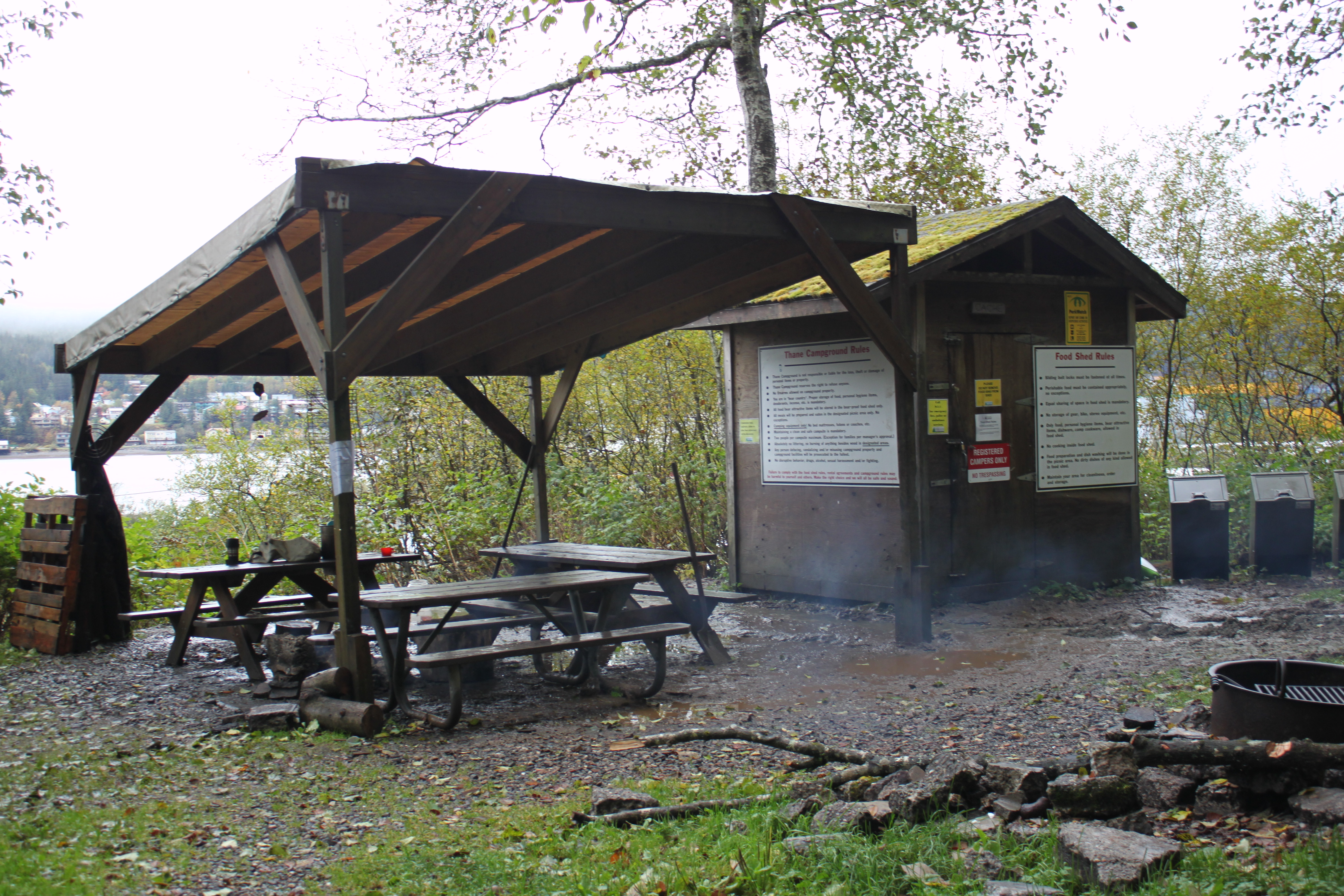
Thane Campground facilities include portapotties, a covered dining area, trash cans and a food shack. (Photo by Lisa Phu/KTOO)
Thane Campground facilities include porta-potties, a covered dining area, trash cans and a food shack. (Photo by Lisa Phu/KTOO)

“It’s kind of a placement for those that don’t really have anywhere else to go. Just somewhere that they can stay temporary where they know that if they’re able to follow the rules that they can stay at a relatively good price,” said Chris Day, administrative assistant for Juneau Parks & Recreation, which runs the campground.

On its last night before closing, seven of the 18 available camp spots were occupied. Day says three people have stayed at the campground the entire season. Others stay for one or two months. From mid-April to mid-October, he says the campground is usually more than 80 percent full.

Besides the Thane Campground, there aren’t other options in Juneau for long-term camping with facilities on public run land. State and federal campgrounds limit stays.

U.S. Forest Service Recreation Program Manager Ed Grossman said the campgrounds are not for permanent occupancy, “We’re in the recreation business. We’re not in the seasonal housing business, no matter what your situation, whether you’re homeless or low-income job or whatever.”

Mariya Lovishchuk, executive director of Juneau’s shelter and soup kitchen, gets worried when the Thane Campground closes. She says some who live there are considered at risk of dying prematurely, including a 65-year-old man she recently interviewed as part of a homeless survey.

“What closing the campground will mean is that he won’t be in one place. He’ll have to move several times because he’ll camp somewhere and then somebody will inevitably find the camp,” Lovishchuk said. “It’s so hard to set up a camp in the winter and to find stuff. In the summer, it’s less critical because you have more time and resources and body energy to survive the elements and in the winter, you really don’t.”

For Elliot Scott, he has a month left in his marine transportation course. If he doesn’t find proper housing by the time that ends, he may leave Juneau.

In the meantime, he’s looking for another place to camp.
Totem poles slated for Douglas mark ‘A Time for Healing’

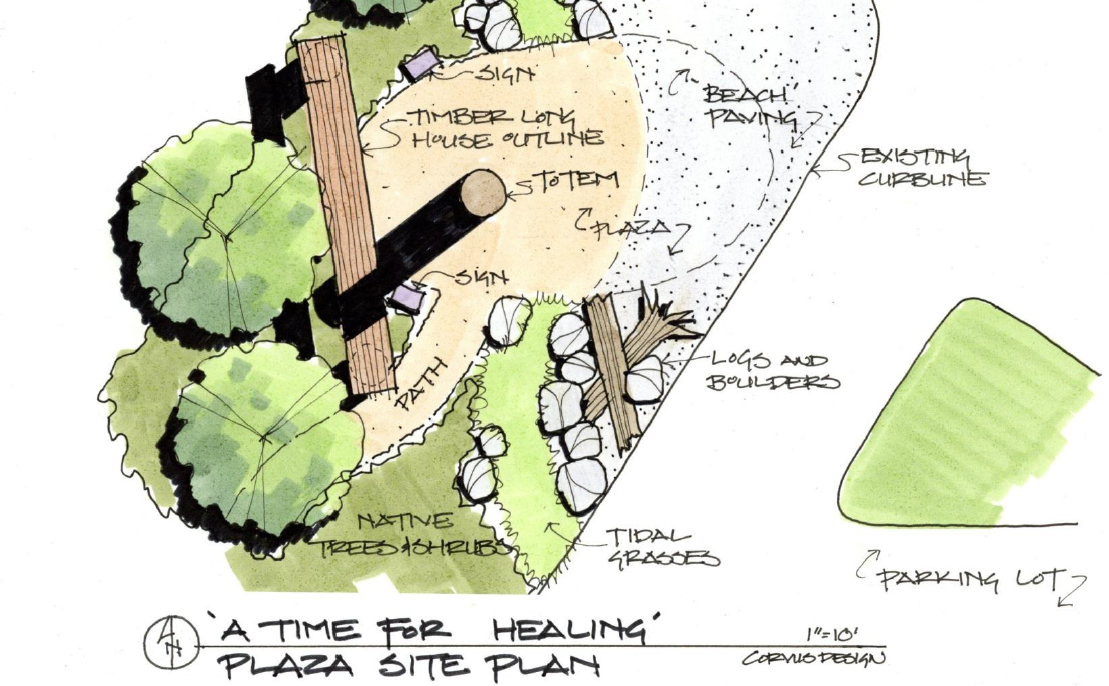
A tentative design of the Native plaza at Savikko park. (Photo courtesy of Corvus Design)

Savikko Park and Gastineau Elementary School will be the future sites of two totem poles. Plans include interpretive signs in Tlingit and English, explaining the history of the original people of Juneau and Douglas: the Aakʼw Ḵwáan and Tʼaaḵu Ḵwáan. Technology also plays a part in telling the story.

In 1956, the site of the Douglas Indian Cemetery was paved over near the elementary school. The Douglas Indian village was burned in 1962 to make way for a new harbor. Signs near Savikko Park explain the history of the Treadwell Mine, but there’s nothing about the area’s Native people.

Now there’s a project to change that. It’s called A Time for Healing: A Gaawooya Yei Shtoosneixhji.

John Morris remembers the spot where his house once stood. (Photo by Elizabeth Jenkins/KTOO)

The Goldbelt Heritage Foundation was awarded over a million dollars from the U.S. Department of Health and Human Services.

John Morris of the Tʼaaḵu Ḵwáan saw his village destroyed back in 1962.

“In my lifetime, I have not seen a Native totem pole placed in Douglas, so that’s really good news,” he said.

Morris, a tribal leader in the Douglas Indian Association, is on the design team for the totems. As the final plans come together, he says he doesn’t want the poles to reflect anything negative. It’s not what the poles are historically intended to do.

“My vision of the totem pole is going to be more of a welcome totem pole with the crest figures of the Tʼaaḵu Ḵwáan Yanyeidí people, which is of the Eagle-Wolf design.”

He says the poles could include other Native people in the area, like the Aakʼw Ḵwáan  and Wooshkeetaan.

The other part of the grant helps fund exhibits at the Juneau-Douglas Museum. The carving of the totems will be documented through photos and videos. Later, an $18,000 touch-table can provide museum-goers with an interactive experience.

“For example, if it were a map of the Douglas Indian Village you could touch a portion of it and it zooms into part of the screen. So it’s however you program it,” said Richard Steele, a grant writer at Goldbelt Heritage Foundation.

He’s been working with Jane Lindsay, the museum’s director, on how technology could play a role.

Lindsay came up with idea of the touch-table after seeing something similar at the Haines Library. And she’s excited the stories of the Aakʼw Ḵwáan and Tʼaaḵu Ḵwáan will be featured in a permanent exhibit.

“You know, we’re looking at some pretty important history in Douglas and for the Douglas Indian Village and for all of the local Native people here that we really need to talk about,” Lindsay said.

The totem poles are slated to go up in 2017. The touch-table is planned for 2018. A Time for Healing culminates in a community-wide celebration later that year.

Juneau organizer hosts discussion on addiction, recent deaths

Juneau has suffered six heroin-related deaths this year. The public is invited to share stories about addiction and discuss solutions at Wednesday night’s Community of Compassion gathering.

Grace Elliott, the event’s organizer, said the losses hit home. A family friend died of an overdose recently. He was dancing at her daughter’s wedding just weeks before.

“What we want is a space that people can gather in, that it’s a safe space for people to talk about their own experience, how they’re affected by this,” Elliott said. “A lot of the people who are coming already are family and friends of people who have died recently. A lot of these people are in their 20s.”

The Juneau Police Department is conducting a six-month anti-heroin initiative to help answer questions about why users start and why it’s so difficult to kick.

Police typically don’t send out press releases about heroin deaths. However, they released one on Oct. 5 after Robert James Hanson died in his family home. Hanson’s mother gave specific permission because she was distressed about the large number of overdoses in the capital city.

Grace Elliott said by talking, she hopes addiction can be de-stigmatized.

“So that we can have a realistic view of what the condition is in our community and then, thus be able to address it,” Elliott said.

Community of Compassion runs from 5 to 8 p.m. @360 in KTOO.

Trapper and hiker take the stand in first day of small claims trial

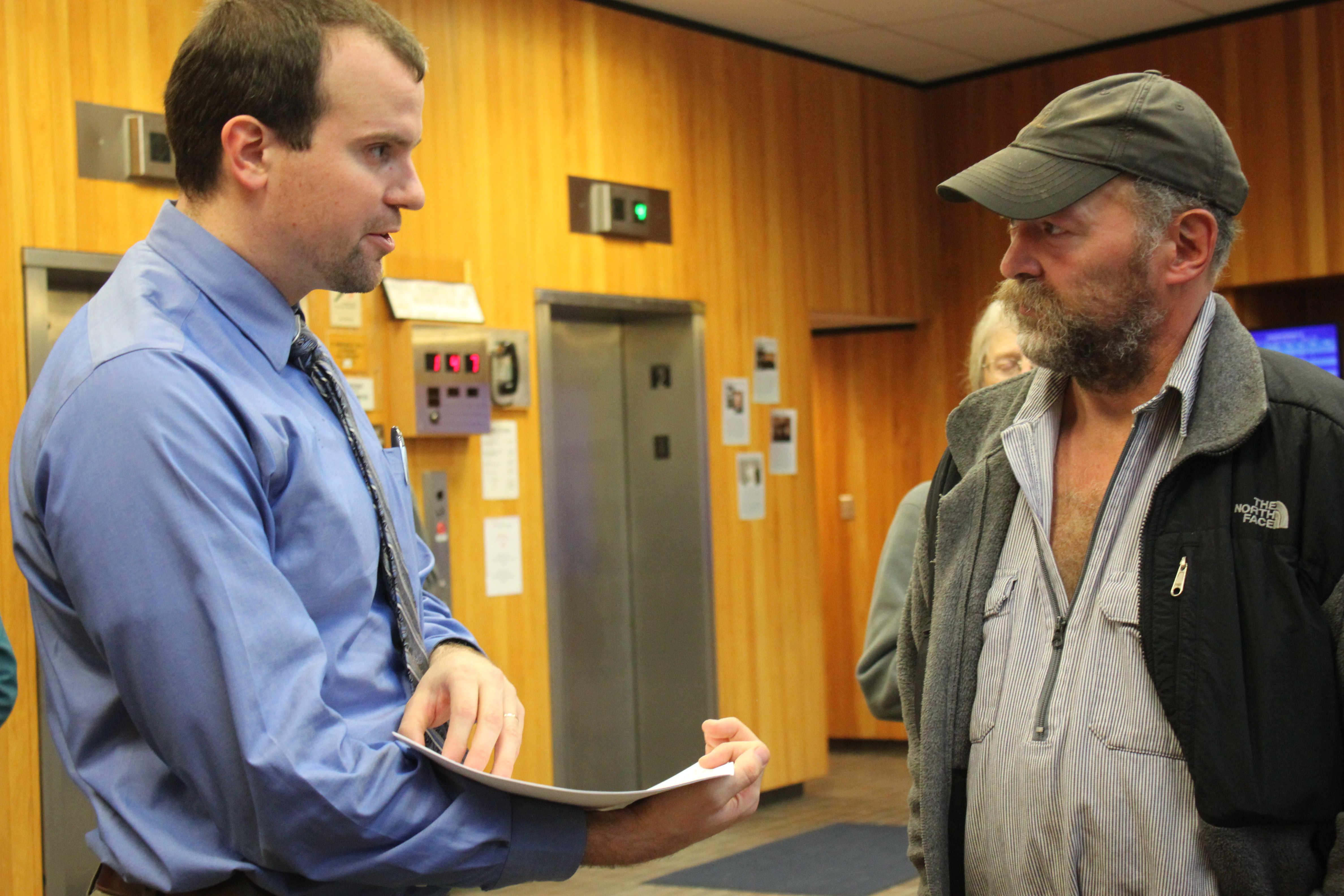
In the lobby of the Dimond Courthourse Monday morning, attorney Nick Polasky hands trapper John Forrest court documents before the trial. Polasky is Kathleen Turley's lawyer. (Photo by Lisa Phu/KTOO)
In the lobby of the Dimond Courthourse on Monday morning, attorney Nick Polasky hands trapper John Forrest court documents before the trial. Polasky is Kathleen Turley’s lawyer. (Photo by Lisa Phu/KTOO)

Monday’s small claims case between a trapper and a trap springer was supposed to last an hour, but after about two and half hours in District Court, it’s stretching into a second day.

Juneau trapper John Forrest is suing hiker Kathleen Turley for springing his lawfully set traps on Davies Creek Trail.

On the witness stand, John Forrest said he’s suing Kathleen Turley because the state dropped its case against her in January.

“I want her to realize she did something wrong that was against the law. My thoughts are if the prosecutor had done his job on the first go-around, we wouldn’t be here wasting our time and more money. What she did was wrong. She had good intentions,” Forrest said.

Alaska Wildlife Troopers had originally cited Turley for hindering lawful trapping, which carries up to a $500 fine and 30 days in jail.

Forrest, a 55-year-old Juneau resident, makes his living chopping firewood and, less substantially, trapping. Forrest estimates he’s owed $500 to $750 in damages.

He’s been trapping for about 45 years and said his traps have been destroyed or stolen numerous times.

“Kind of puts a sour taste in your mouth when you put all this time and effort into something and somebody comes along and fools around with it,” he said. “It’s kind of like going out and setting your string of crab pots and going out a week later and two of the pots are gone and the crabs have been taken out of the rest. It’s like, what the heck am I doing out here?”

Forrest has a 3-mile trap line near Davies Creek trail. On Dec. 27, he said three of his marten traps were sprung–two boxed traps on the ground and one trap that was in a bucket hanging in a tree. He reset them. On his way out, he found one of the ground traps and the one in the tree had been resprung.

“And never in my life have I had to reset the same traps twice in a day due to human interaction. That yanked my chain,” Forrest said.

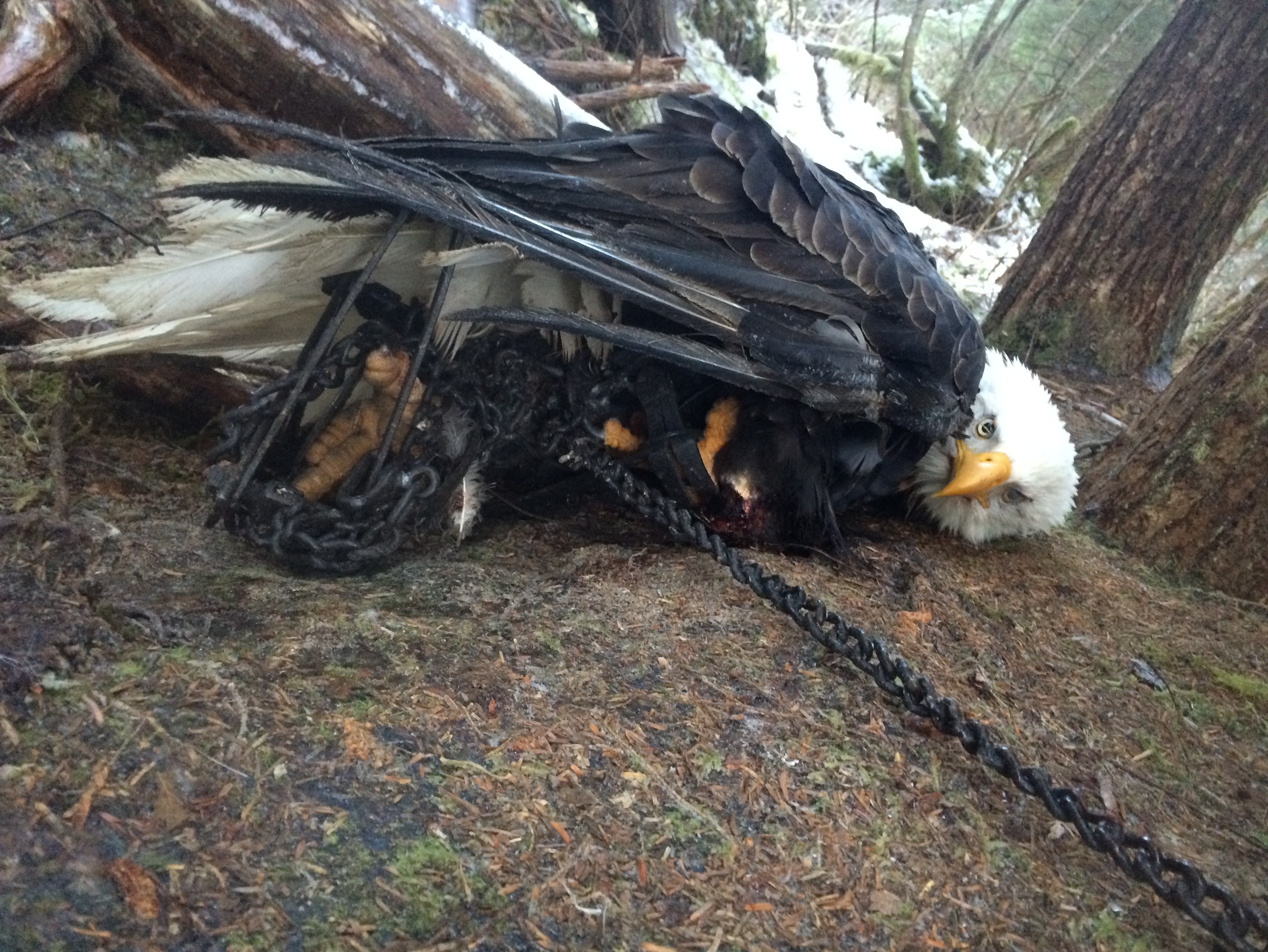
Kathleen Turley encountered this eagle stuck in two traps Dec. 24, 2014. She freed the eagle and tampered with other legally set traps in the area. She's now being sued. (Photo courtesy Kathleen Turley)
Kathleen Turley encountered this eagle stuck in two traps Dec. 24, 2014. She freed the eagle and tampered with other legally set traps in the area. (Photo courtesy Kathleen Turley)

Aside from these three traps, two others targeting wolverine had been sprung as well. These two had caught a bald eagle. Forrest calls that the ugly side of trapping.

“It’s kind of like fishing. Most of the time you catch what you want, sometimes you catch something that you don’t. It’s not something I look forward to, but it happens and it’s part of the whole trapping thing,” Forrest said.

Turley had come across the eagle three days earlier when she was scouting the trail with three dogs. The eagle was still alive and she attempted to save it. She tied up the dogs and sprung another trap that she said was 10 feet away.

“When you set off that marten trap right there, what was going through your mind? What were you thinking about?” Turley’s lawyer Nick Polasky asked.

“That I didn’t want one of my dogs to get caught in that trap while I was working on getting the eagle out,” Turley said.

It took Turley an hour to free the eagle out of the two traps. As she was walking out with the eagle, she said she sprung another trap on the ground.

“I grabbed a stick as I got close to it and then leaned over and tossed the stick in the trap as we went by, because I knew I could easily keep my dogs under control as I was doing that, but I didn’t want to go past the trap and have one of them break control 20 feet later and run back to it. I didn’t want to deal with trying to get another animal out of a trap that day. It was almost dark by then,” Turley said.

Three days later, Turley was back on Davies Creek Trail leading a group of hikers. She said she sprung this same trap as she was walking out because it was dark and she didn’t want her dog or other hikers to stumble into it.

On both days, Turley said she saw a trap hanging from the tree, but didn’t spring it. She said another group of hikers was also on Davies Creek Trail on Dec. 27.

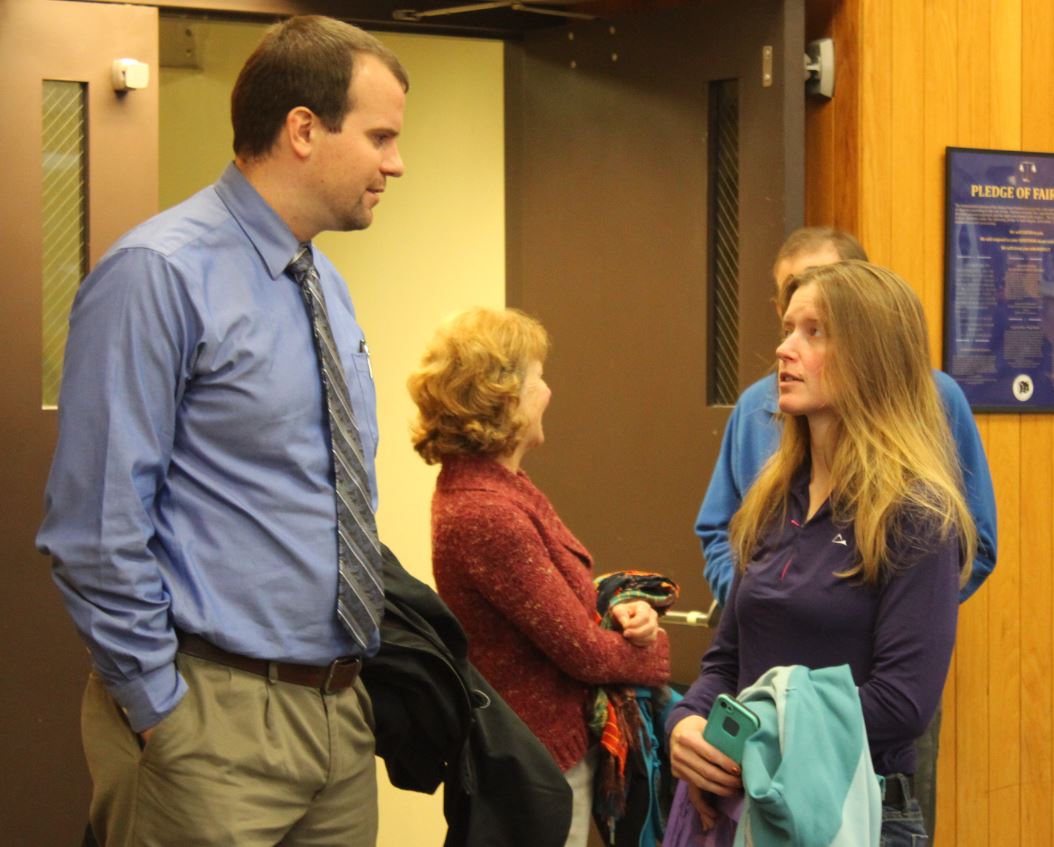
Nick Polasky talks with his client Kathleen Turley before trial Monday morning. (Photo by Lisa Phu/KTOO)

Turley is an avid outdoors person and a hunter. She raises rabbits for food and is not opposed to trapping.

As Forrest’s lawyer Zane Wilson questioned Turley over the phone, she admitted springing two different traps, one on two separate days.

“Did the thought ever cross your mind about the impact you’d be having on a trapper when you’re out there springing their traps?” Wilson asked.

“No,” Turley replied.

“‘Cause you don’t care about the impact it had on the trapper?” Wilson said.

“Safety of my dogs and my group were foremost on my mind. I didn’t think about what effect it would have on the trapper,” Turley said.

“And the safest thing for your dogs would be for you to leave them at home, correct?” Wilson said.

“Safest thing for any of us would be to stay at home all the time and never go anywhere,” Turley said, which drew a subtle reaction from the roughly 20 people sitting in the audience. Most appeared to be there in support of Turley.

The trial is scheduled reconvene Thursday afternoon.

Fewer than 1 in 4 voters turned out for last week’s election

voter turnout
(Graphic by Jeremy Hsieh/KTOO)

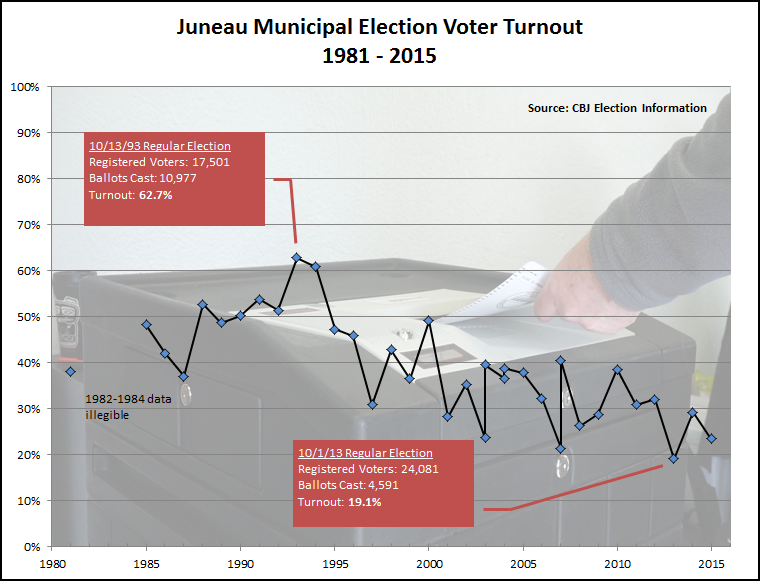
Last week’s municipal elections had the third lowest voter turnout in three decades.

Fewer than one in four of Juneau’s registered voters cast ballots to elect the local officials who direct spending of more than $300 million dollars a year and set school district policies.

The 23.5 percent turnout number comes from the latest election data that include absentee and questioned ballots, which were counted Friday. They results are still unofficial, pending the canvass board’s certification Tuesday.

The additional votes didn’t change the outcome of any of the races.

The lowest turnout came in the regular 2013 election. Fewer than one in five voters participated in that one. Like this year, the 2013 election didn’t have any

ballot questions, which tend to drive up voter participation.

However, the second lowest turnout was in the 2007 special election. That ballot was exclusively questions related to Thunder Mountain High School construction and funding.

Homeless survey finds at least 70 in Juneau sleeping outside

The Glory Hole, Juneau
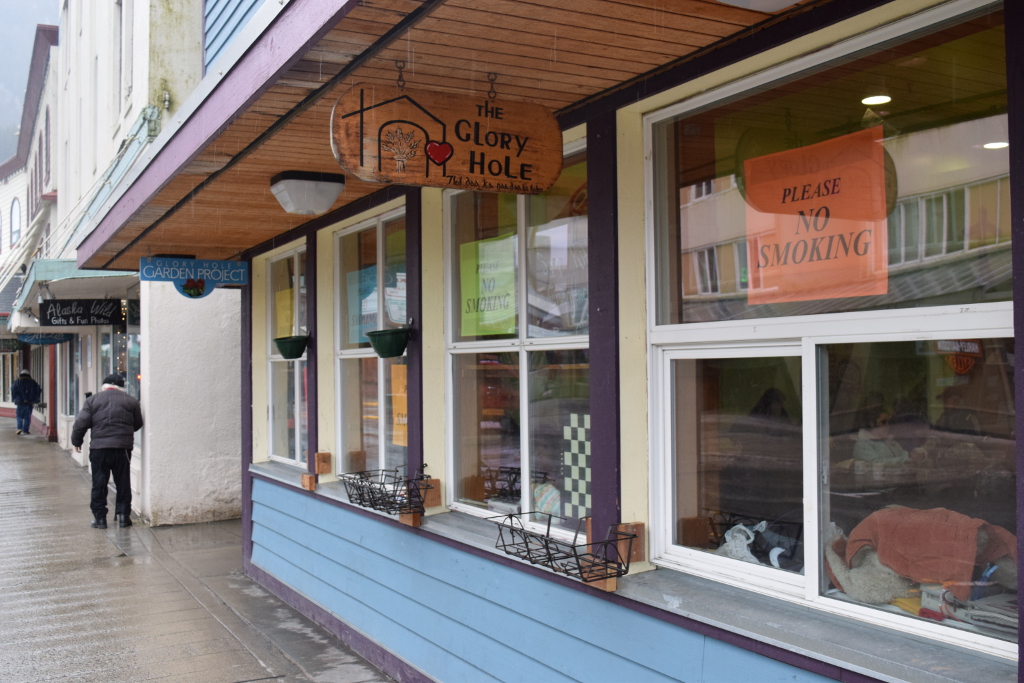
The Glory Hole, Juneau’s emergency homeless shelter and soup kitchen, organized this year’s Vulnerability Index Survey. (Photo by Casey Kelly/KTOO)

Volunteers and staff from Juneau’s shelter and soup kitchen went to the streets and interviewed 70 homeless people over the course of a few days in September. It’s been three years since the vulnerability index survey was done in the capital city.

The surveys can connect people to services, help The Glory Hole keep track of where people are sleeping, and social service agencies can use the data to guide practices and apply for funding.

It’s around 4:30 on a Wednesday morning. At The Glory Hole, groups of volunteers sip coffee and discuss plans for a second morning of surveys. Each group is assigned to search a different area of Juneau. The goal is to find homeless people who are sleeping outside and interview them.

The morning before, Brad Correia’s group didn’t find anyone in the Mendenhall Valley or out the road.

“We walked on a lot of beaches where they have shelters, like in the summer it would be really nice. We thought people would be sleeping in there, like they have fireplaces. But there was nobody,” Correia said.

Brad Correia and his group searched for people sleeping outside in the Mendenhall Valley area and out the road. (Photo by Lisa Phu/KTOO)

The group searched behind Safeway, looked around all the stores in the valley.

“Just everywhere and we didn’t find anybody.”

Correia thought they might find people sleeping in cars out the road.

“‘Cause I thought, if I was homeless and had a car, that’s where I would go to where there wouldn’t be people bothering me, like troopers,” he said.

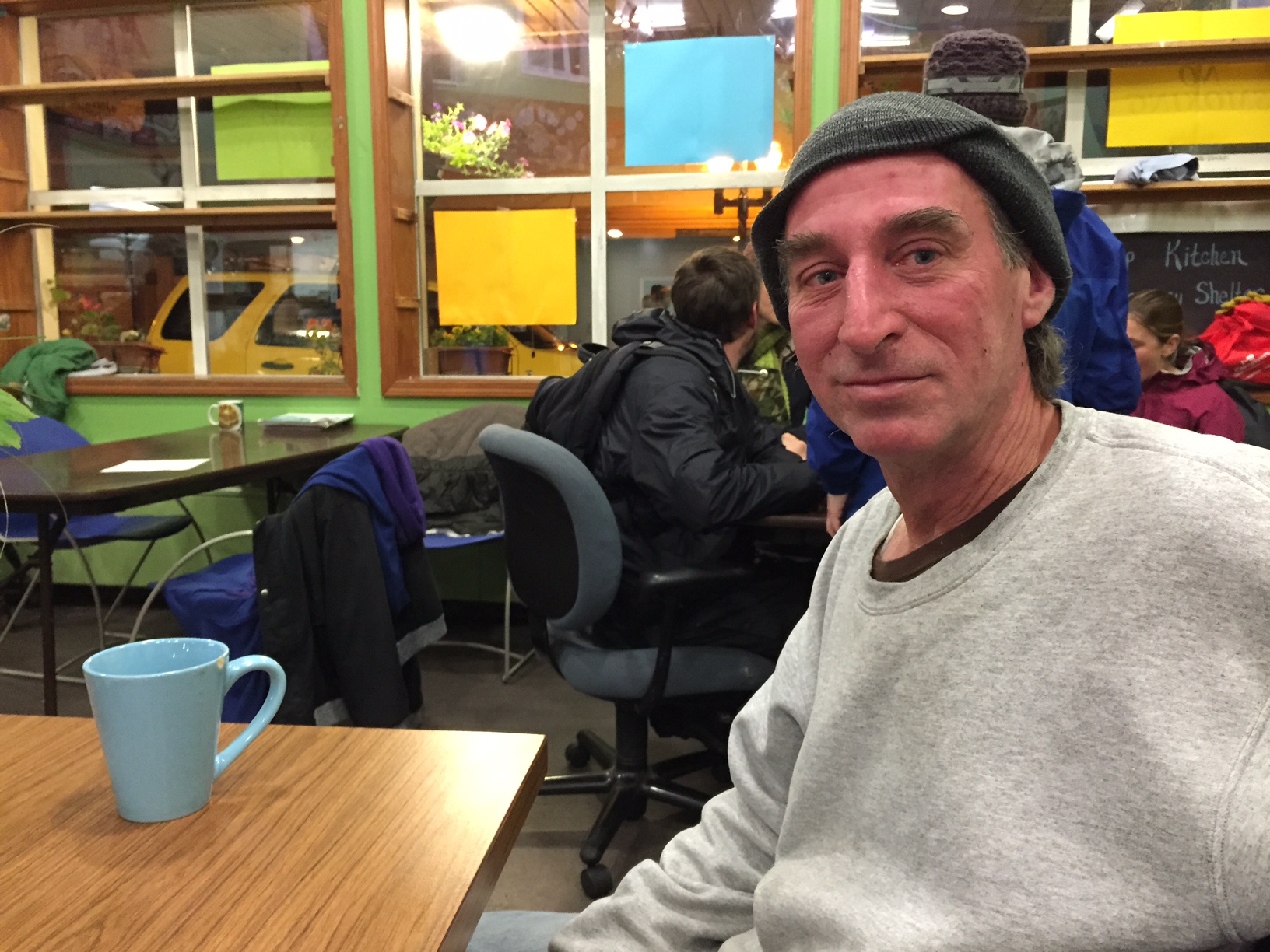
Correia has been homeless. When he first got to Juneau about a year ago, he didn’t have any money and stayed at The Glory Hole. He remembers another man at the shelter who talked a lot.

“I ignored him. I just acted like I was reading when he would come and talk to me. Just talk and talk and talk,” Correia said.

Days later, that man, Gregory Dockery, was found dead, submerged in water in a ditch near Twin Lakes.

This was last November. Correia is afraid Dockery died thinking nobody cared, “Last time I saw him, he was crying, ‘Nobody likes me, nobody cares about me.’”

This is why Correia is volunteering to do the homeless survey. He thinks there’s a better solution than dying in the cold.

Data from the 2012 survey has been used to apply for funding for Juneau’s Housing First Project.

Clyde Didrickson was part of that survey and was just interviewed again. He was walking to the Glory Hole with his wife when a group of interviewers found him.

“They let us know who they were and what they were up to asked me if I cared to be interviewed,” Didrickson said.

Didrickson felt fine answering personal questions about substance abuse, race, health history, mental health, money, education, how long he’s been homeless. There was one question he found intrusive and didn’t answer: What’s your social security number?

Didrickson won’t say where he and his wife spend their nights for fear of being harassed.

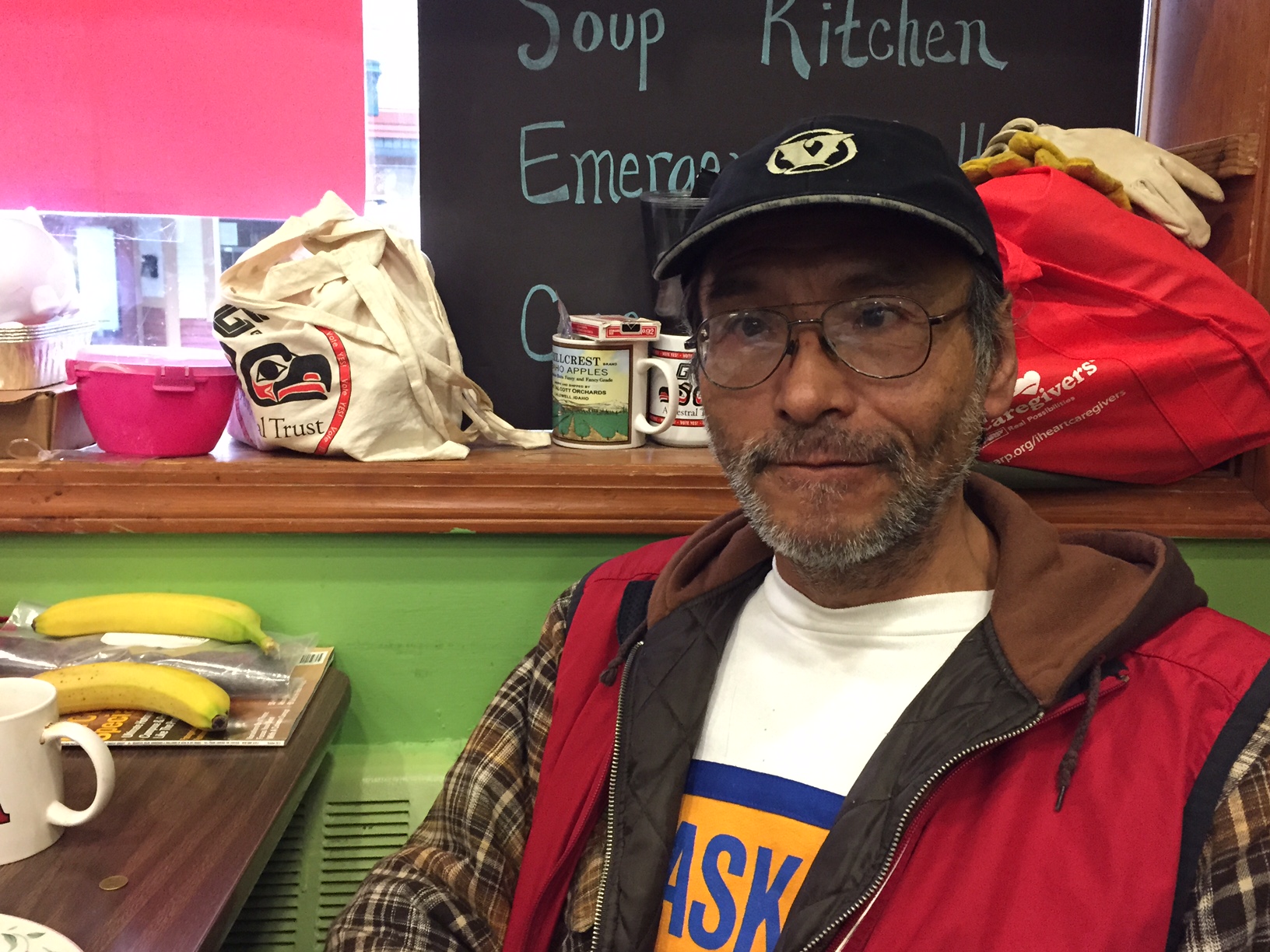
Clyde Didrickson says he's been homeless since 1981. (Photo by Lisa Phu/KTOO)
Clyde Didrickson says he’s been homeless since 1981. (Photo by Lisa Phu/KTOO)

“We found a dry spot,” Didrickson said.

Didrickson is 63, originally from Sitka and a veteran. Didrickson said he’s been homeless since the early 1980s when he was arrested for a felony. His wife is 62. He carries their bedding around in a suitcase – an old tent they use as a tarp and blankets.

“Usually after everybody closes up, basically when people stop moving around, we lay out the tarp to give us something dry to lay on and then we lay our bedding out on top of that and then the excess tarp we put over ourselves,” Didrickson said

The couple wakes up around 5 a.m. They put everything back in the suitcase and begin their day.

“Hardest part for us, especially at our age, is finding a facility to use,” Didrickson said.

Some public bathrooms lock up for good after the tourist season ends. Others don’t open until later in the morning. Didrickson said he sometimes goes to the bathroom in the woods.

At 7 a.m., he walks to The Glory Hole for coffee and warmth. The rest of the day, “Look for some place dry and warm to sit around. A lot of times wait for the library to open,” Didrickson said.

At the moment, he’s sitting with his wife, 27-year-old son, and brother-in-law at a table at The Glory Hole.

Didrickson says he’ll likely be back at the shelter for lunch and dinner before spending another night outside.

Site notifications
Update notification options
Subscribe to notifications