North Slope

House approves TransCanada buyout

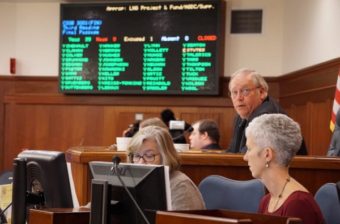
Alaska House of Representatives passes SB3001. (Photo by Jeremy Hsieh/KTOO)

With a unanimous vote in the House Wednesday, the Alaska Legislature has passed Gov. Bill Walker’s bill to end the state’s partnership with TransCanada — and take a larger role in the effort to build a natural gasline from the North Slope.
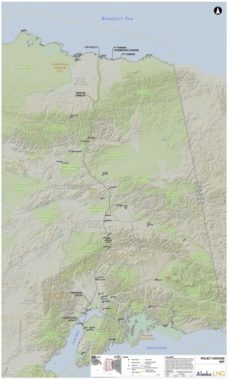
The Alaska LNG project will now become a four-way partnership, between the state and the three major North Slope producers, ExxonMobil, BP and ConocoPhillips.

APRN’s Rachel Waldholz is in Juneau covering the legislative session.

TOWNSEND: Rachel, what was the reaction when the House voted today?

WALDHOLZ: Well, when the board lit up and showed all 39 House members listed in green — meaning every single member had voted yes — there was definitely a bit of a stir. That’s yes votes from 22 Republicans, 16 Democrats and the lone Independent. The only person who didn’t vote was Rep. Louise Stutes (R-Kodiak), who was excused today.

That’s an even stronger bipartisan vote than the Senate, which voted yesterday and passed the measure 16 to 3.

And it’s a big win for Gov. Walker.  He has said from the start said that the state needs a bigger say in the gas line project. Now it will have that.

TOWNSEND: So, what were the stakes here?

WALDHOLZ: By the time they took this vote, a lot of lawmakers saw this as a live or die moment for the gas line project itself. I think a lot of Republicans, especially, aren’t necessarily happy with the Walker administration or the way it’s handling the gas line. But they felt they had to approve this request to support the project, and keep it moving forward.

Rep. Mark Neuman (R-Big Lake) is co-chair of the House Finance Committee, which worked on the bill. He was very skeptical of administration officials during hearings. But this is what he said right before the vote:

NEUMAN: This is Alaska’s future. I see no other way that we can continue to pay the state’s bills into the future without this pipeline. We are a resource development state. It’s what we do.

Other lawmakers saw it as a much simpler issue. Rep. Les Gara (D-Anchorage) said it’s just a financial decision: this project will cost less without TransCanada as a partner.

GARA: Mr. Speaker, we could all engage in a lot of flowery speeches about the importance of the gasline — and it is important to the state’s future. And I suspect we’ll hear a lot of that, and some of that will be justified. But that’s not what this bill is about. This bill is about saving the state money. It’s about saving the public money. And it’s about making more money for the state if this project moves forward.

TOWNSEND: Rachel, remind us what this is all about — how does this mean the state plays a bigger role in the project?

WALDHOLZ: The Alaska LNG project includes three parts: a gas treatment plant on the North Slope, a pipeline down to Cook Inlet, and a liquefaction plant in Nikiski.

Right now, TransCanada controls the state’s share of the gas treatment plant and the pipeline. By ending the partnership, the state will have a full 25 percent stake in all three parts — and a full 25 percent vote in the project itself.

The vote authorizes the state to spend about $157 million to reimburse TransCanada for its efforts to date, and to continue work through the current planning phase, called pre-FEED (pre-Front End Engineering and Design).

TOWNSEND: Many lawmakers started the session much more skeptical of the governor’s proposal, even a little antagonistic. What changed?

WALDHOLZ: I think lawmakers thought the administration made a pretty strong financial case – that it would be more expensive to keep TransCanada in as a partner, than to end the partnership now. So that was key.

But also, it became clear that TransCanada itself wanted out of the partnership. Representatives from the company told lawmakers that once it was clear the Walker administration wanted them out of the project, they couldn’t be as effective, and it wasn’t worth it for them to stay in. It seemed likely that if the legislature rejected this bill, TransCanada would walk away anyway. So I think a lot of lawmakers felt like they didn’t have much of a choice.

And I think they agreed with the administration in the end, that the state needs more control of this potential gas line project, which could be huge.

The House adjourned Wednesday afternoon. The Senate is expected to adjourn Thursday, ending this year’s third Special Session.

Click here for APRN’s “What is Alaska LNG?” series. 


Lawmakers: TransCanada buyout likely, but is state ready?

This map shows the likely route of the Alaska LNG project, as of August 2015. (Map courtesy of Alaska LNG)

Lawmakers now say it’s all but inevitable the legislature will approve the governor’s request to buy out TransCanada and take a larger stake in the Alaska LNG project. A vote is expected early next week.

TransCanada itself has testified in favor of the buyout.

But even as they prepare to approve the deal, lawmakers are raising concerns about the state’s ability to take the company’s place at the table.

The way the TransCanada deal was originally set up, the state and the company share a 25 percent stake in the Alaska LNG project — and a 25 percent vote on project decisions.

In a hearing on Wednesday, TransCanada director Vincent Lee explained that that arrangement only works if there’s a melding of the minds – and when Gov. Bill Walker’s administration took over from previous Gov. Sean Parnell, that was no longer the case.

“As we see, the administration is thinking about doing the project in a different way,” Lee said. “We don’t feel the alignment is as strong as it used to be. And that doesn’t necessarily mean it’s a bad thing, it’s just that, you know, we are approaching the project from a different angle.”

When asked what would happen if the legislature doesn’t approve the buy-out, Lee said TransCanada would have to seriously consider exiting the deal anyway — in which case, the state would still be obligated to pay their costs.

That wouldn’t seem to leave lawmakers with much of a choice, and by Thursday morning, Senate President Kevin Meyer (R-Anchorage) was willing to say so.

“I think we’re going to end up doing as the administration has asked us to, and to buy out TransCanada,” Meyer said. “And it seems to be the right thing to do for the state of Alaska at this time.”

But even as they move closer to the buyout, lawmakers expressed concern about whether the state is ready to take over the company’s role — and with it, a full 25 percent stake in a $45 to $65 billion gas line megaproject.

For days, lawmakers have been asking who’s in charge of the state’s effort — and received no clear answer.

One possible candidate is Dan Fauske, the head of the Alaska Gasline Development Corporation, which represents the state in the project. When AGDC representatives showed up to testify before the Senate Finance Committee, co-chair Anna MacKinnon (R-Eagle River) had one question:

“Gentlemen, the first question out of the gate is, where is Dan Fauske?” she asked.

Joe Dubler is Vice President for Commercia Operations at AGDC. He

“Frank Richards and myself were asked to present to the committee today, and the other gentlemen you mentioned were asked not to,” he said.

“Who asked that Mr. Fauske not be in Juneau today?” MacKinnon asked.

“Madam Chair, the attorney general for the State of Alaska is the one that’s running the special session for the governor,” Dubler replied. “And he asked that Mr. Fauske not be in Juneau today.”

That did not go over well with the committee, which recessed until Fauske could be reached via phone, and later called in Attorney General Craig Richards himself.

Richards explained his thinking this way: “The governor and commissioners and myself thought it best to bring the people to present to you that were the most technically knowledgeable on the subject,” he said. “So I think you’ll find that those are the people that have presented.”

Senator Peter Micciche (R-Soldotna) said the tussle over AGDC was troubling for two reasons: one, it seemed like the administration was trying to limit lawmakers’ access to information. And, it revealed splits among the different agencies who will be taking over the state’s share of the project.

“I’m not sure that those three entities – Department of Revenue, Department of Natural Resources, and AGDC – understand where they fit in that organization, and I think there’s internal tension,” Micciche said. “That internal tension is something that I believe was reflected in TransCanada’s willingness to exit the project.”

But Micciche said he thinks the state will get there.

“If we’re going to operate at the level of the other 75 percent ownership of this project,” he said. “That internal separation needs to come together.”

The Alaska LNG project explained

Lawmakers have one hot and messy item on their hands right now: the Alaska LNG project. It’s a giant pipeline the state hopes to build, along with three or four other industry partners, to bring natural gas from the North Slope to market.

Let’s look at some of the details. First off, this is a big and expensive endeavor — $45 to 65 billion bucks. For comparison, that’s roughly the GDP of Bulgaria.

And that figure accounts for three big things: A gas treatment plant, the pipeline itself, and a giant liquefaction plant in Nikiski.

The gas treatment plant on the North Slope will strip out impurities like carbon dioxide.

From there, the gas would go into an 800-mile underground pipeline built right alongside Alaska’s other trusty pipeline: TAPS. But instead of going to Valdez, this pipeline would head to Cook Inlet, where it’ll end at a brand-spanking-new liquefaction facility in Nikiski.

This is where the magic happens. Expensive magic! Roughly half the cost of the LNG project’s $45 to 65 billion dollar price tag is the liquefaction plant.

Liquefaction is a fancy word for “to make liquid.” And that’s exactly what happens to the gas. Long story short, when the gas is chilled and becomes liquid, it becomes 600 times smaller, which is really convenient for shipping.

But natural gas has to get really cold to liquefy. Like negative-260 degrees Fahrenheit. That’s about how cold it is on Saturn.

If you pour cold LNG in a glass, it would look just like a glass of water. (But don’t spill it.)

So we have a bunch of liquid gas that has to stay really cold. It would get held in storage tanks in Nikiski until ships arrive to courier it away. Those ships are essentially floating thermoses — specially designed to transport LNG to buyers in Asia.

Once the gas arrives in Asia, it’s warmed back up and turned into regular old natural gas — like what your heater runs on.

So that’s the ‘how’ of Alaska LNG. The big question: Will it happen?

That all depends on the market. Are there enough buyers who want LNG in Asia? And will they commit to buy it from Alaska?

Right now the project is still in its early planning and design stages. If all goes according to plan the state and its partners would make the decision on whether to actually break ground in 2018, and the first Alaska gas would ship in 2024.

Kaysie Ellingson, Monica Gokey and Rachel Waldholz contributed to this story and video

The North Slope puzzle: more gas means less oil

Aerial photo of the Kuparuk Camp.
Aerial photo of the Kuparuk Camp. (Photo by dandod)

During this week’s special session in Juneau, most lawmakers have been focused on whether the state should take a larger stake in the Alaska LNG project, which would build a natural gas pipeline from the North Slope.

But Monday afternoon, the Senate Resources Committee met to hear about another crucial, if little-discussed issue: if you tap the state’s supply of natural gas, you’ll end up with less oil.

Cathy Foerster of the Alaska Oil and Gas Conservation Commission put it this way:

“Taking the gas from an oil field … before all the oil has been produced, will … cause some of that oil to be lost,” Foerster said. “That’s not my opinion. That’s not somebody’s prediction … When you take the gas out of an oil field, and there’s oil still left, some of that oil is unrecoverable. Period.”

That’s because the natural gas in fields like Prudhoe Bay is re-injected into the wells to pressurize the field and increase oil production. Take away that gas, and you lose access to some of the oil.

The commission is tasked with making sure the state’s oil and gas resources aren’t wasted, and it has to approve any plans to take gas from the North Slope – including for the Alaska LNG project.

And despite declining production on the Slope, there’s still plenty of oil to worry about, Foerster said.

“There’s 2.5 billion barrels of oil,” she said. “As Donald Trump would say, that’s HUUUGE.”

For context, she said, 2.5 billion barrels is about the amount produced from the North Slope’s Kuparuk reservoir, the second largest oil field in North America, during its entire 34-year lifetime.

Still, in mid-October the commission gave its formal approval for the Alaska LNG project to take gas from both Prudhoe Bay and Pt. Thompson. Foerster and Commissioner Dan Seamount say the timing is finally right.

The state has been trying to build a pipeline from the North Slope for some 40 years. But from the commission’s point of view, it was always too early, Seamount said.

“When I first took this job in the year 2000, they were talking about a gasline in 2014 and that just scared the hell out of me,” he said. “Because we were making a million barrels of oil a day and we were using that gas to help make that million barrels of oil a day.”

Seamount and Foerster said they’re now comfortable tapping the gas fields – starting in 2025. In a best-case scenario, that’s just about when the Alaska LNG pipeline would be ready to start shipping.


What is the Alaska LNG project? We break it down: Part 1

This illustration shows what a liquefaction plant could look like. (Image courtesy of Alaska LNG)

Lawmakers around the state are packing their bags and preparing to head to Juneau for their third special session of the year. This session will focus on one thing: the Alaska LNG project. That’s the giant pipeline the state hopes to build, along with ExxonMobil, BP, ConocoPhillips — and maybe TransCanada — to bring natural gas from the North Slope.

But if you’re like a lot of Alaskans, you might be a little fuzzy on the details.

I wanted to find out what Alaskans know about this project, so I parked myself outside the Fred Meyer on Northern Lights Boulevard in Anchorage.

“If I say liquefied natural gas, do you know what that is?” I asked.

“No? Liquefied natural gas, no,” one woman said.

“It’s something they’ve been talking about for 30 years! It’s just one of those pipe dreams,” a man said.

We shared a laugh over how it literally is a pipe dream. I also asked if people knew what LNG is, and why it’s liquefied.

“I’m thinking it’s liquefied for easier transport … it’s easier to transport a quantity of liquid versus the same quantity of gas,” a second man said, which was exactly right.

Here’s the short version: the Alaska LNG project will bring natural gas from the North Slope down to Nikiski, on the Kenai Peninsula, for export to buyers in Asia. In order to load the gas onto the ships that will carry it across the Pacific, it has to be liquefied.

And it’s a huge project. The estimated price tag is $45 to $65 billion.

Lydia Johnson works for ExxonMobil. She’s the technical manager for the Alaska LNG project.

“This is way bigger than TAPS (the trans-Alaska pipeline system),” she said. “This is one of the largest, most complex projects in the world today. … Right here in Alaska.

The key point — if you remember just one thing — is that the Alaska LNG project is not just a pipeline. It actually has three big pieces. First, there’s a gas treatment plant on the North Slope, to prepare the gas for the pipeline. Then there’s the pipeline itself, running some 800 miles down to Cook Inlet. And then there’s a giant liquefaction plant in Nikiski.

Johnson said each one of the components is a megaproject in its own right.

“You put them all together, that’s a gigaproject. That’s our term,” Johnson said.

That’s right. A gigaproject. And one that could bring in more than $2 billion a year in state revenue.

So let’s walk through this gigaproject.

“If I’m a natural gas molecule, natural gas is found below ground, so we’re looking at the fields of Point Thomson and Prudhoe Bay,” she said.

The gas at Prudhoe Bay has been tempting pipeline builders for decades. For some 40 years, the state has fielded different proposals, most recently to connect the North Slope to the Lower 48. The shale gas revolution put an end to that plan — suddenly, nobody needed more gas down south. That’s why this plan would ship the gas to Asia.

But before it can go anywhere, it has to be treated. The project calls for a gas treatment plant on the North Slope, to strip out impurities like carbon dioxide.

“This would be the largest gas treatment facility in the Arctic,” Johnson said. “Ever. Huge project.”

From that huge project into the next one. From the gas treatment facility, the gas would go into a pipeline rivaling the trans-Alaska pipeline in length.

There are some key differences. The existing pipeline carries crude oil, which comes out of the ground warm. Johnson compared it to syrup.

“Syrup going through a pipeline needs to be very hot,” she said.

That, by the way, is why much of the trans-Alaska pipeline is above ground. You don’t want to build a hot pipeline in permafrost.

“Now you think of natural gas,” Johnson said. “It’s very cold; it comes out of the ground naturally very cold.”

So the gas pipeline will be buried.

The plan calls for the line to run alongside the trans-Alaska Pipeline until about Livengood. From there, it would break off and head south to Cook Inlet.

Along the way, the line would need eight compressor stations to provide pressure and move the gas along. There are also plans for five off-take points. The idea is to deliver natural gas to Alaska communities along the route, with the hope that it would lower local energy costs.

The line would cross under Cook Inlet, perhaps near Tyonek, and end at a brand new liquefaction facility at Nikiski. That’s where the magic happens — and it’s expensive magic. Roughly half the cost of this $45 to $65 billion project is just the liquefaction plant.

The point of liquefaction is to shrink the gas to a manageable size. When the gas is chilled and becomes a liquid, it becomes 600 times smaller.

“If you took natural gas without liquefying it, you would need huge ships,” Johnson said. “And it would be basically a floating bomb, which you don’t want.”

But loaded with liquefied natural gas, those ships then become, essentially, floating pipelines, carrying the gas to markets around the world.

Here’s the catch, however: liquefying natural gas requires cooling it to -260 degrees Fahrenheit. There are only so many places on earth where that can be done.

As it happens, one of those places is already in Nikiski — ConocoPhillips’ Kenai LNG plant.

And that’s where we’ll go in part 2 when we get to use the word cryogenic in a non-sci fi context.

Obama administration cancels offshore lease sales, cites lack of interest

Alaska's congressional delegation and governor gather with press after the Department of the Interior's surprise announcement of the cancellation of off-shore drilling leases. (Photo by Mikko Wilson/KTOO)
Alaska’s congressional delegation and governor gather with press after the Department of the Interior’s surprise announcement of the cancellation of off-shore drilling leases. (Photo by Mikko Wilson/KTOO)

The Obama administration announced Friday that it is canceling plans to open up more of the Arctic Ocean to oil and gas drilling, citing lack of industry interest in the region.

The Interior Department won’t auction off drilling rights in the Chukchi and Beaufort Seas in the next two years. The auctions would have been the first in the Arctic Ocean since 2008, and the first under President Barack Obama.

The announcement comes just weeks after Shell suspended its controversial quest to drill in the Arctic Ocean, after disappointing results this summer. The Department also rejected requests from Shell and the Norwegian company Statoil to extend their leases in the region, which will expire by 2020.

Gov. Bill Walker reacted to the news with frustration.

“As we struggle with funding on education and costs of energy, I can’t tell you how disappointed I am in this decision,” he said.

The Walker administration had high hopes for offshore drilling, at a time when plunging oil prices and declining production have decimated state revenues. Walker said it’s like that door has been shut in Alaska’s face — and said he’ll work with the congressional delegation to formulate a response.

“This hits us at our lowest time,” he said. “And it’s time we stepped up and said lets be Alaskans again. Let’s be more aggressive on this issue.”

But the Interior Department said there simply isn’t enough industry interest to justify the lease sales. At least nine companies already hold more than 500 active leases in U.S. portions of the Arctic Ocean. But since Shell pulled out, there is only one near-shore project under development – Hilcorp’s Liberty unit.

In a written statement, Interior Secretary Sally Jewell cited Shell’s decision, the amount of acreage already leased, and “current market conditions” as reasons to hold off on sales for at least the next year and a half. The Interior Department has not ruled out future lease sales after 2017.

And the department said Shell and Statoil had not laid out specific plans for exploration under their existing leases, a requirement for extending them.

In an emailed statement, Shell spokesperson Megan Baldino wrote, “When it comes to frontier exploration in Alaska, one size does not fit all.  We continue to believe the 10-year primary lease term needs to be extended.”

Environmental groups cheered the decisions. Michael LeVine, of Oceana, said given the challenges of working safely in the Arctic and the lack of exploration happening now, “There is no reason to extend existing leases, and no reason to sell new leases.”

“The right course of action is to wipe the slate clean,” he said. “Let’s get rid of the poorly planned and justified decisions to sell leases in the 2000s, and the unwise investments made by companies.”

Meanwhile, Alaska’s elected officials expressed outrage. Speaking with reporters at the Alaska Federation of Natives Convention in Anchorage, Congressman Don Young said he has a plan. Step 1 is a lawsuit. Step 2 is, essentially, siphon the feds’ oil tank in the Arctic.

“We ought to go right up next to ANWR and go 3 miles off shore. We’ll rent a rig … and we’ll drill in state land, and run the doggone horizontal drilling out 15 miles, which is possible. And we’ll take their oil. See how long that’ll last. That’s my idea. It’s a positive step forward.”

Gov. Walker suggested it’s an idea that’s occurred to him, too: “You been reading my email, buddy?”

KBBI’s Daysha Eaton contributed to this report.

Site notifications
Update notification options
Subscribe to notifications