North Slope

Barrow Rep. Nageak’s nephew killed in police shooting

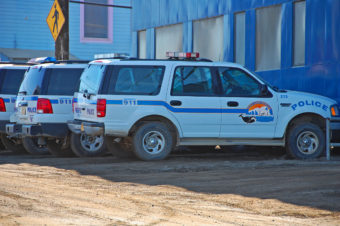
North Slope Borough Police SUVs cars
North Slope Borough Police SUVs in Barrow in 2008. (Creative Commons photo by Mack McKinley and Tim Wilson)

Vincent Nageak III was the victim of a fatal police shooting in Barrow early Wednesday morning, according to the Barrow mayor’s office.

According to the North Slope Borough Mayor’s office, the incident happened around 4 a.m. A North Slope Borough Police Officer was responding to a call for assistance when the shooting took place.

Nageak was the nephew of Barrow Rep. Ben Nageak. Sen. Donny Olson from the Bering Strait region expressed his condolences during Wednesday’s Senate floor session.

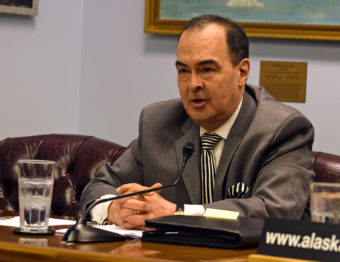
Rep. Benjamin Nageak speaks on the House floor, Jan. 21, 2014. (Photo by Skip Gray/Gavel Alaska)
Rep. Benjamin Nageak speaks on the House floor in January 2014. (Photo by Skip Gray/360 North)

“(Overnight), there was a tragedy up in Barrow when Vincent Nageak, a Middle East veteran, served his country over there, as well a fire chief for the volunteer fire department, passed away,” Olson said.

Olson explained that the victim was Rep. Nageak’s favorite nephew.

“This morning, when I went and told Ben,” Olson explained, “Obviously, they were very broken up by that, so I just want us to be especially sensitive toward Ben and his family at this time.”

Nageak, age 36, was a lifelong Barrow resident. Along with serving as fire chief, he also worked for the Department of Corrections in Barrow for over 10 years.

In a statement, Rep. Ben Nageak said the family “still (doesn’t) know all the facts.” He said they’re trying to get home to be near and find out what happened. Rep. Nageak also expressed thanks for the support of his family.

The Alaska Bureau of Investigation arrived on the scene in Barrow this Wednesday afternoon.

John Boyle, the North Slope Borough’s director of government and external affairs, confirmed the officer involved in the shooting was not injured. His name will not be released for 72 hours, per department policy.

Nageak’s next of kin have been notified. His body will be sent to the State Medical Examiner’s office in Anchorage for autopsy.

KNOM’s Laura Kraegel contributed to this report. 

Another Democrat joins Republican-led Senate majority

Sen. Donny Olson joined the the Alaska Senate’s Republican-led majority caucus on Wednesday. The move by the Golovin Democrat means that 16 of the 20 senators now caucus together.

Sen. Donny Olson, D-Nome, at a Senate minority press availability, March 4, 2015. (Photo by Skip Gray/360 North)
Sen. Donny Olson, D-Golovin, at a Senate Democrats press availability in March 2015. (Photo by Skip Gray/360 North)

Olson said he’s honored to join the majority and will lend a strong voice for rural Alaskans.

He joins Sen. Lyman Hoffman of Bethel, another Democrat, in the Republican-led majority.

Senate Minority Leader Berta Gardner, an Anchorage Democrat, said her caucus members were disappointed.

But she said they’re pleased the majority will benefit from a member with progressive values, who supports public education and Medicaid expansion.

Olson represents District T, which covers much of the state. It stretches from Fort Yukon to Nome, and includes the North Slope and Northwest Arctic boroughs.

Rural Democrats have joined Republican-led majorities for many years. All six Democratic legislators who represent areas outside of Anchorage, Fairbanks and Southeast Alaska caucus with the majority.

BOEM staffers say rush for Arctic study undermined their work

When Shell announced it was giving up on its leases in the Arctic Ocean, it blamed, in part, the challenging regulatory climate. Yet an inspector general’s report released Monday says many government regulators who worked the Arctic lease case felt they were too rushed to provide a rigorous scientific review.

The IG report looks at the last  Supplemental Environmental Impact Statement for Lease Sale 193. It was the second court-mandated do-over for the study, conducted in 2014 and 2015, long after Shell and other companies already won their leases. Several scientists and supervisors working for the Bureau of Ocean Energy Management in Alaska told investigators they were under such tight timelines leading up to Shell’s 2015 drilling season they were unable to do a good job on the study. At least three BOEM employees resigned or retired early over their dissatisfaction, the IG found.

An oceanographer who worked on the study told investigators she had “never worked on an SEIS with such a short timeline in her 26-year career.”

A fish biologist “stated that she believed the timeline was ‘so crushed’ that the quality of the SEIS was significantly compromised,” the report says. “She explained that she did not have enough time to review her own sections for scientific consistency, which is vital to any scientific work product.” She resigned years earlier than planned “to regain her ‘personal and scientific integrity,’” the report says.

The inspectors, though, rejected allegations that nonscientist managers at BOEM had manipulated the scientific findings. The investigators also noted that an outside agency reviewed the science in the SEIS and found it adequate.

Erik Grafe, an Earthjustice attorney who is still challenging the SEIS in court, said the report shows the agency rushed the report to allow Shell to have a 2015 drilling season.

“Scientists could not engage in basic review of their work or peer review of other’s work,” Grafe said. “Managers were concerned that legal requirements were not being met.”

Michael LeVine is an attorney for Oceana, one of the environmental groups that sued over the original Environmental Impact Statement for the lease sale. He says the IG’s lack of fault-finding doesn’t validate the approach the department took.

“The fact that the inspector general found no legal wrongdoing does not mean that a better, more complete process, might not have led to a better, more complete decision,” he said.

The investigation found that Interior Chief of Staff Tommy Beaudreau set an aggressive timeline for the SEIS. Beaudreau said he wanted it done in time for the 2015 drilling season, not really for Shell’s sake, but so that Shell couldn’t blame the department if the company decided not to proceed. Beaudreau also told investigators he knew Sen. Lisa Murkowski, and the rest of the congressional delegation, would be critical if they didn’t get the study done in a timely manner.

The senator’s spokesman, Robert Dillon, said Murkowski wanted to ensure the regulators, while protecting the environment, gave Shell a fair chance to develop its leases.

“If they needed more manpower or more hours they could have allotted more resources to the job. They could do that,” Dillon said. “They can’t blame the senator because the senator is trying to make sure that they’re doing their job.”

In response to the investigation, a deputy Interior secretary said BOEM staff worked long hours to meet their deadlines and that, despite overtime pay, employee morale suffered.

Warming landscape triggers northward habitat shift

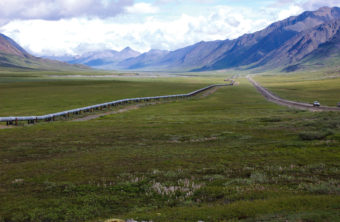
 Much of the North Slope of Alaska is characterized by low, sweeping tundra hills, and a complete absence of trees. (Creative Commons photo by Paxson Woelber)
Much of the North Slope of Alaska is characterized by low, sweeping tundra hills, and a complete absence of trees. (Creative Commons photo by Paxson Woelber)

For years scientists have documented changes in Alaska’s vegetation caused by a warmer climate. Researchers are now seeing animals establish new habitats on the North Slope in response to the altered landscape.

Ken Tape is an Arctic ecologist at the University of Alaska Fairbanks. He says his research often takes him to the North Slope. He’s reported on how shrubs in the region have responded to warmer temperatures and longer summers. They’re thriving — growing taller and moving across the landscape along rivers. It occurred to him those conditions favor moose and, as it turns out, hares. He says that got him thinking.

“’If this change is as dramatic as we think it is, if we look back in the past, maybe there won’t be any moose in these shrub patches.’ And, as it turns out, that’s exactly what I found when I started looking through the literature: A century ago they weren’t there,” Tape said.

Tape says his research, which appears in the journal Global Change Biology, focused on the hares because hunting presents complications when modeling moose populations.

Nevertheless, it’s clear where there were few or no animals in the region before, now they have clearly established habitats. Complete with predators, says Tape, since lynx seem to have followed the hares.

“We sometimes use the phrase ‘formerly boreal wildlife’ expanding along these riparian corridors, because, up until recently, it’s true …. Snowshoe hare, moose … those were strictly boreal species,” he said.

Tape said it’s remarkable how quickly the new habitats were developed. He says it will interesting to see what happens over longer time scales.

Conoco advances project in NPR-A; Independents snap up North Slope leases

Activists with Alaksa Rising Tide held up signs during the Nov. 18, 2015 BLM lease sale. (Photo by Rachel Waldholz/APRN)

ConocoPhillips announced Wednesday that it will move ahead with construction of a $900 million project in the North Slope’s National Petroleum Reserve.

The project, called the Greater Moose’s Tooth Unit, joins Conoco’s CD5 development, which started production earlier this fall on nearby Alaska Native lands. The two projects are the first full-fledged oil development within the National Petroleum Reserve – Alaska.

Conoco says construction will begin in early 2017, with first oil planned for 2018 and an expected peak production of 30,000 barrels per day.

ConocoPhillips was also the only big oil company to bid on oil and gas leases during state and federal auctions held Wednesday. The company spent nearly $800,000 to expand its holdings in the National Petroleum Reserve.

But when it came to lease sales, the real story was smaller independent companies, who collectively spent $9.5 million for the right to drill on state land on the North Slope.

For more than an hour, the state’s annual North Slope lease sale sounded like this…

Feige: 77.54912 percent interest to Accumulate Energy Alaska, 22.45088 interest to Burgundy Xploration LLC…something tells me I’m going to be saying this in my sleep for a long time to come… (Laughter)

That’s Corrie Feige, director of the State Division of Oil and Gas. In all, the state took in more than $9.5 million for 131 tracts — and 121 of those tracts went to a pair of independent companies hoping to try oil shale drilling in the region.

Houston-based Burgundy Xploration teamed up with Accumulate Energy Alaska, a subsidiary of the Australian company 88 Energy, to bid on a significant chunk of acreage at the southern edge of existing development.

“What we’re doing is we’re chasing, rather than the oil, we’re chasing this thing called a vapor phase,” said Paul Basinski, Burgundy’s founder. “And a vapor phase means where you get a little bit deeper, and where the oil is no longer oil in the reservoir, it’s actually a gas. But when you get it to the surface, then it becomes rich in liquids.”

Basinski says there isn’t yet a productive play in the world in this kind of rock.

“So I don’t know if this is going to work. I think that we’ve got a darned good shot,” he said. “All the pieces are there. The question is, can it be drilled, and can it be fracked?”

Burgundy will control about 20 percent of the project, while Accumulate Energy Alaska will hold about 80 percent. The two companies have one other existing project on the Slope, Project Icewine.

Meanwhile, the company 70 & 148, a subsidiary of Denver-based Armstrong Oil and Gas, spent $4.8 million to beat out ConocoPhillips for several tracts near the larger company’s existing holdings around Nuiqsut.

Conoco did better at the federal lease sale held later in the afternoon. The Bureau of Land Management offered 143 tracts — or 1.4 million acres — of the National Petroleum Reserve. But there were only six bids — all from ConocoPhillips.

BLM officials said it was the first time they have had only one bidder, though it’s not unusual to have only two or three.

During the sale, a half-dozen protesters with the environmental group Alaska Rising Tide sat in the back holding signs that read “Clean Energy Now” and “We only have 1 earth.”

WEIO athlete, mentor Big Bob Aiken dies at 62

A legend of traditional Alaska Native games has died. Big Bob Aiken, known as the “The World’s Largest Eskimo” still held records for the Indian and Eskimo stick pull competitions. He believed deeply in the original purpose of the games.

In a phone conversation last July from the World Eskimo Indian Olympics, or WEIO, games in Fairbanks, he said the games were meant to be friendly competition that tested strength and revealed who would be a good hunter.

Big Bob Aiken and Miss WEIO 2014 Chanda Simon. (Photo courtesy of Miss World Eskimo Indian Olympics)

“Then if you knew exactly what you are capable of, you’d have a better chance of surviving in an incident that happens out in the wilderness. Because I hurt myself one time and I knew I was capable of by these games. So we were raised to survive whatever happens. That’s who we are, that’s how we grew up.”

Lew Freedman worked as a reporter for the Anchorage Daily News in the late ’80s and became a friend of Bob Aiken as he covered him in Fairbanks at the WEIO games. He said although Aiken didn’t have his own children, he cared for all children involved in the games and was an important diplomat.

“The kids would like swarm around him and he was interacting with everybody. You know it was sort of like, we can’t make a decision about anything without seeing what Big Bob thinks about it and he was that kind of fella, you know he just stood out with a big personality to go with his big size.”

Freedman says he thinks the final year that Aiken competed in strength games was 1989 and Big Bob intended to retire with all of his gold medals and one more win.

“There was a big surprise that year because a new guy came on the scene, Brian Walker from Eagle River, who was also a big guy but nobody was as big as Big Bob at the time. And Brian beat him, so actually Big Bob lost at the end of his career, kind of probably completing the thought process that it was time to retire.”

Bob Aiken was a lifelong Barrow resident until the last few years when he had to live in Anchorage for dialysis treatments. In recent months he had also developed a heart problem. Freedman says he was a warm man with a great sense of humor and even with his health trouble, he never missed the games, acting as an MC, or an official and remained a large figure both physically, at 6 foot 4 and as a champion of performing the games correctly.

“But more than anything else he had a sense of tradition and heritage and wanted that to be passed on to future generations. That was the most important to him. You’d have to say he was a keeper of the flame and that was what really integral to his continuing involvement with WEIO was, through the rest of his adult life.”

Big Bob Aiken was 62 years old and died in Anchorage Tuesday.


Site notifications
Update notification options
Subscribe to notifications