North Slope

Women’s traditional chin tattoos are making a comeback in Alaska


More and more Inuit women are getting face tattoos.

The traditional practice dates back centuries but was banned by 19th and 20th-century missionaries. Now it’s coming back. Though the techniques and customs were nearly lost, a new generation is using tattoos to reclaim what it means to be a Native woman in the 21st century.
In the backroom of a small Anchorage tattoo parlor, Maya Sialuk Jacobsen uses a thin needle to pull an inky thread through the skin on her friend’s wrist.

“I use the exit hole as the entrance for the next stitch,” Jacobsen explained, bent over her work as a small crowd observed.

The friend is Holly Mititquq Nordlum, organizer of a weeklong series of tattoo-related events called Tupik-Mi. Compared to the sting of a tattoo gun, the stitches hardly register, and Norldum looks unfazed, greeting and bantering with observers cycling in and out of the cramped room.

“It’s loose,” Nordlum said, nodding at the flesh on her arm. “I put on a few pounds so she’d have something to work with.”

“Her skin is so much better than my husband’s skin,” Jacobsen laughed. “She has really lovely skin to tattoo.”

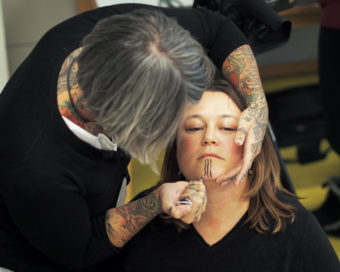
Maya Sialuk Jacobsen of Greenland gives a henna tattoo to a friend’s chin during an event at the Anchorage Museum, part of the Polar Lab’s Tupik-Mi series on traditional tattoos. (Photo by Zachariah Hughes/KSKA)

Jacobsen is one of the few Inuit women who knows how to give tattoos through traditional methods like sewing and poking in dabs of dye. She’s candid about the fact that the equipment has changed. Instead of whale sinew, she uses cotton thread; rather than coloring with soot, she uses tattoo ink. But much like rifle hunting compared to harpooning, she sees her modern tools simply as superior means towards traditional ends: inscribing the skin with meaningful marks.

Jacobsen has spent years cobbling together a body of knowledge about what the practice meant before Danish colonization in her native Greenland almost three centuries ago.

“There is no short answer,” Jacobsen says, adding, “it’s also a very Western, academic way of thinking.”

Jacobsen’s son Benjamin came with her from Greenland, and shows off self-administered henna designs made of different traditional patterns, but reconfigured. (Photo by Zachariah Hughes/ KSKA)

Outsiders have looked at Inuit tattoos as having legible meanings embedded within stable rituals, like clear markers signifying marriage or adulthood. But not only did those cultural foreigners import concepts of their own–like marriage–but also a sense of fixity to a practice Jacobsen says was much more fluid and interpretive. “I can’t tell you a triangle means an iceberg,” she explained dryly. That’s partly because the historical record is unreliable, but also because symbols were not nearly so firm.”

You can’t understand tattooing, she believes, without understanding the lives of Inuit women.

While working as a tattoo artist in Europe, Jacobsen was diagnosed with fibromyalgia, which made it difficult to wield the heavy, vibrating drill that is the trade’s standard instrument. So she started poking, and from there stitching. But as she tried learning more about how Inuit women had traditionally been marked, the few historical accounts all came from European adventurers and missionaries.

“I assure you, they did not really know what tattooing was,” Jacobsen says with a wry smile.

But then came the mummies. A group of 15th century Inuit women discovered during 1972 at the Qilakitsoq (“little sky”) grave-site in Greenland, preserved tattoos and all. Jacobsen found a book about them, studied the designs, and realized the marks on their foreheads, cheeks, and chins were similar to the tight stitches she’d learned as a girl. It was her first primary source.

“I have, like, literature, and then I have, what I call ‘from the horse’s mouth,’” Jacobsen says, “and that is the mummies.”

Tupik-Mi, Jacobson and Norldum’s project, is part of an effort within the Urban Interventions series in the Anchorage Museum’s Polar Lab.

“Tupik means tattoo,” explained Nordlum, who is Inupiaq, “and then ‘mi’ is a shortened version of muit, which means ‘people.’ In Kotzebue, we say ‘Qikiqtaġrumuit’ which means, ‘We’re the people from Kotzebue.’”

Nordlum was introduced to Jacobsen over Facebook after she couldn’t find anyone to give her a traditional tattoo in Alaska. A friendship blossomed, and they arranged the first in what they hope will be yearly Tupik-Mi events.

In addition to a lecture and live tattooing demonstration, the women also hosted a light explanation of traditional tattoos for high schoolers before letting them apply tube after tube of henna to their appendages.

Nordlum squeezed a tight formation of dots and lines onto the back of an 11th grader’s wrist.

“She’s making my initials with the Inuit designs,” says Ben Hunter-Francis.

The West High junior says he has plenty of time to decide whether or not he’ll get a tattoo. But if he does, he’d like it to be attached to his Yup’ik roots in the Lower-Yukon community of Marshall.

“Just to make my heritage proud, and make my family proud,” Hunter-Francis says, “that I’m connected with my heritage in some way.”

Traditionally, tattooing was the province of women. They were the ones who wore them, and exclusively the ones to administer them. But as Nordlum finished Hunter-Francis’s wrist, she explained that the practice isn’t bound in place by history.

“In modern culture, men getting tattoos is not a rarity. We are contemporary people working in modern times, so although it was a rarity traditionally, now it isn’t,” Nordlum says, not letting up her hold on Hunter-Francis’s arm.

“Culture is not a set thing, it is a living breathing thing that changes as time goes, and we’re just adapting … like skin.”

Holly Mititquq Nordlum shows off her partially complete tattoo during a live demonstration at Anchorage’s Above The Rest studio. Each horizontal line is 40 individual stitch marks through the first layer of skin. Before starting the stitches, Jacobsen poked the basic design of three bird feet rising from the lines. Nordlum’s Inupiaq name, Mititquq, means ‘a place where birds land,’ and she celebrates big life goals with bird feet tattoos, like the two on her opposite wrist, done with a tattoo gun. (Photo by Zachariah Hughes/ KSKA)

If plans go ahead, Tupik-Mi will expand next year to train a handful of Alaskans in traditional tattooing methods. By the third year, the hope is to hold workshops in Canada and Greenland, growing tattooing capacity across the high north.

“The idea,” Nordlum explains, “is for Iñupiaq, Inuit, Yup’ik women to feel proud of who they are. To feel strong. To create a sisterhood. To belong to something bigger than yourself, so that you’re safe and you’re supported by all these other women.”

Nordlum was a few days away from getting lines tattooed on her chin, one of the most visible and common styles across a wide array of indigenous Arctic communities. She says more women in Alaska are opting for chin tattoos, to the point where she brushed off the suggestion it was a bold decision to get one

“I don’t feel very brave here because there’s so many of us,” Nordlum says.

Permanence is part of why tattoos carry so much weight, and Nordlum sees the resurgence in women’s chin tattoos as putting forward a permanent, proud Native identity for all to see.

Jacobsen had her own chin lines laid down by her partner just two months ago. Soon after the process began, she felt a visit from her late mother.

“My mind was just wrapped around all of these thousands of fore-mothers I must have had that had tattoos,” Jacobsen says, her words growing softer. “My heart was beating so hard, and I cried, and I was shaking.”

Four thin lines that would have normally taken a few minutes took hours. “It was definitely very, very emotional,” she says.

Jacobsen is sharing that intimate experience with Nordlum, dot-by-dot, as she pokes a tattoo into her friend’s chin.

Arctic Natives’ history, artifacts may soon be lost to the sea

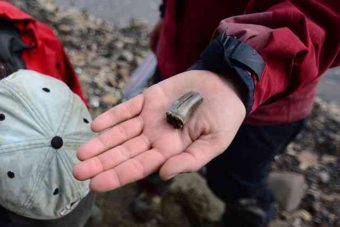
A paleontologist holds a newly-discovered fossil dinosaur tooth on the Colville River. Annual erosion of the crumbling Colville River bluffs causes fossils to spill onto the riverbanks every year. (Creative Commons photo by Paxson Woelber)

Climate change is destroying the historical record of Arctic peoples.

Archeologists are alarmed by the rapid deterioration of organic artifacts excavated in the Arctic. Those artifacts, made of materials like wood or animal hides, were until recently abundant at digs around the region, because they’d been preserved in permafrost or silty soils.

Josh Reuther opens the heavy door to the artifact repository at the University of Alaska Fairbanks’s Museum of the North. Reuther is a professor of archeology and a curator at the museum, where most of the artifacts excavated in Alaska are preserved.

“Everything’s climate-controlled — temperature and humidity,” he says as he thumbs through a drawer of plastic bags filled with artifacts excavated from St. Lawrence Island in the 1920s.

Josh Reuther at an archeological dig in Alaska. (Photo courtesy of UAF)

“Let’s see … harpoon heads; you can see toggles; you can see drilling implements …”

Reuther says over the past few years the museum has been getting more artifacts that are more deteriorated than those excavated decades ago.

He says that’s mostly due to climate change.

University of Toronto archeologist Max Friesen is working on a dig near the MacKenzie River Delta, in Canada’s Northwest Territories.

“It’s something that’s now a concern really around the entire circumpolar north,” Friesen says.

“It’s kind of a whole series of problems coming together at the same time to sort of create a perfect storm. You have the potential melting of the permafrost, you have sea level rise, you have in some cases changing weather patterns. It’s a very rich data base that’s being lost all across the Arctic.”

Rick Knecht at the dig near Quinhagak, Alaska. (Photo courtesy University of Aberdeen)

Rick Knecht, a professor of archeology at the University of Aberdeen in Scotland, agrees. He’s been working a dig near Quinhagak, in Southwestern Alaska.

“There’s so much information there that’s far away and beyond a conventional archeological site, which is just stones and bones,” Knecht said.

Anne Jensen is an archeologist and senior scientist for Ukpeagvik Inupiat Corp. who’s working at sites near Barrow, Alaska.

Anne Jensen examines artifacts in her lab. (Photo courtesy of Anne Jensen)

She says the threat to artifacts is growing, and that time is short for archeologists to recover them.

“We probably only have 20, 30 years to get this data, or it’s gone,” Jensen said.

The archeologists say more funding is needed to get as much work done as possible in the time remaining.


Obama emphasizes security of Alaska’s Arctic coastline

President Barack Obama. (Creative Commons photo by mikebrice)

President Barack Obama discussed Alaska, climate change, and Arctic issues in speech last week. The president told cadets at a U.S. Coast Guard Academy commencement they’re part of the first generation of officers to begin their service in a world where the effects of climate change are so clearly upon us.

“Climate change means Arctic sea ice is vanishing faster than ever. By the middle of this century, Arctic summers could be essentially ice free. We’re witnessing the birth of a new ocean,  new sea lanes, more shipping, more exploration, more competition for the vast natural resources below,” Obama said.

Obama said focusing on the security of Alaska’s thousand miles of Arctic coastline is a priority.

“The United States is an Arctic nation, and we have a great interest in making sure that the region is peaceful, that its indigenous people and environment are protected, and that its resources are managed responsibly in partnership with other nations,” Obama said.

The nation’s first U.S. Special Representative to the Arctic, Adm. Bob Papp, says the U.S. is also keeping an eye on Russian efforts to build military depots all along its northern shore. He also says the eight nations that make up the Arctic Council have tackled two critical issues:

“When you have maritime traffic, inevitably, inevitably, particularly in the conditions that you find in Alaska, in the Arctic — weather and seas, rocky shores — there will be an accident some day and you need to be prepared for that,” Papp said.

Papp says much more is needed: a U.S. Coast Guard Air station, a deep water port north of the Bering Strait and icebreakers. Hesays the U.S. is down to one medium and one heavy icebreaker, far behind other nations.


Researcher leaves Homer for studies in the Arctic

(Photo courtesy of Dr. Linda Chamberlain)

Homer resident Dr. Linda Chamberlain has been selected to participate in the Fulbright Arctic Initiative. The initiative seeks to create a network of scholars on the Arctic. Sixteen researchers from the United States, Canada, Finland, Denmark, Iceland, Norway, Russia and Sweden will meet over the next year to collaborate on multidisciplinary research on Arctic energy, water, health and infrastructure issues. Individuals will also make international trips for their specific areas of study.

“We work in cross disciplines to find the common ground of different issues. For example, our climate up here is warming at twice the rate as the rest of the world. How does that affect communities relative to family, wellness, health and sustainability,” Chamberlain says.

Chamberlain will contribute to the initiative by sharing her more than 20 years of experience studying ACEs, or Adverse Childhood Experiences. Simply put, she says ACEs are examples of childhood trauma.

“The original research on ACEs looked at all forms of child maltreatment: sexual, physical, and emotional. It also looked at neglect,” Chamberlain says.

She says ACEs also stem from household dysfunction caused by substance abuse, domestic violence, divorce and a number of other issues. The other side of her work is building community resiliency.

“What can we do to keep those tough times during childhood from affecting brain development, a child’s school performance, and the long term health effects that we know can happen with this,” says Chamberlain.

Chamberlain says problems in households that negatively impact children can be triggered or worsened by outside stressors, such as climate change.

“That is affecting subsistence living. It affects the fish. It affects the fishing lifestyles [and] families’ economic welfare. Then you have another layer of pressure on a family or community that may already be struggling with these issues,” Chamberlain says.

Chamberlain will work to understand what effect ACEs can have on the issues her fellow researchers are studying. She expects the opportunity to learn from her Fulbright colleagues will be priceless.

“Communities like Homer are working to become ‘trauma informed’. I think we’ve learned a lot from communities elsewhere [that] are doing a lot of work around that and now we have an opportunity to learn from communities who live like we do in the circumpolar world,” Chamberlain says.

The researchers met for the first time this week for a program orientation in Iqaluit — the largest city in the Canadian territory Nunavut. Over the next year they will conduct research at home as well as travel to institutions located in the home countries of the initiative’s participants.

Chamberlain will visit Finland in June to give a presentation on ACEs and from there she’ll travel to a research center in Nova Scotia that studies community resilience.

“Then I’ll be back home laying out what my research plan will be,” Chamberlain says.

Once all the teams’ research is complete and the results are analyzed, the initiative will culminate in a final meeting next year in Washington D.C. Chamberlain plans to share the end result of her research online.


Flooding closes Dalton Highway

Flooding near Milepost 394 Dalton Highway. (Photo courtesy of Alaska Department of Transportation)

The northern end of the Dalton Highway is closed again. A month after overflow from the Sag River shut it down, spring melt water has made the only access road to the North Slope oil fields impassable again.

On Sunday night the Alaska Department of Transportation announced a 4 day closure of the Dalton Highway from mile 375 to 410, south of Prudhoe Bay.  DOT spokeswoman Meadow Bailey says it was anticipated that overflow ice that that built up this spring would cause major problems during break up.

Bailey says the DOT is prepared for serious road damage due to erosion.

Bailey says the worst area remains between milepost 395 and 405, but the closure has been expanded to take in a few other areas where there’s water over the highway, and to allow a contractor to stage repair equipment and materials. She says the section of main impact is completely covered by flood water.

Bailey says the state has been in communication with North Slope oil companies and the truckers who supply them, and they prepared for the extended closure. After the flooding subsidies and emergency repairs are made, the section of road is scheduled for major reconstruction this summer that will raise it 7 feet above the current grade.


Iñupiaq lands rights activist Etok Charlie Edwardsen, Jr. dies

Etok Charles Edwardsen Jr. (Photo courtesy of the Edwardsen family)

Alaska Native activist Etok Charlie Edwardsen, Jr. has died.

In the years leading up to the Alaska Native Claims Settlement Act of 1971, Edwardsen testified before Congress on behalf of the Arctic Slope Native Association, saying that a land deal between Russia and the United States didn’t affect Iñupiaq ownership of their lands. He also led protests calling the land settlement “robbery.”

Edwardsen died in his sleep Friday night while at whaling camp. He was 71.

Site notifications
Update notification options
Subscribe to notifications