The top energy industry lobbyist in Alaska denounced Gov. Bill Walker’s proposed oil and gas tax changes on Monday.
Alaska Oil and Gas Association President Kara Moriarty told the House Resources Committee that companies can’t afford higher costs when oil prices are low.
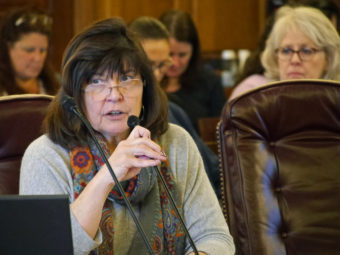
“If you want the policy of Alaska to be to raise taxes on an industry that has negative cash flow, then that’s your prerogative, but what we’re saying is that that policy will impact their investment and production,” Moriarty said.
Walker proposed raising the minimum oil and gas tax from 4 to 5 percent. He also wants to eliminate some tax credits for drilling and exploration.
The changes would reduce the state government’s $3.5 billion deficit by $500 million.
Rep. Geran Tarr, an Anchorage Democrat, asked Moriarty to reconcile industry concerns with the actions of some companies, such as Hilcorp, which gave employees $100,000 bonuses last year.
“How can you expect the Alaska public to react to information like that?” she asked.
Moriarty said Hilcorp honored a long-term commitment to their workers with the bonuses. She added that other major employers have been laying off workers in Alaska.
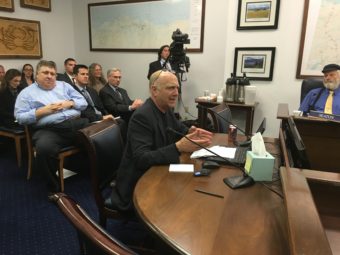
Armstrong Oil & Gas Inc. Chairman Bill Armstrong testifies on Feb. 29, 2016 (Photo by Andrew Kitchenman)
Armstrong Oil and Gas Chairman Bill Armstrong said other states have had stable oil and gas taxes. But Alaska has made several changes over the past decade, making it more difficult to invest.
He said most countries have been cutting taxes on energy companies.
“They’re all making things better, with the exception of three countries that I could find: Congo, Madagascar, and Tanzania. And Alaska,” Armstrong said. “Three countries and a state. So, to make things worse when things are bad is, you’re kind of in rare company.”
The committee will hear testimony from more industry executives on Tuesday.
State officials have put a number on how much they will trim from next year’s budget for marketing liquefied natural gas from the proposed pipeline: $7 million.
That’s the cut Governor Bill Walker’s administration will make to its budget request. It reduces the number of companies marketing gas to customers in Asia from three to one.
Deputy Commissioner of the Dept. of Natural Resources, Marty Rutherford, gives an overview of the Alaska Liquefied Natural Gas Project in House Finance, Feb. 23, 2016. (Photo by Skip Gray/360 North)
State Deputy Natural Resources Commissioner Marty Rutherford told the House Finance Committee Tuesday the change reflects slow negotiations with the state’s three pipeline partners, as well as the low price of gas.
“The commercial negotiations have not moved as expeditiously as we would have wished, um, and recognizing the reality of the environment we all are living in,” the state made the budget change, she said.
The state originally asked for $35.7 million for the AK LNG project in the coming budget year. Now it’s asking for $28.7 million.
While negotiations are slow, the state still faces a tight window for completing the project.
Between seven and nine years from now, many contracts in Asian countries will be up for renewal.
Rutherford said some of these contracts won’t be renewed because the current suppliers are tapped out.
“And growth for LNG demand is fairly flat,” she said. “It’s not forecast to grow at a very strong rate over the next 10 years. So trying to respond to that market window, if you will, is a very critical issue for the state of Alaska.”
Walker and leaders of ExxonMobil, BP and ConocoPhillips announced last week that they’re exploring options to advance the pipeline. They said they’ll provide more details next month.
The trans-Alaska pipeline in the northern Brooks Range of Alaska in June 2007. (Public domain photo by U.S. Geological Survey)
As Alaska’s Legislature digs through Gov. Bill Walker’s budget proposal, a prime focus is the overhaul Walker put forward for oil and gas taxes.
By reducing tax credits and increasing minimum production taxes, Walker aims to shave $500 million off the state’s budget shortfall.
House members question whether Walker’s administration has done enough analysis of the oil and gas tax changes – as well as other tax increases the governor has proposed.
Speaker of the House Mike Chenault, a Nikiski Republican, said it’s important for legislators to study economic models showing how the changes will affect the state.
Rep. Mike Chenault, R-Nikiski, at a House Majority press availability Feb. 18, 2016. (Photo by Skip Gray/360 North)
“They were told basically they have no modeling – or that they were working on modeling. Well, it’s hard to put together a tax bill if you don’t have modeling,” Chenault said.
The state didn’t conduct statistical modeling before Walker proposed the tax changes.
State Revenue Commissioner Randall Hoffbeck said officials focused on the fact that the state is committed to paying oil and gas companies more in tax credits than it has to spend.
But state officials did talk with oil and gas company executives about which tax credits were most effective.
Hoffbeck said the process of deciding how to change tax credits had three steps.
“One is, you know, which credits didn’t necessarily work the way they were intended. Either they didn’t get used or really the return on the credits weren’t all that we had hoped that they would be,” Hoffbeck said. “And secondly, you know, which credits worked really well, and may have accomplished their purpose. And then, of course, the remaining is the credits that are still seen as critical moving forward.”
Speaker Chenault is not convinced. He said the fate of Walker’s proposed tax increases depends on the information the House receives.
“How those come out – which ones pass or not I can’t tell you until we at least hear them, understand them, make sure the administration understands the consequences of the actions that we take as far as public policy for the state of Alaska — and that’s going to take time,” Chenault said.
Hoffbeck said more information will be available next week on the economic effects of the tax changes.
BP Alaska President Janet Weiss, Gov. Bill Walker and ConocoPhillips Alaska President Joe Marushack announced Wednesday that they’re exploring options on the Alaska Liquefied Natural Gas Pipeline, but declined to give specifics. (Screenshot)
Changes are coming to state plans for a liquefied natural gas pipeline, but the governor and the state’s three pipeline partners aren’t ready to say what those changes will be.
At a news conference Wednesday in Anchorage, executives with ExxonMobil, BP and ConocoPhillips joined Gov. Bill Walker to announce that they are “exploring options” to advance the pipeline.
Walker emphasized the importance of keeping the project on track.
“We know that most likely there needs to be some modifications in some way and so we sort of come back to the drawing board a bit on how to look at this project a bit differently,” Walker said.
The executives said they would complete preparations for front-end engineering and design work — also known as “pre-FEED” — on schedule by this fall.
But ConocoPhillips Alaska President Joe Marushack didn’t offer assurances beyond a commitment to explore options.
“What we’re trying to do is get through the pre-FEED process,” Marushack said. “Clearly the economic headwinds are pretty tough right now, but we’ve got to see what the project costs before we can make a statement if we should participate and go forward or not.”
Energy industry experts have said the project doesn’t make economic sense at today’s natural-gas prices.
The announcement put into doubt the state’s timeline for the project.
State Natural Resources Deputy Commissioner Marty Rutherford says everything is on the table ahead of another pipeline announcement next month.
“It’s sort of a nexus of problems that have happened — this economic situation on the value of oil and gas as well as slow negotiations — which has caused everybody to begin to discuss: ‘Well, as we continue forward on AKLNG as currently envisioned, are there other alternatives we should be looking at so we don’t have a delayed feed decision?’ ”
Walker earlier said he would seek a state constitutional amendment to lock in tax rates for the energy companies who are working with the state on the project.
The governor said Wednesday he isn’t ruling out the amendment, but the state may be able to provide cost certainty without an amendment.
The project has an estimated cost of $45 billion to $65 billion.
Speaker of the House Mike Chenault said he wished there was something more concrete from the announcement.
The Nikiski Republican added that he welcomes greater scrutiny of the cost of the project, which is the largest proposed infrastructure project in the world.
“I don’t know whether to take it as a sign of good or bad,” Chenault said. “I think we take it as a time that they’re still talking and, you know, in the economic times that we’re in, with the price of a barrel of oil, I think that it might do us well to step back and look at it and make sure that we haven’t missed something that may cost us in the future.”
Kenai Peninsula Borough oil and gas adviser Larry Persily said the options may include changing the percentage ownership each partner has in the pipeline.
Persily previously was the federal coordinator for natural gas projects in the state. He said if some of the partners decide to scale back their participation in the project, it will present a dilemma for the state.
“Right now, the state, I think, wants it more than the others, but when it comes down to it, the state is not in a position to take on more risk than the companies can afford,” Persily said. “We have enough of a financial hole in our budget.”
Persily said if the state wants to borrow money, it will have to show lenders it can pay the bills it already has. He said the announcement is a reminder that the state must be financially self-supporting before it can think of new options for the gas line.
For 40 years, Alaska’s North Slope oil production has taken place on a stretch of state land sandwiched between two major federal reserves: to the east is the Arctic National Wildlife Refuge. To the west, the much larger National Petroleum Reserve Alaska — which, despite its name, never produced any oil until this fall.
ConocoPhillips hopes to change that in a big way. Despite oil prices hovering around $30 a barrel, the company is plowing ahead with efforts to develop the NPR-A. The company invited Alaska journalists on a tour last week of CD5, the first drill site to produce oil in the reserve — and, the company hopes, the gateway to more development.
The 7 a.m. flight to the Kuparuk oil field took off from Anchorage with a dozen reporters joining the regular commuting crowd.
“Good morning ladies and gentlemen, once again welcome aboard Shared Services Flight 151 with service to Kuparuk,” the flight attendant said.
This is the only way to reach Kuparuk, on a flight operated and paid for by ConocoPhillips and BP’s Shared Services, which ferries more than 26,000 workers a month to and from the North Slope oil fields.
Arriving at ConocoPhillips Kuparuk River Unit, the temperature hovered around -7 degrees. (Photo by Rachel Waldholz/APRN)
When we landed, it was -7 degrees. In the morning half-light, the scene, with its modular buildings, heavy equipment, steam rising in the distance and sweeping wind felt more than a little otherworldly. One reporter commented that this must be what it will look like when we colonize other planets.
Kuparuk can house up to 2,500 people, and keeping them all fed, safe and comfortable is an operation in and of itself.
“We’re like a little city,” said operations manager Ty Maxey. “We have our own power system, our own wastewater treatment system, our own potable water treatment system.”
A unit at the edge of ConocoPhillips’ Kuparuk oil field. (Photo by Rachel Waldholz/APRN)
Alaska’s most famous field, of course, is Prudhoe Bay, operated by BP. Discovered in 1968, it’s still the largest oil field in North America.
Conoco’s Kuparuk River Unit is 40 miles west of Prudhoe and only slightly less massive. It began operations in 1981.
West of Kuparuk is Alpine, in the Colville River delta. It came online in 2000.
Alpine has about 450 people right now.
“Kuparuk is the big brother for Alpine. That’s for sure,” said Steve Thatcher, the operations manager at Alpine. “It’s much bigger, much more complicated field. But Alpine is where we’re growing.”
The newest development at Alpine is CD5. The drill site is on a tentacle of road stretching west from Alpine, and sits just inside the National Petroleum Reserve. The billion-dollar project started producing oil in October – the first from the NPR-A – and is eventually expected to produce about 16,000 barrels per day.
Conoco hopes CD5 will be both the gateway and launch pad for development in the rest of the NPR-A. From CD5, Conoco plans to build a road to its next development, Greater Mooses Tooth 1. And from there, if it gets through permitting, to Greater Mooses Tooth 2.
So today we’re traveling west from Kuparuk. If you remember just one thing, that’s it. This is what Conoco is doing on the North Slope. Marching west.
There is no permanent road connecting Alpine and Kuparuk. Instead, during the winter, the two units are linked by a 25-mile ice road.
A 25-mile ice road connects ConocoPhillips’ Kuparuk and Alpine units on the North Slope. Here, it crosses part of the Colville River. (Photo by Rachel Waldholz/APRN)
Built with ice chips harvested from lakes along the route, the ice road is rebuilt every winter, at a cost of $20 million each time. In the summer, it melts into the tundra, leaving Alpine accessible only by plane.
Roads — their presence or absence — are a big deal on the North Slope, and often one of the hardest things to get regulators to approve.
It took 10 years to permit CD5, in no small part because the project required a 6-mile gravel road and four bridges, including one over the Nigliq Channel of the Colville River. At 1,400 feet, it’s the largest bridge on the North Slope.
The 5-mile road from Alpine Central Facility to the CD5 drill site crosses four bridges, including the Nigliq Channel bridge, the longest on the North Slope. (Photo by Rachel Waldholz/APRN)
The road passes through a key subsistence fishing area for the village of Nuiqsut, which is just 8 miles from Alpine.
Though it’s inside the NPR-A, CD5 is actually on land owned by the Nuiqsut village corporation, Kuukpik. The road was controversial, and the village insisted Conoco change the bridge location.
“CD5 came a long way,” said Kuukpik Corp. President Isaac Nukapigak. “In the beginning we had a little disagreement over where the project itself should be developed. We were able to compromise on a way of responsible development.”
Kuukpik, he said, aims for “balance.”
As for development farther west in NPR-A, Nukapigak said, his view is it’s going to happen one way or another, and Nuiqsut needs to have a seat at the table.
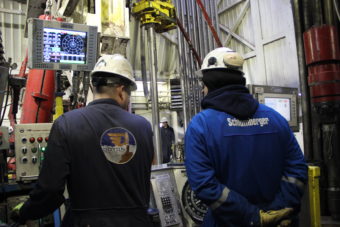
As we drove up to CD5 itself, a Doyon drill rig emerged from the fog, sitting crouched on the pad like a rocket, not far from some caribou. At 12 acres, the pad itself was crowded with equipment. Our bus nearly caused a traffic jam. Inside, the sound was deafening, and the crew was busy at work on an injection well, the newest well on Alaska’s North Slope.
A Doyon drill rig putting in new wells at the ConocoPhillips CD5 drill site. (Photo by Rachel Waldholz/APRN)Two contractors monitor the drilling of an injection well at ConocoPhillips’ CD5 drill site. (Photo by Rachel Waldholz/APRN)
Whale, otter and other marine mammal carcasses were found with evidence of two algae-carrying toxins along most of the Alaska coastline in a study released Thursday. (Map courtesy Northwest Fisheries Science Center)
For the first time, scientists have documented the prevalence of two biotoxins in Alaska’s marine mammal population above the Arctic Circle.
That’s according to a new study out Thursday in the Journal Harmful Algae. But it’s not clear if algal toxins have always existed in the Arctic, because scientist never looked before now.
Scientists did not expect to find algal toxins in ocean water or marine mammals that range north of the Gulf of Alaska and the state’s Southeast region.
“This is really important, because these are animals that are integral to the culture and the community and food security here in Alaska,” said Frances Gulland, a commissioner with the federal Marine Mammal Commission. She co-authored the new study.
“There are detectable levels that have actually been measured of two different biotoxins: domoic acid and saxitoxin and both these toxins are produced by harmful algal blooms,” Gulland said.
The two are known to cause amnesic shellfish disorder and paralytic shellfish disorder in people.
“Now that we see that algae is there,” said Gay Sheffield, a biologist with the Alaska SeaGrant Marine Advisory Program and a study co-author.
“What would be the best coarse of action to make it comprehensive knowledge is to find out how our Russian neighbors have seen any of these unusual algaes or if they have any unusual concerns and more importantly is there traditional knowledge on shellfish poisoning or algal blooms or is there strange behavioral events with marine mammals,” she said.
After algae dies in the ocean, what’s left gets consumed – or filtered – by shellfish like clams and mussels, staple foods for many marine mammals. So, if there are algal toxins present they could end up in the gut contents of an unsuspecting Pacific Walrus, for example. Sheffield said of the 13 marine mammal species sampled over the course of nearly a decade, walrus had the highest levels of algal toxins.
“Because its such an important subsistence food item for the Bering Strait, there’s of course interest both from an animal health perspective, but a public health, human health, food security as well, but right now, there’s no problem,” said Sheffield.
According to the study, levels of algal toxins measured do not exceed regulatory limits for seafood safety in Alaska, or at the federal level. It’s also not clear if the toxins have always been present in the Far North, because scientists never tested for them before now.
Frances Gulland added that the study is not only limited in size, but the data itself can’t provide information about the magnitude of exposure, because toxins like domoic acid are cleared from an animals bloodstream and the gastrointestinal system so quickly.
“If the animal ate some food 10 minutes ago that was full of domoic acid, it would have a high level, but if its 12 hours since the animal ate, the levels will be lower,” she said.
“If it’s two days since the animal ate, the levels will be really low,” said Gulland. “So, really the data are limited because they’re only telling you what’s in that snapshot in time.”
Research does indicate an increase in the occurrence of algal blooms in the Arctic. Gulland believes that’s due to warming ocean temperatures and changes in sea ice.
“They’re plants, they grow, they are temperature dependent,” she said, “so clearly, with warmer waters, they’re going to replicate quicker, so its sensible to assume that temperature is important, but there also changes in micro-nutrients – things like iron and different components of water – that will affect how they bloom as well.”
Funding for study sampling came from the U.S. Fish and Wildlife Service, the National Marine Fisheries Service and the Alaska Department of Fish and Game. Additional money came from the National Institute of Health and the National Science Foundation.
Close
Update notification options
Subscribe to notifications
Subscribe
Get notifications about news related to the topics you care about. You can unsubscribe anytime.