Alaska

Alaska offers free rocks and dirt, helping big state-backed construction projects

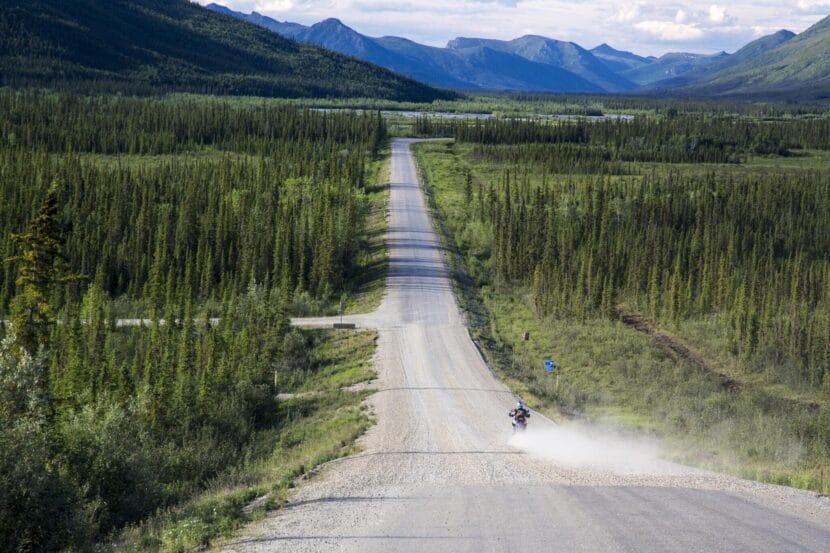
A motorcyclist descends a hill as he approaches Coldfoot, Alaska on the Dalton Highway in 2014.
A motorcyclist descends a hill as he approaches Coldfoot, Alaska on the Dalton Highway in 2014. (Bob Wick/Bureau of Land Management)

The state of Alaska is preparing to give away millions of dollars worth of gravel to public corporations, a move that would amount to millions of dollars in assistance to some of the state’s biggest construction projects.

According to a Q&A posted by the Alaska Department of Natural Resources, the beneficiaries could include the proposed Ambler Access Project and the proposed trans-Alaska natural gas pipeline.

The state’s plans were disclosed the day before Thanksgiving in a public notice stating that DNR is planning “regulation changes on material sales and conveyances to state agencies.”

The Department of Natural Resources oversees mining on state lands in Alaska, including the extraction of gravel and fill dirt for use in construction.

While humble, gravel can be serious business — in November, DNR commissioner-designee John Crowther signed an order that prohibits gold, silver and other kinds of mining near gravel quarries along the Dalton Highway, which links Fairbanks to Prudhoe Bay.

For state maintenance crews that need to keep the highway open, gravel is more important than rare minerals.

In 2024, High Country News reported that for construction projects on the North Slope, gravel is a “precious commodity” because of its scarcity.

One of DNR’s proposed changes to its gravel rules declares “that the department convey material to a state agency or public corporation at a base price of $0.00 per cubic yard and without retaining a reversionary interest.”

Currently posted price charts show the state selling gravel for $3 per cubic yard in Interior Alaska.

State law prescribes that any time DNR wants to sell land or public resources for less than market value, the commissioner must declare that the sales “serve a public purpose and are in the public interest.”

The upcoming regulation change states that transfer to a state agency or state corporation is automatically consistent with that requirement.

That would allow the Alaska Department of Transportation and Public Facilities to get gravel from state land for free, excepting the cost of processing and transportation.

In a question and answer notice published Dec. 26, DNR said the change is intended to allow “for maximum use of state land consistent with the public interest.”

“Examples of a public purpose would be a state agency or public corporation using gravel to construct a gravel pad on a state leased site for infrastructure development; to construct a new state highway right-of-way or expand an existing state right-of-way; or to build an embankment along a river; or gravel needed for the development of a gas line right-of-way,” it wrote.

The free gravel and dirt would also be available to state-owned corporations, which is likely to affect some of the state’s biggest development projects.

The Alaska Industrial Development and Export Authority is developing a 211-mile road between the Dalton Highway and mine sites in northwest Alaska and would be eligible for the free rock and dirt. So would the Alaska Gasline Development Corp., which is now a junior partner in the development of the proposed trans-Alaska natural gas pipeline.

A spokesperson for Glenfarne, the pipeline’s lead developer, said the firm did not request the regulation change.

In 2024, the Bureau of Land Management estimated that the proposed Ambler Road would need between 15 million and 22 million cubic yards of gravel, plus an additional 220,000 to 347,000 yards annually for maintenance.

If the state of Alaska provides that gravel for free, it would be a revenue loss of between $45 million and $66 million for construction alone.

The public comment period on the change expired on Jan. 2, and it was not immediately clear when the change would take effect.

Lorraine Henry, director of communications for DNR, said by email that it isn’t yet clear how much gravel might be affected by the regulation change, and that the agency didn’t intend to benefit any specific project.

“DNR cannot speculate on the volume of gravel that may be involved, as each application from State of Alaska agencies will be evaluated on its merits – and will include a public process and follow statutory authorities,” she said.

Mary Peltola enters Alaska U.S. Senate race

a woman talks into a microphone at a podium on stage
Mary Peltola, then Alaska’s U.S. representative, at the Alaska Federation of Natives convention in Anchorage in 2023. (Matt Faubion/Alaska Public Media)

WASHINGTON — Democrat Mary Peltola announced Monday that she’s running for U.S. Senate, taking on Republican incumbent Sen. Dan Sullivan.

Peltola served one partial and one full term in the U.S. House, becoming the first Alaska Native person elected to Congress. She then narrowly lost her seat in 2024.

Her announcement Monday came with a video portraying her salmon-centered family life on the Kuskokwim River. She repeats her previous campaign slogan: “Fish, family, freedom.” She also hearkens back to Alaska senators who served in less partisan times.

“Ted Stevens often said, ‘To hell with politics. Put Alaska first,'” Peltola says on the video. “It’s about time Alaskans teach the rest of the country what Alaska first and, really, America first looks like.”

(Peltola modified Stevens’s oft-repeated quote. The late senator’s catchphrase was actually “To hell with politics. Just do what’s right for Alaska.”)

Nationally, Democrats believe that with Peltola on the ballot, Alaska presents one of their best hopes of flipping a seat. Political analyst and statistician Nate Silver said in a social media post last week that Democrats still have an uphill battle to win back the Senate majority but that Peltola’s candidacy moves their chances in Alaska from a long-shot to plausible.

Sullivan has already raised $6 million this election cycle. He has President Trump’s endorsement and maintains a strong alignment with Trump.

But, in what Democrats took to be a sign that he’s feeling the political heat, Sullivan last month unexpectedly voted to extend health insurance subsidies. He’s also touting a new bill that targets one of Peltola’s primary issues: Bycatch, or the accidental catch of salmon by the pollock fleet.

For U.S. Sen. Lisa Murkowski, Peltola’s candidacy presents a dilemma. They’re both moderates, and Murkowski endorsed Peltola in the past, despite their party differences. The senator declined to pick a side when a reporter asked before Christmas. But Thursday Murkowski said she’d made a decision: She’s endorsing her Republican colleague.

“We’ve had a pretty solid team here in the Senate for the past 12 years, so we want to figure out how we’re going to keep in the majority,” she said. “And Dan delivers that.”

Both sides are expected to pour tens of millions of dollars into the race.

Sullivan’s last race in 2020 was one of the most expensive elections in state history, with spending by the campaigns and outside groups totaling more than $57 million.

Sullivan was outspent but beat independent candidate Al Gross by a substantial margin.

Peltola lost her House seat to Republican Nick Begich. After ranked ballots were tallied in 2024, she had almost 49% of the vote to his 51%. (The rankings had little impact on the final result in that race. Before voters’ second- and third- choices were counted, Begich’s lead was slightly smaller.)

Sullivan and Peltola will face off first in a nonpartisan primary in August. The top four candidates will advance to a ranked-choice ballot in November.

Multiple small avalanches release in Juneau after city issues evacuation advisory

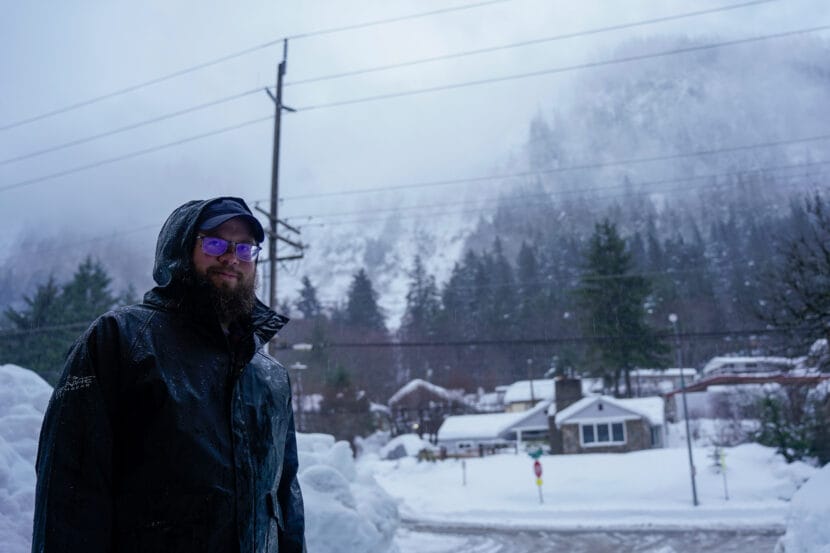
Ezra Strong in front of the Behrends slide path on Friday, Jan. 9, 2025. (Photo by Alix Soliman/KTOO)

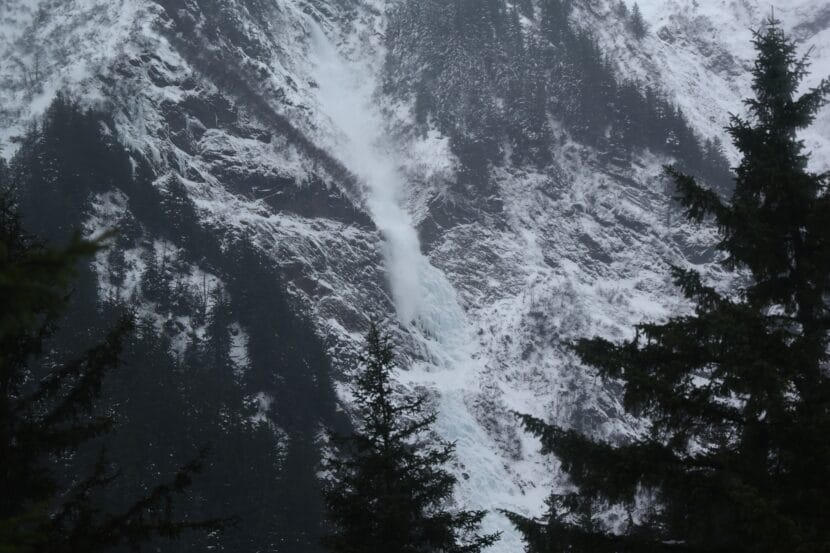
Two small avalanches released on a slide path of Mount Juneau, above the Behrends neighborhood, as Ezra Strong was on a walk this morning in the pouring rain. 

The city issued an evacuation advisory about an hour earlier for Juneau residents in all known slide paths downtown and along Thane Road. Strong and his wife live on Gruening Avenue with their dog. He said he’s not heeding the advisory.

“I think in part because we’re a little bit protected by a rock wall and some other things behind us, in part because we have seen slides come down before on the main slide path that didn’t even get close to us,” he said.

During an online press conference Friday morning, the City & Borough of Juneau’s new Avalanche Advisor John Bressette said that many small slides reduce the hazard by decreasing the amount of snow that could be released in a larger slide. 

“So it’s actually a good thing that we’re seeing smaller slides reducing the total snow load that is capable of producing an avalanche,” Bressette said. 

Some avalanches released above the Flume Trail today. The Alaska Department of Transportation and Public Facilities confirmed numerous small avalanches along Thane Road Friday morning. The agency expects more avalanches this evening since the forecast shows continued heavy rainfall, strong winds and warming temperatures. The closure of Thane Road could be extended multiple days. 

A slide coming off Mt. Juneau down Chop Gully above the flume in the Basin Road area on Friday, Jan. 9, 2026. (Photo by Mikko Wilson/KTOO)

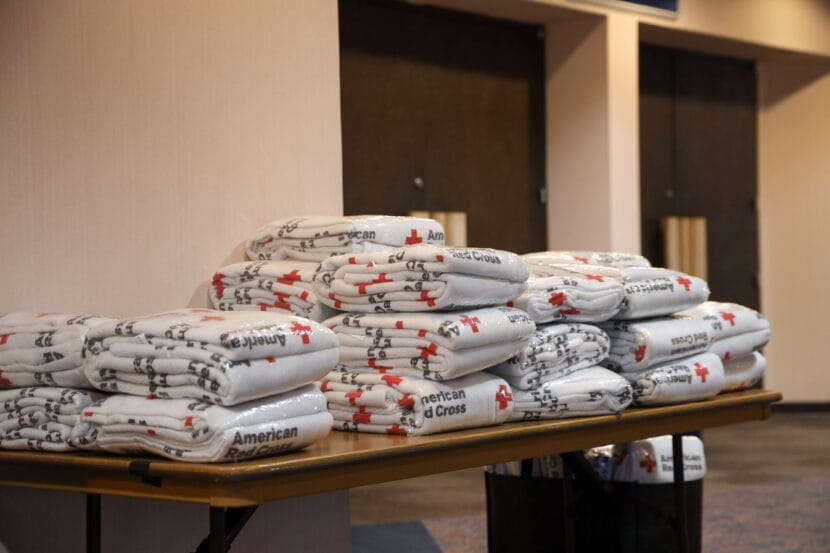
Some residents of the Behrends neighborhood have evacuated to friends’ houses or Centennial Hall, the official shelter set up by the city and the American Red Cross.

Carlos Cadiente lives kitty-corner from Juneau-Douglas High School: Yadaa.at Kalé in the Behrends slide path. He evacuated at around 11:30 a.m. in one vehicle while his wife drove behind in another. At a stop sign, he told KTOO they were headed to a friend’s house just down the street. 

“We already had a go-bag going and we already had the cars loaded up and ready to roll, and so we’re rolling,” Cadiente said. 

He said this is the first time they’ve heeded an avalanche evacuation advisory in the decades they’ve lived here. 

“It’s kind of an extreme measure, you know, extreme weather that we’ve had,” he said. “So we’re just kind of trying to be proactive and not be a problem,” he said. 

Britt Tonnessen is the community disaster program manager for the Red Cross of Alaska in Southeast. In coordination with the city, the Red Cross set up an emergency shelter at Centennial Hall downtown for residents on Friday. 

Blankets sit in a stack for avalanche evacuees at Centennial Hall on Friday, Jan. 9, 2025. (Photo by Clarise Larson/KTOO)

At the shelter on Friday morning, she said the Red Cross has been preparing for the last week in case of an evacuation. 

“We’ve seen multiple fatal landslides and avalanches in the past decade,” she said. “Evacuating to a congregate shelter is not people’s dream idea. It’s a safe place to go. We do the best to meet the needs and we have incredible, loving, warm volunteers to meet people.”

Tonnessen said that anyone from avalanche zones, as well as those who feel the load on their roof is becoming too heavy, are welcome at the shelter. 

She said they are prepared to take 150 people, and around 30 people signed in by the early afternoon

Avalanche, weather and road conditions are expected to worsen Friday evening.

KTOO reporter Clarise Larson contributed to this report. 

Snow removal, roof monitoring at Juneau schools continues through weekend

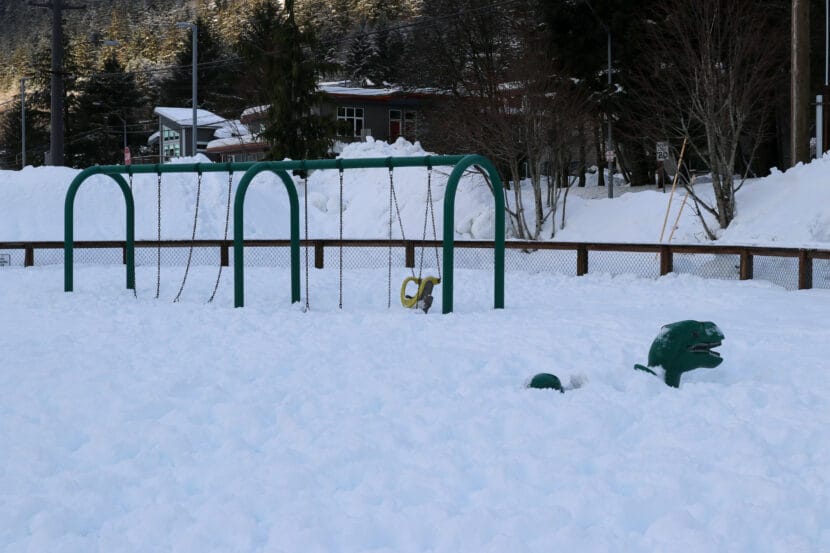
A green dinosaur play structure and a green swing set are covered in several feet of snow.
A swing set and dinosaur play structure are buried under several feet of snow at Harborview Elementary School in Juneau on Jan. 7, 2025. (Photo by Jamie Diep/KTOO)

The City and Borough of Juneau has largely wrapped up shoveling on Sít’ Eetí Shaanáx — Glacier Valley Elementary School and began work on Mendenhall River Community School on Friday. 

This comes after record snowfall caused the district to close schools multiple times this week, including all schools Friday.

Assistant City Manager Robert Barr said at a press conference Friday the rain from the current atmospheric river could increase the weight on roofs.

“We expect snow weights to increase because of the rain, until it is able to warm up sufficiently for that snow-ice melt to drain both through the roof drains, which we’re giving careful attention to, as well as off the roofs through through, you know, gutter and gutter style systems,” he said.

Juneau School District Superintendent Frank Hauser said shoveling on the roof of Mendenhall River Community School is expected to continue this weekend. He said CBJ engineering teams plan on inspecting schools through this weekend to make sure it’s safe to occupy them on Monday.

Hauser said schools will move to remote learning if there’s any need to be closed for snow removal next week. He said a wider number of factors will determine if another districtwide closure is needed.

“Though none of our schools are in the avalanche zones, it is something that, you know, could inhibit transportation,” Hauser said. “And so as we’re looking at that and looking at the road conditions, those are factors we take when we look at a more broad potential school closure.”

Juneau-Douglas High School: Yadaa.at Kalé and Harborview Elementary School sit just outside the Behrends Avenue slide path avalanche zone, which is included in the evacuation alert issued Friday.  

Hauser encouraged families to make sure their contact information with schools are up to date, and to download the district’s app to receive the latest alerts.

Eaglecrest Ski Area’s general manager resigns, board chair steps down

Craig Cimmons interviews for the Eaglecrest Ski Area general manager position during a meeting at City Hall on Friday, Aug. 2, 2024. (Clarise Larson/KTOO)

The general manager of Juneau’s Eaglecrest Ski Area has resigned and the chair of its board of directors has stepped down. Both departures were announced Thursday night during the ski area’s board of directors meeting.

Hannah Shively served as the board chair for less than six months. At the meeting, she said she was leaving the role due to health reasons. The board elected Brandon Cullum as its new chair. 

Craig Cimmons, Eaglecrest’s general manager, was absent from the meeting Thursday night and did not immediately respond to a request for comment on his resignation. He has not publicly offered a reason as of Friday morning. 

“We’re not sure why the manager is not here tonight, totally honestly, we’re still trying to figure that out,” Cullum said during the meeting. “I’m sure it’s not out of disrespect to anyone, but we’re going to do the best we can to present the information that he’s provided and answer questions.”

Cimmons’ resignation comes after serving in the role for less than two years. He was hired as general manager in the fall of 2024 after the former manager, Dave Scanlan, was abruptly asked to resign by the board.

Both departures also come as the city-owned ski area faces a tough start to its 50th season, including a broken water line and a delayed opening of the Ptarmigan lift. And, that’s all while Juneau has been facing back-to-back snowstorms, prompting city officials and tribal leaders to issue a joint disaster declaration. The capital city is currently bracing for heavy rain and potential flooding from an atmospheric river on Friday.

“This month has been terrible,” Shively said at the meeting. “Pretty much anything that could have gone wrong went wrong.”

Eaglecrest staff originally announced in mid-December that there was a large break in its main water line that supplies its lodges. And, while that has since been repaired, staff say there are still other repairs that need to be done before the water is restored. In the meantime, skiers and staff have been using portable toilets outside of the lodge. 

Another issue is the delayed opening of its Ptarmigan lift due to unexpected repairs. The chairlift serves the middle of the mountain. According to Shively, the ski area hopes to open it soon. 

“All our required state certifications have been received, and we’re currently waiting for that final inspection from our insurance provider,” she said at the meeting.

Cimmons agreed to stay in his role for another month to help facilitate finding his replacement. Meanwhile, the ski area’s Director of Snowsports School, Rental, Retail & Repair Erin Lupro will take over the role of acting general manager.

The ski area is slated to celebrate its 50th year as a ski area next weekend.

Alaska’s Rep. Nick Begich votes against 3-year extension of federal health care subsidies

Rep. Nick Begich, R-Alaska, speaks during the commissioning ceremony for the Coast Guard icebreaker Storis on Sunday, Aug. 10, 2025, in Juneau, Alaska.
Rep. Nick Begich, R-Alaska, speaks during the commissioning ceremony for the Coast Guard icebreaker Storis on Sunday, Aug. 10, 2025, in Juneau, Alaska. (James Brooks/Alaska Beacon)

The U.S. House of Representatives voted 230-196 on Thursday to extend Affordable Care Act subsidies for three years and reverse massive cost increases that went into effect with the new year.

The reversal must still be approved by the U.S. Senate and President Donald Trump before becoming effective.

Alaska’s lone member of the House, Republican Rep. Nick Begich III, voted against the extension, as did 195 other Republicans.

Seventeen Republicans voted for the extension of subsidies that were enacted during the COVID-19 pandemic emergency, joining all of the chamber’s Democrats.

The House’s Republican leaders opposed the extension, but a handful of Republicans signed a petition in December to force a vote.

Begich did not sign that petition, and on Wednesday, he joined other Republicans in an unsuccessful procedural vote intended to block Thursday’s decision.

In a written statement explaining his vote on Thursday, Begich said extending subsidies would not fix the problems he sees with the Affordable Care Act, commonly known as Obamacare. “The health insurance system created by Democrats under Obamacare has proven completely unaffordable for the American healthcare customer,” the statement said. “An extension of Obamacare COVID subsidies does not fix what is broken.”

He said he would like to see reforms to the Affordable Care Act, without which he said the extension “has no credible pathway forward in the Senate.”

In December, Begich voted in favor of a Republican-proposed alternative to the extension. That alternative, which focuses on drug costs, would not stop or reverse the new cost increases and has thus far been rejected by the Senate.

The Congressional Budget Office reported that the alternative would reduce health insurance premiums for insured Americans but would also reduce the number of Americans who are insured.

“I remain committed to working on reforms that lower costs, expand access, and improve outcomes for all Americans,” Begich said in his statement. “Temporary extensions without meaningful reform are not the solution. Real reform that puts patients first is.”

In December, Alaska’s two U.S. Senators, Lisa Murkowski and Dan Sullivan — both Republicans — joined Senate Democrats in an unsuccessful attempt to advance a condition-free extension similar to the one passed by the House on Thursday.

That was a change in position for Sullivan, who had previously opposed extensions that were not coupled with changes to the Affordable Care Act.

Begich and Sullivan are each up for election this fall. Sullivan does not have a Democratic Party-backed opponent yet, but former U.S. House Rep. Mary Peltola is widely expected to enter the race this month.

Begich is being opposed by Anchorage pastor Matt Schultz. Alaska Democratic Party Chair Eric Croft said by email that Thursday’s vote will be a campaign issue in the fall.

“After allowing lifesaving ACA tax credits to expire on December 31, Nick Begich doubled down on his betrayal of Alaska families and blocked the extension of these credits,” he wrote. “We cannot afford these health care price hikes, and we won’t forget about Nick Begich’s betrayal this November.”

Site notifications
Update notification options
Subscribe to notifications