Alaska

Kookesh challenges Stedman for Senate seat

A pair of powerful Southeast lawmakers will face off in the 2012 election. Angoon’s Albert Kookesh and Sitka’s Bert Stedman will both run to represent a Senate district newly configured by redistricting.

Earlier this year, Kookesh predicted reapportionment would merge part of his Senate district into another one in Southeast.

The Angoon Democrat, Sealaska board chairman and Alaska Federation of Natives leader told a public forum in Juneau that the change would leave him little choice about his political future.

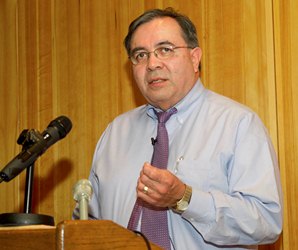
Sen. Albert Kookesh

“For me, if that’s what happens, it’s time for me to ride off into the sunset and say goodbye to everybody,” he said.

Reapportionment is taking away most of the 130 communities in his current Senate district, which stretches from Southeast, through Prince William Sound, and up into the Interior.

What’s left is combined with about three quarters of Sitka Republican Stedman’s existing district. But Kookesh has decided to run in 2012.

“You know what? I’m not going to roll over and just go away. I’ve been in the Legislature for 16 years, eight in the House and eight in the Senate. And I think that I’ve developed a wealth of information and a good background,” he says. “I don’t want to quit being in the Legislature. I enjoy it, it’s something I really have fun with, so I decided I’d give it a shot.”

In addition to Angoon and Sitka, the new district includes Ketchikan, Wrangell, Saxman, Metlakatla, Haines, Hoonah and Prince of Wales Island.

Sen. Bert Stedman

Stedman, who’s served in the Senate since 2003, faces a smaller challenge.

“So there’s about 26 percent of people that will be new. And I‘ll be spending a considerable amount of time going out and meeting with them and getting detailed understandings of their issues and try to resolve some of their stuff,” he says.

Stedman and Kookesh have worked together as members of the Senate’s bipartisan majority organization. Stedman co-chairs the chamber’s budget-writing Finance Committee. Kookesh heads up its transportation panel.

Both say they plan a clean campaign.

“I just want to concentrate on the merits of myself and I don’t intend to be negative at all. I have nothing negative to say about him. He’s a good guy,” Kookesh says.

“It always seems in politics in the end it gets a little bit messy with whoever happens to be behind, walking into the election the last few weeks,” Stedman says. “But I’m hoping this election will stay at the high road the whole way through. I fully intend to talk about the merits of my tenure in the Senate and not concentrate so much on my opponent.”

Stedman says he’ll campaign on his efforts to fund numerous projects throughout Southeast. That includes hydropower facilities and transmission line work.

He’ll also continue pushing for in-state construction of new Alaska Class Ferries.

“Expansion of Alaska Ship and Drydock in Ketchikan so we can build those vessels in Ketchikan. Along with working with the need for another 10 megawatts of power for the Niblack mine on south Prince of Wales. If we can do those two things, we’ll be looking at 200 to 300 jobs,” he says.

Kookesh says he’ll cite his relationships with community leaders. But he understands that means reaching out to new communities.

“I expect that I’m going to have to do a lot of door-to-door work. Especially in Sitka and Ketchikan and Wrangell where people haven’t had the occasion to get to know me. I don’t want to take any of the communities I’ve represented in the past for granted either. I’m going to have to do some campaigning there. I just think that’s going to be a lot of work, but a lot of fun,” he says.

Before facing each other, Stedman and Kookesh will have to clear their party primaries. So far, no one else has filed for what’s now called Senate District Q.

All but one of Southeast’s other six lawmakers have filed for re-election.

Redistricting, which still faces court challenges, is costing Southeast one House seat and half a Senate seat.
Hear a report on Stedman’s last campaign.

Listen to a report on Kookesh’s last campaign.

ANCSA 40 years later

Courtesy Brian Wallace
Sealaska Corporation President Chris McNeil is optimistic about Alaska Native Corporations in the current U.S. economic climate. McNeil spoke yesterday (Monday) on the 1971 Alaska Native Claims Settlement Act as part of the Sealaska Heritage Institute’s lecture series celebrating Native American Heritage Month.

“It’s in these kind of times that you can come up with different kinds of new ideas about how to create new opportunities in the economy for Alaska Native people,” McNeil said.

The Sealaska CEO called the 1971 Alaska Native Claims Settlement Act, or ANCSA, an adaptive tool for social, cultural, and economic development of Alaska Natives. He gave Alaska Native leaders of the time credit for “thinking out of the box” by implementing ANCSA as federal law, rather than as a treaty. McNeil said ANCSA is similar to a “double-edged sword,” and its meant to be amended.

“But it also means that every generation is free to look at it and decide for themselves whether or not the way the law is stated actually meets the needs of Alaska Native people at that moment,” McNeil said.

The language included in the first draft of ANCSA simply substituted existing federal funding with the payment provided by the Settlement Act, he said.

“Essentially they were going to take away with one hand, give with the other. But the leadership was very clear about this. They wouldn’t stand for it. Without that, for these 40 years, we might have had our Land Claims Settlement Act, but we might have not been able to participate in any of the federal programs,” he said.

McNeil also stressed the importance of the role of the Indian Self-Determination Act of 1975 in securing federal funds for Alaska Natives.

He said an enormous amount of economic development has occurred because Alaska Natives were considered Indian Tribes in the law. “And then there was almost a companion bill called the Indian Financing Act which also stated that ANCSA would be considered Indian Reservations for the purposes of the Indian Financing Act,” he said.

Examples McNeil gave of these programs included aid from the U.S. Forest Service to facilitate more sustainable timber practices, including tree thinning and planting, and the potential for interested Alaska Natives to pursue oyster farming.

“I think it provides a basis for being able to participate in these programs, to be able to have sustainable economies for the long term future. And I would suggest that we have not plumbed the depths of what the art of the possible is. It seems to me in Congress that there are always opportunities to make things better,” he said. “Administrations come and go, Congresses come and go; we’re always going to be there. One of the things that we need to be thinking about is “What’s next?”

The last lecture in the brown bag series will be delivered by Rosita Worl, the President of the Sealaska Heritage Institute, on Monday, Nov. 28. Worl’s lecture is titled “ANCSA: A Path to Assimilation or Cultural Survival?”

Kootznoowoo to manage Angoon hydro projects

Kootznoowoo Inc. is taking over development of two hydroelectric projects to move them along.

The City of Angoon holds federal permits for the Ruth Lake and Scenery Lake projects at Thomas Bay, north of Petersburg. Angoon has designated its village Native corporation as development manager.

“Facilitator is a good word for what I think we’re trying to do here,” says Kootznoowoo general manager Peter Naoroz. He says the corporation will help Angoon get the regional projects to license.

“They’re valuable permits and we just hate to see them languish.”

The Federal Energy Regulatory Commission awarded the Ruth Lake preliminary permit to Angoon in 2009, in the first ever random drawing. The award ended up in court, when the City of Petersburg challenged the drawing method of choosing among applications submitted by Petersburg, Wrangell and Angoon. A federal district court upheld the award.

Petersburg also opposed Angoon’s Scenery Lake permit. Both projects became controversial, even in Angoon, when the city wasn’t able to keep up with regulatory reporting requirements.

Kootznoowoo is stepping into the development phase, which requires an environmental assessment and pre-engineering work. Naoroz also says the corporation will advise the city on future power sales agreements.

He’s already contacted the Southeast Alaska Power Agency, which he calls integral to the success of the Ruth and Scenery projects. He hopes Kootznoowoo and SEAPA can help facilitate discussions among the communities that opposed Angoon’s preliminary permits.

“For whatever reason there wasn’t kind of a level playing field for those discussions to take place and we’re hoping to try and create that level playing field,” Naoroz says.

SEAPA owns two hydro plants and transmission lines that serve Wrangell, Petersburg and Ketchikan. SEAPA Chief Executive Officer Dave Carlson says the organization will evaluate all the potential hydro projects in Southeast. He says a state-sponsored Integrated Resource Planning study will provide the agency direction in its goal of getting the best result for SEAPA members and ratepayers.

Naoroz admits the corporation has “selfish reasons” to help Angoon pursue its hydro permits. Kootznoowoo owns about 23,000 acres west of Ketchikan near mining exploration. He says the Ruth and Scenery projects are needed to help the mines develop.

Naoroz says the hydroelectric projects will provide affordable power to stimulate growth and job creation throughout the Southeast region.

Smaller timber sales might help small communities


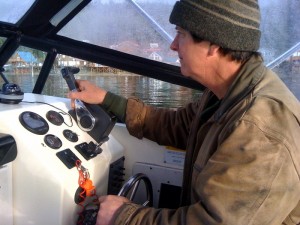
Gordon Chew pilots his boat, the Cool Cat, to the Tenakee Springs fuel dock on Monday, Oct. 24. Chew runs Tenakee Logging Company. (Photo by Ed Ronco/KCAW)

The era of large-scale logging might be gone from northern Southeast Alaska, but across the region, people are turning to smaller timber sales to earn a living. Officials hope the model can support local economies in the region. And for one family in Tenakee Springs, the effort has paid off. KCAW’s Ed Ronco has this profile.

Gordon Chew runs a small logging operation in Corner Bay, just across the inlet from Tenakee Springs. And it keeps him busy. So busy, in fact that he says he doesn’t have time to stop for an interview, but that I can borrow his adult son’s bike and talk to him as we ride down to the harbor. In the interest of my own safety, I wait until we get to his boat before I reach for a microphone.

“We have to do a little bit of everything, between all the boating and barging and lumber milling and logging and construction and restoration around town,” he says.

Chew runs the Tenakee Logging Company, and he’s part of the changing face of the lumber industry. In this part of Southeast Alaska, large-scale logging doesn’t exist anymore. But smaller, selective cuts – like the 100,000 or so board feet each year that Chew takes from the Tongass – are becoming more popular.

Chew’s company logs, but it also builds. He uses the timber taken from Corner Bay on projects in Tenakee Springs. As we leave the harbor, he opens up the throttle and we head to the fuel dock. There’s a 55 gallon drum in the back of the boat.

The fuel will go over to Corner Bay to feed the company’s truck. But not far from where we’re tied up is the Snyder Mercantile – a general store dating back to 1899. Chew and his team are working to restore the old building, along with its adjacent property, using wood they’ve harvested and milled. Chew says that part of the business is essential.

“The foundation under that warehouse are all hemlock pilings,” he says. “We drag a lot of them over here as pilings. Also, the underpart of the store is all repaired with cedar pilings. I’m not sure if we could manage it on our timber sales alone. The fact we get to work with the timber as builders is what makes it lucrative for us. It’s not selling the timber.”

Zia Brucaya, of the Sitka Conservation Society, says Chew’s operation “is definitely unique in our ranger district,” but not to the region.

“Throughout Southeast Alaska there are lots of small mills that are operating to different degrees,” she said. “Some of them are doing construction as well as milling, like Gordon is. Some of them are just doing milling, putting together cabin kits and things. They’re all working at that smaller scale of a few hundred thousand board feet per year.”

SCS and other environmental groups in Southeast have taken an interest in operations like Chew’s because they say they’re smart, sustainable ways to use the Tongass. It was never logging outright that was the problem, she says. It was the scale of what happened in years past.

“We’re now working at a scale that is appropriate for the community, and it’s needed in the community,” she said.

Brucaya says it’s also an opportunity to build up the local economy for the benefit of local residents – a way to keep people living in Southeast, especially in small, remote communities, where the loss of even a family or two can be felt throughout town.

And few are more aware of that than Chris Budke, a forestry technician in the U.S. Forest Service’s Hoonah office.

“It seems like every time I turn around I read something in the paper or I see a reason or I look at people and I see lots of reasons for people to be leaving Southeast Alaska,” he said.

He lists off reasons: it’s a harsh environment, goods and services are expensive, and more. But he says offering opportunities to run small businesses using Tongass resources might help keep people around.

“If we can work with local people that are using local products and meet the objective of everybody – which is really difficult, by the way – and provide a product for those people they can turn around and make a living off of, that, to me, gives you reasons to be here,” Budke said.

And giving people reasons to be here can have big implications for Southeast, which is hemorrhaging population.

“This is incredibly important for people to be working. It’s incredibly important for us to be using our natural resources. It’s incredibly important for people to understand that we can use it responsibly. So we can meet the objectives of a lot of things here and give people a reason to stay in Southeast.”

Gordon Chew and his family are examples of that. They saw Alaska during a trip in 1995, and loved it so much that they went back south and made plans to move up. They returned in 1999 and have been here since. Back in Tenakee Springs, Chew’s 55 gallon drum is nearly full of No. 2 diesel.

As the nozzle is hoisted back onto the fuel dock, Chew says there’s a future in the kind of small-scale logging he does, not only for places like Tenakee Springs, but for the entire region.

Summer salmon harvest among most valuable in history

The 2011 statewide salmon harvest is currently the third most valuable since 1975, according to a report Monday from the Alaska Department of Fish and Game.

The estimated value of this summer’s catch of 603-million dollars is third behind 1988 and 2010. But Commercial Fisheries Division Assistant Director Geron Bruce says it won’t stay that way for long.

“We expect that once we get the final price information in from processors and buyers – and we’ll get that next spring – that it’ll actually become the second highest,” says Bruce.

While harvest volume varied from area to area and species to species, prices were strong throughout the state, particularly for pink and chum salmon. In Southeast, for instance, pinks averaged 42 cents a pound and chum averaged 81 cents. Bruce looks at this year’s good prices as the continuation of an upward trend over the past decade.

“The recognition in the marketplace that Alaska’s commercial salmon fisheries are sustainable; that it’s a wild, natural food, I think those have been important programs. And also the collapse of the Chilean salmon farming industry due to a virus a few years ago – they’re still recovering from that – played a part as well,” Bruce says.

Southeast Alaska’s combination of big harvests and high prices produced the most valuable salmon harvest for any region in 2011 – estimated at 203 million dollars. Nearly half of that came from a big pink harvest of 59 million fish. Bristol Bay is usually the most valuable fishery in the state, but catches there fell short of projections this summer. Bristol Bay had the second-highest value at 137 million dollars. Prince William Sound had the third most valuable catch at an estimated 101 million dollars.

In total, Alaska commercial fishermen landed 176 million salmon in 2011. That was the 9th largest catch since 1960, but well below the preseason forecast of 203 million fish.

Ketchikan’s Jack Shay arrested for child pornography

Ketchikan City Council member Jack Shay has resigned his seat, after being arrested on 10 counts of possession of child pornography.

Shay is a former mayor of both the Ketchikan Gateway Borough and City of Ketchikan, a former member of the Ketchikan School Board, and a past president of Alaska Municipal League. He also served for a time as head of the Alaska Division of Employment Security.

The 80-year-old Shay was arrested Friday night after a computer shop worker contacted Ketchikan police about images he reportedly found on Shay’s computer. The business was required by law to report the child pornography to police.

Deputy Chief Josh Dossett says Shay had taken the computer to the shop because it would not print.

“The tech put the computer and printer together and turned it on and the printer began to printout out pictures that were already queued in the computer,” Dossett says. “Several of those pictures were of child pornography.”

Dossett says police officers obtained a warrant and searched Shay’s computer and residence. He says child pornographic images were found on top of a printer in a home office. Officers also found other media.

“I have a detective and two officers working this case full time,” he says. “They’re basically working their way through the different media.”

Shay was arraigned in Ketchikan Superior Court Saturday morning and pleaded innocent. He was released on $30,000 bail.

Ketchikan City Mayor Lew Williams III says Shay was not forced to resign his seat. He says Shay told him he thought it best to do so.

Williams says the Ketchikan City Council will appoint a replacement and expects the city to begin advertising for applicants soon.

Shay is a well-known figure in Ketchikan, who has steeped himself in the city’s political establishment. He is a founder of First City Players and has been a Grand Marshall of the community’s Fourth of July parade.

Site notifications
Update notification options
Subscribe to notifications