Shareholders for Southeast’s regional Native Corporation can look forward to another dividend payment next month.
Sealaska’s board of directors has approved a dividend distribution of nearly 12-million dollars to the corporation’s more than 20-thousand shareholders.
It’s the second payment this year and will mean $1.02 per share for village and descendant shareholders, and twice that for elders.
Sealaska Chief Investment Officer Anthony Mallott says the dividend reflects losses from the economic downturn.
“The operations distribution and the permanent fund distribution have been in the just over a dollar range, we have now for a couple years, mainly affected by the fact that we average our distributions over a long time period and we’re still averaging the negative effects of 2008 where there were significant losses within our investment portfolio and there were some operational losses as well,” Mallott says
Urban and at-large shareholders also receive $6.12 per share under revenue sharing among Alaska’s regional corporations, required by section “7-i” of the Alaska Native Claims Settlement Act.
Additional payments are made to the various village corporations that can pass the money on to shareholders or use it for operations.
Dividends are paid from revenue sharing, earnings from a corporation permanent fund as well as earnings off investments and Sealaska’s subsidiary companies. The corporation owns timber, construction and environmental services businesses. It also has invested in plastics manufacturing and information technology.
Mallott anticipates payments could increase as the economy improves.
“One of the long term goals of Sealaska is to create and provide meaningful distributions to their shareholder base and we continually strive for that,” Mallott says. “The amounts recently are probably under our goal if you don’t count the 7i but again we’re working out of the great depression and great recession and we’ll continue to build those distributions to a point where both the winter and spring distributions are meaningful to those shareholders that are in our villages and elsewhere.”
Including last spring’s payment, the corporation’s total dividend this year will be nearly 24-million dollars. Fall dividend payments will be made by direct deposit or U.S. mail around December 8th.
Congressman Don Young lashed out at the U.S. Fish and Wildlife Service during a hearing last week on legislation that would loosen restrictions on the sale of sea otter pelts in parts of Alaska. Young is hoping the bill will stem the growth of sea otters in Southeast and Southcentral.
The U.S. Forest Service is considering a new timber sale on Kupreanof Island, west of Petersburg. In October, the agency released a draft Environmental Impact Statement for the Tonka Timber Sale, which could provide up to 53-million board feet of timber to area sawmills. The logging could also fund some second growth thinning and fish habitat work. Joe Viechnicki reports.
For the first time ever next summer, Hoonah will have more cruise ship visitors than Sitka.
Fred Reeder, with the Cruise Line Agencies of Alaska, told the Sitka Chamber of Commerce on Wednesday (10-26-11), that the Icy Straits Point cruise destination was reaping the benefits of sustained marketing, at the expense of Sitka.
“Like it or not, other communities are out stealing your cruise ship passengers right now. Icy Straits Point (Hoonah), they’ve been sending delegations to Miami and Seattle for the last six years. Who are they taking it from? They’re taking it from you.”
Sitka and Hoonah had comparable cruise visits this season, but next year Sitka will drop to 116,000 and Hoonah will go up to 140,000. Reeder encouraged the city of Sitka to improve its marketing, but conceded that geography favored the port closest to Juneau.
“The issues and the challenges facing Sitka are that we’re on the outside of Baranof, and it’s far easier to pull into Hoonah on the Inside Passage than it is to come around to Sitka because of the cost of fuel. Whatever we do, we have to be out there and make Sitka as attractive as we can.”
Reeder argued that cruise ship visitation represented real revenue for the community. He said that the city finance department traditionally budgeted about $5 in sales tax revenue per cruise visitor. Peaking in 2008 at 289,000 passengers, cruise ship visitation represented almost $1-and-a-half million dollars in sales tax revenue. In 2010, that figure will be closer to $500,000.
Reeder framed his remarks in an overall presentation on the efforts by the Alaska Travel Industry Association to reinvigorate statewide travel marketing. Reeder played four television spots aimed at Alaska’s so-called “primary market”: College-educated visitors with no children at home, 45 to 65 years of age, who earn over $75,000 a year. Based on research, the spots all touch on Alaska’s main selling points: mountains, glaciers, and wildlife.
Reeder, who until recently sat on the board of the ATIA, said the organization hoped to maintain a $20-million dollar annual budget for marketing, with the goal of building awareness of Alaska on a par with other major destinations like Disneyland, Los Vegas, California, and Hawaii.
Reeder said focus groups had responded positively to the ad campaign. Many people said the ads helped them see the state as something other than remote, cold, and snowy.
That said Reeder, was a major goal.
“What we have to do as a state is convince them that it really isn’t that big of a deal. That it’s easy to get here. That it’s an easy one to check off your bucket list.”
The return on investment is huge, Reeder said. The one national visitor industry statistic in which Alaska leads is visitor spending – almost $3,000 per person, not including travel costs. According to ATIA data, only Hawaii comes anywhere close in visitor spending, at $2,700 per person. The average for the rest of the 48 states is only $645.
What inspires a person to twist a balloon into the shape of a moose? Or take photos of someone vacuuming a glacier? Or run for mayor in a gorilla suit?
Those questions come to mind when you’re talking about Jeff Brown. The Juneau artist, musician, author and entertainer was recently recognized for his lifetime achievements as part of the Governor’s Awards for the Arts.
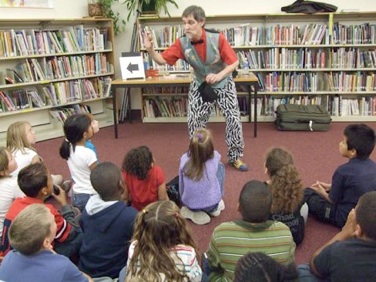
Jeff Brown is a longtime Alaskan, who entertains kids, produces radio shows, writes how-to books, puts out parody post cards and publications, volunteers with community groups … the list goes on.
“Where does he come up with those ideas? He’s constantly filled with funny ideas and constantly filled with just amazing connections,” says Juneau Arts and Humanities Council Executive Director Nancy DeCherney.
She’s known Brown for years, as have hundreds, even thousands, of others around the state.
“I don’t think there’s everybody in this town who can summarize everything that Jeff did. Because you know him from a different perspective and I know him from a different perspective,” she says.
Brown says it all started in high school when he heard the experimental comedy group Firesign Theatre.
“They made it possible for me to think it would be possible to go to a radio station and start volunteering,” he says.
He moved to Juneau as a Coast Guard medic in 1975. Soon, he came across fledgling public radio station KTOO.
“They were having a fund-raising marathon and I asked if I could help out and they said, ‘Sure.’ And they asked for volunteers to be on the radio and I said ‘Sure.’ And I’ve been saying ‘Yes’ ever since,” he says.
Brown went on to work for the station and its TV affiliate. He also became a key member of an improvisational theater group, a historical play for tourists and a news parody show.
As time passed, he also became a recognized artist, working with stained glass, manipulated photographs and assembling found objects. He’s even created museum exhibits of Alaska mazes and board games.(Read about the exhibit Vinyl Resting Place., which Brown created.)
“He’s one of those rare individuals who seem to have no boundaries in regard to medium. It’s Jeff. You can see it. His signature’s there,” says Bob Banghart, chief curator of the Alaska State Museums.
He’s also a musician and founder of the Alaska Folk Festival, another place Brown has been active.
“In any various year he was engaged in putting together programming or doing the newsletter or organizing the workshops or organizing M.C.s or being the M.C. or being on stage playing. He’s done everything there is to do, probably with the exception of selling of hot dogs, but we’ve never sold hot dogs,” he says.
Then there’s the kid-focused efforts. Brown’s produced a nationally-distributed children’s radio program, toured an Alaska magic show, and was half of the kids’ music duo The Wigglers.
He also became king of balloon animals, organizing a worldwide celebration. It brought him to the attention of then-Governor Wally Hickel.
“He would come down on a monthly basis to do his call-in show. And being a fresh balloonist, I thought, ‘Wouldn’t it be fun to have a title called balloonist laureate. And they agreed with me and gave me a certificate to prove that,” he says.
Following governors named him minister of merriment, commissioner of mirth, professor of play, and now, master of cheerful smiles.
One of Brown’s most recent efforts has been Real Alaskan Magazine. The 64-page, full color, glossy humor publication parodies images and stories from the north.
He says people have been more than willing to help.
“I can call up somebody up in Sitka and say, ‘Can you find a couple ballet students and put them up in tutus and rubber boots and have them posing at Swan Lake?’ and they say, ‘No Problem.’ I talk to people like Martin Buser, will you pose with a can of dog mush? ‘Sure, no problem,’” he says.
A third edition is due out on April Fools’ Day.
In fact, he took a side trip from his recent awards ceremony to create a new visual pun.
“When I was in Anchorage I convinced the head of the Alaska Zoo to have my friend Karl Ohls pose inside a cage as ‘The Wild Alaskan Bureaucrat.’ And I photo-shopped some kids looking at him as well as the executive director of the zoo,” he says.
Brown continues as program director of KTOO and its sister station KRNN. And his next project? A series of radio programs of Alaska poets and authors reading their own works.
Brown’s lifetime achievement award comes at a time when he’s having to slow down. He has Parkinson’s disease, a brain disorder that causes shaking, stuttering and makes movement difficult. But he’s still being creative.
“I can do the same things I’ve done before but it takes a lot longer. It’s kind of discouraging that way but you just have to muscle through,” he says.
He’s a little self-conscious about the lifetime achievement arts award, and says lots of other people have done as much or more. And it hasn’t changed his goal.
“I guess it all centers around making people happy. And that’s kind of what I’ve given myself as a job in life, is to make people’s lives a little bit better. And making them laugh, making them smile and making their lives just a little bit easier to live,” he says.
Friends and colleagues are planning a community celebration of his award and works. It’s from at the Juneau Arts and Culture Center, from 5 to 7 p.m., on Monday, October 31st.
Scientists and fishermen are following news of a deadly fish virus found in British Columbia salmon. It’s a scary situation, but it may not be as bad as it sounds, at least for now. And it’s not a threat to people who eat salmon.
Infectious salmon anemia has badly damaged populations of farmed Atlantic salmon. So when scientists found the virus in a pair of wild, Pacific sockeyes, they were worried.
Should they be?
“It’s not a time to panic or overreact. I think some folks have been a little bit overly concerned about it,” says Ted Meyers, chief pathologist for Alaska’s Department of Fish and Game.
If confirmed, he says the virus, found in two central British Columbia fish, needs to be watched, and understood. That’s because it is a deadly disease that affects the blood and internal organs of salmon.
“Basically, they develop an anemia and they hemorrhage. And it can kill market-size fish,” he says.
The virus has badly damaged captive Atlantic stocks in Chile, Norway, Scotland and eastern Canada.
Pacific salmon are different, and Meyers says several thousand earlier tests by the British Columbia government showed no presence in wild fish.
But he warns this disease adapts.
“It’s possible that some of these viruses could mutate to potentially affect Pacific salmon. But that would probably occur under situations where there’s a selective pressure, like a hatchery situation or a pen farming situation or something of that nature,” Meyers says.
That’s what happened to farmed Pacific cohos in Chile in the late 1990s. Infectious salmon anemia spread quickly through cohos raised in net-pens along with Atlantic salmon and rainbow trout.
“We shouldn’t underestimate the power of viruses,” says Dale Kelley, who heads up the Alaska Trollers Association.
The Juneau-based group is among commercial fishing organizations that want action.
“It’s a pretty scary situation for us all and we want to put it into context. We would like to continue to urge the Canadians and other fisheries professionals to make sure that they’re doing as much as fast as they can,” she says.
Some politicians agree. Alaska Senators Lisa Murkowski and Mark Begich have joined Washington Senator Maria Cantwell to ask Congress to require U.S. agencies to become involved. They want an emergency research effort to calculate how much of a threat the virus may pose.
Canadian officials have stepped up their interest. But they say they will decide on an action plan after they confirm identification of the virus.
Kelley says the initial diagnosis came from a lab that specializes in infectious salmon anemia. So, she asks, why wait?
“What we’ve seen out of Canada is a press release that says, if our tests, a few weeks down the road, come up with a finding of ISA, then we’ll be bring people together and then we’ll talk about what to do,” Kelley says. “It seems like there’s probably some information they could be gathering up, before winter hardens everything up, to at least give them a boost on sorting out the extent of the problem.”
Those concerned assume the virus came from Atlantic salmon in British Columbia fish farms. It appears to be the same European strain found in Norway and Scotland.
The fear is close quarters could quickly spread the illness, which could further spread it to wild stocks. Those fish could then carry the disease up the coast into Southeast, and other Alaska waters.
Other pathogens attack Pacific salmon, and some are widespread.
One, known as the IHN virus, also causes hemorrhaging and organ failure.
State pathologist Ted Meyers says it’s common in Alaska sockeyes. It’s adapted to live in Chinook, chums and steelhead down south. But in this state, it hasn’t crossed those boundaries.
“We’re always concerned about this virus potentially mutating and being able to affect other species. But so far our hatcheries have been following a sockeye salmon culture procedure, which really mitigates or reduces the risk from this virus,” Meyers says.
He says the hatchery procedure has been in place for close to 30 years and it’s been successful.
The salmon viruses pose no threat to people. But some fisheries advocates worry consumers won’t understand that, and word of the latest problem could hurt salmon sales.
Close
Update notification options
Subscribe to notifications
Subscribe
Get notifications about news related to the topics you care about. You can unsubscribe anytime.