An Anchorage police vehicle at the scene of an officer-involved shooting on Wednesday, Aug. 14, 2024. (Ava White/Alaska Public Media)
Anchorage police say officers shot and killed a teenage girl armed with a knife late Tuesday.
The shooting happened in a neighborhood on the 4800 block of East 43rd Avenue, near the Alaska Native Medical Center, according to a police statement.
At a brief news conference Wednesday morning, Police Chief Sean Case said that officers had been responding to a “disturbance” between two family members at about 11:30 p.m. Tuesday. The caller said her sister had threatened her with a knife.
Several officers responded, some of them entering the apartment the call came from, according to the police statement.
Officers gave the girl commands but she approached them still holding the knife, Case said. At that point, he said, two officers opened fire.
“One single officer fired multiple rounds,” he said. “A second officer fired a round with a less-lethal projectile.”
Police and medics treated the girl, but she died at a local hospital.
“The subject that was shot was a 16-year-old female,” Case said. “She would have started her junior year in high school on Thursday.”
Police declined to name the girl, due to her age, but family members later identified her as Easter Leafa.
She attended high school in the Anchorage School District, according to a statement from Superintendent Jharrett Bryantt.
“Our deepest condolences are with the families involved in this tragic situation,” he said.
Thursday is the first day of school in Anchorage, and Bryantt said there will be additional support services for impacted staff and students.
“We are working in partnership with the Anchorage Police Department,” he said. “We do not have any additional information to release at this time as this is an on-going investigation.”
During the news conference, Case called the shooting tragic.
“There’s no other way to describe it,” he said. “As police officers, we strive to protect human life and when we don’t meet that goal, there’s no other way to describe it then it’s tragic.”
Police say no one else in the apartment or any officers were injured.
Christina Konnig lives in an apartment building nearby. She watched Wednesday as officers walked in and out of the multi-level beige apartment complex where the shooting happened. She said she was shocked and angry that police killed a teenager.
“That’s pretty sad,” Konnig said. “I don’t get how APD is going to shoot a 16-year-old girl. They could’ve done a taser, not f*cking shooting them.”
Anchorage police went in and out of an apartment building Wednesday, Aug. 14, 2024, where a teenage girl was shot by officers the night before. (Matt Faubion/Alaska Public Media)
Other community members also expressed outrage in the aftermath of the shooting. There was a flood of online comments on a video of the police news conference, many people mourning the loss of a young Alaskan and also questioning why police didn’t use nonlethal force.
Case said Anchorage Police Department policy calls for officers using less-lethal weapons to be backed up by others with lethal force. But, he added, officers have personal discretion in using those weapons.
“Each officer is making a determination to use the tool that they have with them based on the circumstances in front of them,” he said.
The teenager is the sixth person shot by Anchorage police since mid-May and she is the fourth person killed after the deaths of 34-year-old Kristopher Handy, 21-year-old Tyler May and 58-year-old Lisa Fordyce-Blair. State prosecutors have so far reviewed two of the fatal shootings, and declined to file criminal charges against the officers who shot Handy and May, saying the use of force was justified.
Case acknowledged the rising toll of shootings by Anchorage police this summer.
“We are committed to continue to look at our training, our tactics, as well as our supervision in these types of incidents to try to prevent future officer-involved shootings,” Case said.
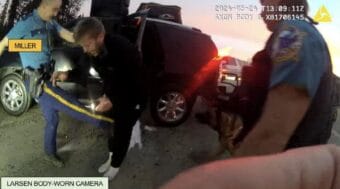
The shooting was recorded on the officers’ body cameras, Case said, but the officers involved in the shooting had not yet been interviewed by Wednesday morning.
Per police policy, the name of the officer who killed the teenage girl will be released after 72 hours, and he will be on administrative leave for four days. The state Office of Special Prosecutions will investigate the shooting.
Police planned a second news conference Monday to discuss the incident in detail.
Alaska Public Media’s Ava White contributed information to this story.
This is a developing story. Check back for updates.
Paris Olympics two-time cycling gold medalist Kristen Faulkner of Homer celebrates at the Eiffel Tower. (Zac Williams/Courtesy of EF Pro Cycling)
Homer’s Kristen Faulkner came out of relative obscurity to win not one, but two gold medals in cycling at the 2024 Paris Summer Olympics.
KBBI’s Jamie Diep spoke with Faulkner on Friday about how growing up in Homer shaped her fast-paced journey to the podium.
Editor’s note: The following transcript has been edited for brevity and clarity.
Jamie Diep: You went from gradually making a name for yourself in professional cycling to winning the first American Road Race and Team Pursuit in decades. How has that been for you throughout your time at the Olympics?
Kristen Faulkner: Yeah. You know, each race has been really special in their own way. You know, the first road race I think for the U.S. in 40 years. To be honest, I actually didn’t know that fact until after the race, and I wasn’t really thinking about what’s been done in the past or what hasn’t been done. I was just thinking about, you know, ‘how do I win this race?’ And afterwards, people came up to me and told me, you know, the history of it, and it made it quite special and quite unique.
And the same with the team pursuit, actually. It was the first time the U.S. has ever won gold in Team Pursuit. And so that was really special. I think we, we knew we had a really strong team going in. But we also knew that we had to pull a lot of things together on race day, and we had to really have a perfect race in order to win. So they were each very different races, very different journeys to get there, very different preparation. And the road race was more of an individual event. The team pursuit was more of a team event. And so they felt very different, even though they were both bike races. And so each win is very special in its own way.
Jamie Diep: Let’s talk about the road race. You know, that was an incredible finish. What was going through your mind as you pulled ahead of the pack in those last few miles of the race?
Kristen Faulkner: Well, I knew I needed to attack the group before the finish and go away solo to the finish line. And the reason is that I was not the fastest sprinter in the group. I was probably the weakest sprinter, and so I didn’t want to go to the line, because there were four of us and only three medals. And so I said, ‘If I go to the line with these girls, I’m probably not going to end up with a medal.’ And so I knew that the best moment to attack would be as soon as we caught those front two riders, because that’s when everyone was going to be the most tired. And so I said, ‘Okay, as soon as we catch them, I have to go.’ And it’s kind of a now-or-never moment, you know, I need to attack, and I need to go all in, and I can’t look back. And if it works and I’m going to win, and if it doesn’t work, I‘m gonna get fourth. But those are the cards I had to play. And in road racing, you really have to think on your feet. You have to go all in with your decision, and you can’t second-guess yourself, or won’t work. And so, yeah, I think in those last kilometers, I was like, ‘what is happening?’ But also at the same time, you know, just really focused on on the here and now and doing what I had to do to get across the line. There was no celebrating before the line. I wasn’t convinced I’d won until I was 500 meters from the finish line, and then I kind of knew, but yeah, it was a very calculated move, and I knew that I had to go all in, and I had to do it if I wanted the chance to win.
Jamie Diep: What about the team pursuit? You were a later pick for the event. What was it like winning that race as a team versus the road race, which is an individual event?
Kristen Faulkner: So actually the team pursuit, I’d been selected in June. So I was selected the same as all the other riders. There were five riders selected, four of which ended up racing, and so I knew quite early that I would be on that team. I think it was different, though, because I was the newest rider to the team. So the other three had ridden together at former World Championships. They’d rode together in Tokyo at the Olympics, and so I was the only one on the team who hadn’t ridden an Olympics with the team before. And I was also the only one who never won a medal in the event. And this was my very first year competing with the team. And so in many ways, I was the least experienced, and potentially the weakest one in the group in that way.
And physically, I was strong, but I was the least experienced, and so I guess I was the most unknown in the group. And so I think that race was really special to me, because I think I went into it feeling like, if we don’t get a medal, it might be on me, because, you know, they’re all experienced, and I’m showing up as the least experienced one. And so I felt that I had to really level up my game and really prove myself that I belong there.
So the last year has been such a deep learning trajectory. You know, I’m surrounded by three riders who were all way better than me a year ago, and I really felt that I had to earn my spot on that team. You know, I wasn’t the one who’d earned a medal. I hadn’t been to Tokyo before. And so the last year has been, I don’t want to say like an uphill battle, but that’s really, you know, what it is like, having to earn my cards on that team and to earn the respect of my teammates.
And so when, even though I was selected for the team, I still had a lot that I needed to improve on, and a lot to learn. And so on race day, I felt, you know, we had gold-medal potential, and I really wanted to contribute to the team winning, and I wanted to make sure that they felt confident that they’d selected me for the team, you know. And I had to earn that spot, and I really had to earn that spot. And so when we went into the race, I just said that you know, like, I have to make this the race of my life. I have to fight for my life, and I have to give 100% for my teammates.
Jamie Diep: In the midst of winning these races and doing all of these things. I’m sure it’s been a bit of a whirlwind, but we’re all still human. So after your races, what was the first thing that you ate, both for the road race and the team pursuit?
Kristen Faulkner: Well, actually the first thing that I ate was a cold Coca-Cola after the road race, because I needed the bubbles. You know, it was hot out. I needed the sugar, I needed the hydration. And so actually I crossed the finish line and I was given one Coca Cola, and I finished it right away. And I said, ‘Do you have a second one? I need a second one.’ So I actually had two Coca-Colas, were the first thing that I consumed after I crossed the finish line in the road race.
And then in the team pursuit, when I crossed the finish line, actually the first thing was just my recovery shake. It had, like, it was like a protein shake with a little bit of sugar. But then I also had some gummy bears, because I needed to just, you know, get some sugar in me.
And then when I came home, I think I had a really good dinner with some salmon, and I had a chocolate croissant for dinner, because I’ve been holding off on the chocolate croissant since I got to France. I don’t know how I had the willpower to not have one until then, but yeah, that night, I had a chocolate croissant, and it was absolutely delicious.
Jamie Diep: You’re from Homer, but you didn’t really get a start in cycling until you moved to New York and took all of those classes. So how did growing up in Homer shape you as an athlete?
Kristen Faulkner: It made me really resilient, you know, I think Alaskans are just resilient people. I think the upbringing, as a child in Alaska, you’re just exposed to more things, you know? You, you go to the wilderness, it’s the extreme cold. There’s a lot of independence. And in the culture, I think this kind of element of, you know, modern self-sufficiency in in Alaska, you know. We’re not, we’re not living subsistence in Alaska, but there’s still this element of, you know, it’s still kind of the free land up there, you know, and and so I think there’s this really strong sense of independence in the culture.
I think Alaska made me really tough. It made me feel that whatever I wanted in life, I really had to work for. It taught me to really be independent and have conviction in my own belief. And I wasn’t surrounded by the media growing up, I was, I don’t want to say off the grid, but Alaska as a state is a bit off the grid, you know? And in that sense, I think learning to just trust my gut and be independent and not think too much about what the rest of the world thinks, I think, is a really valuable lesson as a kid.
You know, the other thing is just my parents made me work a lot when I was a kid, (I) work(ed) in the hotel. I was scrubbing toilets as a housekeeper for a long time. I worked in landscaping. I was a busser in the restaurant. And so, you know, learning the value of hard work as a kid as well. So those are all really important things.
And you know, I think one of the most underrated things also is the sense of community. So when you, when you grow up in a really small town, you have teachers as your neighbors and everyone kind of knows each other and watches out for each other. And that’s something that I didn’t realize how much I needed and how much I valued for the first half of my life. And then when I moved to New York City, I realized it was such a big place and there were so many people, and I really missed that small-town feel. And that’s when I realized that if I wanted that, I really had to cultivate it. And part of the reason why I joined a cycling team is I really wanted that kind of team camaraderie, that community feel that I had in college sports and that I had growing up in Homer.
And when the Olympics came around, I had so many friends and family that came over to support me, and it just made me realize just how much of a huge deal it is when you, when you have people around you that have known you for so long, seen you struggle. Have seen you work hard? Have seen you when you fell, when you got back up. And I think having that community support me my whole life, hearing them cheer for me from when I went to Paris, and having babysitters and friends wearing T-shirts and said, ‘Go Kristen.’ You know that just meant so much to me, and really gave me a lot of strength, and made me realize that they really believed in me, but also they would be there for me no matter what happened, and no matter whether I earned a medal or not, and I think that really meant a lot to me.
And yeah, that sense of community is something I hope Homer never lets go of, and I hope it continues to cultivate, because it makes a big difference in people’s lives like me.
Jamie Diep: Finally, what’s next for you on and off the race course? Are there plans to return the Homer? I know that our mayor, Ken Castner, has mentioned holding a bike parade to celebrate your win.
Kristen Faulkner: Yeah, I actually have the Tour de France that starts in three days. So on the bike. That’s my next big goal, very soon with my EF-Oatly-Cannondale teammates. And so I’m really excited for that. It’ll be an eight-day stage race. It starts in Rotterdam, and then it kind of goes all the way through the east coast of France, all the way south. So that’s my first on-the-bike goal.
And then my kind of off-the-bike plans, I’m actually going to spend Christmas in Alaska this (December), so I will be returning home. And I just want to give a big hug to everyone who supported me, everyone who cheered for me, everyone who had ‘Go Kristen’ shirts, everyone who didn’t, you know, everyone who just has been there to support me this whole time. You know, I had people who I swam with as a little kid that were posting about what it was like to swim with me, and they were cheering me on and wishing me good luck. And I just want to give all those people a really big hug and tell them thank you, because they gave me so much support and strength when I needed it, and I think it made a big difference.
Jamie Diep: Thank you so much.
Kristen Faulkner: Okay, thank you. I appreciate it.
The Matanuska-Susitna Borough School District office located in Palmer Alaska. May 30, 2024. (Matt Faubion/Alaska Public Media)
U.S. District Court Judge Sharon Gleason ruled in favor of most of the American Civil Liberties Union of Alaska and Northern Justice Project’s lawsuit against the Matanuska-Susitna Borough School District over the removal of challenged books from school libraries.
Gleason ruled that all but seven books — deemed to violate state statute on obscenity by an 11-member Library Citizens Advisory Committee — must be returned to school library shelves before school starts on Aug. 15.
Savannah Fletcher is a lawyer with the Northern Justice Project, and represented the eight plaintiffs who sued the district including six students.
“What this injunction is about is the process, and she made very clear that any kind of process where you’re removing books before you’ve actually reviewed them, that is definitely worrisome and likely unconstitutional,” Fletcher said.
The district removed 56 library books from shelves in April of 2023 in response to citizen complaints. After the removal, a new Library Citizens Advisory Committee began reviewing books last August, and finished their review of all but two of the available books this June. The committee recommended seven be removed from circulation altogether, and a spokesperson for the district said last month that 28 books had been returned to shelves.
The plaintiffs sued last November, and asked the court in January to return the books to shelves until the committee had finished their review. Gleason granted that motion on Tuesday, stating that the district must return the remaining books to shelves.
The case will still go to trial in April to determine if Judge Gleason’s order will be permanent. That would bar any district from removing books from school libraries without following a neutral process, and a defined time period when books would be reviewed by the district. Fletcher said the plaintiffs feel confident after Gleason’s order.
“That is still seeking a permanent finding that once we have all the facts before Judge Gleason that she will reaffirm this is in fact unconstitutional,” Fletcher said. “So that declaratory relief, just making it clear moving forward, and that would then allow a permanent injunction that says you cannot continue such unconstitutional behavior, so that’s the key thing we’re seeking at trial.”
The Mat-Su School District did not provide comment about the ruling for this story.
The seven books that will stay off Mat-Su library shelves are You by Caroline Kepnes, Call Me By Your Name by Andre Aciman, Verity, Ugly Love and It Ends with Us by Colleen Hoover and A Court of Mist and Fury and A Court of Silver Flames by Sarah Maas.
An enlargement of a still taken from an Anchorage police vehicle’s dashboard camera, showing Kristopher Handy holding a shotgun in his right hand moments before officers shot and killed him on May 13, 2024. (From Alaska Office of Special Prosecutions)
State prosecutors have declined to file charges against the Anchorage police officers who shot and killed an armed man after a domestic dispute in May.
The case drew calls for better police accountability after a video surfaced that contradicted officers’ account of the moments before the shooting.
Officers’ shooting of 34-year-old Kristopher Handy outside a Sand Lake apartment complex May 13 also prompted a routine investigation by the state Office of Special Prosecutions, which released its findings Wednesday morning. The public release of the investigation findings, which were included in a letter to Anchorage Police Chief Sean Case dated Friday, came Wednesday shortly before Anchorage police held a news conference releasing officers’ body camera footage of the incident.
In the 21-page letter, Senior Assistant Attorney General John Darnall includes previously unreleased information on the events leading up to the shooting, as well as imagery of Handy from a police car’s dashboard camera just before he was shot.
Darnall’s decision means Sgt. Noel Senoran and Officers Jacob Jones, Jacob Ostolaza and James Stineman will not be charged in the shooting. Per department policy, Chief Case said Anchorage police would be conducting their own investigation of the officers’ conduct, but that process is considered a confidential personnel matter.
Police say the call that led to Handy’s death started out simply: a disturbance between a man and a woman, reported to dispatchers at about 2:15 a.m. on May 13.
But as officers headed to the apartment complex on Bearfoot Drive, off Northwood Street near Strawberry Road, dispatchers told them that the man – later identified as Handy – had left the building carrying a long gun.
As officers arrived, they split up into two teams and approached the building.
The Office of Special Prosecutions report notes that officers used a public address system on a police vehicle to repeatedly order Handy out of the apartment with his hands up, and to drop his weapon. Handy ignored the commands and strode toward the officers, shotgun in hand.
An APD statement – read verbatim to reporters by then-Chief Designee Bianca Cross at a news conference just hours later – had at least two significant discrepancies with the OSP report.
“As they advanced towards the apartment complex on foot, the adult male raised a long gun towards the officers,” police said. “Four officers discharged their weapons, striking the adult male at least once in the upper body.”
Cross confirmed that the officers involved in the shooting had been wearing body cameras. Police didn’t immediately release their video, the first such footage of a fatal shooting by Anchorage police since officers started to be outfitted with body cameras late last year, as the state conducted its investigation.But the public got a first look at the shooting days later from a doorbell camera at another apartment in the Bearfoot Drive complex. That footage never shows Handy raising his gun at officers. State investigators also concluded the claim that Handy pointed the shotgun at police “is not borne out by a review of the available video footage.”
According to Darnall’s letter, Handy’s girlfriend later told police he had an argument with his mother, then got a shotgun and started drinking. She said that she had tried to talk Handy down, but that he said, “No, screw it, I want you to watch when they mow me down.” She said Handy had taken off his shirt and stepped outside “screaming and hollering” as he awaited police. She had just convinced him to come inside when police responded.
When police arrived at the apartment complex, Darnall said, Handy came “charging” out of an upstairs apartment onto an exterior walkway with a pistol-grip, short-barrel shotgun.
“Handy raised this shotgun straight in the air above his head and yelled (an expletive) at the officers,” Darnall said in the letter.
Darnall said Handy then moved “rapidly and purposefully” along the walkway and down a set of stairs, at one point facing other officers who were trying to flank his position.
“Handy quickly turned towards the officers who were stationed in and near the patrol vehicles while holding the shotgun,” Darnall said. “Handy stepped forward off the sidewalk and into the parking lot, and at that moment, multiple APD officers fired shots.”
Darnall said Handy dropped his gun after he was shot. Officers and medics performed first aid on Handy, but police said he died at the scene. An autopsy determined he had been struck 10 times in the shooting and that he had a very high blood-alcohol content and an antidepressant in his system.
Handy’s mother, who arrived at the scene after he was shot, told officers he “had been making suicide threats and telling family members goodbye” the previous day. She also said he had recently suffered a head injury at work and “has not been the same.”
Darnall found that the investigation “generally corroborated officers’ accounts of the events.” He also determined that the officers were justified under state law in using deadly force against Handy, because they believed he posed a threat to their lives.
Chief Case said at the Wednesday press conference that, beyond the criminal and administrative processes for the individual officers, the department will take a wider look at these incidents to inform their training and tactics.
“20/20 hindsight is a wonderful thing. We can look at this from the perspective of, we have all the time in the world to make these decisions, which is not the position the officers are in,” Case said. “And it allows us to look at our training and how our training impacts our performance on the street and what our tactical approaches to these are. And it’s important for us as we move forward that we take those two things into consideration so we can do everything we can do to reduce lethal force encounters.”
A jury convicted Brian Steven Smith of murder in February for killing two Alaska Native women, and a judge in mid-July sentenced him to 226 years behind bars. In their sentencing memorandum, prosecutors included photos from one of Smith’s cellphones showing another woman who appeared to be unconscious or dead, along with a forensic artist’s sketch of her.
Now, Cassandra Boskofsky’s family says she is the woman in the photos, and they want answers about where her remains are located and why police haven’t identified her as Smith’s third victim.
Protesters led by Amber Batts, one of the main organizers of the demonstration, chanted “Justice for Cassandra,” and “Where is Cassandra?” They stood for about an hour outside the Anchorage Police Department at noon on Friday. They called for police to fully investigate the disappearance of Cassandra Boskofsky, who is believed to be killer Brian Smith’s third victim. Batts represents CUSP, Community United for Safety and Protection, an advocacy group for sex workers. (Rhonda McBride/KNBA)
Protestors stood in the rain across from the Anchorage Police Department at noon on Friday. Their faces were stamped with red handprints, a symbol of solidarity in the Missing and Murdered Indigenous People movement.
They carried signs that said, “Where is Cassandra?” and “Bring Cassandra home.”
Raindrops streamed like tears on a poster-sized photo of Cassandra Boskofsky’s face. She was 38 when her family reported her missing in August 2019.
Lisa Ann Christiansen and her daughter joined Friday’s demonstration across the street from the Anchorage Police Department’s headquarters downtown. Christiansen was Cassandra Boskofsky’s aunt. (Rhonda McBride/KNBA)
Detectives seized the phone from Smith, when they took him in for questioning in another case, about a month after Boskofsky disappeared.
That was almost five years ago. In February, a jury convicted Smith of the murders of Kathleen Jo Henry and Veronica Abouchuk. Both were from remote coastal communities in Western Alaska. Evidence in Smith’s trial included video of him taunting and killing Henry.
Prosecutors said in their sentencing memo that the woman in the newly released photos was likely another of Smith’s victims, and they used them to make a case for a harsher sentence. Their recommendations prevailed, with Smith receiving the equivalent of two life sentences.
But Cassandra Boskofsky’s family still wants justice for their loved one.
Marcella Bofskofsky-Grounds is Boskofsky’s cousin, and said they were raised together like sisters when they were small. It was Bofskofsky-Grounds who reported her missing, shortly after her disappearance in 2019.
When Marcella Boskofsky Grounds was five years old, she watched after her cousin, Cassandra, whose mother had been killed in an ATV accident. She last saw her in August of 2019. (Rhonda McBride/KNBA)
Bofskofsky-Grounds said she doesn’t understand why police kept the photos a secret for so long and why they waited to share them only days before Smith was sentenced. She said she recognized Boskofsky instantly and felt shocked, distraught and angry with police.
“She didn’t matter. That’s how I felt, like she didn’t matter to them,” Bofskofsky-Grounds said, “because they only brought it up to our attention, a week before his sentencing.”
So far, Anchorage police have not confirmed that the unidentified woman in Smith’s cell phone photos is Boskofsky.
It’s the department’s policy not to comment on active investigations, according to APD Detective Brendan Lee. Police try to avoid contacting a victim’s family until they have physical evidence, to avoid causing them grief over a case of mistaken identity, he said.
“APD takes the families affected into account and does not want to give information until it is 100% confirmed,” Lee said in an email. “Telling a family member that a loved one is missing or deceased without being 100% accurate can be just as mentally detrimental to them.”
Antonia Commack, an MMIP advocate, who has a video blog on her Facebook page, was one of the organizers of the protest, along with Amber Batts, who represents CUSP, Community United for Safety and Protect. CUSP advocates for laws to keep sex workers from harm. (Rhonda McBride/KNBA)
Antonia Commack, a Missing or Murdered Indigenous Persons activist, isn’t satisfied with that explanation. Once the photos and the artist’s sketch went public, she said, it was easy to identify the images on Smith’s cellphone.
“I knew of a lot of (MMIP) cases statewide, and I knew, I knew immediately, that that was Cassandra,” she said. “When regular people can just look at a photo and identify it immediately, that’s really poor investigation.”
Police should be held accountable for their failure to act, Commack said. If they had made an artist’s sketch of Smith’s victim public shortly after they found the photo of the unknown woman on his phone, Boskofsky might have been identified a long time ago, she said.
But there’s often more going on behind the scenes than police can share with the public, said Lee, the detective.
“APD does not give out all details about ongoing investigations in order to preserve the investigation and not compromise it,” Lee said.
Cassandra Boskofsky’s aunt, Terrie Boskofsky, was one of about eight family members at the protest who chanted, “Where is Cassandra?” and “Justice for Cassandra.”
Her message to police: Their work is far from over.
“I want them to help find the remains,” she said, “so we can put her to rest.”
Grief over Boskofsky is widespread, she said.
“She came from a very large family,” Terrie Boskofsky said. “She had 14 aunts and uncles on my side.”
Cassandra Boskofsky holding one of her seven children. (Courtesy Boskofsky family)
Boskofsky was raised in Ouzinkie and Old Harbor, two communities near Kodiak, where she has dozens of extended family members who will feel her loss, made more painful by knowing the difficulties she faced throughout her whole life. Boskofsky lost her mother in an ATV accident when she was small, and as an adult, her family said, she struggled with addiction. She had seven children, and all were adopted out.
But despite that, another aunt, Lisa Ann Christiansen, said people loved her niece for her good qualities, like the way she enjoyed the outdoors and helping others.
Family members say Cassandra Boskofsky was happiest when she was outdoors. (Courtesy Boskofsky family)
“She had really pretty, dark, long hair,” Christiansen said. “Dark eyes. The high cheekbones. Dimples. Just beautiful.”
Boskofsky enjoyed showing off pictures of her children, Christiansen said.
“You know, she loved her family,” she said. “Even though she didn’t have her kids, she loved them.”
People always hoped Boskofsky would eventually turn her life around, Christiansen said, but Smith cheated her of that opportunity to find her way.
Smith, who moved to Alaska from South Africa, worked at a Midtown Anchorage hotel as a maintenance man. During his trial, the jury saw a video Smith made of torturing and killing Henry in a room at the hotel. In an interview with police, he admitted that he specifically targeted vulnerable women, who could be lured away with offers of alcohol, food or shelter. The Carrs grocery store on Gambell Street was one of his preferred spots to pick up women.
MMIP activists have offered two separate $500 rewards, one for information leading to the recovery of Cassandra Boskofsky’s remains and a second that asks for information leading to the arrest of Ian Calhoun, a man prosecutors said was a friend of Smith’s. In the sentencing memo, prosecutors said they believe Calhoun probably knew about one of the murders. So far, he has not been charged in the case.
A woman named Amber, who asked that only her first name be used for this story, stood in the back of the group of protesters. She said she once lived on the streets and could have easily been one of Smith’s victims. Amber also said she was friends with Henry and Boskofsky.
A woman who asked to be only identified as Amber says she became friends with Cassandra Boskofsky and Kathleen Jo Henry, who was murdered by Brian Smith. (Rhonda McBride/KNBA)
Amber is half Black and half Lingít and was raised mostly in Anchorage. She said she grew up marginalized and that she and her friends, including Henry and Boskofsky, shouldered the burdens of past traumas.
Their loss will be felt in small villages across the state and even by those who didn’t know them, because many families have loved ones who have disappeared, she said.
“Their story is my story. It’s their story. It’s a community story,” Amber said. “We put ourselves in some dangerous situations, especially those of us who are looking for love and acceptance.”
“And I come from that. I come from the streets,” she said. “It’s so easy to get into the wrong person’s vehicle, and you don’t even know it.”
Before Amber left the protest, she rubbed red paint on her hands and crossed the street to leave imprints on the police department’s glass doors, a reminder of Cassandra Boskofsky, she said, and of all the “missing sisters whose voices have been silenced.”
A handprint on the front door of the downtown Anchorage Police Department’s headquarters, left by Amber, one of the protestors. (Rhonda McBride/KNBA)
An air-to-air heat pump can provide a more efficient alternative for heating a home, particularly in regions of Alaska with less dramatic temperature swings like Southeast. Because they run off of electricity, they can also reduce greenhouse gas emissions in communities that use renewable alternatives like hydropower or solar. (Erin McKinstry/KCAW)
Southeast Conference and the Juneau-based nonprofit Alaska Heat Smart have received a $38.6 million federal grant to help homeowners in Southeast and Southcentral coastal Alaska buy electric heat pumps to replace traditional fossil-fuel based heating systems.
AK Heat Smart has already helped to get heat pumps in 1,000 households across the region. This new infusion of money, which came in an announcement from the Environmental Protection Agency last week, will “supercharge” those efforts.
“It was, you know, definitely a feeling of shock,” said Andy Romanoff, Alaska Heat Smart’s executive director. “Then a little little bit of terror at the same time, which soon translated into excitement.”
Romanoff says the region is poised for more heat pump installations.
“We like to say coastal Alaska, from Ketchikan to Kodiak, is sort of the Goldilocks zone for heat pumps,” he said.
On Alaska’s southern coast, winters are not too cold and summers aren’t too hot, so heat pumps can easily maintain comfortable temperatures. And communities like Juneau, Sitka and Ketchikan have clean, renewable electricity in the form of hydropower, while Kodiak combines hydropower with wind energy. When heat pumps tap into those grids, they’re essentially emissions-free.
But even when they run on diesel-generated electricity, heat pumps can save homeowners up between 25% to 50% on heating bills when compared to traditional oil-based heating systems.
“That’s a really big lift, especially in our rural communities,” said Robert Venables, executive director of Southeast Conference. “And that is one of the primary focuses of this project, where over half the funds are really intended to those small rural villages that struggle with heating costs.”
The new funding will establish the Accelerating Clean Energy Savings in Alaska’s Coastal Communities Program, administered by Southeast Conference and AK Heat Smart, with help from Alaska Municipal League. The program will dole out financial incentives for heat pumps in communities from Ketchikan to Kodiak. Homeowners will be eligible for between $4,000 up to $8,500, depending on household income, to put towards a heat pump.
The program proposal was selected from more than 300 applicants nationwide who submitted bids under the EPA’s Climate Pollution Reduction Grant program, which ultimately divvied up $4.3 billion dollars total to states, local governments and a tribe for 25 projects that will cut down on the nation’s greenhouse gas emissions.
The biggest potential hurdle to this program’s success, Romanoff says, may be the workforce. There’s money for heat pumps, but there’s not really enough people to install them. He hopes more HVAC professionals, plumbers, electricians and even companies that have traditionally serviced oil boilers will go all-in on heat pumps, following this funding announcement.
“This is a chance to either grow a business, start a business, move into the space and recognize that this is where things are going, especially with this kind of infusion of money,” he said. “Now is a great time to get on the train and go for the ride with us, because we’re leaving the station.”
The program is expected to be officially up and running sometime next spring.
Correction: A previous version of this story characterized the new program as a rebate program, which would give refunds for heat pumps after purchase. Instead, homeowners will receive direct financial incentives ahead of purchase.
Close
Update notification options
Subscribe to notifications
Subscribe
Get notifications about news related to the topics you care about. You can unsubscribe anytime.