Southcentral

President Biden commemorates anniversary of 9/11 attacks at memorial in Anchorage

President Joe Biden speaks at a 9/11 memorial held at Joint Base Elmendorf-Richardson in Anchorage on Sept. 11, 2023. (Matt Faubion/Alaska Public Media)

President Joe Biden led a memorial at Joint Base Elmendorf-Richardson in Anchorage Monday on the anniversary of the 9/11 attacks. He described that day, 22 years ago.

“My fellow Americans, September 11, 2001 tested our strength, our resolve and our courage,” Biden said. “The billowing smoke and ash, the dark and the clear blue sky that September day. Those shredded steel concrete slabs that rained down from the World Trade Center. The plume of fire that shot up in the sky and Pentagon.”

Biden stopped at JBER on his way back from the G20 summit in India and a diplomatic visit to Vietnam.

He spoke for more than 15 minutes in a hangar filled with Alaska-based military members and their families, as well as more than a dozen politicians and policymakers, including Gov. Mike Dunleavy, U.S. Congresswoman Mary Peltola and Anchorage Mayor Dave Bronson.

A man in a blue suit walks up to the podium.
President Joe Biden walks up to the podium at Joint Base Elmendorf-Richardson. (Matt Faubion/Alaska Public Media)

The president said though JBER was thousands of miles away from the World Trade Center and the Pentagon, the distance “did not dull or diminish the pain.”

“We know that on this day, 22 years ago from this base, we were scrambled on high alert to escort planes through the airspace,” the president said. “Alaskan communities opened their doors to stranded passengers. American flags sold out in every store, were placed in front of seemingly every home.”

Biden decried terrorism — not only foreign, but domestic and ideological violence as well. He also used the remembrance to call for national unity.

“That’s how we truly honor those we lost on 9/11,” Biden said. “By remembering what we can do together. To remember what was destroyed, what we repaired. What was threatened, that we fortified. What was attacked, and an indomitable American spirit prevailed over all of it.”

A woman and her son listen to a speech.
A woman and her son listen to President Joe Bidens remarks at Joint Base Elmendor-Richardson. (Matt Faubion/Alaska Public Media)

Biden’s stop in Anchorage comes five days after his administration canceled oil leases in the Arctic National Wildlife Refuge, a move blasted by Alaska’s congressional delegation and Gov. Dunleavy. In the president’s remarks, he sought to find some common ground with the Republican governor: their hometown.

“We’re both from Scranton, Pennsylvania,” Biden said. “I wish I had him playing in my high school ball club when I was playing. I could’ve been an All-American having you in front of me.”

Dunleavy spoke before the president, and while he didn’t mention ANWR, he did note Alaska’s strategic military position in the world.

“Parts of Alaska are just 2.4 miles away from one of our nearest neighbors, Russia,” Dunleavy said. “Servicemen and women here at JBER intercept Russian fighters on a regular basis. Alaska is also within reach of Korean missiles, and Chinese warships ply the waters just off our coast.”

a man in a suit
Gov. Mike Dunleavy speaks at the 9/11 memorial on Joint Base Elmendorf-Richardson. (Matt Faubion/Alaska Public Media)

Rep. Peltola spoke ahead of the president’s remarks as well. While she also didn’t mention ANWR, she spoke about resource extraction in Alaska broadly, calling Alaska energy, “one of our nation’s best defenses against foreign aggression.”

“Today our president is returning from meeting partners in Asia, who seek independence from the influence of authoritarian states,” Peltola said, “and see Alaska’s resources as a means of achieving their own freedom, showing that America remains a beacon of hope around the world.”

After his remarks, the president shook hands with audience members for nearly an hour before departing on Air Force One back to Washington, D.C.

A man in a suit takes pictures with soldiers
President Joe Biden takes a selfie. (Matt Faubion/Alaska Public Media)

Watch the full remarks:

Hamilton star says cast is feeling ‘so much love’ from Anchorage audience

Pierre Jean Gonzalez is known for the Alexander Hamilton role in Hamilton. Sunday, Sept. 10, 2023, will be the last show for Hamilton in Anchorage. (Mizelle Mayo/Alaska Public Media)

Alaska audiences had to “wait for it” for years.

The Tony Award-winning musical “Hamilton” made its way from Broadway to Anchorage recently, running shows at the Alaska Center for the Performing Arts from mid-August through Sept. 10.

The musical tells the story of the founding of the United States from the perspective of the country’s first Treasury Secretary Alexander Hamilton, blending show tunes and ballads with hip-hop and R&B.

Pierre Jean Gonzalez starred as Hamilton in the Anchorage run. He spoke with Alaska Public Media’s Wesley Early about his experience bringing the “$10 Founding Father without a father” to the Anchorage stage.

Listen:

This interview has been lightly edited for length and clarity.

Wesley Early: So what’s it like to play Hamilton, and why did you want this role?

Pierre Jean Gonzalez: I mean, who doesn’t want to play Hamilton, right? Truthfully, the first time I saw the show, it kind of blew me away. And I’ll never forget telling one of my friends when we were sitting there, I was like, “Oh, God, I can’t play Hamilton. But who else can I play in the show?” Right? Like having that conversation. As an actor, we always think like, “Who’s my person? Like, maybe I could do Philip/Laurens. Oh, let’s look into this.” (In the musical, the characters of John Laurens and Phillip Hamilton are typically played by the same actor.) So I think back to that moment, and I’m just like, I’m playing Alexander Hamilton in “Hamilton.” Every single day, I’m up on stage, I still have like a moment where that little inner child is just blown away. I’m always tearing at, “Yorktown.” You know, I’m a crier. So I know the first people in like the first couple rows, they’ve been seeing me going really hard. But it’s been mind blowing. I feel very grateful. I feel very fortunate. I feel very lucky. And I’ve worked my butt off to get here. You know, I started off as a standby first on this company, which is an understudy covering Hamilton, Burr and the king. And then I got promoted to be Hamilton and I was supposed to debut March 2020. Let that settle in. Yep, March 2020, it was like March 24. I was supposed to debut in Toronto. And you know, two weeks turn into three months, turn into 18 months, right? So when we came back and opened it at the Fox Theater in Atlanta, it was such a magical and such an important moment for my life and for all the people that look like me. Because you know, also I’m a queer, out, Afro-Latinx man. And I really want to make sure that people see me up there playing a leading man and representing everything that I represent. So that’s really important to me.

Wesley Early: Yeah, I was gonna say, you know, Lin Manuel-Miranda, the writer and original star of the musical, has described “Hamilton” as a story about “America then as told by America now.” As such, most of the historical figures in the musical, all of them white, are portrayed by people of color. As a person of Dominican and Puerto Rican descent, how do you describe your feelings stepping into this role?

Pierre Jean Gonzalez: I think it’s the magic of the show, right? It’s a statement. You know, I feel very powerful. And I feel very aligned in the mission of what the show represents. You know what I mean? I think that it’s hard for a lot of people to realize that the United States. And I can only talk about my New York experience, you know, New York is really diverse. And touring in this company, I’ve got to see a lot of places in Middle America and a lot of places in the United States. A lot of places aren’t as diverse as New York. So it’s just about, this show gives people the capacity to see people who don’t look like them, playing these amazing, powerful people. And I think that that’s part of the magic of the show. I think that’s a part of the attraction to the show. And I think, again, we’re healing a lot of the trauma of people of color not seeing themselves as leading men or women, or seeing themselves as people of power and only seeing themselves as, you know, if you look at my resume before I did “Hamilton,” it was like Dishwasher, Thug No. 2, Assassin, Bad Guy, Thug No. 3, you know what I mean? So I had to fight really hard in this industry to try. At the end of the day, we gotta get paid, right? So I take the roles, but I knew at a certain point that I had to use this platform as playing Hamilton to create more opportunity for people that look like me.

Wesley Early: Have you been to Alaska before? What’s been your impression? Do you think “you’ll be back?”

Pierre Jean Gonzalez: Ha! Absolutely. Listen, first of all, the views here are insane. I mean, I did a tour the other day. We did the helicopter going up to the dog sledding, and then like the glaciers, and I’m still riding high off of that. I think Alaska… I wasn’t ready. I didn’t know. Nobody told me. For me as a boy who grew up in the projects in the Bronx, I never could have imagined that I would be here. Not just playing Hamilton, but just being in Alaska. Like that’s unknown for a lot of people I grew up with. They just stick in that same area. So for me, this has really opened up my mind and my eyes to a lot.

Wesley Early: How have the Alaska audiences reacted so far to seeing the musical in person?

Pierre Jean Gonzalez: They’ve been amazing. The audiences here are lit. They’re loving the show. We’re feeling so much love from the people here. And I love the people who come again. I always catch a couple people who’ve come like a couple times, and we got to meet a couple of people who came to the backstage area and let us know that they drove eight hours, or flew or took two planes to get here, and this is the second time they saw it. So I can feel the love and I can feel the importance of what the show means to be here in Alaska.

Wesley Early: And I gotta ask, do you have a favorite musical number from the show? And could you describe how it fits in the overall story for people who may not be super familiar?

Pierre Jean Gonzalez: I love “We Know” into like “The Reynolds Pamphlet.” That’s like my… it’s just so meaty. And it’s just so like, “fuuu…” Oh, excuse my language. It’s so like, “Oh, man!” And then also, I know that there’s 20 minutes left for the show.

Wesley Early: Could you sing a little bit of that for us?

Pierre Jean Gonzalez: My favorite is “We Know” because it’s just so Bronx. “She courted me. Escorted me to bed and when she had me in a corner, that’s when Reynolds extorted me, for a sordid fee, I paid him quarterly.” Like it’s like that kind of hip-hop. That comes from the Bronx. It’s home to me. The rhythms in the show represent who I am 100%.

Anchorage Mayor Bronson sued by former city manager for wrongful termination

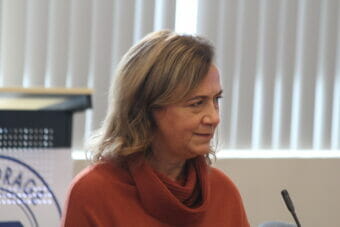
A woman sits behind a microphone at an assembly meeting.
Municipal Manager Amy Demboski at a June Anchorage Assembly meeting (Lex Treinen/Alaska Public Media)

Former Anchorage municipal manager Amy Demboski is suing Mayor Dave Bronson for gender discrimination, defamation and for firing her in retaliation when, she says, she raised concerns over his administration’s actions.

Demboski’s attorney filed the lawsuit last week in Superior Court in Anchorage.

Demboski had threatened to sue the city shortly after the mayor fired her last December. In a blistering letter to the Assembly and other city leaders, she alleged numerous illegal and unethical actions by Bronson and his staff, including illegal contracting and creating a hostile work environment. She demanded a written apology and a settlement to avoid going to court. The Assembly rejected the $550,000 settlement in May.

Demboski’s 24-page lawsuit, filed Sept. 1, includes numerous allegations against the mayor and high-level city staff that she had written about in her letter, and also new ones including that the mayor gave his “tacit approval” for his then-chief of staff to have an “improper relationship with a subordinate” and that the mayor was pressured by associate John Morse to “swing” a contract for homeless services at the Sullivan Arena mass shelter to a friend of Morse’s.

Demboski claims she tried to get staff to follow the law but was rebuffed and eventually fired by Bronson for bringing the concerns to light. The lawsuit says Bronson “told others he ‘had to fire her’ for putting her concerns ‘in writing.’”

“Their wanton disregard and disdain for following the law and propriety presented daily problems,” says Demboski’s lawsuit.

The mayor’s office issued a brief statement Wednesday in response to the lawsuit.

“The Mayor is aware Ms. Demboski has filed a civil suit,” said the statement sent by Bronson spokeswoman Veronica Hoxie. “He will continue to work hard on behalf of the people of Anchorage and looks forward to this matter being resolved.”

Bronson has repeatedly declined to publicly discuss Demboski’s allegations, saying they’re personnel issues and citing legal advice. He has also declined to publicly address wider management issues at City Hall.

Here are some of the allegations laid out in Demboski’s lawsuit:

  • Demboski says she received complaints of then-chief of staff Alexis Johnson having an improper relationship with an unnamed subordinate. Demboski says the mayor was also aware of the concerns and directed Demboski to “catch” Johnson and the subordinate at City Hall. She says the relationship continued forward with the mayor’s “tacit approval” and “Mayor Bronson himself began engaging in retaliatory behavior toward the administrative staff who brought the inappropriate relationship to light.” Johnson did not respond Wednesday to a request for comment.
  • The mayor was pressured by an associate, John Morse, to “swing” a contract for homeless services at the Sullivan Arena mass shelter to Bean’s Cafe, which was operated by Morse’s friend. Demboski says Bronson later fired Shawn Hays, who oversaw the contracting process, in retaliation after Beans Cafe did not get the contract.
  • The mayor contracted Larry Baker as an advisor without approval of the Assembly or the municipal manager. Demboski alleges that Baker’s consecutive short-term contracts were intentionally made to avoid a dollar threshold that a longer contract would have required approval by the Assembly.
  • The mayor unlawfully turned off the city’s water fluoridation.
  • The mayor directed work to be done on a proposed East Anchorage homeless shelter without Assembly approval.
  • Bronson and Baker attempted to have the Department of Law municipal prosecutors  drop domestic violence charges made against Brandon Spoerhase, a business partner of Baker’s, by Kolby Hickel, Bronson’s then-deputy municipal manager.
  • Baker attempted to convince Bronson to direct city real estate transactions toward properties managed by Baker and Spoerhase.
  • Bronson would treat women as subservient to men. Demboski described an instance involving Anchorage CFO Grant Yutrzenka. She said the mayor “raised his voice to a shout and held his hands in front of her at different heights explaining that in Mayor Bronson’s mind — because Mr. Yutrzenka is a man and Ms. Demboski is a woman — Mr. Yutrzenka is ‘up here’ and Ms. Demboski is ‘down there.’”

Demboski also alleged that Bronson convened senior staff to “get their stories straight” regarding her termination, and the Bronson administration spread misinformation about Demboski, which “negatively impacted her ability to obtain new employment.”

Scott Kendall, the attorney for Demboski, did not respond Wednesday to a request for comment.

The lawsuit alleges that Dembsoki was fired in retaliation by Bronson, in violation of the Alaska Whistleblower Act, that the mayor was engaged in gender discrimination against Demboski, that the mayor breached his obligation to good faith and fair dealings and that the mayor and his staff defamed Demboski and made it difficult for her to find new employment.

The lawsuit asks for more than $100,000 in compensatory damages, in addition to other damages and attorney’s fees. Additionally it asks for an injunction by the court to prevent additional damaging actions to Demboski.

Alaska Public Media’s Jeremy Hsieh contributed to this report.

After surprise eviction notice, residents of a Soldotna trailer park are wondering what’s next

River Terrace in Soldotna currently includes seasonal RV residents and year-round trailer residents. (Riley Board/KDLL)

The River Terrace RV and Trailer Park is just upstream of the Kenai River Bridge in Soldotna. To the right, there are temporary and seasonal RVs parked along the banks of the river. To the left, about 40 trailer homes house a low-income community, many of them seniors.

On July 27, trailer park residents got notice to vacate by May 3, 2024. The notice says the closure is related to “planned changes in the future use of the land.”

Daniel Lynch has lived in the trailer park since 1995.

“There’s no need for these people to become homeless, and that’s what’s gonna happen to the majority of them,” Lynch said.

He said there are few options for mobile home placement, much less for 40 all at once. He suspects many of his neighbors will end up living in their cars.

“We’ve checked trailer parks out from Sterling toward the end of Nikiski and anything south,” Lynch said. “There’s really nothing available. Maybe one or two spots, potentially.”

The trailer park section of River Terrace in Sept. 2023. (Riley Board/KDLL)

The trailer park residents don’t just have to be gone by May — they have to move their entire mobile home, a process that may involve deconstructing any add-ons like decks, disconnecting from utilities, then finding a towing company to move the home to a different site. Most residents rent the land but own the physical home. Lynch estimates moving costs at about $5,000.

“Many people have put in thousands of dollars in improvements, from rubber roofs to decks to plumbing, new windows, etcetera etcetera. And then to find this out at the end of July, and, ‘Oh, by the way, you have two months before the snow flies, and you have to be out by May.’ People were beside themselves,” he said.

This week, Lynch and many of his neighbors gathered to talk through their options. They’re looking at tenant legal resources, learning from a similar situation happening in Chugiak, and hoping for more time.

Lynch suspects the eviction is related to the city of Soldotna’s riverfront redevelopment project, a plan to convert riverfront property into a walking path and market area. That project is working with money from the U.S. Economic Development Administration, and an Oregon-based consultant.

The latest plans do include a map encompassing the River Terrace property, and even suggest constructing mixed-use buildings and housing diversity, including affordable housing. Project manager Jason Graf with the consulting company presented the idea to the city council last week.

“There’s always a need for more housing in communities. Where you can partner or work with affordable housing developers, you as a public entity have access to grants and funding that can build affordable housing in the community,” he told the council. “There are developers out there who do that work, there are federal grants that you can acquire.”

But Soldotna City Manager Janette Bower said that work is far in the future and the city has made no moves to purchase River Terrace at the moment. She said the city has talked about purchasing it in the long term, but not until after an appraisal, which could reveal too big of a price tag for the municipality.

She said she was also surprised to find out trailer park residents were being evicted.

Plans for the riverfront redevelopment project, with the River Terrace RV and Trailer Park property in the foreground. (City of Soldotna)

Jim Butler, an attorney for the property’s owners Gary and Judith Hinkle, said nobody has expressed serious interest in buying the property.

Butler confirmed the owners are not in negotiations with the city, and said the reason residents are being evicted is to, “convert the balance of the property’s use to seasonal or temporary use by customers.”

Daniel Lynch, the River Terrace resident, hopes the city will help him and his displaced neighbors.

“There is no need in today’s society for us to become Anchorage, where we just have homeless people because of a situation like this,” he said.

City Manager Bower said the city doesn’t have the money to help the residents relocate, but she is worried about them and will refer them to services if she can. She wishes they had more time to prepare to move.

Mat-Su Borough welcomes Alaska’s biggest solar farm

Chris Colbert(center left) and Jenn Miller(center right) of Renewable Independent Power Producers prepare to cut the ribbon on the opening of the new solar farm located in Houston, Alaska on Tuesday Aug. 29, 2023 (Adam Nicely/Alaska Public Media)

Alaska’s largest solar farm was unveiled on Tuesday in the city of Houston, about an hour north of Anchorage. The project owners gathered with local and state officials to ceremoniously cut a gold ribbon with a giant pair of scissors.

The woman holding the scissors was Jenn Miller, founder and CEO of Renewable Independent Power Producers. Her company broke ground on the 45 acre project last summer, and it’s now feeding power into the Mat-Su Borough electric grid.

Miller and her team also built the state’s second biggest solar array just north of Houston in Willow. Speaking under a tent on the rainy afternoon, she said that with this 8.5 megawatt farm, Alaska solar has reached a new scale.

“It’s not the first in the state, but I will say, it’s the first of a material scale,” Miller said. “It’s the first where we brought in outside investment. And with tying into the grid, you know, it’s a large enough scale that when it drops in and out, it will be noticed, it will be felt.”

The Houston solar array covered in rain droplets. It was built with Alaska’s cloudy weather in mind, and still pencils out to save ratepayers money. (Adam Nicely/Alaska Public Media)

Matanuska Electric Association CEO Tony Izzo said the utility is actively trying to increase its renewable energy sources without increasing rates.

“This project from day one, and it was commissioned, provides energy to MEA members for less than our natural gas fired generation,” Izzo said. “In a meeting with some other representatives from Clean Capital a few months back, I think my message was, how fast can you build more of these things?”

Clean Capital is a national company that helped finance the project, and will be the long-term owner. Izzo says the Houston array could, at peak production, provide about 5% of the utility’s output. It’s expected to power about 1,400 homes.

As for the ironically rainy weather the day of the ribbon-cutting, Miller said the array was built with Alaska’s climate in mind.

“One of the things that’s unique to our solar design is that we actually oversize on the panel side, just because Alaska has so many cloudy days,” Miller said. “And so because panels have gotten so cost competitive, we’re able to kind of over-install on the panel size so that on cloudy days, we can boost our production, and it makes the project more economic overall.”

Miller said the Houston farm is currently feeding small amounts of power into the grid for testing, but it should be fully operational by next month. Her company is currently looking at building another large solar project on the Kenai Peninsula.

Wall Street Journal: Limited interest in Alaska LNG from Asian buyers

The Alaska Liquefied Natural Gas project has long promised to bring North Slope natural gas to Nikiski, for export to Asia. Optimism about the project among Alaska politicians has remained high, despite the long timeline and cost of the project. But last month, the Wall Street Journal reported that buyers in Japan and South Korea aren’t confident in the project, and don’t plan to make investments or sign contracts.

KDLL talked with River Davis, one of the reporters behind that Journal story.

Listen:

Riley Board: Could you start by telling me a little bit about what your job is and what you typically cover?

River Davis: I’ve been a reporter with The Wall Street Journal here in Tokyo, reporting out of Japan covering Japanese businesses, for the past five years. Most of the topics that I look at cover the automotive sector, and I also cover energy security and Japan’s energy transition.

Riley Board: And how did this particular story about the AK LNG project come to your attention?

River Davis: Well, we were hearing a lot from Japanese companies — and Korean companies as well — that they were being approached by some political figures and people in the business world in Alaska, basically pitching contracts and deals to these companies, asking if they wanted to sign up to take Alaskan LNG.

And so we started this project kind of very neutrally looking at sort of the trade offs that are involved in the project. The positives, of course, being this is a project that could help with energy security, and help Korea and Japan transition away from using Russian gas and oil. So that was kind of the positive energy security angle. Of course, on the other end, we were looking at climate issues. There’s been some backlash about the project going forward, particularly a new fossil fuel project going forward in 2023.

So that was the kind of stance we originally approached the story with. But once we did some reporting, we found that the story about how there wasn’t a whole lot of interest in the project out of Asia, which were kind of the main target customers for the gas projects. That became kind of the main angle that we discovered hadn’t been told yet.

Riley Board: Could you go into more detail about what sentiments you learned that people in those countries had about the project?

River Davis: So the sentiment, specifically out of Japan, I would say is that they felt that this project has been happening for a long time, and that it hasn’t had much progress. So for Japan, in particular, companies here, government officials say that they want natural gas quite soon; in the next couple of years is when they’re going to witness their worst pinch when it comes to supply. So the project’s timeline is a little bit too far out for their wishes. And also, because it has been kind of delayed for such a long time, they are a bit dubious about whether the project itself will actually get off the ground.

Of course, it’s a massive project, a massive investment. So those were just factors that they’re considering. It’s really important to companies here, that if they do indeed sign up for a contract to offhand gas, that a project moves forward, because they will give up other contracts elsewhere. So that security element I think, was a large kind of off putting factor for them.

Riley Board: Did these buyers have other options when it comes to getting natural gas on the timeline they’re looking for?

River Davis: They do. Of course, Alaska officials and others supporting the project would say that Alaska has a lot of benefits. Of course, for Japan and Korea, it’s just over a week to get natural gas shipped over here. And there’s no kind of choke points that the gas has to go through. That could be a potential security issue.

But on the other hand, Japan thinks that it can get gas from other kinds of secure projects. There’s a lot of new supply coming to market, you know, around 2027, 2028 out of the US, Australia, the Middle East. And so Japan sees it has a lot of options beyond just Alaska at this point.

Riley Board: In Alaska, politicians are still very publicly optimistic about this project. Lisa Murkowski voiced her optimism around here — she was visiting the Kenai Peninsula and expressing her optimism about the project as recently as last week. Why do you think that attitude is still prevalent over here, even as interest is waning in Asia?

River Davis: Yeah, I think, of course, it’s in the interest of people supporting the project to make sure that there’s still kind of some optimism about it going forward. They’re in the stage where they’re looking for investment in the project. So I think if there’s too much of kind of a dreary tone, that would be problematic.

I do also get the sense that out of South Korea and Japan, perhaps there’s a bit of…information hasn’t sort of traveled to Alaska in the way that perhaps it would in other situations. Talking to companies here, you know, they say, ‘we’re not interested in this project.’ But I’m not sure to what extent that kind of has been directly conveyed to people, you know, sitting locally in Alaska. Seems like there’s a bit of an information divide there.

Riley Board: Do you think your story was one of the first first ways that that information was maybe conveyed in the US?

I think there has been a decent amount of skepticism towards the project, because it has taken kind of such a long time to move forward. And it’s been eluding that final investment decision for some time now. So we did see other publications, you know, questioning whether it would be able to reach that final FID stage. But I think as a story that conveyed the voice of potential off takers of gas — that being Japan, Korea, other countries in Asia — this was sort of one of the first stories that I’ve seen to convey that specific angle.

Site notifications
Update notification options
Subscribe to notifications