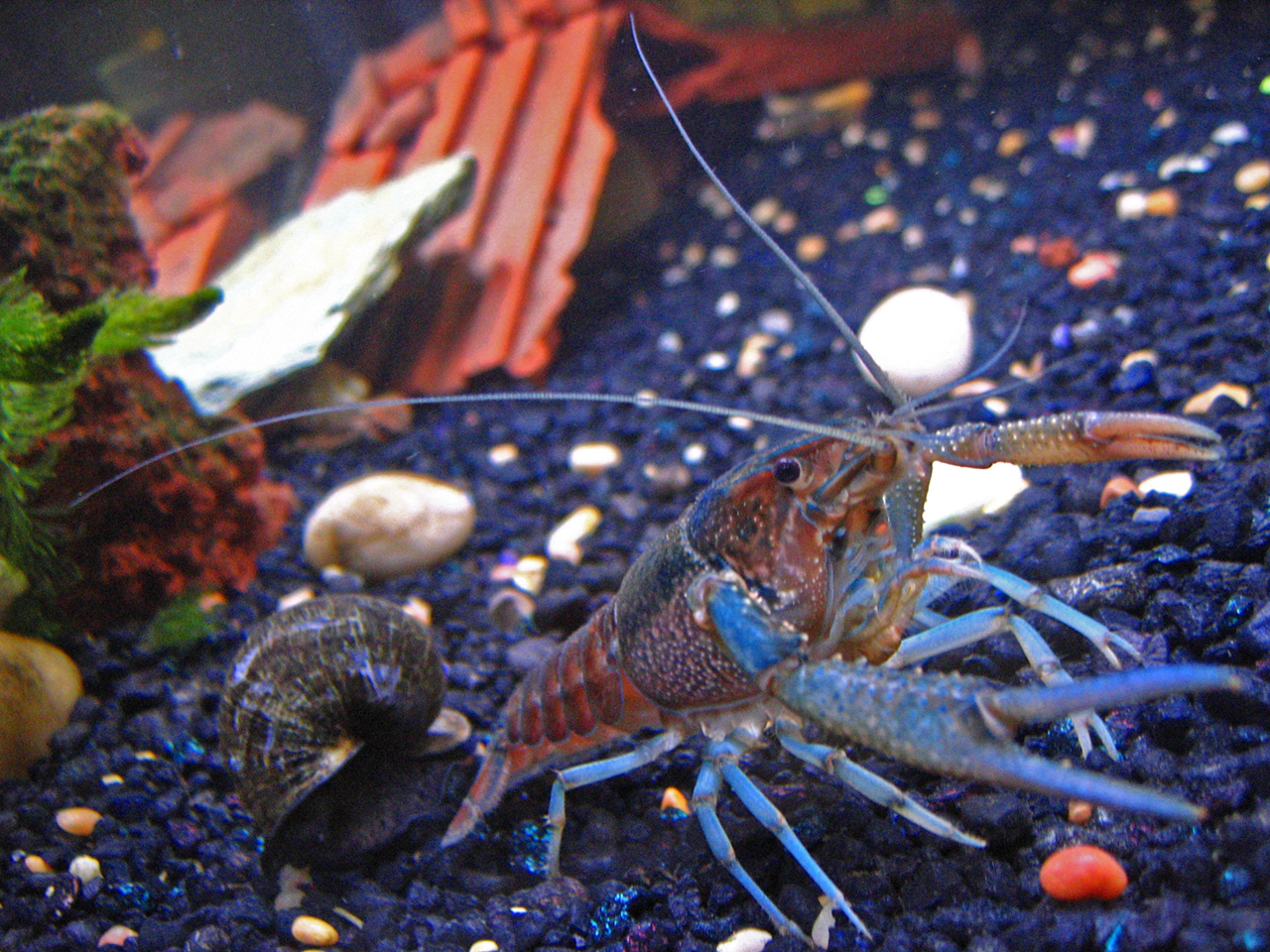
A pet crayfish in a freshwater home aquarium. (Creative Commons photo courtesy of Joseph Stansbury Rosin)
There’s a slow invasion of a freshwater crustacean happening in Buskin River and Buskin Lake. It has a hard shell, two claws and tastes great in pies.
“Crawdads, crawfish, crayfish, it all depends on where you grew up,” said Blythe Brown of the Kodiak Soil and Water Conservation District.
Brown said they’ve caught a lot of crayfish this year compared to the roughly one per year they’ve found in the past. They went into the project last year hoping to find out whether crayfish were breeding and this year they did a little bit of experimenting with traps.
“The crawdad that was found last fall was quite large so we thought maybe our trap openings aren’t large enough, so we enlarged the traps, talked to other people from other places that had grown up with crawdads and they said, ‘Try an oily, stinky fish or something, some bait that they might like better. So we tried herring this year and it worked.”
Alex Hughes is a Fish and Game technician who volunteers with KSWCD. He said based on their studies at the Buskin river, crayfish are successfully breeding.
“I’ve caught a couple of them just visually, flipping rocks and looking through the river especially up near the weir, near the lake,” he said.
Hughes said crayfish are originally from the Pacific Northwest and as with many invasive species, it’s anyone’s guess how they got to Kodiak.
“I’ve seen crawdads used for fishing bait before … I suspect that someone brought them for that reason, but no one really knows the answer. It could’ve been a pet; it could’ve been used as a potential fishing bait,” Hughes said.
He said he’s concerned that if the crayfish population continues to flourish, it could spread from the Buskin River into other systems.
“We don’t really know the implications of that, what that’ll mean to the juvenile salmon that are growing or the eggs that are buried in the sediment of the river,” Hughes said. “Our worry is that the crayfish could start to sort of uncover those eggs and eat them. So, we’re trying to solve this issue before it expands into something that is more difficult to control.”
If you spot any crayfish, KSWCD asks that you remove them from the body of water, if possible, and report the sighting. If you come across a lot of them, you can always try some of the solutions listed here
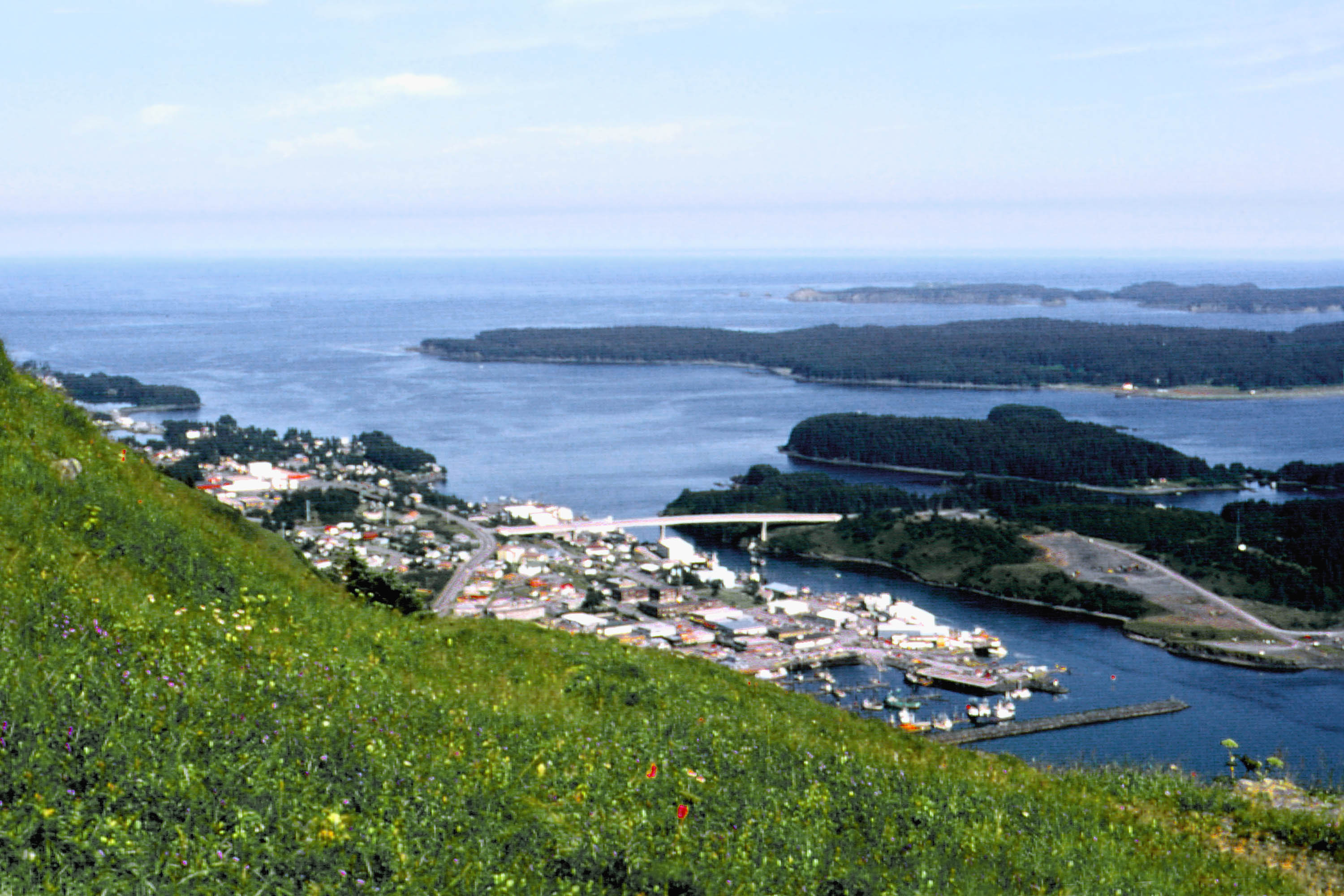
A view of Kodiak from Pillar Mountain. (Creative Commons photo by Wanetta Ayers)
It’s been a dry summer for Kodiak, which has left the Monashka reservoir on Kodiak Island low.
According to Rick Thoman, the climate science and services manager for the Alaska region of the National Weather Service, it’s one of the driest seasons in Kodiak history.
“Kodiak since June 1 has received just over 10 inches of rain. That’s just about half of normal for that time and is the second lowest of record … the only reliable warm kind of time of year was 1941 when there was less than 8 inches of rain through June through September,” Thoman said.
Thoman says areas of Southcentral Alaska were dry during part of the summer but have rebounded in September. In fact, he says this month is Anchorage’s fourth wettest September. But Kodiak remains dry.
Kodiak city public works director Mark Kozak says the lack of snowfall last winter has also contributed to the lowered reservoir. He says Kodiak has consumed a little over half its capacity — although that capacity is still more than it was in the early 2000s.
“In 2003, we raised the Monashka reservoir and at that time, it pretty much doubled our capacity, so we’re now slightly below the level of the old reservoir, which the city used from 1982 to 2003, and we’re 3 feet below that old reservoir if it were full,” Kozak said.
Kozak says both the community at large and its seafood processors rely on the Monashka reservoir as a water source.
“When the processors aren’t using water, our daily consumption is about 2 million gallons a day, but when they’re processing here prior to the middle of last week, as a community we were averaging between 7.7 and 8.3 million a day,” Kozak said.
He says at a meeting Friday, the processors agreed to limit their water usage where they can.
“They’ll do all the careful monitoring of excess water usage and turn things off and that, and what we really want to be able to do is support the processing industry so that everybody’s still working and the fishermen are working and the process workers,” Kozak said.
The Pollock season opens Oct. 1 and processors are in transition at this point, which also affects the water use. Kozak says they’ll have a better idea of what changes processors have been able to make by the end of the week when they reach full production.
Mobilized by a coalition of faith groups, opponents of the measure wore red. (Photo by Zachariah Hughes/KSKA)
Just before midnight Tuesday, the Anchorage Assembly voted to extend full legal protections to residents on the basis of sexual orientation and gender — the first such ordinance in the state of Alaska.
After extending the discussion on 17 proposed amendments, the body voted overwhelmingly to amend the city’s rules on discrimination. Many see it as simply a modest update to laws already on the books.
“It expands our notions of equality to include people based on their sexual orientation and gender identity,” said assemblymember Bill Evans, the ordinance’s original sponsor.
“It basically says that those are issues that it’s just not an employer’s business to get into.”
Evans thinks that in spite of dire predictions by opponents, the ordinance is adjusting labor and legal standards to an evolving society. “It more or less just expands the path of civil rights we’ve been on for decades,” he added.
Opposition to the bill came primarily from two conservative assemblymembers, Amy Demboski, and Bill Starr, both of who say it infringes on residents’ religious and speech rights.
Both gave impassioned testimony on amendments dealing with issues like gender-segregated bathrooms, government process, and a contentious mechanism for what are called “ministerial exemptions.” In the end, the assembly voted to use the Hosanna-Tabor precedent in the Supreme Court to measure where religious institutions are protected in hiring decisions.
The room was filled with opponents to the measure wearing red shirts, mobilized by a coalition of faith groups. Demboski and others believe that Anchorage voters made their will clear in a 2012 ballot measure and expects a similar initiative will bring the matter back to a referendum vote this coming April.
“This is absolutely the tyranny of the liberal assembly,” Demboski said in a brief interview after the meeting. “I don’t think the majority of Alaskans will agree with that policy.”
But others disagree that the past vote amounts to a mandate. During the discussion, assemblymember Patrick Flynn pointed out that when it comes to civil rights there is a long American tradition of the Legislative branch expanding legal protections in advance of popular opinion.
Many members of the LGBTQ community were relieved by passage of the ordinance, saying it recognizes a problem they’ve struggled for years to get the municipality to simply recognize.
“I feel like a weight has been removed because as a transgender man I haven’t been protected,” said Drew Phoenix with the advocacy group Identity. “When I go into a restaurant, when I go into the locker-room, when I apply for a job or a rental–I can be denied, and have been.”
Anchorage Mayor Ethan Berkowitz applauded the decision after the measure passed by a veto-proof 9-to-2 vote.
The ordinance is expected to be officially signed by the end of the week.
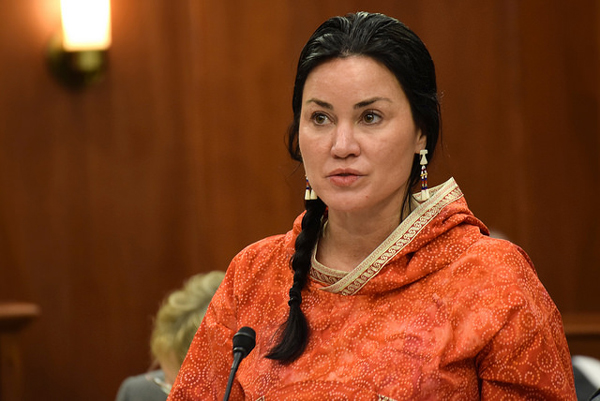
Sen. Lesil McGuire addresses the Alaska Senate, April 19, 2014. (Photo by Skip Gray/Gavel Alaska)
Sen. Lesil McGuire, a Republican from Anchorage, likely surprised attendees at the Arctic Energy Summit in Fairbanks Monday when she announced she would not seek re-election next year.
McGuire said she chose the summit as the place to make her announcement because Arctic and energy issues are two of the great passions of her life. She said although being a senator for the past 15 years has been an honor, she will not seek re-election when her term ends in 2016.
“But I’ll remain the next year and a half to work on more issues in the Arctic and energy over the next year and a half but I decided to announce it today because there has been speculation about me running again and others jumping into the race and I just wanted to make that announcement,” she said.
McGuire has served as the co-chair of the Alaska Arctic Policy Commission. She also chairs the Senate Rules Committee and is a member of the Senate Resources and Judiciary Committees.
High school junior Anna McDonald treats a field with organic fertilizer as part of a scientific research project. (Photo by Kayla Desroches/ KMXT)
High school students in Kodiak are doing college-level science. Maybe even Ph.D.-level science.
World Bridge is a NASA-sponsored group that assigns Alaskan students to scientific research projects. At a recent competition in Italy, the group showed that their earthquake research could have a global impact, but that’s only one project they’re working on. They’ve also entered the world of nano-agriculture.
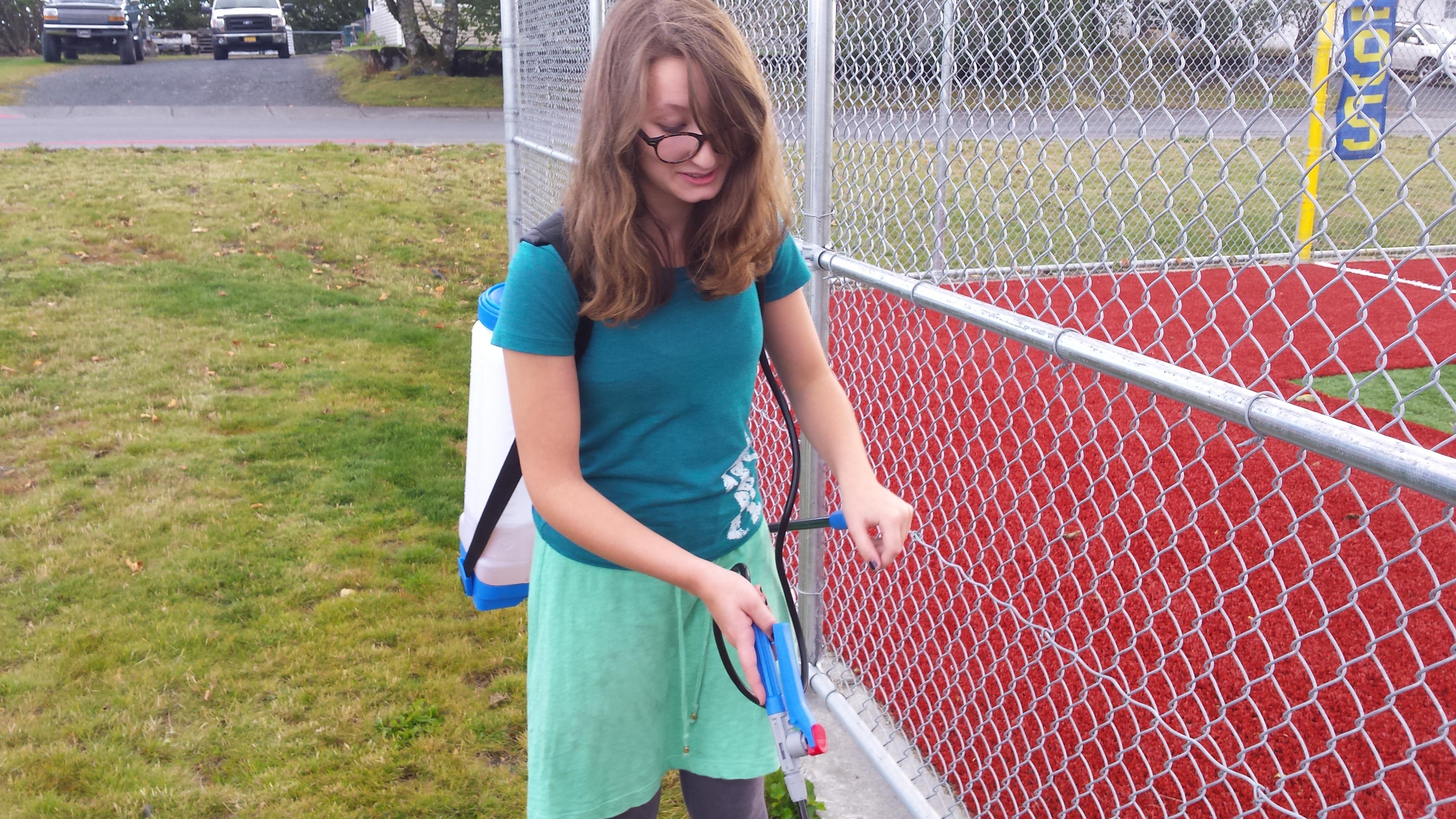
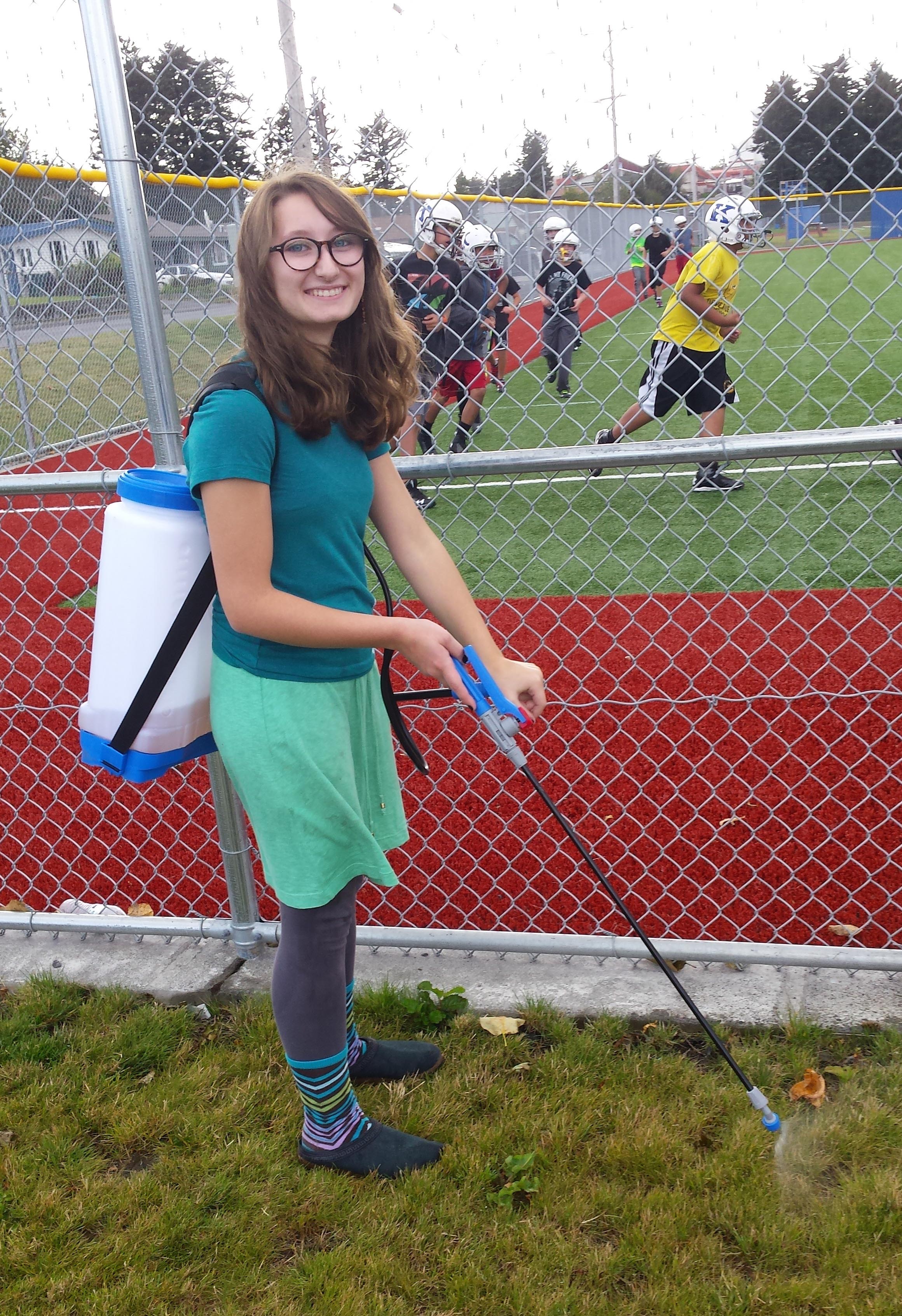
Anna McDonald sprays a patch of grass as the Kodiak football team practices in the background. (Photo by Kayla Desroches/ KMXT)
High school junior Anna McDonald sprays an organic fertilizer over a sad-looking patch of dirt on a baseball field. The solution isn’t a chemical, just a combination of microorganisms, sea kelp, and mineral electrolytes. Anna says microbes do all the work.
“… Like an earthworm, just eats the toxic soil and digests it and it comes out and it’s perfectly balanced, perfectly natural, just how the earth is made to function,” she said.
Anna and two other students look like exterminators – or Ghostbusters – carrying the fertilizer in plastic backpacks, which Anna says they bought off Amazon. The team has already treated eight other fields and, so far, Anna says the fertilizer seems to be working.
“There was area that was completely bare and we treated it with this enzyme and we came back in four weeks to measure our data and get our results and see what had happened, and it had grown back completely,” she said. “It was full and green, and it looked better than the surrounding area.”
Anna and a handful of other students partnered with the fertilizer’s company to spray a local golf course. Why this product? Well, Anna says, the company reached out to them.
But also, “We were very interested in what we could do with it and we wanted to see what it would do for ourselves instead of just reading about it in a paper,” Anna said.
Anna says she’s especially interested in chemistry and the way it can be applied in real-world situations, which is why she loves nano-agriculture.
While spraying the field, a young student recognizes her.
“Ron and I have gone to some middle school classes before to talk to kids about nano-ag and also about tsunami marine debris,” Anna said.
She means Ron Fortunato, the creator of World Bridge, an Alaska STEM program that develops partners in business and industry and then creates real-world projects in school districts.
Fortunato is based in New Jersey. But he worked on a project in Juneau’s school district and the positive experience, and interest in further collaborations from other people in the state, led him to Alaska once again for World Bridge.
Fortunato says officials with the Kodiak Island School District jumped at the chance to get involved in World Bridge.
And this summer, a group of Kodiak high schoolers traveled to Como, Italy, to present earthquake data at the Europa Challenge. It’s a competition sponsored in part by NASA along with other international organizations and it usually only accepts university students or industry professionals. Fortunato says they made an exception for the group.
“The researchers that were there, the universities, all the professional who were there,” Fortunato said. “They didn’t talk to them like they were high school students. There was a full measure of respect and welcome into the community – of that geospatial community, which is a big international group there. And it wasn’t that they were looking at them as students. They were looking at their work.”
The Kodiak team won that competition.
With the help of NASA and other sponsors, World Bridge’s Kodiak students have a lot of resources at their fingertips.
I drop by their lab in the Alaska Department of Fish and Game building, and there’s a 3D printer set up on one table and a drone on another. In other words, it’s every science buff’s fantasy.
“And then this is the nano-ag bench,” Anna said, giving me a tour of the facility. “Since most of our work is done in the field, this is just kind of where we’re able to sit at our computers and write up reports or decipher all of our data. And it’s where we store our enzyme and our other supplies.”
And if you’re wondering where World Bridge is headed from here, well, it’s all ongoing. And as another student, senior Levi Purdy explains, they’re a team like any other research group.
“Both the professionals and the students and the teachers, we’re all learning above what we understand,” Purdy said. “We’re all experimenting and testing hypotheses, so there’s really no one of us can be on any level higher than the other, because we’re all collaborating and we’re trying to solve a problem.”
As the program proves, the line between high school and college, student and teacher, can blur. Check the sources the next time you read a study online or a news article. You may be surprised by who collected that data.
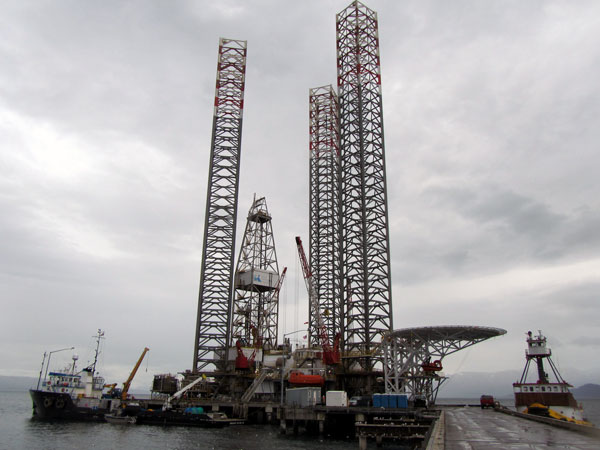
The Buccaneer jackup rig drills for oil and gas just north of Anchor Point, in Cook Inlet, Alaska. (Photo by Bill Smith)
As Alaska continues to grapple with a major budget shortfall, one line item promises to be particularly controversial: tax credits for oil and gas producers.
The state projects that credits will reach $700-million this year. That number has about tripled since 2010, with much of the increase going to producers outside the North Slope, especially in Cook Inlet.
Now, a group of lawmakers is tackling the issue head-on.
On Tuesday, Sen. Cathy Giessel, Republican of Anchorage, opened the second session of her tax credit working group by posing the big question: “Our question really on the table today is, are the credits working, [and] are they still needed?”
The answer, at least from the oil and gas companies themselves, was a resounding yes.
Tuesday’s session focused on Cook Inlet producers, and company after company said the renaissance in drilling in the past half-decade was the direct result of tax credits.
“Without the tax credits, Furie wouldn’t be here,” Bruce Webb, of Furie Operating Alaska, said. “If tax credits went away, we’re stubborn enough to stay and work through it, but it would decelerate the further development and exploration.”
Webb told lawmakers that the credits are crucial for smaller operators to secure financing for projects. Companies like Furie borrow against the credits, using that funding to pay for exploration and infrastructure.
And companies reminded lawmakers that just a few years ago, Southcentral was preparing for a natural gas shortage. They said new investment has led to a secure energy source, jobs for local communities and royalties for the state.
At the end of the day, companies said, they’ve built credits into their business plans. Any changes should be gradual, said Benjamin Johnson of BlueCrest Energy, which hopes to tap the inlet’s Cosmopolitan gas field.
“Bottom line is, we can’t commit to Cosmopolitan gas development unless we have either the existing tax credits or a reasonable alternative,” Johnson said. “We just need some stability. We need to know what it is we’re dealing with. We can’t have uncertainty on this.”
But these days, uncertainty is the name of the game for everyone dependent on state funding – from the classroom to the gas field.
Giessel said she hopes to convene one more hearing on Cook Inlet, before the working group turns its attention to the North Slope.
The group hopes to draft a set of proposals by December 1.
Close
Update notification options
Subscribe to notifications
Subscribe
Get notifications about news related to the topics you care about. You can unsubscribe anytime.