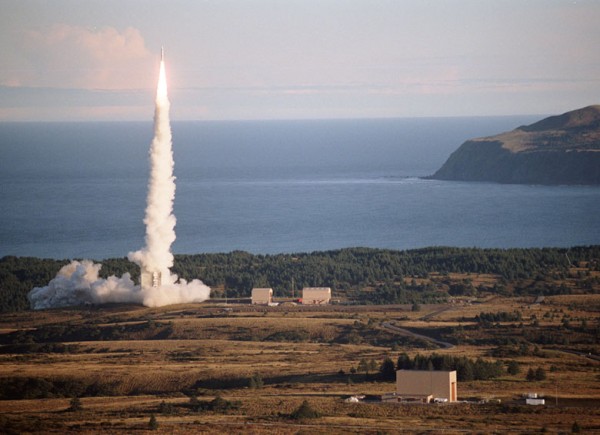
A rocket takes off from the from the Kodiak launch facility. (Photo courtesy of Alaska Aerospace Corporation)
Reconstruction of the former Kodiak Launch Complex should begin soon.
Mark Grebe, COO of the Alaska Aerospace Corporation announced that a $23 million contract has been awarded to Davis Constructors and Engineers of Anchorage.
“Without any kind of magic set-aside or preference, we were pleased to see that we had excellent participation from the Alaska contracting community,” he said. “And are very happy and pleased that an Alaska company flat out won the selection.”
Grebe said repairs to what is now called the “Pacific Spaceport Complex – Alaska” will be paid for out of Alaska Aerospace Corporation’s insurance through the state.
“There’s a few structural members that were damaged that need to be replaced. Our spacecraft assembly and transfer facility essentially needs to be completely rebuilt. The integration and processing and launch service structure, which people think of as the launch pad, they essentially need to be re-skinned,” he said. “And all those services that usually run inside the skin, you know your power conduit, your compressed air lines, and all those electrical cabling, all need to be replaced.”
Though it sounds like a good deal of work, Grebe says it all should be completed by late March or early April.
“It wasn’t that significant of damage to the facility. We just took our time since we did not have any launches on the book, and did not spend premium dollars to get it done faster than it needed to. So we did the best value approach,” Grebe said. “It was showy damage, but without a lot of structural damage, it’s relatively easy to recover from. I worked in Florida for many, many years and I’ve seen hurricane damage after a hurricane that was actually worse than this damage.”
Davis Contractors and Engineers has worked on the Fairbanks International Airport and Ted Stevens Anchorage International Airport terminals.
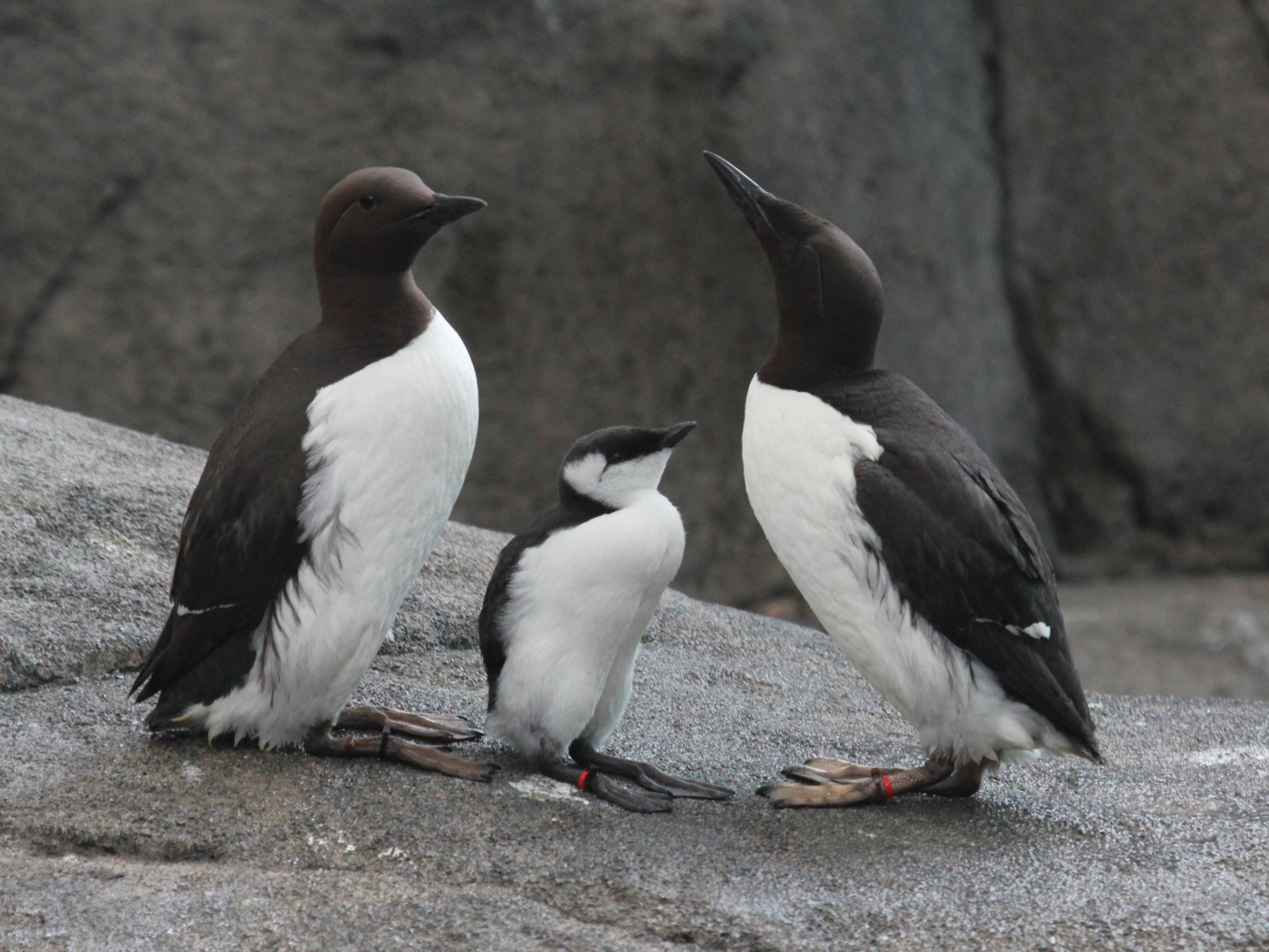
Common Murre ( Uria aalge), also known as Common Guillemot. Photographed at Alaska SeaLife Center in Seward, Alaska. (Creative Commons photo courtesy of Dick Daniels)
Kodiak Island residents have been reporting a large number of common murres washing up dead on local beaches.
The small black and white seabird usually establish breeding colonies on the Alaska Peninsula and in the Aleutian Islands.
Kodiak National Wildlife Refuge bird biologist Robin Corcoran said there are a few colonies on the island, but they’re less than 200 birds.
Corcoran said the refuge first started receiving reports in April and May about a handful of murre die-offs.
“They were showing up in places where people don’t normally see them. These are birds that are usually pretty far off shore,” she said. “We were getting all these reports of them being seen close to shore, foraging.”
Corcoran said more and more reports of dead birds started coming in August. She said some beaches have a large number of carcasses; there are over a hundred on the shores of Pasgashack.
She said she doesn’t know what could have caused the deaths, but it could be related to the birds’ inability to catch fish because they’re currently going through a flight feather molt stage.
“They spend about 70 days where they can’t fly, and so the die-off seems to coincide with this flight feather molt where they’re flightless and it might be that they don’t have the mobility to move to locations where they can find the forage fish,” Corcoran said,
Making things worse is that the birds are in a mostly unfamiliar territory. No one knows why they’re congregating on Kodiak Island. Corcoran hypothesizes that colony abandonment in other areas could be a factor.
Corcoran said 2012 the last year they saw a major bird die-off, that time of both murres and grebes in January through March. They collected carcasses and sent them to the National Wildlife Health center in Madison, Wisconsin, where they ruled starvation as the cause of death.
The carcasses they’ve sent this year have been emaciated. Corcoran said the murres’ plight it could be connected to recent whale die-offs.
“[We’re] looking into the possibility of harmful algal blooms. … It could be related to the warm ocean temperatures having an impact on forage fish populations,” she said.
Corcoran said refuge survey data indicates that several other bird species’ numbers have declined, like the pigeon guillemot and the marbled murrelet. She said she’s read about the die-off reaching Homer, as well as along the Alaskan Peninsula and into the Aleutians.
An equal rights ordinance that divided Anchorage before failing in a ballot vote is expected to easily pass the city Assembly this week.
The ordinance was originally introduced by South Anchorage Assembly Member Bill Evans and was modified with input from Downtown’s Patrick Flynn. It adds sexual orientation and gender expression as categories under which city residents are protected from discrimination in housing, at work or at public facilities.
Evans works as an employment lawyer and has seen a small number of discrimination cases the new law would cover. But because gender and sexuality aren’t protected by discrimination law, incidents aren’t reported when they happen.
“The intent was to make a statement about what is appropriate or inappropriate in our community,” Evans said of the ordinance. “That statement is that in Anchorage in the 21st century. Discriminating against someone on the basis of their sexual orientation or gender identity isn’t acceptable.”
The modified version of the ordinance leaves in language for ministerial exemptions, a way of giving some latitude to religious institutions in employment issues. Some feel the exemptions go too far; others say they don’t go far enough.
Though public testimony at Tuesday’s Assembly meeting is expected to be heated, most of those watching city politics expect the measure to pass overwhelmingly.
If it does, Anchorage will become the first city in Alaska to put full protections for gender and sexuality into law.
More than $18,000 has been raised for the daughters of Seth Fairbanks, the pilot from Bethel who died after a plane crash in early August.
After learning of her friend’s death, Bethel resident Nikki Corbett hosted an online auction on Facebook. The funds went to a trust fund for Seth Fairbanks’ twin daughters.
“When something like this happens every one kind of comes together and helps the families,” Corbett said. “It’s been an amazing outpouring of support.”
Corbett was out of town when she heard about the accident but still felt a call to action. She got the OK and began planning.
“I didn’t think it would turn out to be so big,” Corbett said. “I was only thinking there would be about 30 items because that’s how it started out. I think it ended up being over 50, 60 items.”
Donation items included everything from handmade children’s clothing and pottery to canned salmon and handcrafted artwork. Donations came mostly from the Bethel region and Anchorage area, with some items coming as far as Arizona.
“Now’s the fun part where we have to get everything ready and process it and send it out,” Corbett said.
Corbett and Fairbanks’ mother will cover the cost of shipping and they hope to send items out soon.
Fairbanks, who was 29 and living in McGrath, died with passenger Anthony Hooper after his plane crashed in the Knik Arm River. He was traveling to Anchorage for his sister’s wedding reception.
“I’ve just known him since grade school. We were great friends through high school,” Corbett said. “It was amazing to see him evolve from when his daughters were first born. He was a great dad.”
An Anchorage group is examining economic options to cope with Army downsizing in the years ahead. The Base Economic Analysis Review, or BEAR group, held its second meeting Wednesday.
City officials are working with a small division from the Department of Defense that routinely helps plan for what to do when changes in the military hit the communities where troops are based.
Myer Hutchinson is a spokesman for the mayor, and says the BEAR group met with the Office of Economic Adjustment over a grant he’s “fairly confident” Anchorage is going to receive. That money will go toward “A study, or studies, to figure out the potential economic impacts of a force reduction at Joint Base Elmendorf-Richardson.”
Hutchinson says that while the administration is still working with its partners to reverse the drawdown that will remove more than 2,600 troops and thousands more dependents from the Anchorage area by 2017, the city is making sure to cover its bases by examining ways to mitigate negative effects.
Currently there’s no timeline for when the OEA report will be available.
At the Ninilchik Tribal Council Community Clinic, Dr. Sarah Spencer is looking to make a dent in the number of opioid overdoses on the southern Kenai Peninsula. She’s advocating an antidote called Naloxone that is proven to counteract the effects of opioids. She wants to give naloxone kits to patients who are at risk.
Opioids are either naturally derived from the opium poppy or they’re man-made, synthesized from natural opioids. Examples of synthetic opioids are heroin and prescription painkillers like oxycodone. According to the National Center for Health Statistics, in 2013 16,000 Americans died from a prescription opioid overdose and 8,000 died of heroin overdose.
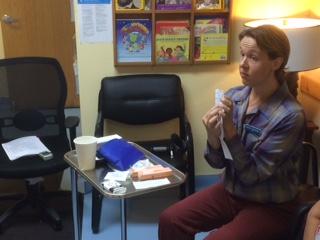
Dr. Sarah Spencer Explains Benefits of Naloxone. (Photo by Quinton Chandler/KBBI)
“The states that have the biggest program that distribute these kits like in Massachusetts where the kits are widely distributed among community members who have an interest in trying to help … they’ve shown that they’ve reduced their overdose death rates by approximately half,” says Spencer.
Spencer works at the clinic, the emergency room at South Peninsula Hospital in Homer and she’s also working in addiction medicine at the Homer Medical Clinic. She says overdoses are relatively rare in these small communities, but they happen often enough.
“I think all doctors who have worked in the emergency room in the last year have seen at least one or more overdoses come in. Hopefully if the person makes it to the emergency room we can save their [life]. But, we’ve had a few deaths in the community from people accidentally overdosing so if we can save one of those people by having those kits available that would be great,” says Spencer.
Overdoses are unpredictable. They can potentially kill in just a few minutes or their victims could live for a matter of hours.
“What happens is they become very sleepy and their breathing slows down sometimes stopping completely but sometimes just slowing down so much the person can’t get enough oxygen in. They turn blue and eventually when you don’t have enough oxygen then you die,” says Spencer.
Having naloxone kits on hand will give the friends and family of overdose victims a chance to reverse those symptoms immediately. Armed with tales of naloxone’s success in the Lower 48, Spencer is introducing the antidote to her co-workers at the Ninilchik Clinic. She and a handful of her colleagues are seated in a semi-circle around a small tray holding the naloxone.
“This is a trainer for it like there [are] trainers for the epi-pen,” says Spencer.
Spencer is demonstrating how to use the most expensive option, an automatic injector. The white and black trainer has a kind of rectangular shape and fits easily in Spencer’s palm. It’s biggest perk…it talks its user through the injection. The price might push people away from the auto-injector, but it’s not the only choice. The naloxone itself is a clear liquid and it also comes in a transparent vial that can be attached to a syringe. The medicine is then injected or it can be squirted up a person’s nostrils. This route means more steps, but it’s much cheaper.
“If you’re going to be paying cash at a local pharmacy, if you don’t have insurance, you’re going to be paying between $80 to about $120 for the medication. And it is covered by many insurances,” says Spencer.
Spencer stresses the naloxone kits are most effective if their users have practiced and know exactly how to assemble and deliver the antidote before they’re faced with an overdose.
“If you overdose you’re going to be unconscious and you can’t help yourself. So the key thing is to have patients when they get the kit, they take it home, and sit down and read the instructions with their friends and family members,” says Spencer.
Naloxone is now available at the clinic in Ninilchik. Spencer says there are a few local pharmacies on the Southern Peninsula carrying the kits, and they’re also available at the Homer Medical Clinic. She’s eventually hoping to have the kits for overdose patients who come into South Peninsula Hospital’s emergency room.
“Previously we didn’t really have anything to offer them when they left the emergency room other than counseling them to see a counselor and try not to let it happen again. As far as being able to give them a kit to use in case of emergencies that hasn’t been an option,” says Spencer.
Spencer encourages anyone struggling with addiction to reach out for help. She says there is hope and community resources they can lean on.
Close
Update notification options
Subscribe to notifications
Subscribe
Get notifications about news related to the topics you care about. You can unsubscribe anytime.